
Bus Wash System Guide: How to Choose the Right Solution for Your Fleet
Bus Wash System Guide: How to Choose the Right Solution for Your Fleet
Last updated: April 14, 2026
If you manage a fleet of 50 to 500+ buses or trucks, you already know that manual washing doesn't scale. Every vehicle added to the fleet increases labor hours, staffing requirements, and inconsistency. An automated bus wash system changes the equation — centralizing costs into infrastructure and predictable operating expenses instead of variable labor that grows with every route you add. If you are at the point of writing the RFP, our transit wash specification guide sets out the vehicle envelope, throughput, utility and certification requirements a procurement committee can score.
The question isn't whether to automate. It's which system matches your depot layout, your vehicle mix, and the throughput targets your operations demand.
Why fleet washing is shifting from manual to automated
Manual washing creates a cost structure that works against you as your fleet grows. Labor is the dominant variable — it scales linearly with fleet size, and fleets that transition to automated systems report cutting wash-related labor by 40% or more. At $20–$25 per vehicle in labor alone for a manual wash, the math compounds quickly across a 200-vehicle depot.
But cost isn't the only driver. Consistency matters for fleet operations where vehicle appearance reflects on the organization — transit authorities, branded logistics carriers, school districts. Manual wash quality varies with staff experience, weather conditions, and fatigue. Automated systems deliver the same wash cycle every time, regardless of who's on shift.
Environmental compliance adds urgency. Manual wash runoff flowing into storm drains creates regulatory exposure that closed-loop automated systems eliminate entirely. Modern bus wash systems reclaim up to 90% of wash water through filtration, separation, and treatment — reducing both water costs and compliance risk.
Bus and truck wash system types compared
Four primary system architectures serve the fleet market. Each makes different trade-offs between throughput, footprint, investment, and operational complexity.
Drive-through gantry and tunnel
Drive-through systems are the highest-throughput option for fleet operations. Vehicles enter at one end, pass through multiple wash stages — pre-soak, brush or touchless wash, rinse, spot-free rinse, and drying — and exit without reversing. One-way traffic flow integrates naturally with depot circulation patterns and eliminates the safety risk of large vehicles backing up.
Standard drive-through configurations process 20 or more buses per hour per lane. High-throughput multi-stage configurations push well beyond that baseline — the HyTian TH-Series bus and truck wash systems achieve up to 80 buses per hour at depot peak operations.
Investment starts at $500,000+ for a full drive-through tunnel installation, but the per-wash cost drops significantly at high volumes.
Rollover / gantry
Rollover systems keep the vehicle stationary while the wash gantry moves over it. A typical bus wash cycle takes approximately 3.5 minutes; trucks with more complex profiles take around 8 minutes. This translates to 12–17 vehicles per hour — lower throughput than a drive-through, but adequate for many fleet operations.
The advantage is footprint. Rollovers require less space than drive-through tunnels and handle mixed fleet profiles effectively — the gantry adjusts its travel path to accommodate different vehicle heights and lengths. Investment ranges from $185,000 to $225,000 per unit, making rollovers the most accessible entry point for fleets automating for the first time.
Best for: mid-size fleets of 20–100 vehicles, school bus operations, and municipal depots with varied vehicle types.
Touchless high-pressure
Touchless systems rely exclusively on high-pressure water jets and chemical action — no brush contact with the vehicle surface. This makes them the right choice for fleets running branded wraps, vinyl advertising graphics, or vehicles with complex body profiles where brush systems could catch edges or damage decals.
The trade-off is cleaning power. Touchless systems may not remove heavy road grime, mud, or adherent contaminants as effectively as brush-based alternatives. For fleets operating in clean urban environments with regular wash schedules, the difference is minimal. For vehicles returning from construction zones or unpaved routes, it matters.
Touchless configurations are available in both rollover and drive-through formats.
Combination / hybrid systems
Hybrid systems combine brush and touchless stages within a single wash cycle. A typical sequence starts with a high-pressure pre-wash that removes loose material, followed by a brush stage for adherent grime, and finishes with a touchless rinse that protects the vehicle finish.
This architecture handles the widest range of cleaning scenarios — particularly useful for fleets that operate across varied conditions. The trade-off is higher mechanical complexity and maintenance requirements compared to single-mode systems.
System comparison at a glance
System Type | Throughput | Typical Wash Time | Footprint | Best For | Approximate Investment |
|---|---|---|---|---|---|
Drive-through gantry / tunnel | 20–80+ vehicles/hr | 1–3 min (continuous flow) | Large — requires approach + exit lanes | High-volume transit depots, 100+ vehicles/day | $500K+ |
Rollover / gantry | 12–17 vehicles/hr | 3.5 min (bus), 8 min (truck) | Compact — single bay | Mid-size fleets, mixed vehicle types | $185K–$225K |
Touchless high-pressure | 10–15 vehicles/hr | 4–6 min | Moderate | Branded wraps, vinyl graphics, delicate finishes | $150K–$300K |
Combination / hybrid | 10–15 vehicles/hr | 5–8 min | Moderate–Large | Heavy-soil environments, mixed conditions | $200K–$400K |
Infrastructure and space requirements
Your longest vehicle sets the building dimensions. Standard city buses run 14–16 meters; articulated buses extend to 20–22 meters. The wash bay must accommodate the full vehicle length plus clearance for entry guides and exit staging.
Overhead clearance requires a minimum of 0.5–1 meter above the tallest vehicle in your fleet. For operations with double-decker buses, plan for 5.5 meters or more of clear interior height. Width should accommodate vehicle mirrors and gantry travel — typically 4–5 meters clear interior.
Water infrastructure demands careful planning. Automated systems require consistent flow rates, and a water reclaim system reduces mains water dependency by up to 90%. Drainage is non-negotiable: enclosed bays, graded floors, sumps, and oil/water separators are required in most jurisdictions before any wash water reaches the sewer system.
Depot integration determines how well the wash system fits your existing operations. One-way drive-through designs eliminate reversing — safer for large vehicles, faster throughput, and compatible with depot traffic patterns. Plan staging space for 3–5 vehicles before the wash bay to prevent bottlenecks during shift-change peaks when every bus needs to be washed and back in service by departure time.
What to evaluate when selecting a bus wash system
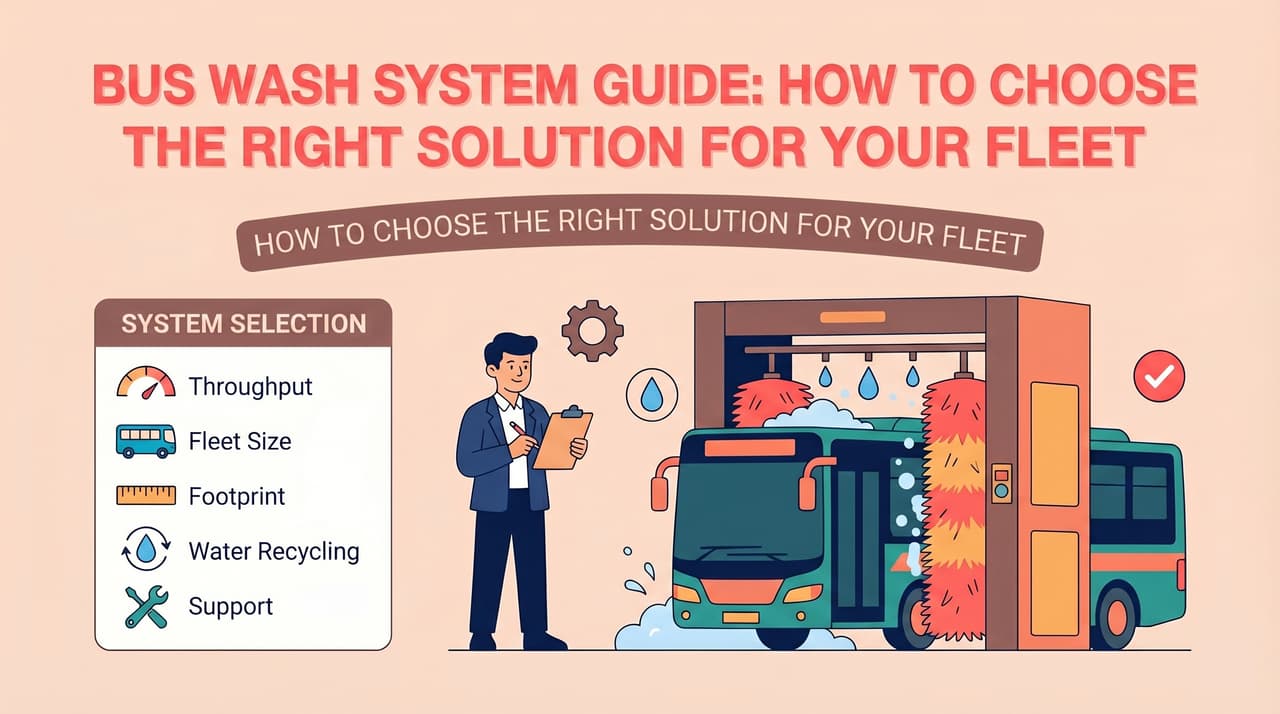
Selecting a fleet wash system is an infrastructure decision, not a line-item procurement comparison. The right system depends on six factors that interact with each other.
Fleet size and vehicle mix. A 50-bus transit depot has fundamentally different requirements than a 500-vehicle logistics fleet running mixed trucks, vans, and buses. Mixed fleets need adjustable gantry heights and brush reach — or a drive-through system configured to handle multiple vehicle profiles without manual adjustment.
Throughput target. How many vehicles need to be washed per shift? An express depot turnaround — all buses cleaned and out by 5 AM — demands very different throughput than spreading washes across an 8-hour operating day. Match your system's vehicles-per-hour rating to your peak-period requirements, not your average daily volume.
Operating environment. Indoor installations protect equipment and operators from weather but increase construction costs. Outdoor systems need freeze protection in cold climates and drainage capacity for heavy rainfall. Consider shift patterns: a 24/7 logistics operation accumulates wash demand differently than a transit depot with a defined overnight window.
Water and environmental compliance. Regulations vary by jurisdiction, but the direction is consistent — discharge requirements are tightening. Closed-loop water reclaim systems that capture and recycle 90%+ of wash water address most regulatory frameworks and reduce ongoing water costs. Factor compliance into system selection early, not after installation.
Total cost of ownership. Equipment price is the visible cost. The real comparison is TCO over a 10+ year horizon: equipment + installation + water, chemical, and energy per wash + maintenance and parts + labor. A $185,000 rollover with higher per-wash costs and lower throughput may cost more over a decade than a $500,000 drive-through with lower marginal costs and significantly higher vehicle capacity. For a framework on connecting equipment investment to long-term returns, see our equipment maintenance best practices.
Manufacturer support. Remote diagnostics, spare parts availability, training for your depot maintenance staff, and warranty terms all factor into long-term reliability. A system is only as good as the support behind it — especially for fleet operations where downtime during peak wash periods directly impacts vehicle availability. Look for manufacturers with internationally recognized quality and environmental certifications (ISO 9001, ISO 14001, CE) as a baseline indicator of production standards and compliance readiness. For a structured approach to evaluating manufacturers, see our manufacturer evaluation checklist.
Fleet-scale deployment: what 80 buses per hour looks like
The throughput gap between standard and high-performance fleet wash configurations is significant. Industry-standard drive-through systems process 20+ buses per hour. The HyTian TH-Series drive-through bus washer deployed at Zhuhai Public Transport Group Company processes up to 80 buses per hour at depot peak — four times that baseline.
The Zhuhai deployment shows what fleet-scale automated washing looks like when throughput, infrastructure, and sustainability align. Zhuhai Public Transport Group Company operates a large municipal bus fleet and needed to wash vehicles at depot peak rates without expanding existing facilities. The challenge was twofold: hit high throughput during the narrow overnight turnaround window and do it within the depot's existing footprint.
The TH-Series drive-through system was engineered to integrate with the depot's current infrastructure — compact enough that no major rebuild or expansion was required. Detail-aware cleaning stages adjust automatically to each vehicle profile in the fleet, maintaining consistent wash quality across standard and articulated buses without manual intervention.
Water recycling was built into the system from the design stage. The integrated reclaim system met Zhuhai's local environmental compliance requirements while substantially reducing fresh water consumption — a critical factor for municipal operators accountable to public sustainability standards.
What makes Zhuhai instructive beyond the throughput figure is the deployment model. This is a long-term partnership with ongoing system optimization, parts availability, and maintenance training for depot staff — not a one-time equipment purchase. For fleet operators evaluating bus wash systems, that distinction matters: a vendor relationship that supports your operation through the equipment's full lifecycle directly affects uptime, parts lead times, and total cost of ownership. Read the full deployment details: how Zhuhai scales fleet washing to 80 buses per hour.
Frequently asked questions
What is the best bus wash system for a transit fleet?
Drive-through gantry systems are the strongest fit for high-volume transit depots. They process 20–80+ buses per hour depending on configuration, support one-way traffic flow that integrates with depot operations, and deliver the consistent wash cycle that transit fleets require across every shift. For smaller or mixed fleets where space is limited, a rollover system offers comparable wash quality with a more compact footprint.
How much does an automatic bus wash system cost?
Automatic bus wash systems range from $150,000 to over $500,000 depending on system type and configuration. Rollover units cost $185,000–$225,000. Drive-through conveyor systems range from $150,000–$500,000 depending on wash stages. Full tunnel installations for high-volume depots start at $500,000+. Equipment price is only part of the equation — total cost of ownership including installation, water, chemicals, energy, and maintenance over a 10+ year lifecycle is the more meaningful comparison.
How many buses can an automatic wash system handle per hour?
Rollover systems process one bus every 3.5–5 minutes, or 12–17 per hour. Drive-through gantry systems handle 20+ per hour per lane at standard configurations. High-throughput systems like the HyTian TH-Series achieve up to 80 buses per hour at depot peak operations — well above the industry baseline.
What are the space requirements for a bus wash bay?
Bay length depends on your longest vehicle: 14–16 meters for standard city buses, 20–22 meters for articulated buses. Overhead clearance should be at least 0.5–1 meter above your tallest vehicle — plan for 5.5 meters or more if your fleet includes double-deckers. Interior width of 4–5 meters accommodates vehicle mirrors and gantry travel. You also need staging space for 3–5 vehicles before the bay and a clear exit lane to maintain traffic flow during peak wash periods.
Do bus wash systems recycle water?
Modern automated systems reclaim up to 90% of wash water through filtration, separation, and treatment. Closed-loop water recycling is increasingly standard for fleet installations — it addresses environmental compliance requirements and substantially reduces water costs at fleet scale. Most jurisdictions now require some form of wastewater containment for commercial vehicle wash operations.
Key takeaways
Automated bus wash systems replace linear labor costs with fixed-throughput infrastructure — the economic case strengthens as fleet size grows, with fleets reporting 40%+ labor reduction after transitioning.
System selection depends on fleet size, vehicle mix, depot layout, and throughput requirements — not equipment price alone. TCO over 10+ years is the real comparison.
Drive-through systems lead on throughput at 20–80+ vehicles per hour; rollovers offer flexibility for smaller or mixed fleets at a lower investment point.
Water recycling and environmental compliance are non-negotiable in modern fleet wash design — systems reclaim up to 90% of wash water.
The vendor relationship matters as much as the spec sheet — remote diagnostics, parts availability, training, and ongoing support determine long-term system reliability.
Next step
Every fleet has its own mix of vehicles, space constraints, and throughput targets. Discuss your fleet's washing requirements with our engineering team — we can assess your depot layout and recommend the right system configuration for your operation.
Related articles
Explore more insights from the HyTian team.
How to Evaluate a Car Wash Equipment Manufacturer: A Buyer's Checklist
A practical buyer's checklist for distributors and dealers evaluating a car wash equipment manufacturer. Learn what to look for in engineering capability, certifications, after-sales support, and global track record before committing to a factory partnership.