
The Year-Round Car Wash Equipment Maintenance Schedule: Daily, Weekly, Monthly, and Quarterly Checklists
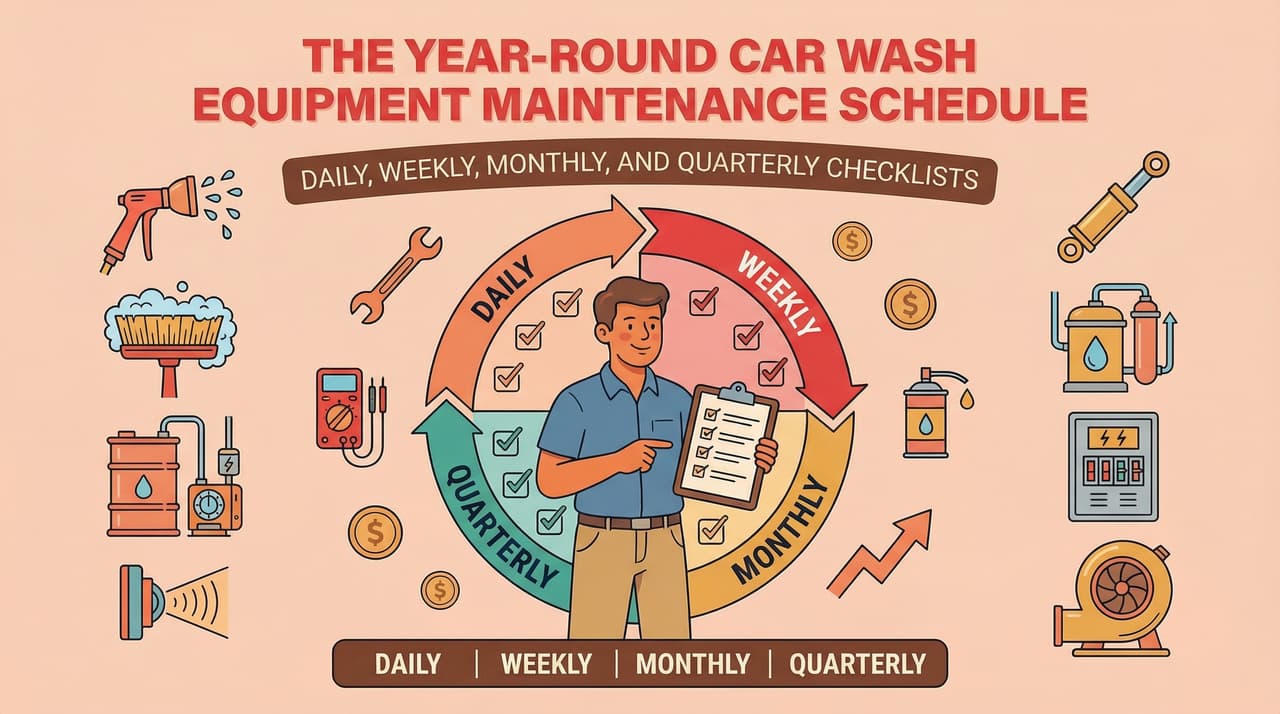
A conveyor jam on a Saturday morning. A chemical pump that quits during the lunch rush. A sensor misalignment that sends three vehicles through without soap. If you run a wash site, you already know what unplanned downtime costs: $200 to $500 or more per hour in lost revenue during peak periods, plus the emergency repair bill on top.
The frustrating part? Most of these failures are preventable. Industry maintenance data consistently shows that the majority of automatic car wash equipment failures trace back to missed or deferred maintenance tasks. Not catastrophic design flaws. Not freak accidents. Routine items that someone skipped, delayed, or never scheduled in the first place.
A structured car wash equipment maintenance schedule changes that equation. Car wash equipment preventive maintenance is not about adding work to your day -- it is about replacing expensive surprises with predictable, manageable tasks at defined intervals.
This schedule is built from field data across 20,000+ installations in 40+ countries, spanning tropical, arid, and cold climates. It covers four frequencies:
Daily (15-20 minutes): Catch the issues that cause tomorrow's downtime
Weekly (1-2 hours): Prevent the most common quality and reliability failures
Monthly (3-4 hours): Calibrate the systems that control your cost-per-wash
Quarterly (half-day): Address high-cost components that fail catastrophically when neglected
This is the year-round complement to seasonal preparation. If you operate in a cold climate, pair this schedule with specific cold-weather protocols for freeze prevention, glycol systems, and cold-start procedures.
Maintenance frequency overview
The car wash preventive maintenance checklist below summarizes what to check at each interval. The sections that follow break down each frequency in detail.
System Component | Daily | Weekly | Monthly | Quarterly |
|---|---|---|---|---|
Brushes | Visual inspection | --- | Measure foam height | Mounting hardware audit |
Nozzles / Spray arches | Check alignment | Clean and descale | --- | Full replacement assessment |
Chemical dosing | Verify levels | --- | Calibrate pump accuracy | --- |
Water recycling / Filters | Check pressure | --- | Test TDS levels | Membrane overhaul |
Conveyor / Drive system | Visual check | Lubricate chains | --- | Full mechanical audit |
Electrical / Sensors | Test e-stops | Inspect connections | --- | Motor amperage test |
Hydraulics | --- | --- | --- | Fluid, hoses, seals |
Dryers / Blowers | --- | Check belt tension | --- | Airflow measurement |
Your car wash daily maintenance checklist
Think of this as 15 to 20 minutes at the start of each operating shift. These are the checks that catch overnight accumulation, environmental debris, and the small issues that compound into shutdowns if left for a week.
1. Visual inspection of brushes and contact elements. Check EVA foam brushes for debris entanglement, uneven wear patterns, or material buildup. EVA closed-cell foam maintains a linear pressure curve that protects modern clearcoats, wipers, mirrors, and accessories -- but that consistent pressure only holds when the brush surface is clean and uniform. Flag any sections where foam appears compressed or torn.
2. Nozzle and spray arch alignment. Walk the tunnel or bay and confirm that every nozzle is pointed where it should be. A single misaligned nozzle can leave an unwashed strip on every vehicle that passes through, and you may not notice until a client complains.
3. Chemical levels. Verify soap, wax, rinse aid, and drying agent levels in the dosing system. CNC metering pumps -- like those on the TX-380 -- deliver chemical with 0.28 mL precision per application, which means your cost-per-wash stays predictable. But precision dosing only works if the drums are not empty. A pump running dry damages seals and throws off calibration.
4. Water system pressure and filtration. Check incoming water pressure and inspect filter screens for blockage. Confirm the recycling system is cycling properly. Low pressure or clogged screens cause inconsistent rinse quality and can overstress pumps. If pressure problems persist after cleaning, the pump may be sized wrong for the system; our guide to sizing car wash pumps explains how PSI and GPM requirements are derived.
5. Safety systems. Test every emergency stop button. Verify sensor alignment on photo-eyes for vehicle detection. Confirm bay doors or entrance gates operate correctly. These are non-negotiable -- a malfunctioning e-stop is a liability, not just an inconvenience.
6. Drainage. Clear drains and sump pits of debris accumulation. Standing water accelerates corrosion on floor-mounted components and creates slip hazards for technicians.
Weekly maintenance tasks that prevent costly repairs
Set aside 1 to 2 hours on a slower day. Weekly tasks target the components most likely to cause inconsistent wash quality or incremental mechanical degradation. At minimum, car wash equipment should receive a thorough weekly inspection covering lubrication, nozzles, sensors, and electrical connections -- with deeper monthly and quarterly service on top of daily checks.
Lubricate moving parts. Conveyor chains, guide rails, and gantry tracks all require scheduled lubrication. VFD-controlled conveyors, like the TX-380 tunnel system, have specific lubrication requirements for chain and roller assemblies -- follow the manufacturer's recommended grade and interval. Under-lubrication accelerates chain stretch; over-lubrication attracts grit that accelerates wear.
Clean and inspect nozzles. Remove mineral buildup from all spray nozzles and check spray patterns for blockage or misdirection. Nozzle blockage is among the most common causes of inconsistent wash quality -- and one of the most common car wash equipment failures overall. A five-minute nozzle cleaning prevents the callbacks and quality complaints that cost you far more in time and reputation.
Test sensors and photo-eyes. Verify vehicle detection accuracy at every sensor point. Misaligned sensors cause missed vehicles, double-charges, or conveyor timing errors. Test with a vehicle in position, not just a hand wave.
Check belt tension and alignment. Dryer and blower belts stretch over time. A loose belt reduces drying performance and increases energy consumption. Check tension against the manufacturer's specification and inspect for cracking or glazing.
Inspect electrical connections. Look for corrosion, loose terminals, or heat damage on junction boxes, control panels, and motor connections. Wash bay environments are inherently humid and chemically active -- connections that would last years in a dry shop can corrode in months without protective treatment.
Review PLC and controller error logs. Clear non-critical alerts and flag any recurring error codes for further investigation. This is where you catch intermittent issues -- a sensor that drops out once a day, a motor that draws slightly high -- before they become full failures. This is part of a complete car wash preventive maintenance checklist that keeps small problems from becoming expensive ones.
Monthly maintenance: the deep-dive inspection
Schedule 3 to 4 hours during a planned closure or low-traffic window. Monthly tasks focus on calibration, measurement, and the gradual degradation that daily visual checks cannot catch.
Brush replacement assessment. Measure foam height and density on your EVA closed-cell brushes. EVA foam maintains its linear pressure curve longer than PE or cloth alternatives, but it still degrades -- the process is just slower and more predictable. Monthly measurement lets you forecast your car wash brush replacement schedule rather than reacting to quality complaints. Check mounting hardware for looseness or corrosion while you are measuring.
Chemical dosing calibration. Verify pump output accuracy against target volumes. Clean injection points and check valve seats for wear. Even 10 to 15 percent dosing drift increases your cost-per-wash significantly over time -- and it affects wash quality in ways that are hard to diagnose without measurement. A pump that over-doses wastes chemical. A pump that under-doses produces poor results that you may blame on other components.
Water quality testing. Check total dissolved solids (TDS) levels in recycled water. Assess filter condition and schedule replacements before performance degrades. Water recycling systems are critical for both environmental compliance and operating cost -- HyTian holds ISO 14001 certification for environmental management, and the maintenance standards behind that certification inform these recommendations.
Structural inspection. Check frame welds, mounting bolts, and bay or tunnel structural elements for fatigue cracks or corrosion. Pay particular attention to any area where water pools or spray contacts structural steel regularly.
Software and diagnostics. Apply any available PLC firmware updates. Run a full diagnostic cycle and export maintenance logs. Monthly log exports give you the trend data you need to make informed decisions about upcoming quarterly and annual service events.
Quarterly and seasonal maintenance milestones
This is a half-day or full-day service event, often with manufacturer or certified technician support. Quarterly tasks address the high-cost subsystems that fail expensively when neglected.
Hydraulic system service. Check fluid levels, inspect hoses for cracking or swelling, and examine cylinder seals for leaks. Car wash hydraulic system maintenance is one of the most consequential items on the quarterly schedule -- hydraulic failures are among the most expensive emergency repairs, and they almost always show warning signs (seeping seals, discolored fluid, soft response) weeks before catastrophic failure.
Complete electrical system audit. Measure motor amperage against rated specifications. Deviation signals bearing wear or winding insulation breakdown. Inspect contactors for pitting, verify grounding integrity, and check the condition of any VFD units.
Water recycling system overhaul. Replace or deep-clean membranes and filters. Drain and clean holding tanks. Test reclaim rates -- quarterly membrane inspection is needed to maintain reclaim rates above 80 percent. Falling reclaim rates mean higher water costs and potential compliance issues.
Dryer performance evaluation. Measure airflow output against baseline readings. Inspect heater elements if applicable. Clean intake filters. Drying quality is one of the most visible performance metrics -- your clients notice immediately when it degrades, even if they cannot articulate why their vehicle is not as dry as usual.
Seasonal adjustments. Winter preparation requires its own protocol. For detailed cold-weather procedures covering freeze prevention, glycol systems, and cold-start procedures, see our winterizing checklist. Summer brings different challenges: coolant system loads increase, chemical stability shifts at high ambient temperatures, and ventilation systems work harder. Adjust your quarterly review to account for the seasonal demands your climate imposes.
Annual planning overlay. Use each quarterly milestone to inventory spare parts, forecast next quarter's replacement budget, and schedule any major service events. Quarterly planning prevents the end-of-year scramble to justify maintenance spending that could have been spread across the year.
What does car wash preventive maintenance cost per year?
Annual car wash maintenance cost for a structured preventive program typically falls between $4,000 and $15,000, depending on system type, complexity, and operating volume. That covers parts, consumables, and labor for the schedule outlined above.
Compare that to the reactive alternative. A single major breakdown -- a motor failure, a conveyor jam, a hydraulic line burst -- can cost $2,000 to $10,000 in parts and labor alone. Add $200 to $500 or more per hour in lost revenue during peak periods. One bad weekend can exceed an entire year's preventive maintenance budget.
Framed on a per-wash basis, the math is straightforward:
Approach | Estimated Cost Per Wash | What It Covers |
|---|---|---|
Preventive maintenance | $0.05 - $0.15 | Scheduled parts, consumables, labor |
Reactive-only maintenance | $0.50 - $2.00 | Emergency repairs + lost revenue amortized |
The 3x to 10x cost multiplier of reactive approaches is not a scare tactic. It is arithmetic. Emergency parts cost more. Emergency labor costs more. And the revenue you lose while the system sits idle does not come back.
Equipment design affects maintenance cost directly. Systems with modular components -- configurable dryer arrays, slide-rail conveyor options, standardized mounting points -- reduce labor time per service event because components swap faster. CNC metering pump precision extends chemical drum life to approximately 3,000 washes per 20 kg drum, reducing one of the largest recurring operating costs. For the full picture of equipment investment including purchase, installation, and ongoing costs, see our guide to what an automatic car wash system costs.
If you want to model these numbers against your specific equipment and wash volume, our engineering team can help you build a maintenance budget tailored to your operation.
Building your maintenance program: from schedule to system
A checklist is a starting point. A maintenance program is what happens when that checklist becomes embedded in your daily operations.
Assign ownership. Every task on the schedule needs an owner. Daily checks go to the opening-shift technician. Weekly inspections go to the site manager. Monthly and quarterly tasks may involve a manufacturer technician or certified service partner. The principle: no task should default to "whoever gets to it."
Document everything. Maintenance logs serve three purposes. First, warranty compliance -- most manufacturer warranties require documented maintenance records, and a missing log entry can void coverage on an expensive claim. Second, resale value -- a complete service history adds tangible value when you sell or upgrade equipment. Third, pattern recognition -- logs reveal recurring issues before they escalate. A sensor that fails every four months is telling you something about its operating environment.
Partner with your manufacturer. OEM maintenance programs are built on the manufacturer's field data from thousands of installations. Third-party service works, but the OEM knows the failure patterns. HyTian's car wash business solutions include maintenance planning as part of the operator support package, informed by data from 20,000+ systems operating across 40+ countries.
Know when to call the engineer. Some tasks -- PLC diagnostics, hydraulic seal replacement, motor rewinding -- are beyond typical in-house capability. Recognizing that boundary and having a service partner on standby prevents a small issue from becoming a large one.
Key takeaways
Daily checks (15-20 minutes) catch the issues that cause tomorrow's downtime
Weekly inspections (1-2 hours) prevent the most common quality and reliability failures
Monthly deep-dives (3-4 hours) calibrate the systems that control your cost-per-wash
Quarterly milestones (half-day) address high-cost components that fail catastrophically when neglected
Preventive maintenance costs $0.05-$0.15 per wash -- reactive maintenance costs $0.50-$2.00 per wash
Want a maintenance program tailored to your specific equipment and operating conditions? Discuss a maintenance program with our engineering team -- we can help you build a schedule that protects your investment and keeps your site running at peak throughput.
Related articles
Explore more insights from the HyTian team.
Winterizing Your Automatic Car Wash Equipment: A Practical Checklist to Prevent Freeze-Ups & Downtime
A practical winter car wash maintenance checklist for tunnel and in-bay automatics—weep systems, doors, reclaim, heating, and daily/weekly routines to prevent freeze-ups and downtime.
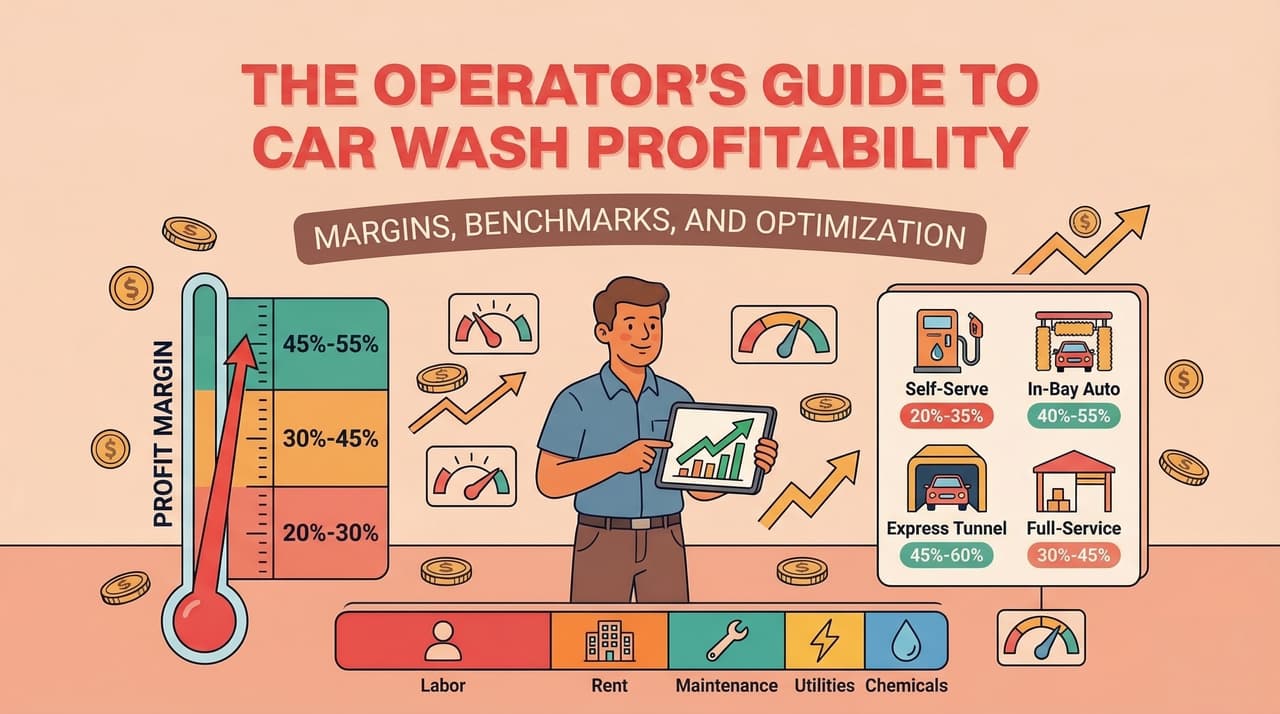
The Operator's Guide to Car Wash Profitability: Margins, Benchmarks, and Optimization
Car wash profit margins by format: 35–55% self-serve, 30–50% in-bay automatic, 25–40% express tunnel, 30–45% full-service with detailing, and what moves each.