
How Much Does an Automatic Car Wash System Cost? A Complete Investment Breakdown
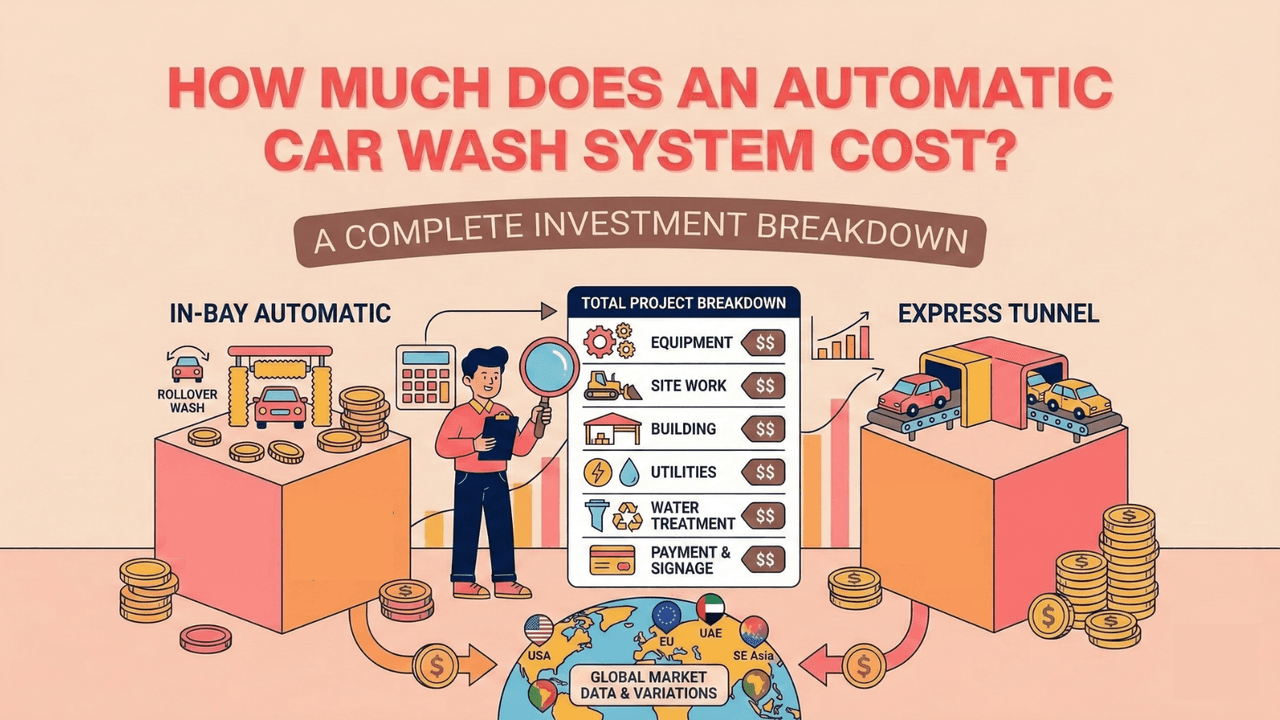
The most common question we hear from operators and investors evaluating automatic car wash systems: how much does this actually cost?
The honest answer depends on two things: what you're buying, and where you're building. This guide uses US and European pricing as the primary reference — these are the markets with the most transparent cost data — but the framework applies globally. We'll cover how costs shift across regions, because a tunnel system in the Middle East faces different site costs, import structures, and regulatory requirements than the same system in Texas. If you are weighing a ground-up build against acquiring an existing wash, how much it costs to build a car wash covers the land, construction and permitting costs that equipment pricing leaves out.
The other essential distinction: equipment cost versus full project cost. Conflating the two leads to either sticker shock or dangerous underbudgeting. This guide breaks down both, explains what drives the price in each category, and gives you the framework to compare quotes on equal terms.
Automatic car wash system cost by type
Equipment cost varies by system type, throughput capacity, and configuration. These ranges represent the machine itself — delivered to your site, before installation, site work, or utilities. Pricing below reflects US/European market ranges; see the regional variation section below for how these shift in other markets.
System Type | Equipment Cost Range (US/Europe) | Typical Throughput | Best For |
|---|---|---|---|
Touchless (in-bay) | $15,000 – $55,000 | 8–15 vehicles/hr | Low-volume sites, premium vehicle markets, add-on to existing business |
Rollover / Gantry (in-bay) | $20,000 – $70,000 | 10–20 vehicles/hr | Gas stations, standalone single-bay operations, space-constrained sites |
Tunnel (conveyor) | $50,000 – $350,000+ | 40–80 vehicles/hr | Express exterior, high-volume dedicated wash sites, multi-service centers |
The range within each category reflects real engineering differences, not just branding. A $20,000 rollover and a $65,000 rollover are fundamentally different machines in terms of brush technology, chemical delivery, drying performance, and control systems. Understanding what drives those differences is how you avoid both overspending and underspecifying.
What drives the equipment price
Throughput capacity. Higher throughput requires heavier-duty components. A tunnel system designed for 50–60 vehicles per hour needs industrial-grade conveyors with variable frequency drive (VFD) speed control, higher-capacity pumps, and faster drying systems than a unit designed for 30 vehicles per hour. The throughput you need should be calculated from your peak-hour traffic projections, not your average.
Brush technology and materials. Modern EVA (ethylene vinyl acetate) closed-cell foam brushes maintain consistent pressure across different vehicle profiles and resist the grit carryover that causes swirl marks. They cost more than traditional polyethylene or cloth brushes, but they reduce paint damage claims and extend brush replacement intervals. If you're washing premium vehicles, this isn't optional.
Chemical dosing systems. The precision of your chemical delivery directly affects your cost per wash. Industrial metering pumps with CNC-level precision — systems capable of 0.28 mL accuracy — can extend a 20 kg drum of detergent to roughly 3,000 washes. Compare that to gravity-fed or basic pump systems where the same drum might last 1,500 washes. Over a year of high-volume operation, that difference compounds into thousands of dollars in chemical savings.
Drying systems. Options range from basic fixed blowers to profiling dryer arrays that track vehicle contour and silenced fan systems for noise-sensitive locations. Heated air drying adds energy cost but improves dry quality, especially in cold or humid climates. Your choice depends on your site's noise restrictions, climate, and how much you charge for premium wash packages.
Conveyor type (tunnel systems). Heavy-duty chain conveyors handle multi-SUV loads reliably but cost more than belt systems. Slide-rail conveyors offer smoother operation and quieter performance at a higher price point. The right choice depends on your traffic mix and throughput target.
Automation and connectivity. Basic PLC (programmable logic controller) systems manage wash cycles. Advanced systems add IoT connectivity for remote diagnostics, predictive maintenance alerts, and real-time performance monitoring. Remote monitoring capability can pay for itself the first time it prevents an unplanned shutdown — but it does add to the initial equipment price. For what a PLC actually does inside the wash, from sequencing stages to reading sensors and enforcing safety interlocks, see inside car wash control systems.
Beyond the equipment: total project cost
Equipment is typically 15–40% of a total car wash project, depending on land costs in your market. Here's what the full picture looks like:
Cost Category | In-Bay — US/Europe | Express Tunnel — US/Europe |
|---|---|---|
Equipment | $20,000 – $70,000 | $100,000 – $350,000 |
Site preparation & civil works | $30,000 – $100,000 | $150,000 – $500,000 |
Building / canopy structure | $50,000 – $200,000 | $200,000 – $800,000 |
Utility infrastructure | $10,000 – $40,000 | $30,000 – $100,000 |
Water treatment / recycling | $15,000 – $50,000 | $50,000 – $150,000 |
Payment systems | $5,000 – $15,000 | $15,000 – $50,000 |
Signage and site finishing | $5,000 – $20,000 | $15,000 – $50,000 |
Total project range | $135,000 – $495,000 | $560,000 – $2,000,000 |
These ranges assume you already own or lease the land. Land acquisition in high-traffic locations can add $200,000 to $2,000,000 depending on your market.
The numbers that don't appear in equipment quotes but hit your budget:
Water treatment is increasingly non-optional. Many jurisdictions now require water recycling systems that recover 70–85% of wash water. Systems with built-in water recycling integration handle this at the equipment level. Systems without it require a separate retrofit that costs more and works less efficiently.
Electrical upgrades often surprise first-time builders. High-powered pumps, heated dryers, and conveyor motors may require transformer upgrades or new electrical panels. Get a site assessment from a licensed electrician before finalizing your equipment selection.
Annual operating costs
Once the system is running, ongoing costs determine your actual profitability:
Operating Cost | Typical Annual Range |
|---|---|
Maintenance and parts | $4,000 – $15,000 |
Chemicals and detergents | $8,000 – $30,000 |
Water | $3,000 – $12,000 |
Electricity | $5,000 – $20,000 |
Labor (if staffed) | $25,000 – $60,000 per attendant |
Equipment quality has the largest impact on operating costs. Systems with precision chemical dosing, water recycling, and energy-efficient VFD motors cost more upfront but compound savings across every wash. Over a 10-to-15-year equipment lifespan, a system that saves $0.30 per wash in chemicals and water adds up to $50,000–$150,000 in reduced operating costs at moderate volumes. For industry benchmarking data on operating costs and revenue, the International Carwash Association (ICA) publishes annual surveys that provide regional baselines.
What the investment returns
The revenue side depends on your throughput, pricing, and utilization:
Metric | In-Bay Automatic | Express Tunnel |
|---|---|---|
Revenue per wash (avg) | $8 – $15 | $10 – $25 |
Vehicles per hour (realistic) | 8 – 18 | 40 – 60 |
Operating hours per day | 10 – 14 | 10 – 14 |
Peak utilization rate | 40 – 60% | 50 – 70% |
At realistic utilization, an express tunnel processing 50 vehicles per hour at $15 average revenue — running 12 hours at 60% utilization — generates roughly $5,400 per day in gross revenue. Sites in high-traffic locations with strong membership programs regularly exceed this. The key variable isn't the machine — it's the site selection and traffic pattern.
Payback periods in the industry range from 18 months to 5 years, depending heavily on land cost, build cost, and location quality. Be skeptical of claims under 12 months — they typically assume perfect utilization, no seasonality, and no ramp-up period.
How costs vary by region
The equipment pricing above reflects US and European markets. If you're building in the US or Europe, the ranges above apply directly — skip ahead to "How to compare equipment quotes." For other markets, here's how costs shift.
Equipment cost itself varies less than you'd expect. A tunnel system from a global manufacturer is engineered to the same standard whether it ships to Houston or Dubai. The equipment price difference between regions is typically 10–20%, driven mainly by shipping distance, import duties, and local certification requirements.
What changes significantly is everything around the equipment:
Middle East and Gulf states
Land outside city centers can be more affordable, but construction costs tend to run higher due to heat-resistant materials and specialized drainage for sand and dust management. Water treatment systems are more critical (and more expensive) in water-scarce markets. Import duties vary by country — UAE free zones offer advantages that Saudi Arabia or Oman may not. Local construction labor is generally less expensive than in the US or Europe, but specialized installation technicians may need to be imported.
Southeast Asia
Lower construction and labor costs can compress total project budgets significantly compared to the US — in some markets by a third or more. Equipment import duties vary widely — Thailand and Vietnam have different tariff structures from Singapore or the Philippines. The key variable is revenue per wash: lower average ticket prices mean higher throughput is needed to achieve the same ROI. A tunnel that generates $15 per wash in the US may generate $3–$5 per wash in parts of Southeast Asia, fundamentally changing the payback calculation.
Australia and developed Asia-Pacific
Equipment and construction costs comparable to the US. Stricter water recycling requirements in Australia can add $30,000–$80,000 to the project. Compliance with local electrical standards (different from CE or UL) may require equipment modifications.
Latin America
Construction and labor costs are generally well below US levels, but import duties on industrial equipment can be steep — several major markets impose tariffs that meaningfully increase landed equipment cost. Currency volatility adds a layer of budget risk for projects priced in local currencies against USD-denominated equipment. The car wash market is growing fast in urban centers across Mexico, Brazil, and Chile, with express tunnel formats gaining traction. Operators who source equipment from manufacturers with existing Latin American distribution and service networks avoid the hidden cost of flying in technicians for every maintenance issue.
Africa
A rapidly growing market for automatic car wash adoption, particularly in South Africa, Nigeria, Kenya, and North Africa. Construction costs are lower in most markets, but infrastructure reliability — specifically power and water supply — is the critical variable. Backup power generators and water storage tanks are often essential additions that don't appear in standard project budgets. Import logistics can be complex — port clearance timelines and inland transportation costs vary significantly between coastal and landlocked countries. The revenue model often differs from mature markets: higher wash prices relative to local incomes in some markets create strong margins, while others require high volume at lower price points. Partnering with a manufacturer that has existing installations on the continent — and understands local logistics — reduces the risk of equipment sitting in port for weeks.
The framework stays the same regardless of region: understand your total cost of ownership, calculate revenue from realistic throughput at local pricing, and choose equipment that optimizes cost-per-wash over a 10-to-15-year lifespan. The specific numbers change — the decision logic doesn't.
For region-specific cost guidance, contact our team — we've deployed systems in 40+ countries and can provide budgeting benchmarks based on comparable installations in your market.
How to compare equipment quotes
When you receive quotes from different manufacturers, make sure you're comparing equivalent configurations:
What should be in the quote: Equipment, shipping, installation supervision, commissioning, initial training, and warranty terms. If any of these are listed as "additional" or "TBD," factor in the real cost before comparing.
What to ask about spare parts: Where are parts stocked relative to your location? What's the standard delivery timeline for critical components? A machine that's $10,000 cheaper but requires three-week parts shipments from overseas is more expensive in practice.
What to ask about chemical costs: Can the manufacturer provide cost-per-wash data for their dosing systems? Precision metering systems reduce chemical consumption measurably — ask for the numbers, not just the claim.
What to ask about energy: Does the system use VFD motor control? What are the rated power consumption figures at typical operating load? Energy costs vary by region, but the equipment's efficiency rating is constant.
If you're evaluating manufacturers for the first time, our manufacturer evaluation checklist provides a structured framework for comparing beyond price.
Getting a realistic budget for your project
Start with your site and volume projections, not with an equipment catalog. The right system for a 4-bay gas station adding a single rollover unit is a completely different conversation from a greenfield express tunnel targeting 60 vehicles per hour.
If you're choosing between system types, our guide to tunnel vs. in-bay automatic breaks down the site, volume, and staffing trade-offs. For a closer look at the in-bay category itself, our in-bay automatic equipment guide covers how rollover systems work and what to evaluate.
For tunnel systems specifically, the TX-380 series is a good reference point for what a configurable, high-throughput platform looks like — multiple SKU configurations, modular components, and the ability to right-size your investment to your site's actual requirements.
Every project has different constraints. Get a project-specific quote based on your site layout, traffic data, and volume targets — not a generic price list.
Related articles
Explore more insights from the HyTian team.
2026 Car Wash Industry Trends: What Equipment Buyers Need to Know
Discover the top 2026 car wash industry trends shaping equipment decisions. Learn about automation, sustainability, EV compatibility, and smart technology.
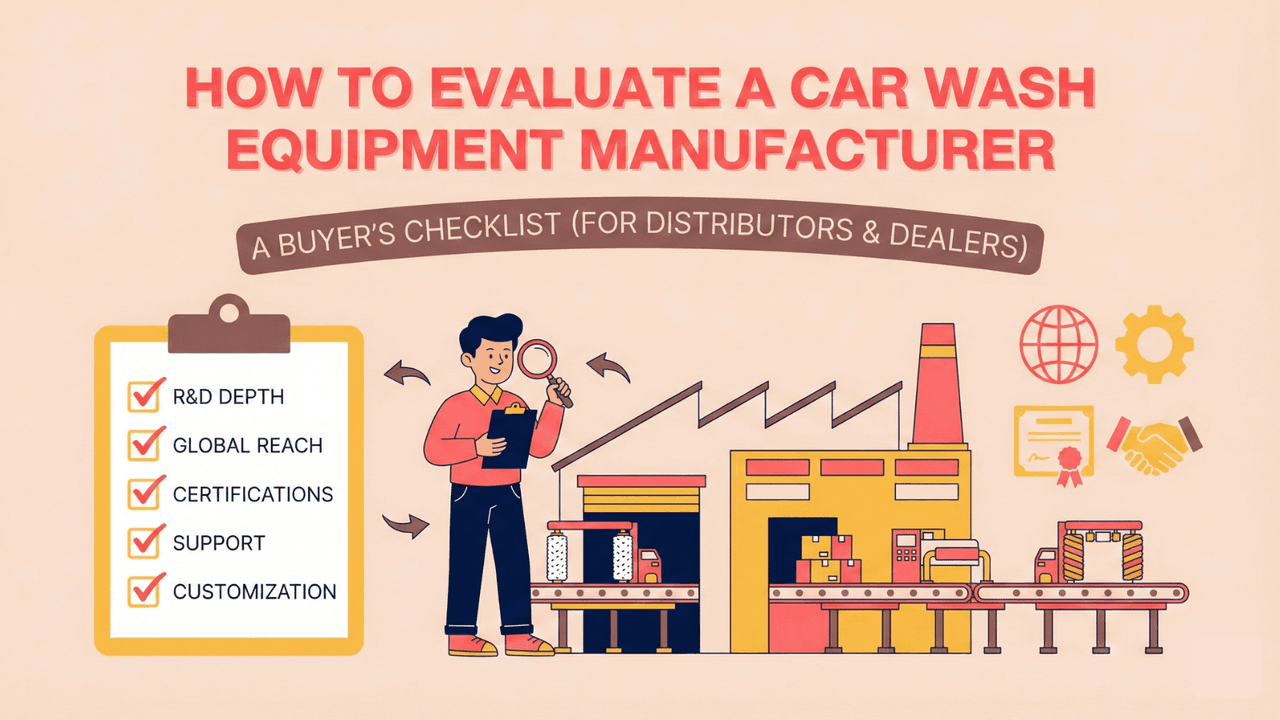
How to Evaluate a Car Wash Equipment Manufacturer: A Buyer's Checklist
A practical buyer's checklist for distributors and dealers evaluating a car wash equipment manufacturer. Learn what to look for in engineering capability, certifications, after-sales support, and global track record before committing to a factory partnership.

How Much Does a Car Wash Make? Revenue Benchmarks by Business Model
How much does a car wash make? Revenue ranges from $41K to $2M+ depending on business model. See benchmarks for self-serve, IBA, tunnel, and express operations.