
Tunnel vs In-Bay Automatic: Which One Fits Your Site, Volume, and Staffing?
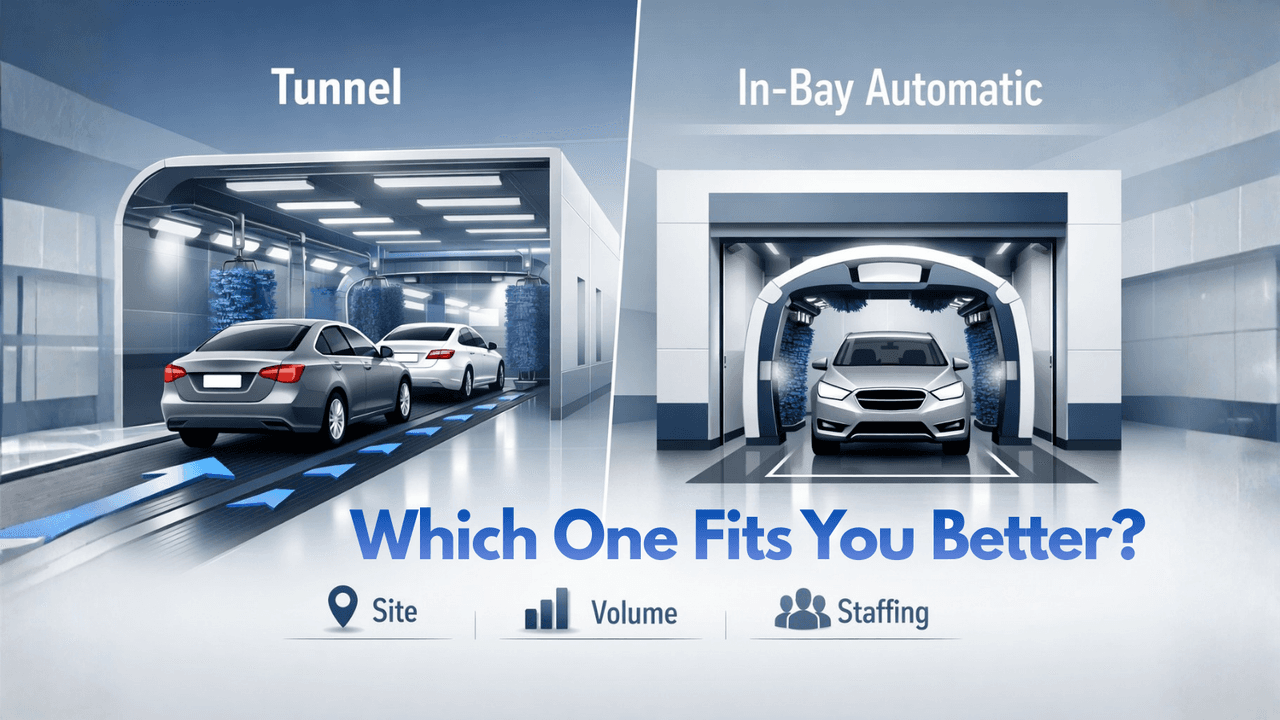
Quick answer: Tunnel vs In-Bay
If you’re choosing between a tunnel and an in-bay automatic, you’re really choosing an operating model: traffic flow, peak-hour capacity, labor, and how you scale.
- Choose a Tunnel when you need high throughput, you expect big peak-hour rushes, and your site can support smooth vehicle flow + stacking lanes.
A tunnel example: HyTian TX-380 Tunnel Series - Choose an In-Bay Automatic (Rollover/Touchless) when you have a tighter footprint, you want lower labor, and demand is moderate or spread out.
Explore in-bay options: Rollover systems and Touchless systems
Want a fast recommendation based on your footprint + target cars/day? Talk to HyTian.
What these formats mean
Tunnel (Conveyor)
A tunnel wash moves vehicles continuously through a sequence of stages (prep, chemistry, contact/touchless steps, rinse, drying). Multiple cars are in the wash at the same time—just at different stations.
In-Bay Automatic (Rollover / Touchless)
An in-bay keeps one vehicle stationary in a bay while the equipment moves around it. You wash one car at a time per bay.
The real differences—the ones that hit revenue and staffing)
1) Peak-hour performance (queues decide conversion)
Most sites don’t lose money on an “average hour.” They lose money at peak—when lines form and customers leave.
- Tunnels handle peaks well because flow is continuous and loading can be optimized.
- In-bays can bottleneck because each wash cycle occupies the bay until it finishes.
Rule of thumb: If your market has sharp rushes (commute, weekends, after rain/snow) and your wash is visible from the road, peak-hour flow matters more than almost anything else.
2) Footprint and traffic flow (this is usually the deciding constraint)
A tunnel isn’t just equipment length. You also need:
- safe, clear entry alignment
- stacking lanes so queues don’t block traffic
- clean exit flow (so cars clear quickly and safely)
If you’re constrained on space, odd lot geometry, or retrofitting an existing bay, an in-bay is often the faster path to launch.
Start with industry layouts here: Solutions by Industry
3) Staffing reality (not your ideal staffing)
Be honest:
- Can you reliably staff attendants?
- Do you want long hours (early/late)?
- Is your goal to run low-labor or unmanned?
In-bays are typically easier to operate with minimal labor—especially with self-service and remote visibility.
Two common in-bay choices:
- Rollover XL-200 (compact, reliable, great for tight sites)
- Rollover XL-200NET (cashless scan-to-start + remote operations for 24/7, low-labor sites)
4) Customer experience (your market decides what “good” feels like)
Some markets want the “line moving” feeling:
- fast entry
- quick progression
- high perceived capacity
Other markets value simplicity:
- drive in
- follow prompts
- wait
- leave
A good way to think about it:
- Tunnel = “fast lane” model
- In-bay = “automated bay” model
5) Vehicle mix and finish sensitivity
If you serve a lot of:
- new vehicles / dealership inventory
- SUVs/EVs with sensors and trim
- specialty finishes, add-ons, accessories
…your choice is less about “tunnel vs bay” and more about control + repeatability (prep effectiveness, dosing consistency, wash coverage, and drying outcome).
If your priority is maximum paint safety with minimal operator workload, consider touchless in-bay: MY-385 Touchless
“At a glance” comparison
Tunnel tends to fit best when you want:
- high throughput and fast recovery after rushes
- a scalable model (more volume, more packages, more consistency at speed)
- an operation that can justify a full wash lane workflow
Explore: TX-380 Tunnel Series
In-bay tends to fit best when you need:
- compact footprint and easier retrofit
- lower labor and simpler day-to-day operations
- a controlled “one car per cycle” customer journey
Explore: Rollover systems or Touchless MY-385
Best fit by business type (common scenarios)
Gas stations / c-stores adding wash revenue
Typical constraints:
- limited space
- staffing is already stretched
- rush-hour spikes
Many sites start with in-bay for low-labor operation, then consider tunnel if volume proves out and site flow supports it.
Dedicated car wash business (express/pro wash centers)
Typical priorities:
- throughput and uptime
- smooth peaks and fast recovery after outages
- consistent results at speed (so you can sell premium tiers)
Tunnel-first planning is common here, with special attention to stacking lanes, entry guidance, and drying strategy.
See: Car Wash Business solution
Dealers & service centers
Typical priorities:
- repeatable results
- paint-safe cleaning
- mixed vehicle profiles and time windows
Either format can work. Choose based on your peak windows and the finish standard you must hit.
See: Dealers & Service Centers solution
The 7-question decision checklist
- What is my peak-hour target (not average day)?
- Can my site support stacking lanes without blocking traffic?
- Do I have a realistic plan for staffing (today and in 12 months)?
- Do I need extended hours / unattended operation?
- Does my market value speed or simplicity more?
- What’s my vehicle mix (SUV/EV-heavy, accessories, premium finishes)?
- Am I trying to launch fast to prove demand or build once to scale?
If you share your footprint, target volume, and staffing reality, HyTian can recommend the right format and a right-sized configuration. Contact HyTian.
FAQ
Is a tunnel always more profitable than an in-bay?
Not automatically. A tunnel can outperform when the site can feed it enough cars and the operation is built for steady flow. If demand is moderate or the site is constrained, an in-bay can win with simpler operations and lower overhead.
Can an in-bay handle high demand?
It can—but peak-hour queues are the risk. Some sites add a second bay, but at a certain volume level, tunnels usually manage peaks more smoothly.
What if I’m unsure about demand yet?
If you want a faster launch with a compact footprint and lower labor, an in-bay is often the “prove it first” move. If your location is naturally high-volume and you have space for flow and stacking, a tunnel can prevent rebuilding later.
Next step: get a layout + throughput recommendation
Start with the format you’re leaning toward:
Tunnel: TX-380 Tunnel Series
In-bay rollover: XL-200 or XL-200NET
In-bay touchless: MY-385
We offer free consultation! Tell us your footprint, expected demand, and staffing plan—we’ll help you map the right system and site flow: Talk to HyTian.
Related articles
Explore more insights from the HyTian team.
2026 Car Wash Industry Trends and Automation Benefits
Automation cuts labor hours per wash, keeps quality consistent and makes uptime plannable. The 2026 car wash industry trends shaping equipment decisions.
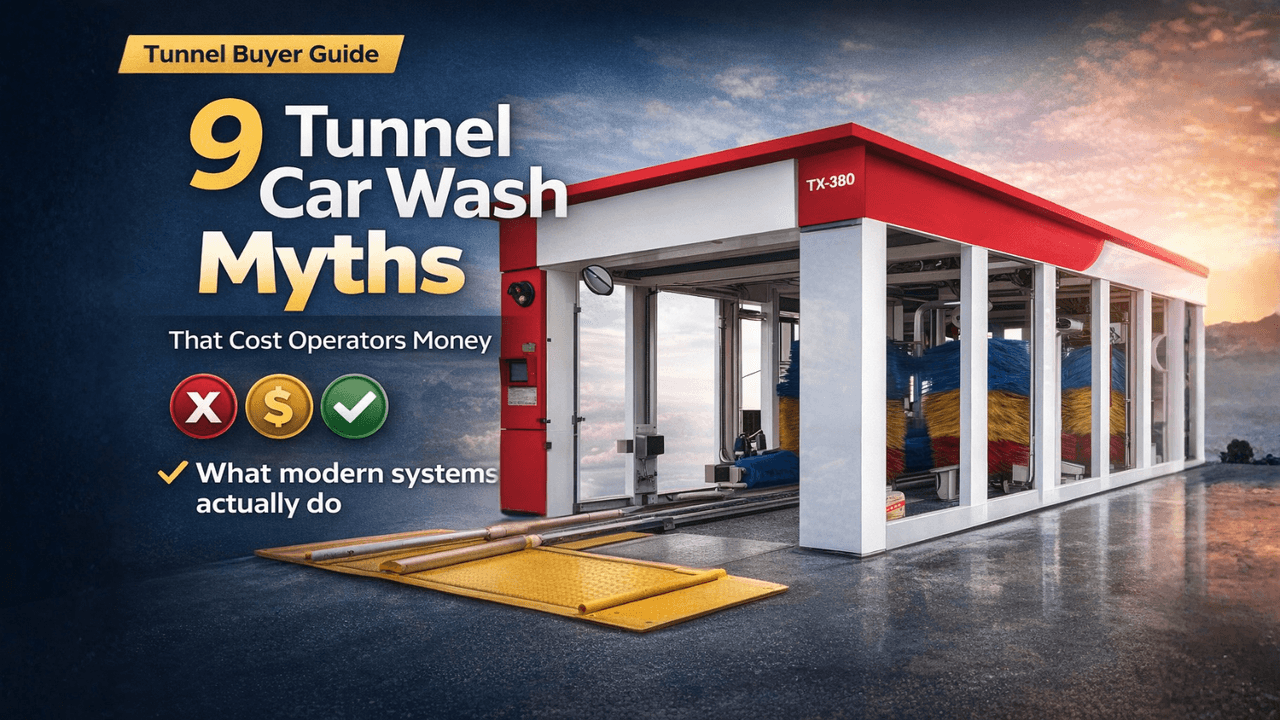
9 Tunnel Car Wash Myths That Cost Operators Money (And What Modern Systems Actually Do)
Debunk 9 costly tunnel car wash myths—brush scratches, throughput, chemical waste, dryers, maintenance, and staffing—and use a 12-question checklist to plan a modern tunnel system.