
9 Tunnel Car Wash Myths That Cost Operators Money (And What Modern Systems Actually Do)
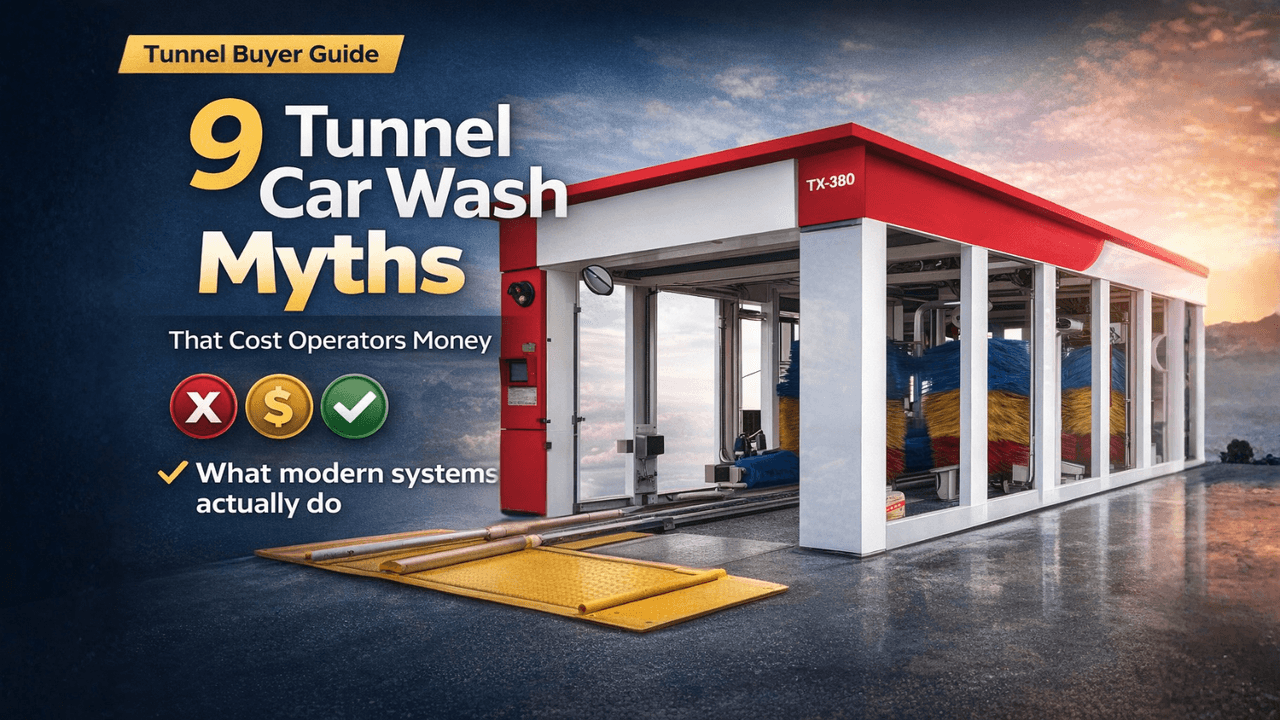
Tunnel systems have a reputation: fast, expensive, complicated. And because a tunnel is a big decision, old assumptions tend to stick—long after the technology has moved on.
The result? Operators overbuild the wrong equipment, under-invest in the parts that actually protect quality, and end up paying for it in lost throughput, chemical waste, callbacks, downtime, and staffing headaches.
This post debunks 9 of the most common tunnel myths—and explains what modern systems actually do to protect paint, increase cars-per-hour, and lower cost-per-wash. (If you’re evaluating a tunnel right now, start with the Tunnel TX-380 Series product page to see a real-world feature set.)
A 60-second refresher: what a “modern tunnel” really is
A tunnel isn’t “a bunch of brushes.” It’s a sequenced, controlled process:
- Guided entry + stable conveyance (consistent loading is half the battle)
- Pre-wash that removes grit before contact
- Brush package designed for even pressure and mixed vehicle profiles
- Metered chemistry (so your best package isn’t the one that destroys margin)
- Drying strategy matched to your power/noise/site constraints
- Controls + reporting (so operations get easier—not harder—as volume grows)
Now, the myths.
Myth 1: “Brushes always scratch paint.”
Reality: What damages paint is usually grit on the car, poor pre-wash, or neglected maintenance—not “contact” as a concept.
What modern systems do instead
- Use high-pressure pre-wash to remove silt/salt/road film before brush contact.
- Use closed-cell EVA brushes designed to resist grit carryover and maintain a smooth pressure curve.
- Use brush motion and profiles that reduce “clamping” and protect trim, mirrors, wipers, badges, and antennas.
What to ask any tunnel vendor
- How is grit removed before contact (and how much coverage does the pre-wash have)?
- What brush material is used, and how does it resist grit loading?
- How is brush pressure managed across different vehicle shapes?
If you wash new vehicles, rentals, or service drive inventory, also check the dedicated Dealers & Service Centers solution to see what “showroom-safe” operations usually require.
Myth 2: “High throughput means lower quality.”
Reality: Throughput comes from flow and consistency, not “rushing the wash.”
Modern tunnels maintain quality at speed by controlling:
- Entry timing
- Conveyor speed
- Chemistry dosing
- Station sequencing
- Dry-off targeting
What modern systems do instead
- Use variable-speed control so you can tune speed to soil level, weather, or queue length.
- Use stable conveyance + consistent loading so every car sees the same wash path.
- Use “right-sized” brush/dryer packages so the wash stays consistent even during peaks.
What to ask any tunnel vendor
- How do you tune speed for different conditions without breaking quality?
- What features prevent stop-start jerks that cause misses or re-washes?
- What’s the realistic, repeatable cars-per-hour target—not the marketing maximum?
Myth 3: “Tunnels always waste chemicals (so margins suffer).”
Reality: Many chemical problems come from inconsistent dosing and “set-and-forget” pumps—especially when speed changes or staff rotate.
What modern systems do instead
- Use precision metering so detergent/foam/wax is dosed consistently (and not “extra for safety”).
- Support more predictable cost-per-wash by reducing over-application and extending refill intervals.
- Make it easier to keep packages consistent across shifts and operators.
What to ask any tunnel vendor
- What dosing resolution can the system hold (and how is it calibrated)?
- How does dosing behave when conveyor speed changes?
- How do you track cost-per-wash (or at least chemical usage per day/week)?
Myth 4: “You need a massive site to justify a tunnel.”
Reality: The better question is: what footprint and flow do you need for your business model?
Modern tunnels can be configured by:
- Tunnel length
- Brush package
- Dryer package
- Conveyance type
- Entry/exit guidance and user flow
What modern systems do instead
- Offer modular SKUs so you’re not forced into one “standard” layout.
- Support urban footprints, retrofits, and greenfield builds with different configurations.
- Provide planning around vehicle flow (queues, entry, exit clearance, and operator area).
What to ask any tunnel vendor
- Can the tunnel be configured to fit my footprint without sacrificing wash consistency?
- What queue length do you recommend to prevent “walk-aways” during peaks?
- What does the ideal exit area look like so cars clear fast and safely?
If your site is a fuel/retail location, you’ll want a tunnel plan that protects traffic flow and staffing. See Gas Stations solutions for typical constraints and recommended models.
Myth 5: “Dryers are always loud and power-hungry.”
Reality: Drying is a design choice, not a fixed outcome.
Noise and energy depend on:
- Dryer type (profiling vs fixed)
- Fan configuration
- Airflow targeting
- Tunnel length and exit conditions
- Optional noise-reduction designs
What modern systems do instead
- Offer multiple dryer arrays (including silenced options where needed).
- Use airflow controls that focus wind where it’s needed—especially near the exit.
- Tune the drying package to your service model (express vs premium, indoor vs outdoor, residential neighbors vs industrial).
What to ask any tunnel vendor
- What dryer configurations are available for my noise constraints?
- How do you improve exit dryness without “just adding more fans”?
- What is the expected drying result at different package tiers?
Myth 6: “Conveyors are risky—especially for SUVs and mixed vehicles.”
Reality: Conveyors are safe when entry guidance and speed control are designed for real-world driving behavior.
Most issues come from:
- inconsistent loading
- poor guidance
- abrupt speed changes
- unclear entry UX
What modern systems do instead
- Use full-plate entry guidance so drivers load quickly and consistently.
- Use stable conveyor options (heavy-duty chain or slide-rail options depending on site needs).
- Use controlled speed changes that reduce jolts and misalignment.
What to ask any tunnel vendor
- What entry guidance system is included, and how does it help first-time users?
- How does the system handle speed changes smoothly?
- What conveyor options match my vehicle mix and site conditions?
Myth 7: “Tunnels are maintenance nightmares.”
Reality: Tunnels run in wet, chemical-heavy environments—so reliability is designed, not wished into existence.
The difference between “maintenance nightmare” and “predictable upkeep” is usually:
- component quality
- corrosion protection
- diagnostics and modular replacement
- how easy it is to isolate and fix issues fast
What modern systems do instead
- Use corrosion-resistant construction and protective finishes for longevity.
- Provide real-time fault diagnostics so you don’t lose hours chasing mysteries.
- Support modular repairs: isolate the problem, replace a module, get back online.
- Offer remote assistance workflows so issues can be triaged faster.
What to ask any tunnel vendor
- What diagnostics exist (and how clearly are faults shown to staff)?
- Can the system keep running safely in a degraded mode if a non-critical module fails?
- What’s the spare parts strategy and remote support model?
Myth 8: “You can’t run a tunnel with low staff (or unattended).”
Reality: You can reduce staffing when the system is built for it—especially around entry UX, payment, and operator visibility.
What modern systems do instead
- Use a modern HMI with counters and reporting (daily/monthly/total throughput visibility).
- Support optional features like LPR, voice prompts, and scan-to-start workflows.
- Make it easier to manage trends in package mix, volume, and peak-time performance.
What to ask any tunnel vendor
- What does the operator see day-to-day (and how easy is reporting)?
- What “low-staff” features are available (and what is optional)?
- What happens when something goes wrong—how quickly can staff recover?
Myth 9: “All tunnel systems are basically the same.”
Reality: Tunnels look similar from the road. In operation, the differences are expensive.
The real differentiators:
- pre-wash effectiveness (grit removal)
- brush material + pressure profile
- conveyance stability + entry UX
- precision dosing and refill efficiency
- drying strategy and noise options
- diagnostics, reporting, and remote support
If you want a concrete example of what “modern” looks like in one platform, review the feature breakdown on the Tunnel TX-380 Series—then compare it against what your current vendor proposals actually include.
The money-saving checklist: 12 questions to ask before you buy
Use this list to keep every vendor conversation grounded in outcomes:
- What cars-per-hour is repeatable at peak—not theoretical?
- What queue length do you recommend to avoid peak-time walk-aways?
- What conveyance type fits our site and vehicle mix (and why)?
- How does the entry guidance reduce loading mistakes for new users?
- How is grit removed before contact (coverage, pressure, and nozzle design)?
- What brush material is used, and how is pressure managed across vehicle profiles?
- What metering precision do you provide for detergent/foam/wax—and how is it calibrated?
- How do you prevent chemical over-dosing when speed changes?
- What dryer configurations are available (profiling/fixed/silenced)?
- What diagnostics exist, and how quickly can staff isolate faults?
- What remote support model is included (and what’s optional)?
- What does reporting look like for owners/operators (daily/monthly totals, trend visibility)?
Next step: get a tunnel plan that fits your site (and your margins)
If you’re considering a tunnel for a gas station, express wash, OEM plant, or professional wash center, start with:
- Solutions (to match equipment to your business model), and
- TX-380 tunnel overview (to see a full modern feature set).
When you’re ready, share your volume goals and site constraints and we’ll help you map the right configuration and flow. Talk with our wash experts.