
How Much Does a Car Wash Make? Revenue Benchmarks by Business Model

How Much Does a Car Wash Make? Revenue Benchmarks by Business Model
Last updated: September 17, 2026
How much does a car wash make? It depends entirely on the business model behind it. A single self-serve bay might bring in $41,000 a year. An express exterior tunnel with a strong membership program can clear $2 million. That's a 50x range — and the difference comes down to equipment throughput, pricing strategy, and how effectively you convert one-time visitors into recurring members.
The U.S. car wash services market hit $15.28 billion in 2025, and it continues to grow. There's real money in this industry. But your share of it depends on the decisions you make before you open your doors — starting with the type of operation you build.
Revenue benchmarks by business model
Not every car wash earns the same. Here's what each model generates based on current industry data, broken down so you can benchmark against realistic targets for your site.
Self-serve bays
Annual revenue: $41,000–$80,000 per location
Self-serve car washes generate roughly $1,489 per bay per month. They're the lowest-investment entry point — minimal staffing, simple equipment, and straightforward maintenance. But the revenue ceiling is low because throughput depends entirely on how long each client takes to wash their own vehicle, typically 10–15 minutes per car.
Self-serve works best as an add-on to existing property or in rural and suburban markets where automated alternatives are limited. If your site sees fewer than 50 vehicles per day, this model can still be profitable with disciplined cost control — but it won't scale.
In-bay automatic (IBA)
Annual revenue: $80,000–$250,000 per bay
In-bay automatics process 8–12 vehicles per hour at $10–$15 per wash. A single bay can operate unattended for much of the day, keeping labor costs low and profit margins above 40% for well-managed sites. This is the standard model for gas stations, convenience stores, and small-footprint locations adding car wash revenue without operational complexity. Our in-bay automatic equipment guide covers how these rollover systems work and what to evaluate before choosing one.
The revenue driver here is ticket average and wash frequency. Sites that offer three or four wash tiers and promote their premium packages consistently outperform single-price operations.
Tunnel and conveyor
Annual revenue: $300,000–$686,000 per site
Tunnel washes scale revenue through throughput. Modern tunnel systems process 50–60+ vehicles per hour — five to ten times the capacity of an in-bay automatic. That throughput advantage is the single biggest factor separating tunnel revenue from IBA revenue, even at similar ticket averages.
Tunnels require more staff and more complex equipment, but the revenue potential justifies the operating cost. A well-located tunnel running eight hours a day at 40% utilization can process 200+ vehicles daily.
Express exterior tunnel
Annual revenue: $700,000–$2,000,000+
Express exterior tunnels are where membership economics and high throughput converge. A single express tunnel location in a good market can generate $700,000 to well over $1 million in annual sales. The top performers — sites with strong membership programs and high traffic counts — push past $2 million. For the full throughput-to-revenue model behind these figures, see our express car wash economics breakdown.
The math is straightforward: an express tunnel can do the work of 5–10 in-bay automatic units. Combine that throughput with a membership base generating $840,000+ in recurring revenue (more on that below), and you have the highest-revenue car wash model in the industry.
Flex-serve
Annual revenue: $250,000–$400,000
Flex-serve operations combine an express exterior wash with interior cleaning and detailing services. The hybrid model produces higher ticket averages than pure express operations but adds labor and operational complexity. Revenue potential sits between full-service and express models — strong for operators who want to serve a broader range of client needs from a single site.
Revenue comparison at a glance
Business Model | Annual Revenue Range | Revenue Per Bay | Typical Net Margin | Membership Potential |
|---|---|---|---|---|
Self-serve | $41K–$80K | ~$1,489/mo | 30–40% | Low |
In-bay automatic | $80K–$250K | $80K–$250K/bay | 40%+ | Moderate |
Tunnel / conveyor | $300K–$686K | N/A (site-level) | 20–30% | High |
Express exterior tunnel | $700K–$2M+ | N/A (site-level) | 25–35% net, 30%+ EBITDA | Very high |
Flex-serve | $250K–$400K | N/A (site-level) | 20–30% | Moderate–High |
For a full breakdown of what each model costs to build and equip, see our equipment cost guide.
Which Car Wash Business Model Earns the Best Margins?
It depends on whether you mean the highest margin percentage or the most margin dollars — and on the benchmarks above, those are two different models. In-bay automatics run the highest net margin percentage at 40%+. Express exterior tunnels produce far more margin in absolute terms, because 25–35% of $700,000–$2,000,000+ beats 40% of $80,000–$250,000.
Format by format:
In-bay automatic — 40%+ net margin. The best percentage of any model: a single bay runs unattended much of the day, so labor barely scales with volume. The constraint is the base: $80,000–$250,000 per bay.
Self-serve — 30–40% net. Strong percentage for the same reason, on the smallest revenue base of any model: $41,000–$80,000.
Express exterior tunnel — 25–35% net, above 30% EBITDA at the best sites. A lower percentage than an in-bay automatic, applied to a far larger base: $700,000–$2,000,000+ a year per site, against $80,000–$250,000 per in-bay automatic bay. Membership is why: recurring subscription revenue, which made up about 75% of wash revenue at Mister Car Wash, the largest US express chain, by the end of 2024.
Tunnel and conveyor — 20–30% net. Throughput without the membership concentration of an express model.
Flex-serve — 20–30% net. Higher ticket averages, offset by the labor interior work requires.
Industry-wide, car wash net margins average 15–18%. Every model above sits at or over that line, which is why format matters less than execution.
Optimizing for margin dollars points to the express tunnel — our express car wash economics breakdown has the working detail. Optimizing for margin percentage against a modest investment points to the in-bay automatic. For the cost structure behind every percentage above, see our car wash profit margin benchmarks. And if the question is really about ownership structure rather than wash format, a franchise fee layer changes this math first — our franchise vs. independent breakdown covers what that costs.
How membership programs change the revenue equation
Membership programs are reshaping car wash economics more than any other factor. At Mister Car Wash, the largest US express chain, members made up about 75% of wash revenue by the end of 2024, and industry surveys show 88–92% of members plan to renew.
The unit economics explain why. Unlimited plans typically sell for $20–$40 a month, and as of 2023 the average member stayed on a plan for about 15 months on a single-vehicle plan and 19 months on a family plan. A member pays every month whether or not it rains, which turns a weather-dependent business into a recurring one.
Here's what that looks like at scale: a location with 2,000 active members paying an average of $35 per month generates $70,000 in monthly recurring revenue — $840,000 annually — before a single non-member pulls in.
Membership also smooths seasonality. Pay-per-wash traffic drops 30–40% in winter months at many locations. Membership revenue stays flat, giving you a predictable revenue floor that covers fixed costs year-round.
For context on what membership-driven scale looks like: Mister Car Wash (NYSE: MCW) topped $1 billion in revenue in 2025 across approximately 480 locations. That's an average exceeding $2 million per location — built primarily on membership economics and express tunnel throughput.
What car wash owners actually take home
Revenue is not income. The gap between what a car wash generates and what the owner takes home depends on operating costs, debt service, and how efficiently the operation runs.
For a single in-bay automatic location, the average owner income is approximately $86,500 per year. That's a solid return on an operation that can run with minimal daily involvement.
Monthly net income for car wash owners typically falls into three tiers:
Average operations: $10,000–$30,000 per month through standard pricing, moderate volume, and basic operational efficiency
Well-run operations: $30,000–$50,000 per month with optimized pricing, strong membership programs, and disciplined cost management
Top performers: $50,000–$200,000+ per month at scale, with multiple locations or high-volume express tunnels
Margins tell the story more clearly than revenue alone. Industry-wide, car wash net margins average in the mid-teens — 15–18% of revenue. Well-run express operations push past 20% net margin. The best express tunnel operators report EBITDA margins above 30%, with top-tier sites reaching 40–50%. For a deeper dive into cost structure and margin optimization, see our car wash profit margin benchmarks.
What drives the difference between a 15% margin and a 40% margin? Four factors dominate:
Equipment reliability — uptime protects revenue. Every hour your system is down during peak operations is revenue you never recover.
Chemical efficiency — precision dosing reduces waste. Systems with metered chemical delivery can extend drum life significantly and cut per-wash chemical cost.
Labor model — express operations need fewer staff per car washed than full-service models.
Membership retention — keeping members enrolled month over month compounds revenue without acquiring new clients.
One note on the 2026 outlook: the International Carwash Association's Q4 2025 Pulse report projects slower revenue growth in 2026 as subscription growth flattens and competition intensifies. Modest single-digit growth is the realistic baseline. This makes operational efficiency and equipment choice more important than ever — in a slower-growth environment, the operators who win are the ones who extract the most revenue from every vehicle and every bay.
How Car Washes Are Valued
Owners ask this when buying, and again when thinking about an exit. The mechanic is the same either way — a car wash sells for a multiple of its normalized annual earnings.
Normalized is the word doing the work. Reported profit is not what an acquirer values. The figure gets adjusted first: the owner's salary is added back, because an acquirer will hire or replace that role at market rate. One-off costs come out, and so does anything personal running through the business. Sellers who skip it undervalue their own operation; acquirers who accept an unadjusted number overpay. The adjustment is where a valuation is won or lost, and most published guidance leaves it out.
What moves the multiple, roughly in order of impact:
Recurring membership revenue. The dominant factor. Acquirers pay for predictability, and a subscription base is the most predictable revenue a wash has — the same economics that drive express revenue drive the multiple.
Real estate. Whether the land is owned or leased, and on what terms. A short remaining lease is a discount.
Equipment condition and remaining service life. An acquirer is pricing the capital they'll spend after closing. Deferred maintenance shows up as a lower offer, not a maintenance bill.
Site traffic quality — counts, access, and durability of the location's advantage.
Published ranges vary widely by source, and most firms publishing them are sell-side brokerages rather than transaction databases — treat any single figure as one firm's observation, not a market rate. Raincatcher, a business brokerage and M&A advisory firm, put express car washes at "6x and 8x EBITDA" in a May 2026 guide, with self-service at "3x and 5x" and full-service at "4x to 6x" — the same format hierarchy that drives revenue throughout this page. Other published sources give materially different numbers.
Equipment is the line we can speak to directly. Condition and remaining service life are assessable before you buy or sell, and they're the input most often discovered late. The section below covers what sets a system's revenue ceiling; the same specifics decide what an acquirer will pay for it.
How equipment choice sets your revenue ceiling
Here's the calculation that matters: cars per hour, multiplied by operating hours, multiplied by average ticket price. That's your daily revenue potential. And the first variable — cars per hour — is set by your equipment.
An in-bay automatic processes 8–12 vehicles per hour. A modern tunnel system handles 50–60+ vehicles per hour. That's a 5x throughput difference with the same operating hours. At a $15 average ticket, an IBA running eight hours generates up to $1,440 per day. A tunnel running the same hours at even 60% utilization generates over $5,400.
Equipment reliability multiplies the effect. The industry standard for modern automatic systems is 95%+ uptime. Every hour of downtime during peak operations doesn't just cost you that hour's revenue — clients who encounter a closed wash site drive to a competitor and may not return. Uptime isn't a maintenance metric. It's a revenue metric.
This is where system selection matters. Matching your equipment to your site's traffic volume, physical space, and target revenue ensures you're not paying for capacity you won't use — or limiting revenue with equipment that can't keep up with demand. A high-throughput tunnel system processing 50–60 vehicles per hour gives you an entirely different revenue ceiling than a single IBA bay. But it also requires a different site, different investment, and different operating model.
Across 20,000+ installations in more than 40 countries, we've seen the same pattern: operators who size their equipment to a three-year revenue target — not just opening-day traffic — consistently outperform those who buy for today's volume and upgrade later. The cost of under-sizing is not just the upgrade expense. It's the revenue you leave on the table every month your system can't keep pace with demand.
The right question isn't "what's the lowest-cost system?" It's "what system matches my revenue target?" To connect equipment costs to returns, our car wash ROI framework walks through payback period calculations by business model.
Frequently asked questions
How much does a car wash make a year?
Annual revenue depends on business model. A self-serve bay generates $41,000–$80,000. An in-bay automatic earns $80,000–$250,000 per bay. Tunnel and conveyor operations bring in $300,000–$686,000 per site. Express exterior tunnels — the highest-revenue model — generate $700,000 to over $2 million, especially with a strong membership program.
How much does a car wash owner make a month?
Monthly net income ranges widely. Average operations produce $10,000–$30,000 per month. Well-run sites with optimized pricing and membership programs generate $30,000–$50,000. Top performers operating high-volume express tunnels or multiple locations take home $50,000–$200,000+ per month. For a single in-bay automatic, the average annual owner income is approximately $86,500.
What is the average revenue of a car wash?
There is no single "average" because the business models are fundamentally different. The U.S. car wash services market hit $15.28 billion in 2025 across tens of thousands of locations. Individual site revenue ranges from $41,000 for a self-serve bay to $2 million+ for a high-performing express tunnel. The most meaningful benchmark is revenue per business model — see the comparison table above.
Is owning a car wash profitable?
Yes, but profitability varies significantly by model and execution. Industry-wide net margins average 15–18%. Well-run express operations achieve 20%+ net margin, and the best express tunnel operators report EBITDA margins of 30–50%. Key profitability drivers are equipment reliability (uptime), chemical efficiency, labor model, and membership retention. The 2026 outlook favors operators who prioritize operational efficiency over growth alone.
Key takeaways
Revenue ranges from $41,000 to $2,000,000+ depending on business model — self-serve, IBA, tunnel, and express exterior tunnel serve fundamentally different markets and revenue profiles.
Membership programs are the recurring-revenue engine — at Mister Car Wash, the largest US express chain, members made up about 75% of wash revenue by the end of 2024.
Owner income depends on margins, not just revenue — express tunnel EBITDA above 30% leads the industry, while IBA operations offer solid returns with lower complexity.
Equipment throughput sets the ceiling — a tunnel system at 50–60 vehicles per hour generates 5x the daily revenue potential of an in-bay automatic.
2026 growth is moderating — execution, equipment reliability, and membership retention matter more than ever in a maturing market.
Next step
Want to understand what revenue your site could realistically generate? Talk to our engineering team about system options matched to your traffic, space, and business model. We've helped operators across 40+ countries build wash programs that hit their throughput and revenue targets — and we can walk you through what that looks like for your operation.
Related articles
Explore more insights from the HyTian team.
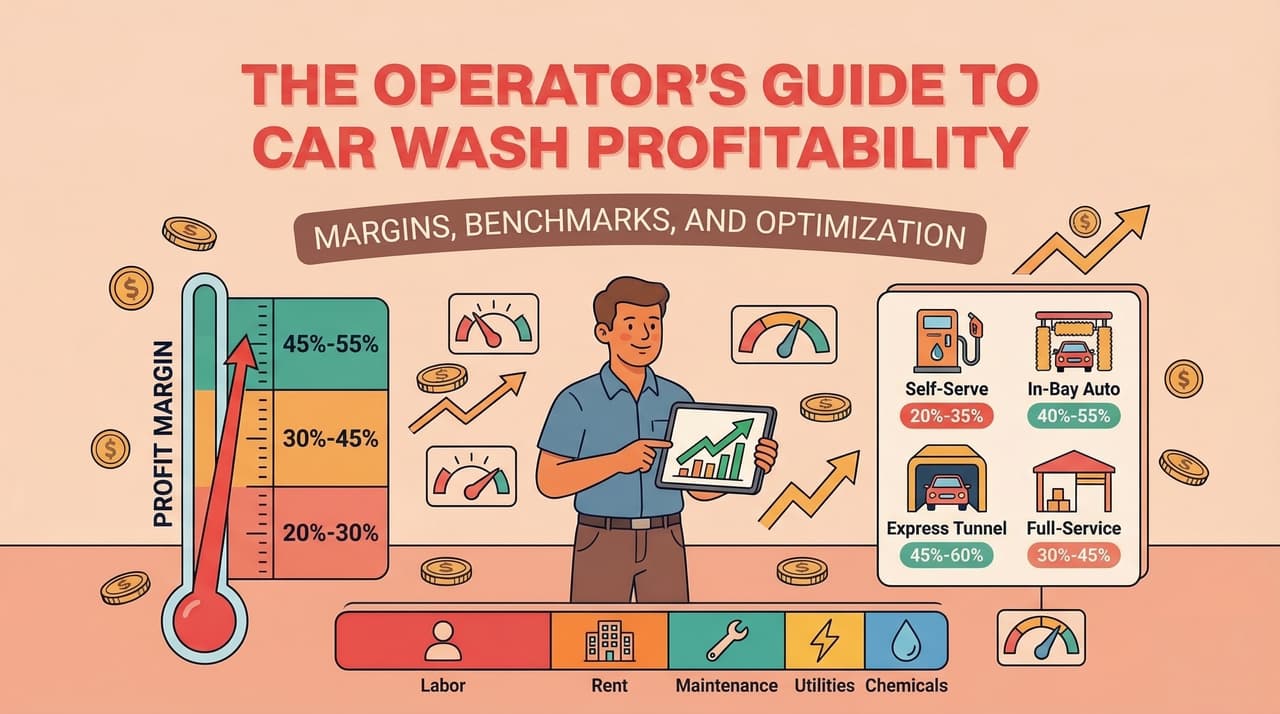
The Operator's Guide to Car Wash Profitability: Margins, Benchmarks, and Optimization
Car wash profit margins by format: 35–55% self-serve, 30–50% in-bay automatic, 25–40% express tunnel, 30–45% full-service with detailing, and what moves each.
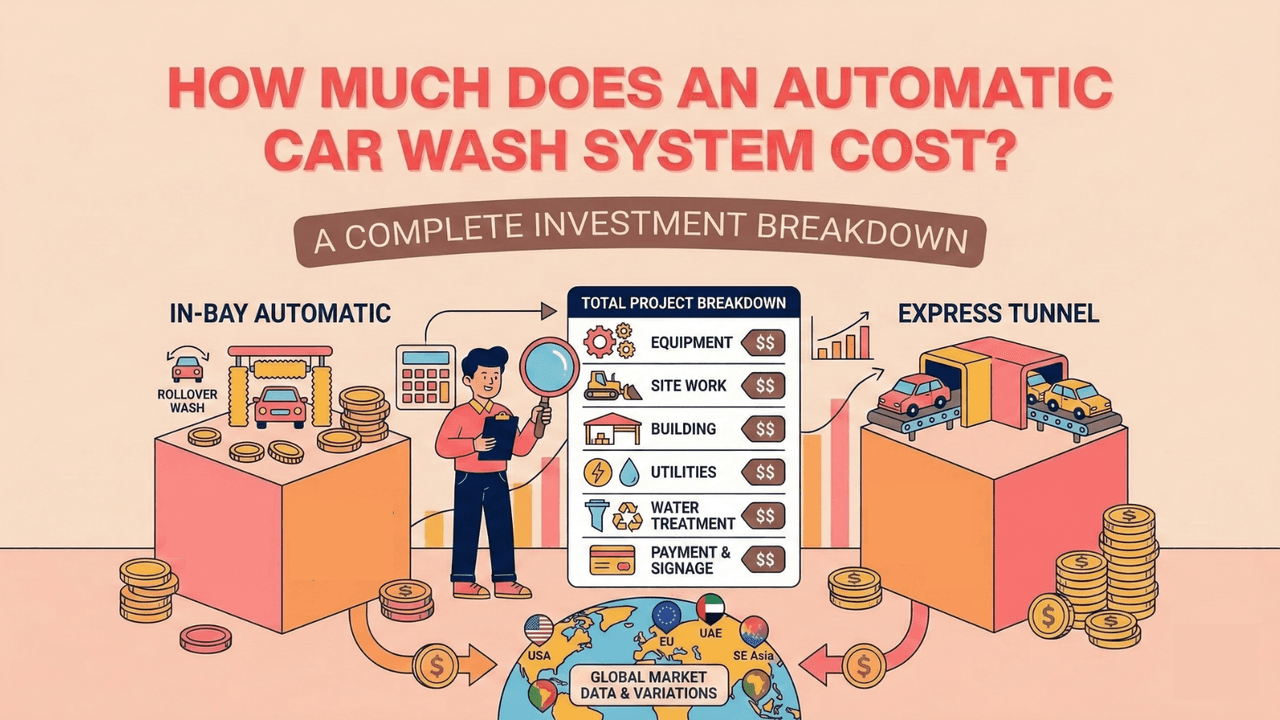
How Much Does an Automatic Car Wash System Cost? A Complete Investment Breakdown
Automatic car wash system costs range from $15,000 to $350,000+ for equipment alone. Here's what drives the price, what the total investment looks like, and how to compare quotes.
Car Wash Membership for Auto Service Shops: How Wash Packages Increase Retention and CSI
Learn how service shops use wash packages and memberships to boost repeat visits, improve delivery experience, and build predictable revenue—with the right equipment setup.