
Car Wash Membership for Auto Service Shops: How Wash Packages Increase Retention and CSI
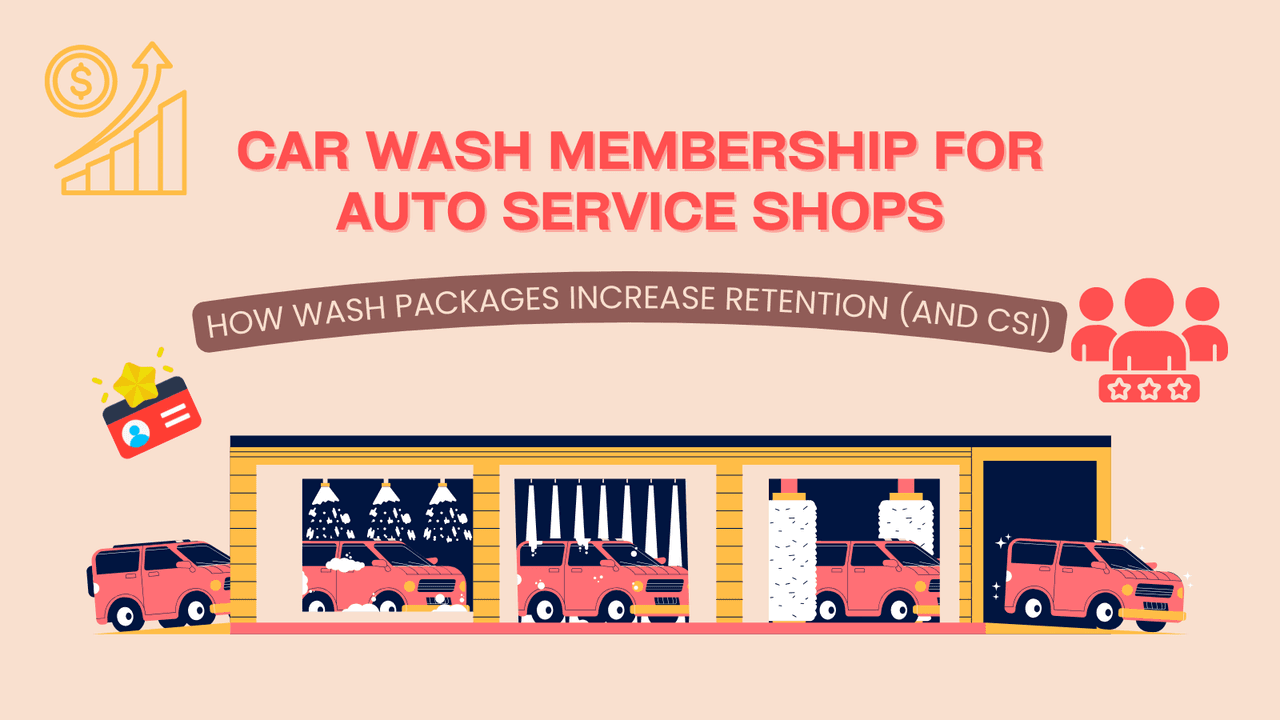
When customers pick up their vehicle, they don’t just evaluate the repair—they evaluate the experience. A clean, dry, delivery-ready car is one of the simplest ways to make that moment feel “premium,” and it’s why more service shops and dealer service departments are adding automatic wash programs.
This guide shows how to design a car wash membership for an auto service shop (or a dealer service wash program) that improves retention, protects paint, and runs with minimal labor. Along the way, you’ll see three proven program models, pricing logic, and the operational setup that keeps bays flowing.
Why this matters: Dealer service satisfaction is strong overall, but friction points like communication gaps and vehicles not fixed right the first time still limit performance—meaning every positive “extra” you can control (like delivery experience) becomes more valuable.
What a wash program actually does for retention
A wash program isn’t a gimmick—it’s a repeatable way to improve three retention drivers:
- Better pickup experience (the “final impression”)
A clean vehicle reduces complaints, feels more “complete,” and makes customers more likely to return. - More frequent touchpoints
Memberships and service-linked wash perks give customers a reason to come back for routine maintenance—and keep you top-of-mind. - Operational consistency
Automatic wash reduces variability vs. manual rinses. Consistency matters because customers notice when results change week to week.
For dealerships, this can show up directly in service CSI outcomes. Industry dealer-facing publications frequently point to complimentary wash programs as a practical lever for stronger CSI performance.
The 3 best wash program models for service shops
Pick one model to start. You can layer later.
Model A: “Courtesy Wash With Service” → best for simplicity
How it works: Every paid service visit includes a basic wash (or basic wash above a minimum ticket).
Why it works:
- Easy to explain at write-up and pickup
- Feels like a premium perk without discounting labor
- Great for first-time customers you want to convert into repeats
Operational note: Courtesy wash is only a retention lever if quality is consistent. If the wash is “sometimes,” it backfires.
Model B: Public Monthly Wash Membership → best for recurring revenue
How it works: Customers pay monthly for unlimited washes. Service customers get a special offer to join (or a discounted first month).
Why it works:
- Predictable recurring revenue
- Higher engagement: ICA’s Pulse research highlighted that even when subscribers cancel, 54% of former subscription members still wash at the same location, which creates clear reactivation opportunities.
How service shops win with this model:
Most small service shops don’t need to become a “full retail car wash.” You can run a membership that’s:
- local (within a few miles)
- limited to off-peak or certain hours (to protect service traffic)
- paired with service perks (below)
Model C: “Service Club” (wash + maintenance perks) → best for retention
How it works: A monthly plan bundles:
- a wash membership (or a set number of washes)
- plus service benefits (e.g., priority scheduling, multi-point inspection, discounts, free rotations)
Why it works:
- Customers perceive ongoing value beyond washes
- You pull forward routine visits (oil, tires, inspections)
- It becomes a “relationship plan,” not a coupon
This model is especially strong for dealer service departments already using prepaid plans—many retention programs explicitly include “free perks—car wash…” as part of the value stack.
Pricing logic that won’t trap you
Instead of copying a random market price, use a simple logic:
- Start with capacity:
How many vehicles/hour can your setup realistically wash (in your chosen package)? - Protect your service flow:
If you’re a service shop, your primary business is still service. Build membership rules around:
- off-peak windows
- appointment-style wash lanes
- member caps (yes, caps are okay early)
- Design 3 tiers max:
Example structure (edit names to your brand):
- Basic: exterior wash + dry
- Plus: basic + wheel focus + protectant
- Premium: plus + “show-finish” add-ons (foam, wax)
Touchless programs can boost perceived value because customers see the high-pressure action and foam effects.
A practical “Service Drive” playbook
Step 1: Pick your promise
Choose one clear promise and train everyone to say it the same way:
- “Every service visit includes a complimentary wash.”
- “Join our wash membership and keep your car clean between visits.”
- “Our Service Club includes washes + priority scheduling.”
Step 2: Build the customer journey
- At check-in: offer the perk or membership trial
- During service: queue wash automatically (no manual chasing)
- At pickup: make the wash part of the “delivery standard”
Step 3: Put KPIs on a simple dashboard
Track:
- wash attach rate (% of service RO that gets washed)
- repeat visit rate (60/90/180-day return)
- membership conversion rate (service customers → member)
- bay utilization and peak-hour bottlenecks
Equipment setup that keeps quality consistent (and labor low)
A wash program only works if it’s easy to operate and produces repeatable results.
If paint safety is the #1 priority: Touchless in-bay automatic
For dealers and premium vehicles, touchless is often the simplest “no-drama” solution:
- brush-free process for maximum paint/accessory protection
- staged detergents + high-pressure jets + drying
- compact footprint and minimal operator workload
Recommended Model: Touchless Car Wash MY-385
If you want 24/7, low-labor operation: Self-service rollover
For service shops that want membership revenue without staffing a bay, a self-service stack can be a strong fit:
- scan-to-start + centralized cloud management
- remote diagnostics/control for fewer service calls
- engineered for low-labor operation and ~15–20 cars/hour (package-dependent)
Recommended Model: Rollover XL-200NET
If you’re higher volume (or multi-lane): Conveyor tunnel
If you’re a high-throughput dealer group, reconditioning center, or a service campus, tunnel throughput can change the game:
- TX-380 is positioned for 50–60 vehicles/hour with configurable drying/controls and paint-protecting brush design
- Options like QR scan-to-start and reporting tools can support low-staff operations
Recommended Model: Tunnel TX-380 Series
Common operational issues (and how to avoid them)
“We don’t have enough space”
Start with in-bay. If you’re unsure, use minimum-dimension guidelines as a sanity check before engineering a final layout.
Learn More: Minimum site dimensions FAQ
“We’re worried about swirl marks or hard-water spots”
This is exactly why dealer/service wash playbooks emphasize:
- paint-safe wash choices (touchless or controlled brush/chemistry)
- spot-free rinse and tuned drying
Learn More: Industry Solution for Dealers & Service Centers
“Staffing is tight”
Prioritize automation:
- unattended/self-service start (scan-to-start)
- remote monitoring and diagnostics
These are explicitly addressed as part of low-labor operation in HyTian’s rollover self-service model.
FAQ
Does a wash program really improve CSI for dealerships?
Many dealer-focused sources point to a complimentary wash as a tangible way to improve service experience and CSI perception—because it’s a visible “extra” customers remember at pickup.
What’s the best membership model for an auto repair shop?
Most independent service shops do best with:
- Courtesy wash with service (fastest to launch), then
- Add a basic membership with off-peak rules once bay operations stabilize.
Touchless vs soft-touch—what should service shops pick?
If paint safety and accessories are the main concern, touchless in-bay is a straightforward option designed for minimal contact and simple operation.
If speed and throughput dominate, tunnel systems may fit better.
How do we keep memberships from overwhelming the bay?
Use guardrails:
- member caps early
- off-peak windows
- package standardization (fewer options = faster cycles)
What should we ask a manufacturer before buying?
Ask for:
- site layout support
- training and commissioning plan
- remote support and diagnostics options
- parts availability and service model
HyTian’s solution workflow emphasizes a structured consult → engineer → install → train process.
Ready to build your wash membership program?
If you’re planning a wash membership for your service shop or a dealership service wash program, we can help you scope the right model and equipment:
- Step 1: Share your site constraints, target volume, and staffing plan
- Step 2: Get a recommended model + layout concept
- Step 3: Launch with a repeatable operating playbook
Explore solution fit: Dealers & Service Centers
Review models:XL-200NET, MY-385, TX-380
Talk to a specialist: Contact
Read Our Case Studies
Related articles
Explore more insights from the HyTian team.
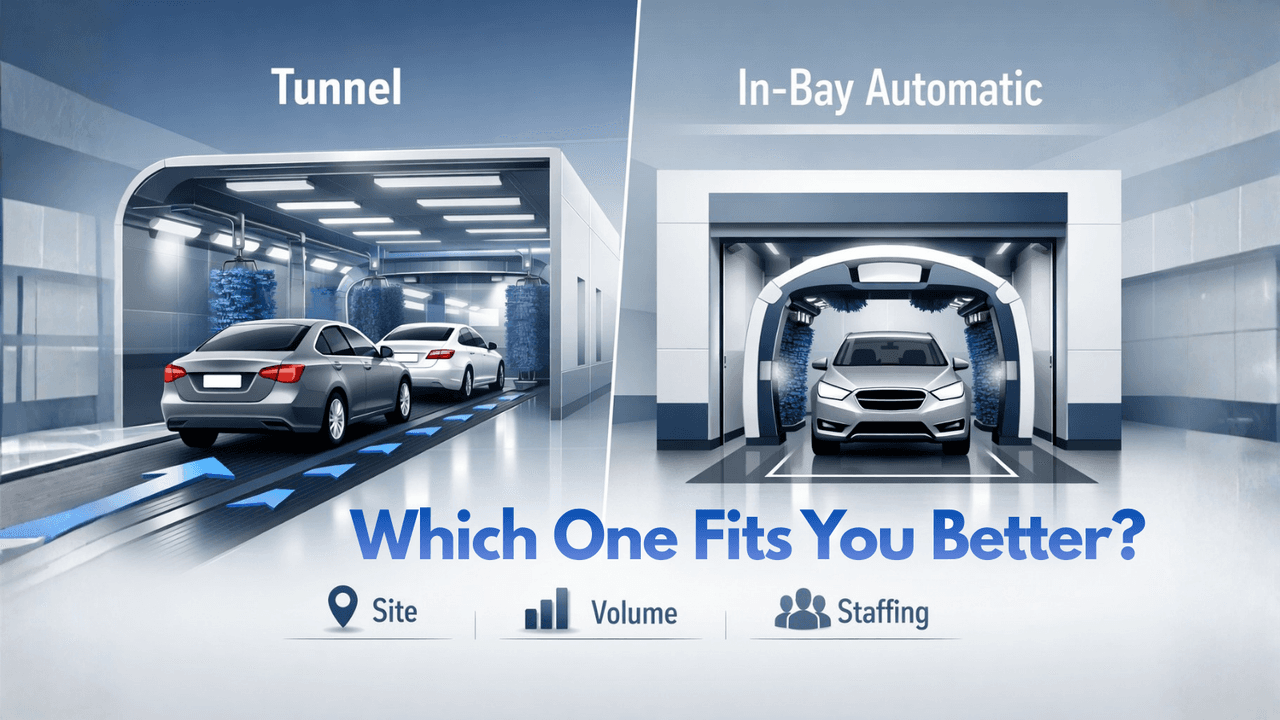
Tunnel vs In-Bay Automatic: Which One Fits Your Site, Volume, and Staffing?
Compare tunnel vs in-bay automatic car washes by footprint, peak-hour volume, staffing, and customer flow. Use this checklist to choose the right format and plan your site.