
Bolivia Tram Operator Deploys Custom Tram Wash System for Streamlined Light Rail Vehicles
A Bolivia tram operator needed a wash system for 34-meter streamlined light rail vehicles with protruding mirrors that no off-the-shelf equipment could handle. HyTian engineered a custom dual-mode system combining stationary-vehicle and tunnel-style operation, with 8 brush groups and integrated water recycling.
Problem
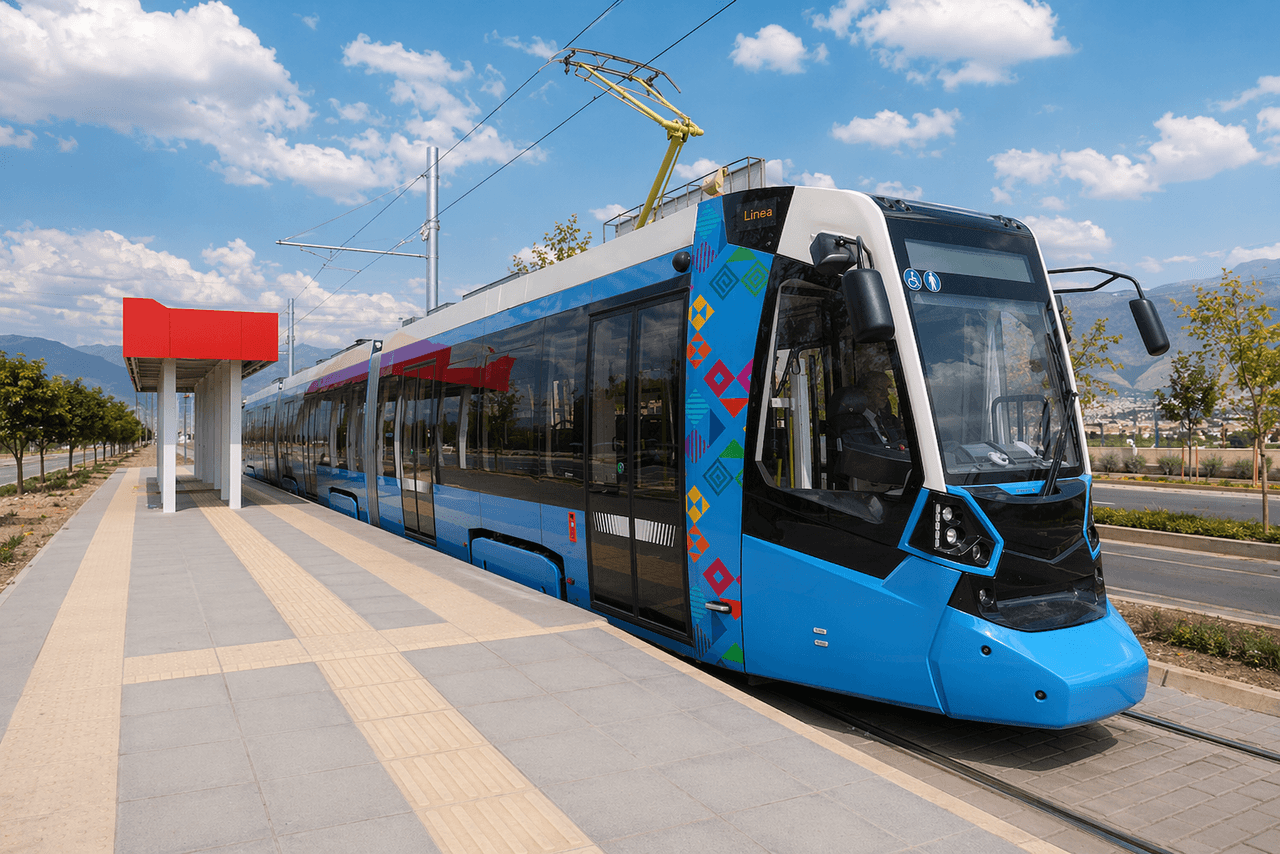
- Wash 34-meter streamlined light rail vehicles with identical aerodynamic front and rear profiles
- Clean compound-curvature nose sections and windshield zones obstructed by mirror mounts
- Navigate protruding rearview mirrors that create collision risk for standard wash equipment
- Replace labor-intensive manual washing with a repeatable cycle fit for daily fleet turnaround
Approach
- Engineer a dual-mode wash architecture — stationary-vehicle mode for the streamlined front and rear, tunnel-style pass-through for the long body section
- Deploy 8 coordinated brush groups — tilting front/rear brushes conform to the aerodynamic nose geometry; large side brushes cover flat body panels at throughput speed
- Install 60-bar rotating high-pressure nozzles on brush arms, positioned specifically to reach windshield zones obstructed by the rearview mirror protrusions
- Integrate water treatment and recycling so wastewater routes back into the pre-rinse and brush stages, cutting fresh-water demand for daily wash cycles
- Manufacture in Nanjing, deploy to Cochabamba — seamless delivery for international transit infrastructure procurement
Outcomes
Full wash coverage achieved — complete cleaning of the entire vehicle including compound-curvature ends and mirror-obstructed windshield zones, with no manual touch-up required
Cycle time reduced — tunnel-mode pass-through on the long body section eliminates the need for the wash machine to traverse the full vehicle length per cycle
Drive-system wear minimized — limiting machine travel to front and rear sections extends component life and reduces long-term maintenance intervals
Water consumption cut — integrated recycling routes treated wastewater back into pre-rinse and brush stages, lowering fresh-water demand for a daily-wash fleet
Operator adoption confirmed — Tren Metropolitano de Cochabamba (Mi Tren) reported high satisfaction with cleaning quality and operational efficiency after 2023 deployment
The Situation
The Bolivia tram operator runs a fleet of modern streamlined light rail vehicles through daily service across the city's transit network. Each tram measures 34 meters — significantly longer than a standard bus — with identical aerodynamic front and rear ends designed for bidirectional operation. The streamlined profiles resemble high-speed rail geometry. Smoothly curved nose sections taper from the roofline down to the coupler level.
Adding to the complexity, protruding rearview mirrors extend beyond the main body envelope on both sides. These mirrors sit at a height and angle that creates collision risk for any wash equipment following a standard clearance profile. The operator needed a commercial vehicle washing solution that could clean every surface — including windshield areas obstructed by mirror mounts — without damaging the mirrors or leaving unwashed zones.
Manual washing was not a viable long-term option. The fleet's service schedule demanded consistent turnaround times, and hand-washing a 34-meter tram to the required standard consumed excessive labor hours and water.
The Challenge: Why Standard Rail Vehicle Wash Equipment Falls Short
Standard rail vehicle wash equipment operates in one of two modes: the vehicle moves through a stationary wash gantry (tunnel-style), or a mobile gantry moves along a stationary vehicle. Neither mode alone could solve this operator's problem.
Tunnel-style pass-through works well for the long, uniformly shaped body section. But the streamlined front and rear ends present a different problem. Their compound curvature and protruding mirrors require the wash equipment to navigate around the vehicle, adjusting brush angles and pressure continuously. A mobile gantry can do this — but running it along the entire 34-meter length wastes time and accelerates mechanical wear on the drive systems. The operator needed a custom car wash machine design that combined both approaches: precision for the complex zones and speed for the regular body.
The Solution: Engineering a Dual-Mode Custom Tram Wash System
HyTian designed a combination wash-and-dry system with two distinct operating modes, each optimized for a different section of the vehicle.
Mode 1 — Stationary vehicle, moving machine. For the streamlined front and rear sections, the tram remains stationary while the wash system moves around it. The brush groups follow the compound curvature of the aerodynamic nose, opening and closing to conform to the changing profile. The machine controls approach angle and contact pressure at every point. This ensures full coverage of surfaces that a fixed-position system would miss — including windshield zones obstructed by mirror protrusions.
Mode 2 — Tunnel-style pass-through. For the long, regular-shaped body section, the roles reverse: the wash machine stays stationary and the tram moves through at controlled speed. This eliminates the need for the machine to traverse the full length, saving cycle time and reducing wear on the machine's drive components.

The system near completion at the Nanjing factory..
The system deploys 8 brush groups in a coordinated sequence:
- Tilting front/rear brushes that open and close to conform to the streamlined head shape, reaching surfaces that fixed brushes cannot contact
- Rotating high-pressure water nozzles (60 bar) mounted on the brush arms, specifically positioned to clean windshield areas obstructed by the rearview mirror protrusions
- Large side brushes for efficient coverage of the flat body panels during tunnel-mode pass-through
- Tilting short brushes for the upper arc transition zone where the roof curves down to meet the side panels
- Top-mounted rotating high-pressure rinse for the roof section

HyTian custom tram wash system during its factory acceptance water-spray test with full-coverage jets before shipment to Bolivia.
Beyond the brush system, the unit includes a clean water rinse stage, wax spray application, and pass-through air drying. An integrated water treatment system recycles wastewater, routing treated water back into the pre-rinse and brush washing stages. For a fleet running daily wash cycles, this reduces fresh water consumption significantly.
Implementation: From Design to Deployment Across Continents
HyTian designed and manufactured the system at its Nanjing headquarters — a facility with annual manufacturing capacity of 3,000+ wash units that has supplied equipment to operators in 40+ countries. The Bolivia project drew on decades of experience engineering bespoke solutions for non-standard vehicle profiles. That capability spans transit and commercial vehicle wash deployments — including the Zhuhai bus fleet deployment where TH-Series systems process up to 80 buses per hour.

Early assembly of the steel gantry at HyTian's Nanjing factory.
The completed system was exported to Bolivia in 2023. International logistics for oversized custom wash equipment required coordination across manufacturing, shipping, and on-site installation teams. HyTian's track record deploying systems across Latin America, Asia, Europe, and Africa informed that process. CE, ISO 9001, and ISO 14001 certifications ensured the equipment met international compliance standards for public transit infrastructure procurement.

On-site installation at the Bolivia depot.
Results: Precision Coverage, Operational Efficiency, and Water Conservation
The dual-mode approach delivered measurable outcomes across every dimension the operator prioritized.
Full geometry coverage. Stationary-vehicle mode handles the streamlined ends. Tunnel-style mode handles the body section. Together, they achieve complete wash coverage of the entire 34-meter vehicle — including the complex aerodynamic profiles and windshield zones obstructed by mirror protrusions. No manual touch-up washing required.

Factory test of Bolivia's custom tram wash system.
Optimized cycle time. By using tunnel-mode pass-through for the long body section, the system eliminated the need for the wash machine to travel the full vehicle length. The dual-mode approach reduced total wash cycle time compared to a single-mode mobile gantry running end to end.
Reduced equipment wear. Limiting machine travel to the front and rear sections — rather than the full length — reduced mechanical stress on the drive systems. Less travel distance per wash cycle means fewer maintenance intervals and lower long-term operating costs.
Significant water savings. The integrated water treatment and recycling system routes treated wastewater back into the pre-rinse and brush washing stages. For a transit fleet running daily wash cycles, this reduces fresh water consumption substantially. Lower utility costs and a smaller environmental footprint follow directly.
Operator recognition. The Bolivia tram operator confirmed high satisfaction with the system's performance, noting that it delivered the cleaning quality and operational efficiency the fleet required.

A Bolivia light rail tram exits the wash system at the depot.
Technical Specifications Deployed
Specification | Detail |
|---|---|
Operating modes | Dual: stationary vehicle (front/rear) + tunnel pass-through (body) |
Brush configuration | 8 groups: tilting front/rear, large side, tilting short upper arc, top rinse |
High-pressure nozzles | 60 bar rotating nozzles on brush arms |
Drying | Pass-through air drying |
Water treatment | Integrated recycling system (wastewater reused for pre-rinse and brush stages) |
Additional features | Clean water rinse, wax spray |
Vehicle accommodation | 34 m streamlined trams with protruding rearview mirrors |
Export year | 2023 |
Every Transit Fleet Has Unique Requirements
The Bolivia deployment demonstrates what becomes possible when wash equipment is engineered around the vehicle — not the other way around. Whether your fleet runs trams, buses, or specialized rail vehicles, the geometry, site constraints, and throughput targets are always specific to your operation.
Every transit operation has its own vehicle profiles and site constraints. Discuss your project with our engineering team — let's explore how we can design a wash solution tailored to yours.