
Sustainable Car Wash Operations: Water, Energy, and Compliance for Procurement Teams
Sustainable Car Wash Operations: Water, Energy, and Compliance for Procurement Teams
Sustainability in car wash operations used to be a sentence in the corporate sustainability report. It is now a line item in the RFP. Procurement teams in regulated markets — public transit authorities, fuel retailers, dealership groups, multi-site operators — are increasingly required to capture vendor environmental performance during equipment selection, not after the fact. ESG language has moved out of the appendix and into the technical scoring matrix.
For car wash equipment specifically, the sustainability conversation reduces to three resource categories: water (consumption and discharge), energy (motors, heating, drying), and chemicals (dosing precision and biodegradability). Each category has a vendor-side answer that procurement can verify, and each has a regional regulatory dimension that varies meaningfully across the European Union, California, the GCC water-scarce region, and Japan.
This article evaluates sustainable car wash operations the way a procurement reader needs to: as a vendor-evaluation framework backed by certifications, deployment proof, and chemical, water, and energy specifics. It is written from a manufacturer's perspective — HyTian has deployed 20,000+ systems across 40+ countries, including water-recycling fleet wash systems and integrated-treatment custom builds — but the framework applies regardless of vendor.
Why Sustainable Car Wash Operations Are Now an Equipment Specification
A green car wash program used to be a marketing layer added on top of a standard equipment package. That arrangement no longer survives modern procurement review. ESG, water-discharge, and energy-code requirements increasingly route through the equipment RFP itself — meaning the technical specification document, not the corporate sustainability statement, is where vendor environmental performance gets recorded.
Three forces have moved the conversation. Tighter regional water-discharge rules in the EU, California, the GCC, and Japan are pushing equipment specs into compliance territory. ESG reporting frameworks now ask procurement teams to evidence vendor environmental credentials at the project level. And rising utility costs quietly turn water-reclamation payback periods from "long-term thinking" into operating-cost decisions. Where the industry is heading provides additional context on the regulatory direction.
ISO 14001 has already become a baseline filter for cross-border car wash equipment RFPs. Vendors without it increasingly fail vendor-prequalification screens before the technical evaluation even begins. The certification does not by itself answer the wash-level questions that follow — but it is the gate at which procurement teams now stop the evaluation when it is missing.
Water: Where the Real Reclamation Happens
Water is the largest sustainability lever in any car wash, by a wide margin. Widely cited industry estimates put fresh-water consumption at roughly 30–90 gallons (approximately 113–340 liters) per wash for traditional automatic systems without reclamation, with the range driven by system type, wash menu, and rinse strategy. Until reclamation enters the picture, every other sustainability lever is rounding error compared with the water bill.
Modern reclamation reduces fresh-water demand by directing treated wastewater to the wash stages where reclaim quality is acceptable — pre-rinse, undercarriage, and brush washing — while reserving potable or treated freshwater for the final spot-free rinse. The exact reclamation share depends on system design, water-quality requirements, and the local discharge regime. The principle is not novel; the engineering question is whether the vendor builds it as a configuration, retrofits it as an add-on, or treats it as a special order.
Real Deployment Context
In Zhuhai, the Public Transport Group operates a fleet wash program built around HyTian's TH-Series drive-through bus washers, processing up to 80 buses per hour at depot peak with the recycling subsystem reducing fresh-water consumption. The reclamation is engineered into the system, not specified separately — a useful indicator for procurement teams evaluating whether sustainability is a default or an exception. The full Zhuhai bus fleet deployment documents how bus and truck wash systems integrate water recycling at fleet scale.
A more recent deployment shows the same engineering posture applied to a non-standard vehicle. HyTian's custom tram wash for a Bolivian light-rail operator features an integrated water treatment subsystem that recycles wastewater for pre-rinse and brush-washing stages — proof of industrial-scale reclamation engineered into a bespoke system, not bolted on after the fact. When procurement asks whether reclamation is reserved for catalog products, the Bolivia deployment is a useful counterpoint.
For tunnel deployments, the TX-380 tunnel system supports water recycling as a configuration option. It is the configuration of choice for clients in space- and water-constrained markets — the Japan deployment case study details one such site.
Two honest framings procurement should hear: water-reclamation systems pay back through utility savings over time, but the strongest case for them is increasingly regulatory. Many jurisdictions now require closed-loop or regulated-discharge systems regardless of operator preference. And the published reclamation ratio for any specific deployment depends on the wash menu, water-quality requirements, and local regulations — vendors that publish a single headline percentage are usually generalizing.
Energy: Where Car Wash Energy Efficiency Actually Lives
Energy load on a car wash splits across three subsystems: drive motors (conveyor, brush, blower), water heating (winter operations, in cold climates), and high-pressure pumping. Drive motors typically account for the largest single share, with dryer arrays a close second.
The most effective car wash energy efficiency lever at the equipment specification stage is variable frequency drive control on the motors that do not need to run at constant full-rated draw. VFD speed control on the conveyor and brush motors lets the system match draw to actual load — slower entry, full speed mid-tunnel, recovery on exit. On the TX-380, VFD speed control on the conveyor is a baseline feature, not an upgrade.
Motor sizing is the most-overlooked lever. Oversized motors run inefficiently at part load and the inefficiency compounds across thousands of cycles. Properly specified motors — right-sized to the throughput target rather than padded for safety — cut idle draw substantially and reduce nameplate capacity at the panel.
Dryer arrays are the second-largest energy consumer after motors. The TX-380 offers configurable dryer packages — profiling, fixed, or silenced — letting operators match dryer power to the actual vehicle profile and wash menu. A site that runs primarily sedans does not need the same dryer footprint as a site that runs trucks and light commercials. Spec'ing the dryer to the menu avoids buying energy that does not improve the wash.
For cold-climate sites, water heating becomes a meaningful third load. Heat-recovery loops and on-demand heating reduce the baseline draw that constant-temperature reservoir heating imposes. The trade-off is straightforward: heated water improves chemistry performance and freeze protection; unheated water saves energy but limits the wash menu.
Chemicals: Precision Dosing as a Sustainability Lever
Chemical waste is the third resource lever and the one most vendors underweight. Imprecise dosing pumps over-dose at low flow and under-dose at high flow — wasting product at one end of the curve and under-cleaning at the other. The wasted product does not disappear; it shows up in the effluent stream as a richer surfactant load that is harder to treat at the discharge stage.
HyTian uses CNC metering pumps with 0.28 mL dosing precision on the TX-380 platform, which extends a single 20 kg chemical drum to approximately 3,000 washes. That is a measurable reduction in chemical consumption per wash, fewer drum changeovers, less packaging waste, and a cleaner effluent stream feeding into whatever discharge or reclamation system follows.
Precision dosing has a second-order regulatory benefit. Less surfactant in the effluent means easier compliance with municipal discharge limits — the metric that increasingly governs whether a wash site can operate at all in regulated markets. Procurement teams evaluating equipment for jurisdictions with strict discharge regimes should treat dosing precision as a compliance specification, not an operating-cost detail.
Chemical sustainability is a shared responsibility between the equipment vendor and the chemical supplier. Pair precision dosing with biodegradable, low-VOC chemistry to meet regional environmental standards. The equipment manufacturer cannot dictate the chemistry, but the dosing system either supports or undermines what the chemical supplier delivers.
Compliance: ISO 14001 Car Wash Equipment and What It Actually Covers
ISO 14001 is the international standard for environmental management systems. For a car wash equipment manufacturer, the certification covers how the company manages environmental impact across design, sourcing, manufacturing, and disposal — not the wash itself. It is a vendor-level certification, not a product-level one.
What ISO 14001 means for a procurement reader: the vendor operates a structured, third-party-audited environmental management system, with documented procedures for resource use, waste handling, and continual improvement. It does not guarantee any specific wash-level outcome. It does indicate that environmental performance is managed deliberately rather than incidentally — which is the verifiable signal procurement is looking for at the vendor-prequalification stage.
HyTian holds ISO 14001 alongside ISO 9001 (quality management) and CE conformity (machinery safety and EU compliance). The three are the certifications most often demanded by international procurement teams, and the combination signals a vendor built for cross-border deployment rather than single-market operation. Our manufacturing capabilities page documents the certification scope.
Beyond ISO 14001, car wash environmental compliance has regional dimensions that procurement should ask about explicitly:
Water-discharge classification in EU REACH-regulated markets, California, GCC water-scarce regions, and Japan — closed-loop requirements vary
Chemical-handling regulations governing transport, storage, and disposal of the wash chemistry
Noise regulations affecting site-selection options near residential or mixed-use zones
Local energy codes that influence motor specification, particularly for high-efficiency motor mandates
ISO 14001 is the global baseline. Regional certifications and regulatory work fill in the rest. A vendor that cannot speak to regional compliance variation is a vendor that has not deployed at scale across regions.
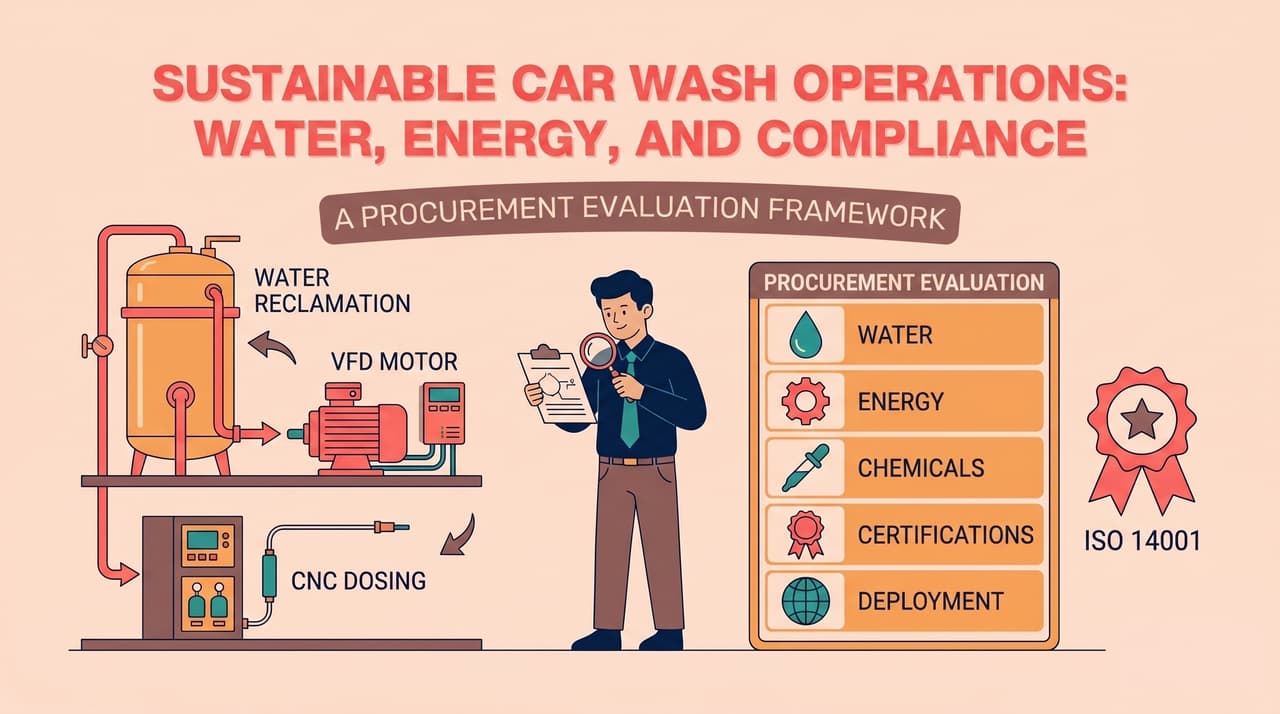
Building a Sustainable Car Wash Program: A Procurement Evaluation Framework
When sustainability lands inside the RFP scope, the question shifts from "is this vendor green" to "can this vendor produce evidence that survives internal review." The framework below extends the broader manufacturer evaluation checklist into the sustainability axes specifically. Five questions cover most cases:
Water. Does the system support reclamation as a configuration, not a retrofit? What stages does reclaimed water serve? Has the vendor deployed reclamation in markets with strict discharge regulations? Reference projects in regulated jurisdictions are the primary evidence.
Energy. Is VFD speed control on the conveyor and brush motors a baseline feature or an upgrade? Are motors right-sized to the throughput target rather than padded? Is the dryer package configurable to match the wash menu and vehicle profile?
Chemicals. What is the dosing precision specification (in mL or equivalent)? What is the chemical drum lifetime per wash count at typical menu mix? Does the vendor support biodegradable, low-VOC chemistry or specify a chemical partner?
Certifications. Does the vendor hold ISO 14001 (environmental management)? ISO 9001 (quality)? CE conformity for EU markets? What additional regional certifications apply to your specific jurisdiction?
Deployment evidence. Has the vendor actually built reclamation-equipped systems for international clients? Reference projects in jurisdictions with sustainability requirements are the evidence layer that closes out the sustainability section of the RFP.
The Zhuhai TH-Series fleet wash answers question 1 (reclamation deployed at fleet scale) and question 5 (real reference project). The Bolivia tram system answers question 1 in a custom-engineered context — useful evidence when the RFP involves non-standard vehicle profiles or unusual site constraints. Together, they convert an abstract sustainability claim into project-level proof an evaluator can cite.
Talk to the Engineering Team About Your Specific Configuration
Building a sustainability story into your next car wash equipment RFP? Our engineering team can walk through your site's water, energy, and compliance requirements, document the reclamation and dosing options that fit your menu and footprint, and provide the certification evidence your procurement review needs. Talk to our engineering team about your specific configuration.