
How to Add a Car Wash to Your Gas Station: Equipment, Layout, and ROI Guide
Fuel margins keep shrinking. According to NACS industry data, retail fuel margins in the US average just 5 to 10 cents per gallon — and that number has been compressing for years. If you operate a gas station or convenience store, you already know the math: fuel alone does not build a profitable business. That is why more station operators are evaluating the best car wash system for gas station sites as their highest-impact revenue addition. Industry reports suggest that convenience stores with car washes can generate significantly higher fuel volumes than those without, creating a halo effect that lifts the entire operation. This guide walks you through how to add a car wash to a gas station — from equipment selection and site layout to realistic cost ranges and ROI benchmarks — so you can make this decision with engineering-level clarity.
Why gas stations are adding car washes
The economics of fuel retail have shifted. With per-gallon margins under pressure, station operators need ancillary revenue streams that justify the real estate and traffic their sites already generate. Car wash is consistently ranked as one of the highest-margin profit centers for convenience and fuel retail sites, ahead of food service and ATMs, according to NACS State of the Industry reports.
Express exterior washes fit the gas station model particularly well. Transactions are fast — typically under five minutes — which means high throughput without bottlenecks at your fuel islands. Staffing requirements are minimal compared to full-service wash operations. And the traffic source is already there: your fuel volume delivers a built-in stream of potential wash clients who do not need to be acquired through separate marketing.
The broader car wash industry reinforces this opportunity. International Carwash Association data indicates the industry is growing at 3 to 5 percent annually, with express exterior formats and unlimited membership programs driving much of that expansion. For a gas station operator, the question is not whether a car wash adds value — it is which system fits your site and your revenue target.
Revenue benchmarks vary by system type. A single-bay in-bay automatic (IBA) can generate $200,000 to $400,000 in annual revenue, while a compact tunnel system can push $500,000 to $1,000,000 or more depending on volume and pricing. We will break these numbers down in the ROI section below.
Which car wash system fits your gas station site
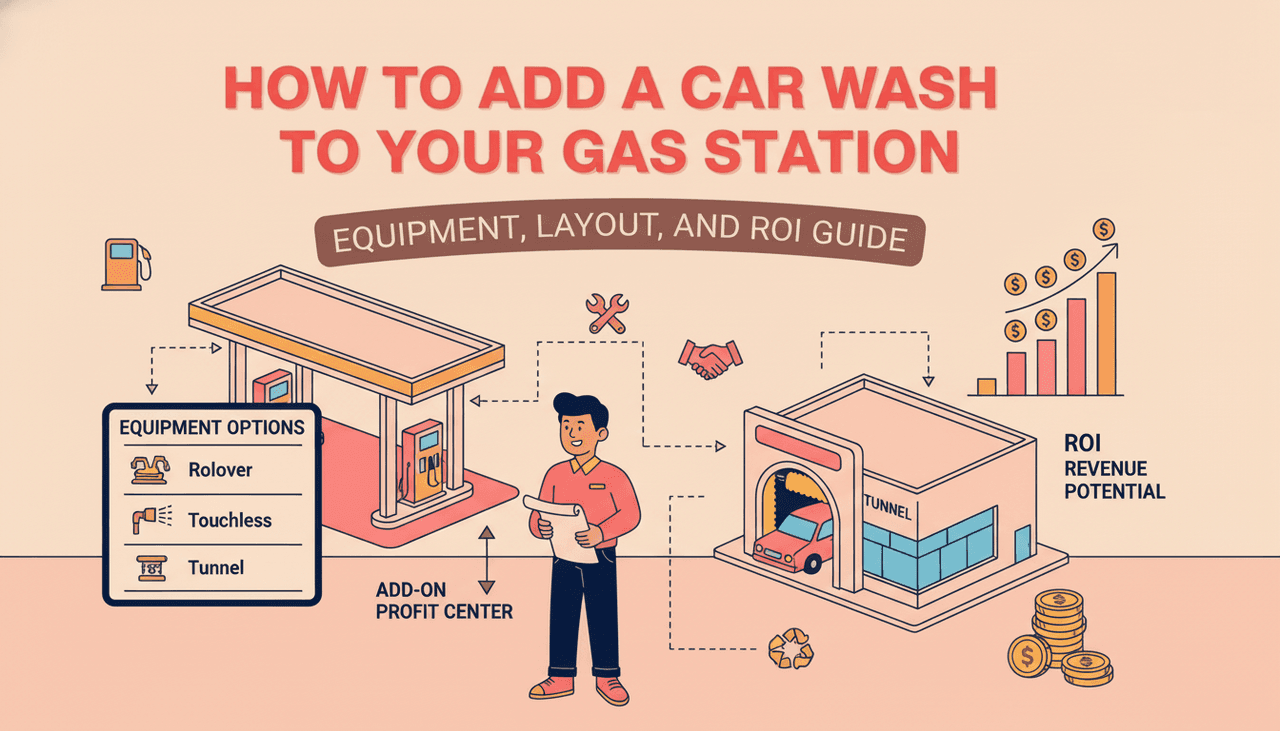
Choosing the best car wash system for gas station operations comes down to three viable equipment types. Each has a distinct footprint, throughput profile, and revenue ceiling. The right choice depends on your daily traffic count, available space, and how aggressively you want to grow the wash program.
Rollover (in-bay automatic) systems
Rollover systems — also called gantry or in-bay automatic systems — are the smallest-footprint option. The machine moves over the stationary vehicle inside a single wash bay, making this format ideal for operators converting an existing service bay or building a compact new structure.
Throughput runs 15 to 25 vehicles per hour, which supports moderate-traffic stations processing up to roughly 100 washes per day. Equipment cost ranges from $20,000 to $70,000 depending on configuration and features. If you are entering the car wash business for the first time, a rollover car wash for gas station sites offers the lowest capital entry point with the simplest operations. HyTian's rollover wash systems are engineered specifically for gas station and space-constrained applications.
Touchless systems
Touchless systems share the same single-bay footprint as rollover units but use only high-pressure water and chemical application — no physical brush contact with the vehicle. This appeals to operators in markets where paint-safety perception drives purchasing decisions, especially around premium vehicles.
Equipment cost ranges from $15,000 to $55,000, making touchless the most affordable entry point. The trade-off is wash quality: without brush contact, the system relies entirely on chemical and pressure to remove road film, which may not satisfy operators or their clients who expect the deepest clean. A touchless car wash for gas station sites works best in premium-vehicle markets or locations where "touchless" itself is a marketing differentiator.
Compact tunnel systems
Compact tunnel systems deliver a fundamentally different throughput profile. Instead of washing one stationary vehicle at a time, a conveyor moves vehicles through a sequence of wash stages continuously. The result is dramatically higher volume: the TX-380 tunnel system, for example, processes 50 to 60 vehicles per hour with configurable tunnel length that adapts to available space.
Tunnel installations require more real estate — 80 to 120 feet of length minimum, plus entry queue and exit lanes. But the revenue ceiling is proportionally higher. Gas station car wash equipment in the tunnel category ranges from $50,000 to $200,000 or more depending on configuration, conveyor type, and feature set. Compact tunnels are the right fit for high-traffic stations targeting 200 or more washes per day, sites near highways or major intersections, and operators who want to maximize revenue per square foot. For a deeper comparison of system types, see our tunnel vs in-bay comparison.
System comparison at a glance
Rollover (IBA) | Touchless | Compact Tunnel | |
|---|---|---|---|
Footprint | Single bay (~30-40 ft x 20-25 ft) | Single bay (~30-40 ft x 20-25 ft) | 80-120+ ft length + queuing |
Throughput | 15-25 vehicles/hr | 15-25 vehicles/hr | 50-60 vehicles/hr |
Equipment cost | $20K-$70K | $15K-$55K | $50K-$200K+ |
Best for | Moderate-traffic, first-time operators | Premium-vehicle markets | High-traffic, revenue-maximizing sites |
Not sure which system fits your site? Our engineering team can assess your space and traffic volume to recommend the right configuration. Explore gas station car wash solutions.
Planning your gas station car wash layout
Site layout can make or break a gas station car wash — and it is often where operators underestimate the complexity. The wash equipment itself is only part of the footprint. You need to plan for the approach lane, the exit path, signage visibility, and the relationship between wash traffic and fuel island traffic.
Minimum footprint by system type:
- Rollover or touchless: Approximately 30 to 40 feet by 20 to 25 feet for the wash bay, plus approach and exit lanes. This is roughly the size of one existing service bay, which is why retrofits are common.
- Compact tunnel: 80 to 120 feet of length minimum, plus an entry queue (plan for peak-hour queue depth, not average-hour) and an exit path that returns vehicles to the street or fuel lot without creating congestion.
Gas station-specific layout considerations:
- Fuel island relationship: Wash entry and exit lanes should not conflict with fuel traffic flow. Operators who route wash traffic through the fuel area create bottlenecks at both the pumps and the wash.
- Queue design: Size your queue for peak hours, not averages. A wash running 50 vehicles per hour needs stacking space for the surges that come with weather breaks and weekend mornings.
- Signage: Visibility from the road and from the fuel island are both critical. Drivers at the pump are your primary conversion audience — they need to see the wash offer without searching for it.
Infrastructure requirements:
Water supply capacity, drainage, and electrical service are the three infrastructure items that catch operators off guard. Most commercial wash equipment requires three-phase power. Water supply must sustain continuous operation at the gallons-per-minute rate your system demands. And water reclamation is increasingly required by local building codes — a requirement that modular tunnel designs with integrated water recycling systems address from the factory rather than as a costly aftermarket addition.
How much does it cost to add a car wash to a gas station?
The total cost to add a car wash to a gas station ranges from $150,000 to $350,000 for a single-bay rollover installation to $500,000 to $1,500,000 or more for a compact tunnel — including equipment, site preparation, construction, utility hookups, and signage.
Equipment is the most visible line item but typically represents only 30 to 50 percent of the total project cost. The rest includes:
- Site preparation: Grading, concrete pad or building foundation, drainage infrastructure
- Construction: Wash bay building or tunnel enclosure, depending on whether you are retrofitting an existing bay or building new
- Utility hookups: Water lines, sewer/drain connections, three-phase electrical service
- Signage and pay stations: Menu boards, pay terminals, lighting
- Permitting and engineering: Local building permits, site plan review, environmental compliance documentation
Retrofitting an existing service bay for a rollover or touchless system typically costs less than new construction — but comes with structural constraints that may limit equipment options or future upgrades.
For a detailed breakdown of equipment pricing across all system types, see our car wash system cost breakdown.
Revenue and ROI: what a gas station car wash can earn
A single-bay in-bay automatic car wash at a gas station can generate $200,000 to $400,000 in annual revenue. A compact tunnel system can generate $500,000 to $1,000,000 or more, depending on traffic volume, wash pricing, and membership program adoption. These are industry benchmark ranges — your actual numbers depend on location, local competition, and how effectively you convert fuel traffic to wash traffic.
Pricing benchmarks: Express exterior washes at gas stations typically price between $8 and $15 per wash. Unlimited membership programs — which are increasingly common and increasingly driving predictable monthly recurring revenue — range from $20 to $40 per month. Membership programs improve gas station car wash revenue by locking in repeat visits and reducing weather-dependent volume swings.
The built-in traffic advantage: Unlike standalone wash operations that must build traffic from scratch through marketing and signage, gas station operators start with a captive audience. Every fuel transaction is a wash conversion opportunity. This built-in traffic reduces the effective cost of acquiring each wash client to near zero — a structural advantage that standalone washes cannot replicate.
Operating cost efficiency: Chemical consumption is one of the largest recurring expenses in any wash operation. Precision dosing technology makes a measurable difference here. CNC metering pumps with 0.28 mL precision, for example, extend chemical drum life to approximately 3,000 washes per 20 kg drum — reducing cost-per-wash and improving margin on every transaction.
Payback periods: Industry data suggests typical payback of 2 to 4 years for a rollover installation and 3 to 5 years for a tunnel, depending on volume and local market conditions. Membership programs can accelerate payback by smoothing revenue across seasons and increasing per-client annual spend.
Choosing the right equipment partner for your fuel site
The equipment you select matters — but so does the manufacturer behind it. Gas station car wash operations have unique demands that not every equipment partner is built to support.
Full product range: Your needs may change as your wash program grows. An operator who starts with a single rollover bay may eventually add a tunnel. A manufacturer who offers rollover, touchless, and tunnel systems gives you a growth path without switching vendors or retraining your maintenance staff.
After-sales support and parts availability: Downtime at a gas station costs more than at a standalone wash because every hour offline means lost fuel-to-wash conversion revenue. Evaluate how quickly a manufacturer can deliver replacement parts and whether they offer technical support across time zones.
Site assessment and layout consultation: The best equipment partners do not just ship hardware — they help you plan the installation. Look for manufacturers who offer site assessment, layout consultation, and commissioning support as part of the project, not as upsells.
Certifications signal manufacturing quality: CE certification (machinery safety), ISO 9001 (quality management), and ISO 14001 (environmental management) are baseline indicators that a manufacturer operates at international standards. With 20,000+ systems deployed across 40+ countries, manufacturers who carry these certifications have been tested by diverse regulatory environments — not just their home market.
For a complete framework to evaluate any equipment manufacturer, see our manufacturer evaluation checklist.
Key takeaways
- Car wash is the highest-margin add-on for a gas station — fuel traffic provides built-in wash volume that standalone operations lack.
- Rollover and touchless systems fit single-bay sites with moderate traffic; compact tunnels deliver higher throughput and revenue for sites with space.
- Total project cost ranges from $150K to $350K for a rollover installation to $500K to $1.5M+ for a tunnel, including all site work.
- Payback periods of 2 to 4 years for rollover and 3 to 5 years for tunnel are typical, with membership programs accelerating ROI.
- Evaluate equipment partners on product range, certification, and support infrastructure — not just equipment price.
Take the next step
Planning a car wash for your fuel site? Our engineering team can assess your space, recommend the right system type for your traffic volume, and provide a project-specific quote. Discuss your project with our engineering team.
Related articles
Explore more insights from the HyTian team.
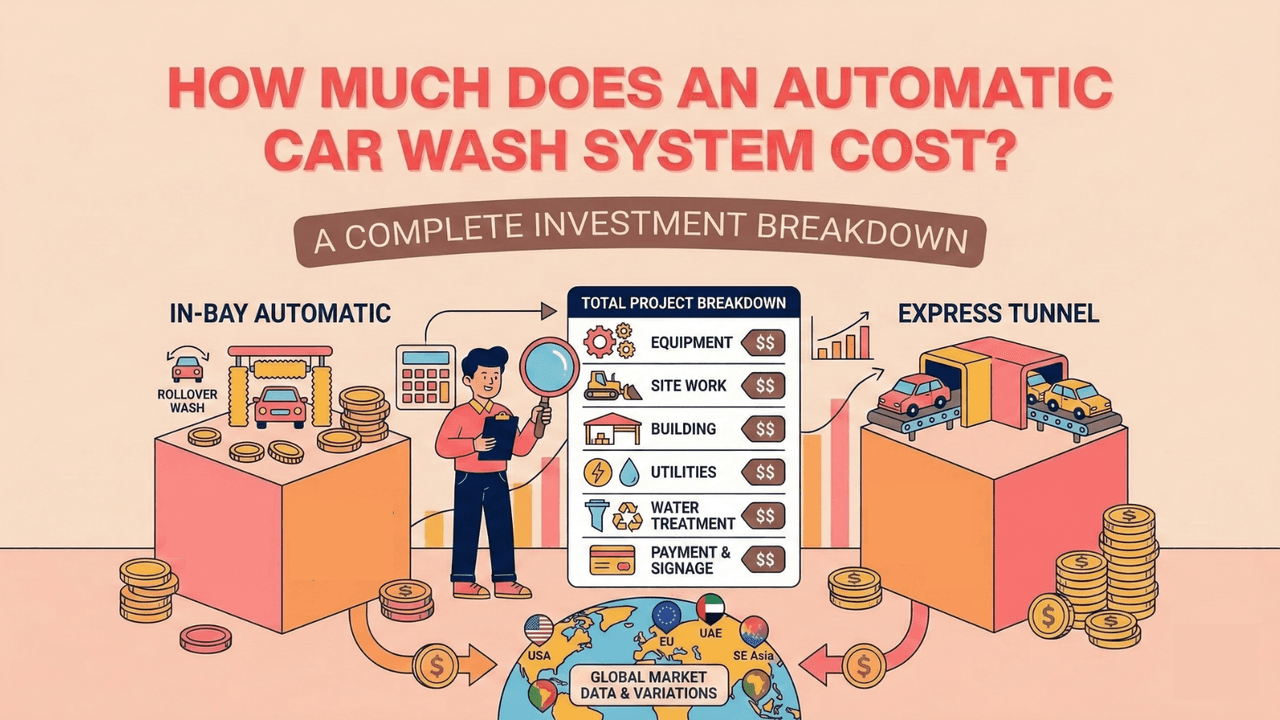
How Much Does an Automatic Car Wash System Cost? A Complete Investment Breakdown
Automatic car wash system costs range from $15,000 to $350,000+ for equipment alone. Here's what drives the price, what the total investment looks like, and how to compare quotes.
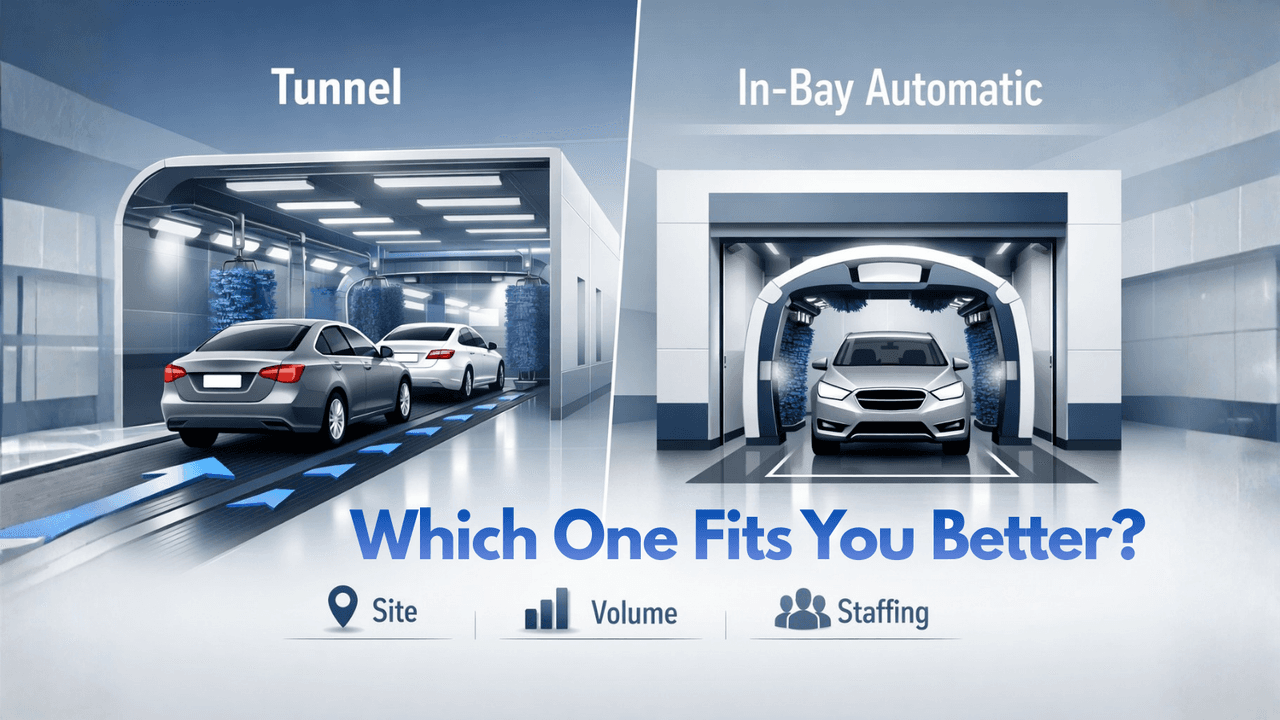
Tunnel vs In-Bay Automatic: Which One Fits Your Site, Volume, and Staffing?
Compare tunnel vs in-bay automatic car washes by footprint, peak-hour volume, staffing, and customer flow. Use this checklist to choose the right format and plan your site.
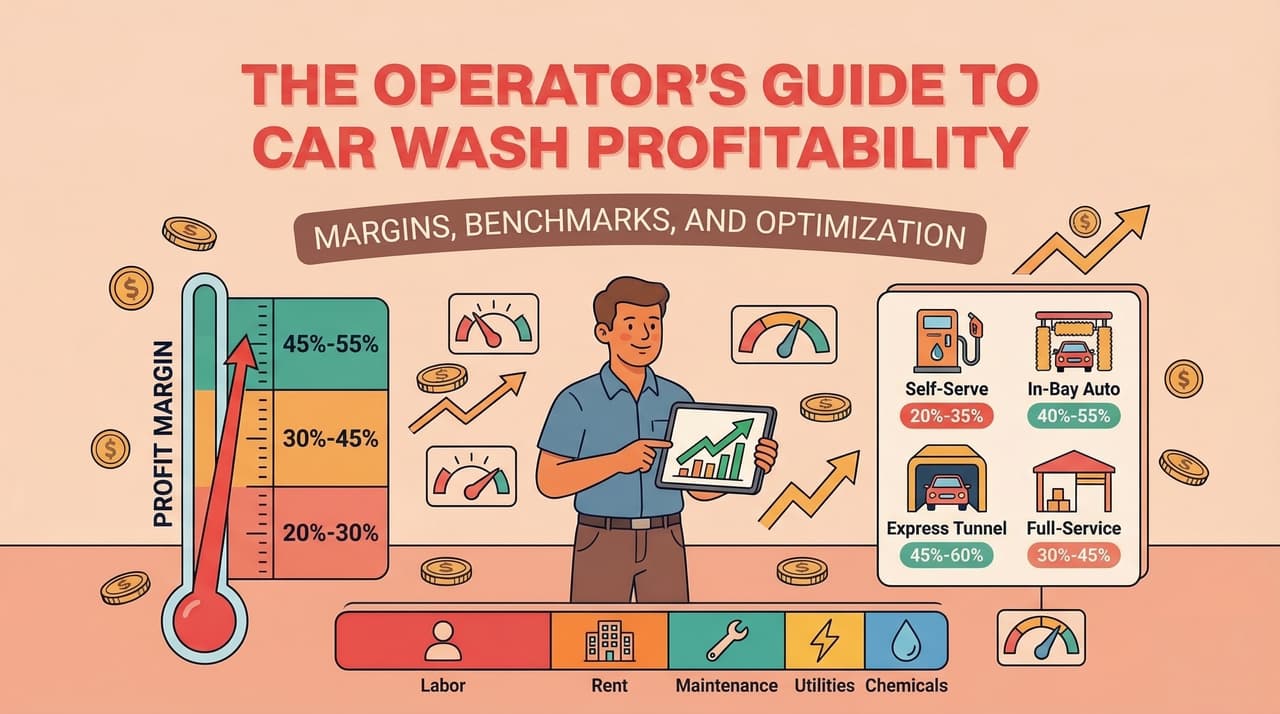
The Operator's Guide to Car Wash Profitability: Margins, Benchmarks, and Optimization
Car wash profit margins range 20–55% by business model. See realistic benchmarks, operating cost breakdowns, and five optimization levers operators control.