
Becoming a Car Wash Equipment Distributor: What to Look for in a Manufacturer Partnership
Becoming a Car Wash Equipment Distributor: What to Look for in a Manufacturer Partnership
Choosing the right manufacturer to partner with is the single most consequential decision you will make as a car wash equipment distributor. That partnership determines the product range you can offer, the margins you earn, the technical support behind every installation, and the credibility you carry into every sales conversation. With the global car wash market projected to grow from $28.07 billion in 2025 to $43.65 billion by 2031 — a 7.54% compound annual growth rate — the distribution opportunity is substantial. But only if you align with a manufacturer whose capabilities match your market and growth ambitions. This guide covers the five factors that separate strong manufacturer partnerships from risky ones.
Why the car wash equipment distribution opportunity is growing
The car wash industry is expanding on multiple fronts. Globally, the market is advancing at a 7.54% CAGR, driven by express exterior formats, subscription-based wash programs, and a steady shift from manual to automated washing. Asia-Pacific represents the fastest incremental growth, where urbanization is boosting vehicle ownership and modernizing legacy coin-operated and hand-wash services into automated operations.
For prospective distributors, these trends translate into sustained equipment demand. New sites need systems. Existing sites need upgrades. And every region needs a local partner who can sell, install, commission, and service that equipment. Manufacturers cannot scale into 40 or 50 countries with direct sales teams alone — they depend on distributors who understand local regulations, client expectations, and service logistics. That dependency is your opportunity.
What a car wash equipment distributor actually does
If you are evaluating how to become a car wash equipment dealer, it helps to understand the full scope of the role. A full-service equipment distributor does far more than resell hardware. You are the manufacturer's representative in your market — responsible for sales, site assessment support, installation oversight, commissioning, after-sales service, spare parts management, and often local marketing. Operators judge dealers on exactly these responsibilities; how operators evaluate a car wash equipment dealer is the checklist your clients will apply to you.
Major manufacturers operate through extensive distributor networks — Coleman Hanna serves clients in 75+ countries, and MacNeil works through 40+ distributors worldwide. The model works because distributors bring what manufacturers cannot: local market knowledge, language capability, regulatory familiarity, and the proximity to respond quickly when a site needs service.
The distinction matters when evaluating a manufacturer partnership. You are not just purchasing equipment at wholesale. You are entering a long-term relationship where the manufacturer's product quality, support infrastructure, and commercial terms directly shape your profitability and reputation.
Five factors to evaluate in a car wash manufacturer partnership
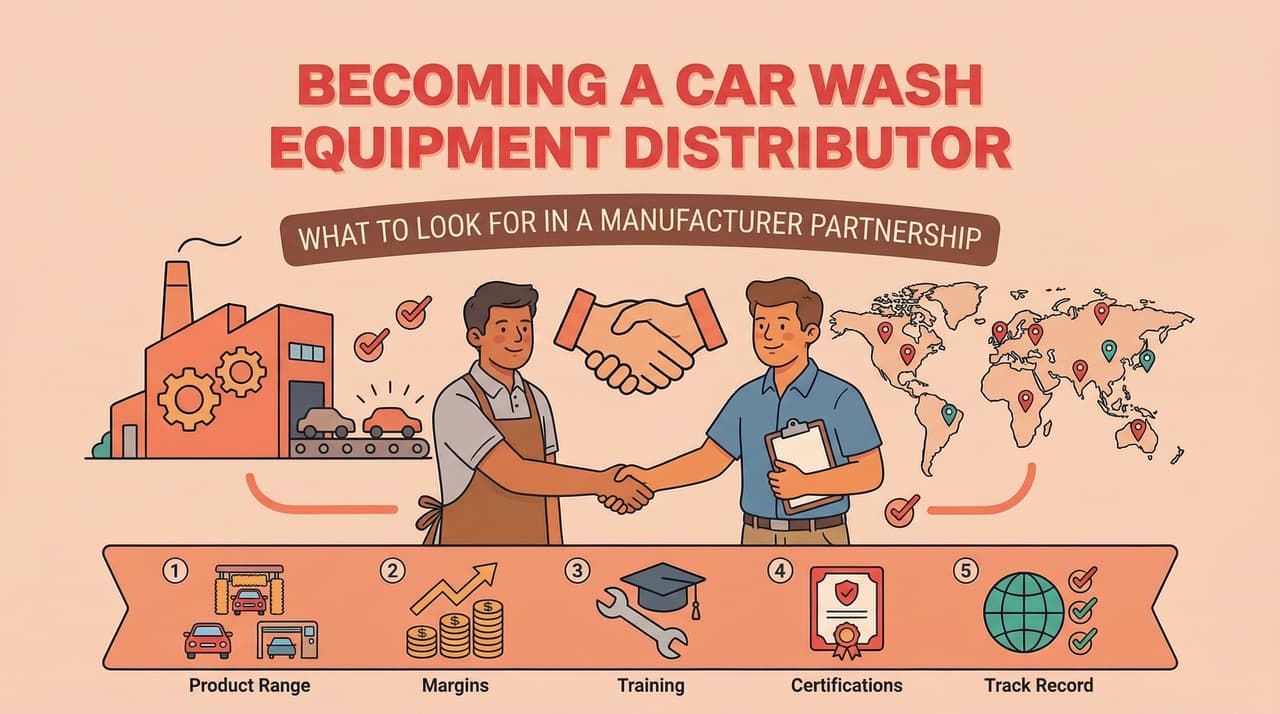
Not every manufacturer partnership is created equal. The following five factors provide a structured framework for evaluating potential manufacturers — whether you are entering the car wash distribution business for the first time or considering adding a new equipment line.
Product range and market coverage
A manufacturer with a full product portfolio allows you to serve diverse client needs without the complexity of managing multiple supplier relationships. When evaluating product range, look for coverage across the core categories: tunnel systems, rollover (gantry) units, touchless machines, bus and truck washers, and specialty equipment like wheel wash systems.
Within each category, depth matters as much as breadth. Configurable systems give you flexibility in proposals. For example, HyTian's TX-380 tunnel system offers adjustable tunnel length, multiple conveyor options (heavy-duty chain or slide-rail), and configurable dryer arrays — allowing distributors to right-size each proposal to the site's volume, footprint, and power availability. Multiple SKU tiers within a product line mean you can match price points to different market segments without switching manufacturers.
The question to ask: can this manufacturer equip every type of site in your territory, from a single-bay gas station rollover to a high-volume express tunnel?
Margin potential and commercial terms
Margin structure varies significantly between manufacturers, and the initial equipment margin is only part of the picture. The distributors who build the most sustainable businesses focus on recurring revenue: spare parts, chemical supply contracts, and maintenance agreements that generate income long after the installation is complete. How much of that recurring business you can actually capture depends on the manufacturer's support program, so use our distributor support evaluation checklist before you sign.
Evaluate the manufacturer's chemical delivery systems as a proxy for recurring revenue potential. Precision-engineered dosing — like CNC metering pumps that deliver 0.28 mL accuracy — extends chemical drum life to approximately 3,000 washes per 20 kg drum. That efficiency is a selling point to your clients and a stable revenue stream for your business.
Beyond margin, scrutinize territory structure. Exclusive or protected territories prevent intra-network competition that erodes pricing. Ask about volume incentives, performance tiers, and early-payment terms. The right commercial framework rewards growth without forcing you to compete against the manufacturer's other partners in your region.
Technical training and after-sales support
Your service capability is only as strong as the manufacturer behind it. The best manufacturer partnerships include structured technical training — not a one-time product orientation, but an ongoing program that keeps your team current as product lines evolve.
Remote support capability is particularly important for international distributors. When your team encounters a commissioning issue at 2 AM in a market 8,000 kilometers from the factory, remote diagnostic access and responsive engineering support make the difference between a one-day delay and a one-week delay.
HyTian demonstrated this during its Japan market entry, when travel restrictions during 2020 prevented on-site engineering support. The company commissioned TX-380 tunnel systems remotely with its distribution partner, Splash N Go — and that partnership has since grown into a multi-site franchise network processing 500+ washes per day at individual locations during peak periods. The Japan deployment is a concrete example of what a car wash manufacturer partnership program looks like in practice: a dedicated distributor and service team, not a one-time equipment sale.
Certifications, compliance, and quality standards
International certifications reduce your compliance burden and strengthen your proposals. At minimum, look for CE conformity (EU machinery safety), ISO 9001 (quality management), and ISO 14001 (environmental management). These certifications are not decorative — they signal that the manufacturer's production processes meet internationally recognized standards, which matters when you are competing for tenders or selling to corporate procurement teams with strict vendor qualification criteria.
Financial stability indicators matter too. A manufacturer with 30+ years of continuous manufacturing experience and strong creditworthiness (such as a AAA bank credit rating) represents lower partner risk than a newer entrant without an established production track record. Your clients are investing in equipment with a 10-to-15-year operational life. They need confidence that the manufacturer will still be producing parts and providing support a decade from now — and so do you.
Proven global track record
A manufacturer's deployment history is perhaps your most powerful sales tool. When you walk into a prospect meeting with documented installations in 40+ countries, quantified performance data, and recognizable partner brands — Audi, BMW, BYD, Honda, Hyundai, Lincoln, Mercedes-Benz, Shell, Volvo — you carry credibility that no brochure can replicate.
Look beyond raw installation counts. Evaluate geographic diversity: has the manufacturer deployed successfully in tropical, arid, and cold climates? Across different regulatory environments? In space-constrained urban sites and high-volume highway locations? Market adaptability signals engineering flexibility that protects you when a prospect presents an unusual site configuration.
Manufacturing capacity also matters. A facility producing 3,000 units annually from a dedicated plant provides supply reliability as your network grows. Lead times and production consistency become critical when you are managing multiple active projects simultaneously.
Co-marketing and sales enablement resources
The strongest manufacturer partnerships extend beyond product and support into marketing. Evaluate the manufacturer's willingness to invest in your success through co-marketing resources: branded collateral, published case studies, technical guides, and joint presence at industry events.
Published case studies with quantified results — like the Japan tunnel deployment, the Zhuhai public transit fleet wash, and the BYD factory standardization — are assets your sales team can share directly with prospects. Joint participation at events like ICA in Las Vegas and Automechanika in Frankfurt builds your visibility alongside the manufacturer's brand.
Content marketing resources (blog articles, comparison guides, ROI frameworks) that you can co-brand or share through your own channels compound your marketing investment. A manufacturer that actively produces thought leadership content is signaling long-term commitment to market development — not just equipment sales.
Manufacturer partnership evaluation at a glance
Factor | What to look for | Red flags |
|---|---|---|
Product range | Full portfolio (tunnel, rollover, touchless, bus/truck, specialty); configurable systems with multiple SKU tiers | Single-product manufacturers; no modular options; limited configurability |
Margin potential | Transparent pricing; recurring revenue from parts and chemicals; protected territories; volume incentives | Opaque pricing; no territory protection; no recurring revenue streams |
Training and support | Structured training programs; remote diagnostics; responsive engineering support; spare parts logistics | One-time orientation only; no remote support capability; slow response times |
Certifications | CE, ISO 9001, ISO 14001; financial stability indicators; 10+ year production track record | Missing international certifications; new manufacturer with limited history |
Global track record | Documented installations across diverse markets; recognized partner brands; published case studies | Limited geographic diversity; no quantified results; no referenceable clients |
Key takeaways
The manufacturer you choose defines your business. Product range, margin structure, support quality, and brand credibility all flow from that single partnership decision.
Recurring revenue matters more than the initial sale. Distributors who build service agreements, chemical supply contracts, and parts pipelines create sustainable businesses — not just project-based revenue.
Remote support capability is non-negotiable for international distributors. Evaluate whether the manufacturer can commission, diagnose, and support equipment when on-site visits are impractical.
Certifications protect both you and your clients. International standards (CE, ISO 9001, ISO 14001) reduce compliance friction and strengthen proposals to corporate procurement teams.
A proven track record is your most persuasive sales asset. Documented installations, recognized partner brands, and published case studies carry more weight than any product brochure.
Evaluating manufacturer partnerships for your market? Let's discuss partnership opportunities — including how HyTian's product range, support infrastructure, and distributor model fit your region and growth plans.
Related articles
Explore more insights from the HyTian team.
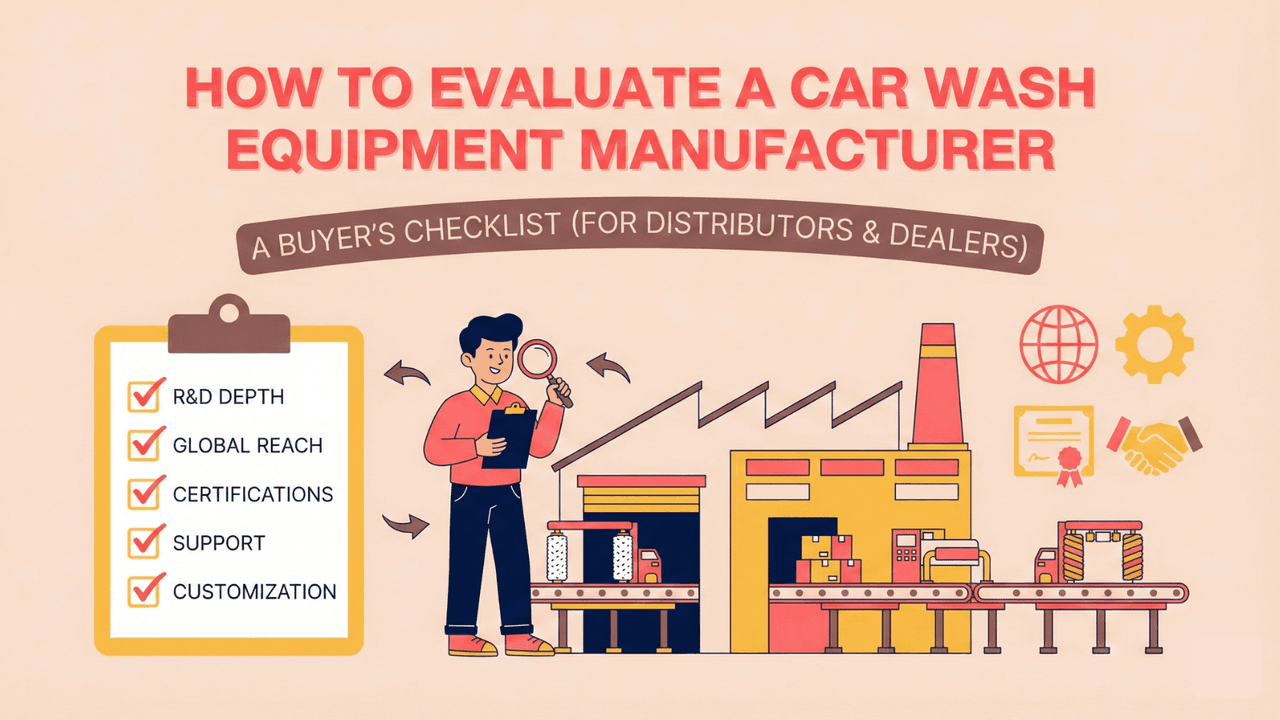
How to Evaluate a Car Wash Equipment Manufacturer: A Buyer's Checklist
A practical buyer's checklist for distributors and dealers evaluating a car wash equipment manufacturer. Learn what to look for in engineering capability, certifications, after-sales support, and global track record before committing to a factory partnership.
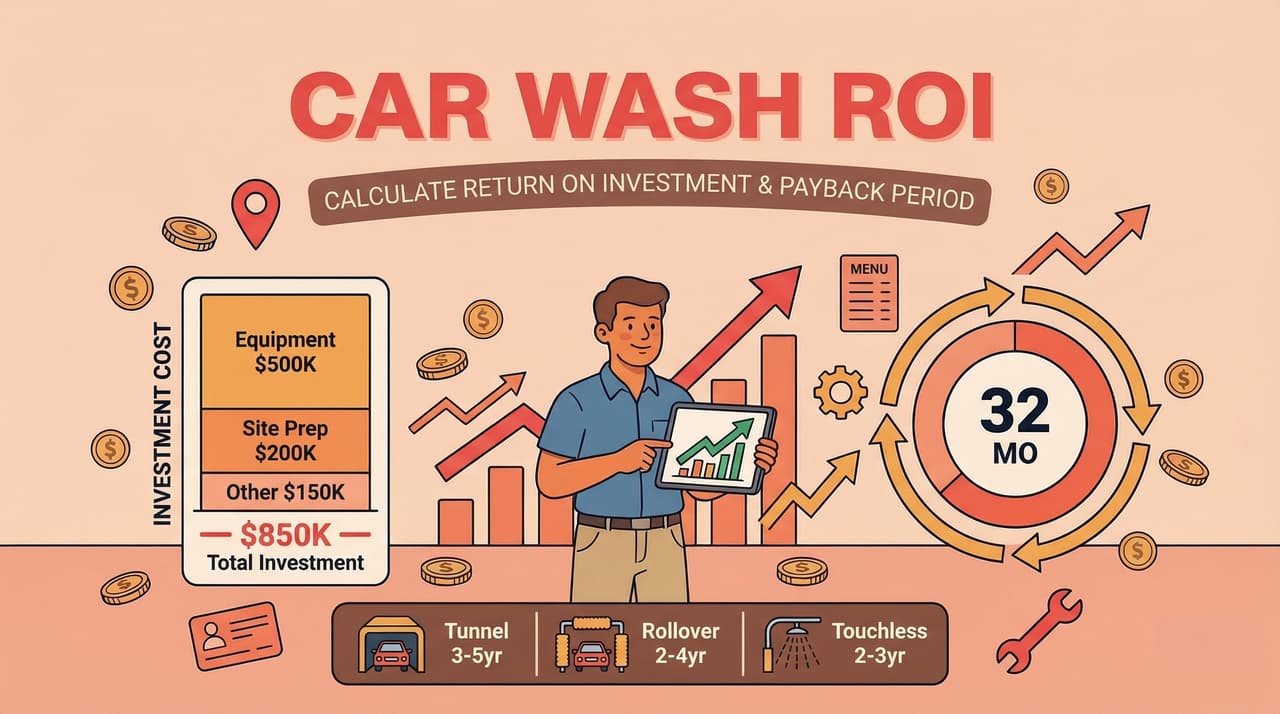
Car Wash ROI: How to Calculate Your Return on Investment and Payback Period
Car wash ROI typically ranges 20–35% annually with 2–5 year payback. Learn how to calculate your return, compare system types, and accelerate break-even.
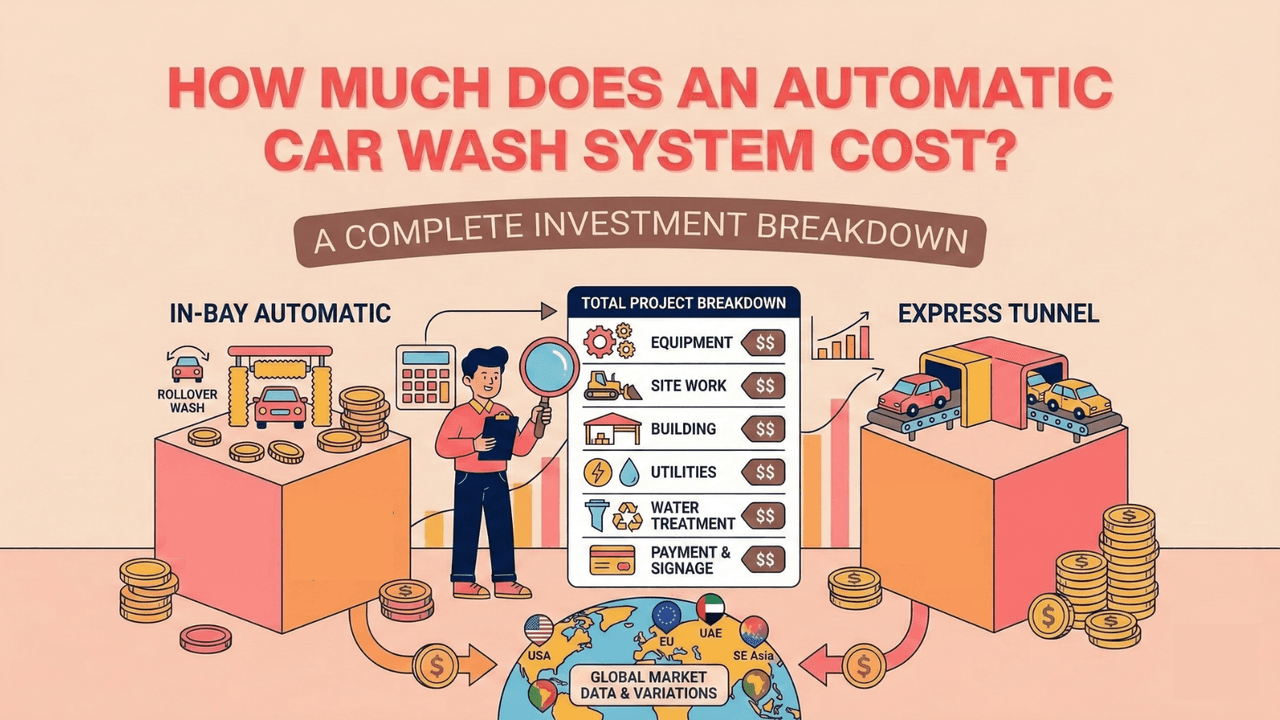
How Much Does an Automatic Car Wash System Cost? A Complete Investment Breakdown
Automatic car wash system costs range from $15,000 to $350,000+ for equipment alone. Here's what drives the price, what the total investment looks like, and how to compare quotes.