
The Car Wash Equipment Distributor's Financial Playbook: Margins, Inventory & Cash Flow
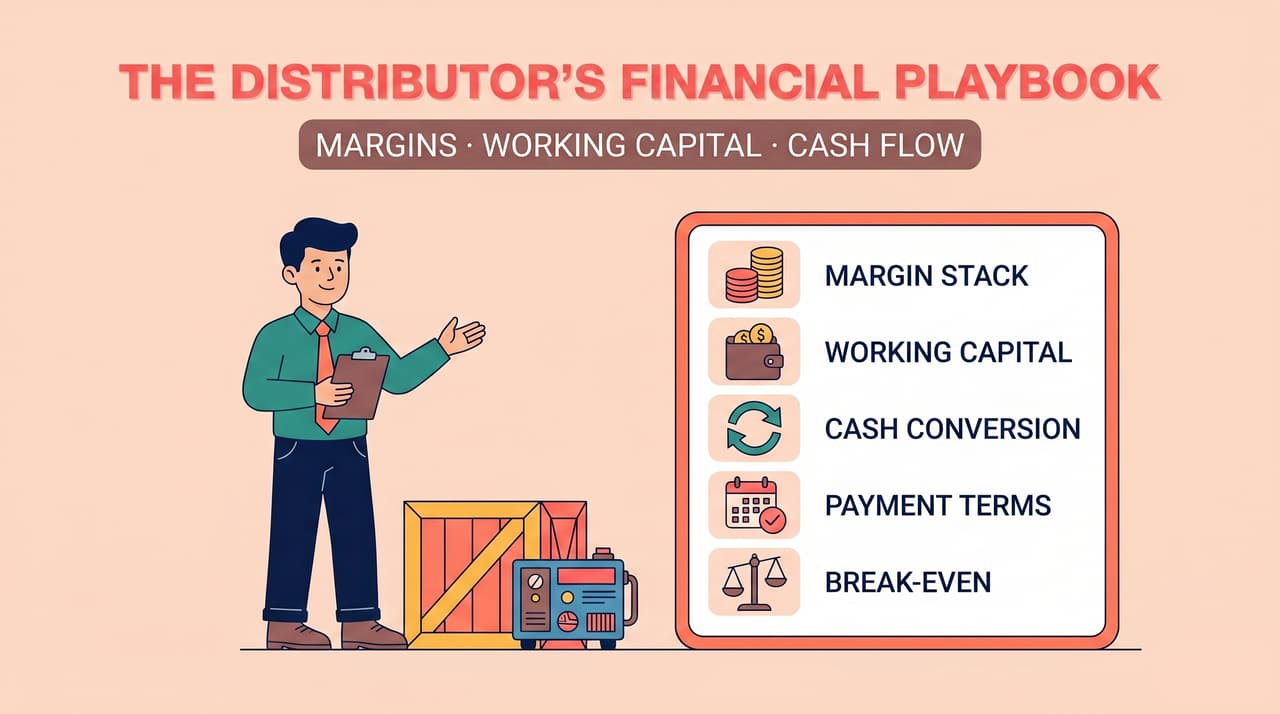
The Car Wash Equipment Distributor's Financial Playbook: Margins, Inventory & Cash Flow
The machines are easy to fall in love with — a conveyor tunnel that moves 100 cars an hour looks like an obvious thing to sell. But the question that decides whether a distributorship survives its first two years isn't "will these systems sell?" It's "can the business behind them make money, and what will it tie up while it does?"
That's where car wash equipment distributor profit margin stops being a single number and becomes a system: the spread you earn, the working capital a capital-equipment line locks up, and the timing of cash in versus cash out. Get the margin right but mismanage the cash, and a territory that looks profitable on paper can still run dry mid-year.
We work with distributors and trading partners across 40+ countries, so this playbook is written from the manufacturer's side of the table. Here's the money math — in market ranges, not a sales pitch.
Distributor Economics Are Not Operator Economics
First, a distinction that trips up newcomers. This playbook is about the business that sells and installs the equipment — you — not the operator who runs the wash. An operator earns per-vehicle revenue and memberships; you earn a spread on the hardware plus recurring parts, chemicals, and service. Different model, different risks — and the four levers that drive equipment distribution business profitability (markup versus net margin, working capital, inventory turns, and the cash conversion cycle) all behave differently on your side of the deal.
This is deliberately the financial counterpart to the relationship side of the decision. Our guide to what to look for in a manufacturer partnership covers the partnership itself — support, warranty, territory, communication. This piece covers the money.
What's a Realistic Profit Margin for a Car Wash Equipment Distributor?
The honest answer: your markup is healthier than your take-home. Distributor markup on equipment commonly runs around 20%, and depending on the product line anywhere from 5% to 40%. That sounds comfortable — until you follow it down to net profit.
Industry benchmark data shows the gap plainly. Distribution businesses post gross margins near 32% but net profit margins closer to 7–8%. Everything between those two numbers — warehousing, sales staff, technicians, freight, demo units, marketing, financing — is the cost of running the operation. So when someone quotes a car wash equipment distributor profit margin, ask whether they mean the markup on the invoice or the profit that reaches the bottom line — rarely the same figure.
There's a second layer that shapes the whole model: the machine is often the thin-margin line. In capital-equipment distribution, the durable profit sits in the aftermarket — spare parts, chemicals, service contracts, installation. A tunnel sale might be a low-margin, hard-won deal; the ten years of brushes, dosing chemistry, and maintenance behind it are where the equipment reseller margin model compounds. That's why the strongest distributorships treat the first sale as the start of a revenue relationship — and why a broad, brandable line, including private-label and OEM options, can matter more to margin than any headline discount.
The Working Capital Problem: Inventory, Deposits, and Slow Turns
Here's the constraint that surprises people coming from faster-moving goods: capital equipment ties up a lot of cash and turns slowly. Capital-goods distributors turn their inventory only about 2.4 times a year, against roughly 5 turns for general manufacturing (CSI Market data). Every unit on your floor, in your showroom, or on a ship is cash you can't spend elsewhere.
That slow turn is why a distributorship's real question isn't "how much do I earn per unit?" but "how much cash must I have working at once?" The main drains on a car wash equipment distributor startup cost and its ongoing working capital are consistent:
Demo and showroom units you own so partners can see the equipment run.
A spare-parts buffer deep enough to keep a client's site from going dark waiting on a component.
In-transit inventory — units you've paid for that are still crossing an ocean on a long import lead time.
Receivables — invoices you've issued but haven't collected yet.
The pattern is clear: distributor inventory working capital is the gap between paying your manufacturer and getting paid by your client. The bigger and slower that gap, the more cash the business needs just to stand still.
The Cash Conversion Cycle: The Number That Actually Runs the Business
If you track one number besides margin, make it the cash conversion cycle. It measures how many days your cash is tied up before a sale turns back into cash in the bank. The formula is straightforward: cash conversion cycle = DIO + DSO − DPO.
In a distributor's language:
DIO — Days Inventory Outstanding: how long a unit sits from the day you receive it to the day it sells. For capital equipment with long import lead times, this is large.
DSO — Days Sales Outstanding: how long the operators you sell to take to pay you after the invoice.
DPO — Days Payable Outstanding: how long you take to pay your manufacturer.
Your cash is trapped for the DIO plus the DSO, and released by the DPO. So the shorter the cycle, the better — and you have three levers. Cut DIO by pre-selling from demo units and forecasting tighter. Cut DSO by taking deposits from clients and invoicing the moment a milestone is hit. Extend DPO by negotiating longer terms with your manufacturer. Pull those together and you free up working capital without borrowing a cent — which brings us to the lowest-cost financing in the business.
Payment Terms: The Lowest-Cost Financing You'll Negotiate
Payment terms are where the cash conversion cycle is won or lost, and they run in both directions. What you extend to your clients sets your DSO; what your manufacturer extends to you sets your DPO.
Know the vocabulary cold. Net 30, 60, or 90 means the full invoice is due in that many days. Deposits or partial payment upfront are standard — the U.S. Chamber notes structures like a percentage on order with the balance on completion — and early-payment discounts such as 5/10 net 30 (5% off if paid within ten days) pull cash in faster when you're the one waiting to be paid.
Big-ticket and cross-border orders add a layer: a common structure is a deposit at order, a progress payment while the unit is built, and the balance at or after delivery, with international trade often running on letters of credit or telegraphic transfer. But the distributor who negotiates a longer payable window with the manufacturer while collecting deposits from clients has quietly financed the business on other people's money — while the one who pays fast and collects slow finances it on a bank line, at bank rates.
Finding Break-Even: How Many Units Before the Territory Pays for Itself
Before committing to a territory, know your break-even. The formula is textbook: break-even in units = fixed costs ÷ contribution margin per unit, where contribution margin is the selling price minus each unit's variable cost. In sales-dollar terms, it's fixed costs divided by the contribution-margin ratio.
For a distributorship, the fixed costs are the ones that don't move with volume: warehouse or showroom rent, demo-unit carrying cost, salaried service technicians, base marketing, and overhead. Contribution per unit is the gross margin on a system minus the variable cost of selling and installing it. Divide the first by the second and you get the number of systems the territory must move before it stops losing money.
Two things make that number friendlier. Recurring aftermarket revenue — parts, chemicals, service — adds contribution without much added fixed cost, so a healthy service book lowers the unit break-even and cushions a slow quarter. And anything a manufacturer does to cut your fixed costs — training that lets your own team commission systems, for instance — moves break-even down. Which is exactly where the partner you choose starts to change the math.
What This Means When You Choose a Manufacturer Partner
By now a pattern emerges: almost every lever is partly set by your manufacturer relationship. The payable terms you negotiate are your DPO. Demo-unit and financing support decides how much inventory cash you carry. Training and remote commissioning cut the fixed cost of fielding your own engineers. Warranty coverage and fast parts availability protect your aftermarket margin and the trust of the clients you serve. Lead time is your DIO. A good partner doesn't just sell you boxes — they shape your cash conversion cycle.
One more line belongs in a financial playbook and rarely makes the brochure: your supplier's own financial stability is your risk too. A manufacturer that fails mid-warranty leaves you holding the parts obligations and the client relationships — so check how long it has been building, how widely it's deployed, and whether its books are sound. For our part, HyTian has been engineering wash systems for over three decades since 1992, with 20,000+ systems across 40+ countries, a 3,000-unit annual capacity, and a full range — tunnel, rollover, touchless, bus and truck, wheel wash, and custom — behind the aftermarket. The systems carry CE, ISO 9001, and ISO 14001 certification, and the company holds an AAA bank credit rating in China: not a wash-quality metric, but exactly the supplier-stability signal that protects a distributor's balance sheet. Becoming a HyTian distributor and our partner marketing and training support lay these levers out in practical terms.
Key Takeaways
Markup is not net margin. A ~20% markup can leave a net profit near 7–8% after operating costs — and the aftermarket, not the machine, carries most of the profit.
Working capital, not headline margin, is the real constraint. Capital equipment turns only ~2–3 times a year, locking cash into inventory and receivables for months.
Run your model on the cash conversion cycle (DIO + DSO − DPO): shortening it frees capital without borrowing.
Payment terms are your lowest-cost financing — longer supplier terms plus client deposits fund the business on other people's money.
Know your break-even in units before you commit to a territory, and remember recurring service revenue lowers it.
Frequently Asked Questions
What profit margin do car wash equipment distributors make? It depends whether you mean markup or take-home. Distributor markup on equipment commonly runs around 20% (5–40% across product lines), but net profit for distribution businesses lands closer to 7–8% after operating costs. Much of the durable profit comes from aftermarket parts, chemicals, and service — not the machine itself.
How much working capital does an equipment distribution business need? More than the margin suggests, because capital equipment turns slowly — roughly 2.4 times a year. Working capital funds demo units, a spare-parts buffer, in-transit import inventory, and the receivables you carry between paying your manufacturer and getting paid by your clients.
What are typical payment terms for buying car wash equipment? Net 30/60/90 invoicing, usually with a deposit upfront and the balance on delivery or completion; large cross-border orders often use milestone payments and letters of credit. Negotiating longer terms with your manufacturer while collecting deposits from clients is the biggest lever on your cash flow.
How do you calculate break-even for an equipment distributorship? Divide fixed costs by contribution margin per unit (selling price minus each unit's variable cost). That's the number of systems you must sell to cover fixed overhead. Recurring service and parts revenue adds contribution without much added fixed cost, lowering the break-even point.
The numbers that make a car wash equipment line work are partly yours to run and partly set by who you partner with. If you're weighing a territory, talk to our team about terms and territory — payment structure, demo support, training, and the product range behind the margin. We'd rather help you build a model that holds up than close a sale that doesn't.