
OEM, Private-Label, and Custom-Engineered Car Wash Equipment: A Distributor's Guide
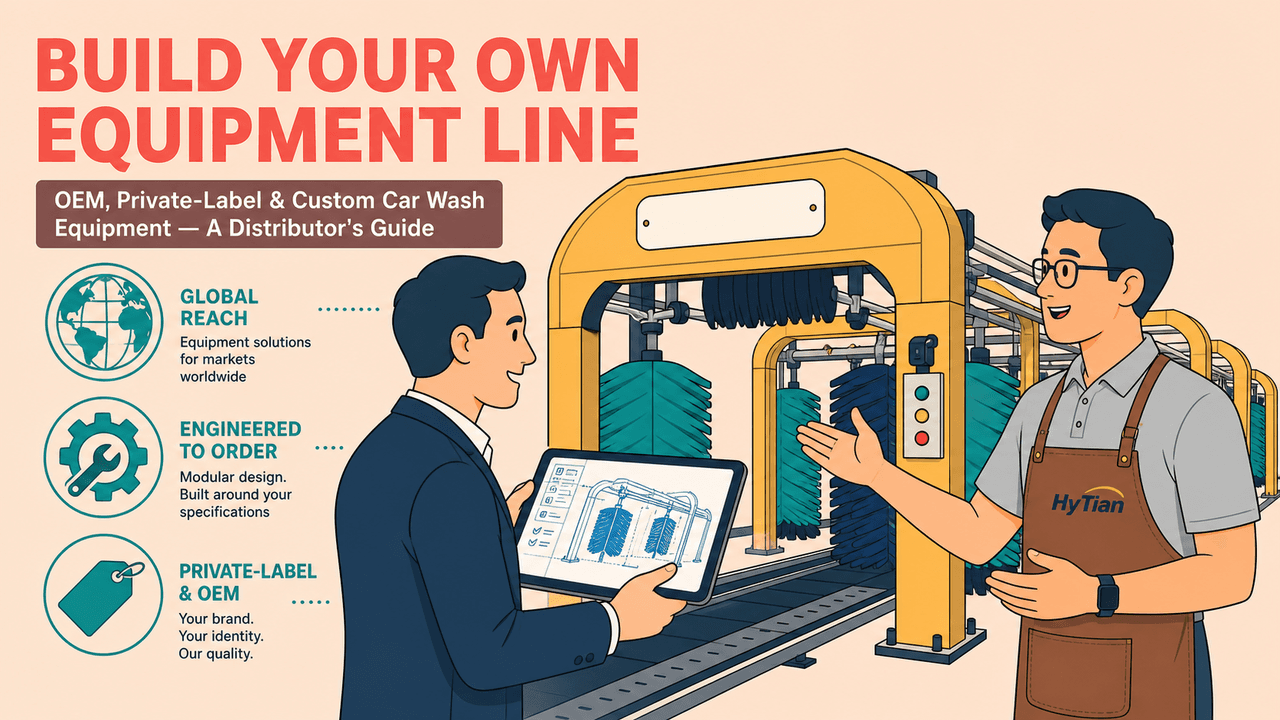
OEM, Private-Label, and Custom-Engineered Car Wash Equipment: A Distributor's Guide
Every distributor eventually hits the same ceiling. You can resell a capable machine — but so can the distributor in the next territory, often the identical unit from the identical catalog, competing on the identical spec sheet. Margins compress, the relationship stays transactional, and your brand never becomes the reason a client chooses you.
The way past that ceiling is to stop reselling a box and start building a line: private-label car wash equipment, an OEM program, or a custom-engineered system adapted to your market. This guide explains how those options actually differ, what engineered-to-order looks like in practice, and what to look for in a manufacturing partner who can deliver them.
What "Private-Label," "OEM," and "Custom-Engineered" Actually Mean
These terms get used interchangeably, but they describe very different relationships — and the difference determines how much you can differentiate.
There's a spectrum, from least to most adapted:
Model | What it is | Branding | Engineering control |
|---|---|---|---|
Standard resale | Sell the manufacturer's catalog unit as-is | Manufacturer's | None |
Co-branding | Manufacturer's unit, presented alongside your name | Shared | None |
Private / white label | The manufacturer's existing design, sold under your brand | Yours | Minimal |
OEM | Manufacturer builds equipment to your specification and brand | Yours | Moderate |
Engineered-to-order | The system itself is redesigned around your application | Yours or shared | Full |
The two most-confused terms are OEM and private-label. The short version: private-label (or white-label) equipment is a manufacturer's existing design sold under the distributor's brand, while OEM means the manufacturer produces equipment built to the distributor's own specification. Private-label changes the badge; OEM changes the build. Custom-engineered sits beyond both — the machine is designed for the job, not adapted after the fact.
One practical note worth setting straight: search "private label car wash" and you'll mostly find chemicals — soaps, waxes, and coatings. Equipment is a different conversation entirely, and far fewer manufacturers are set up to have it. That gap is your opportunity.
What "Engineered to Order" Looks Like in Practice
A manufacturer can only offer you a genuine private-label or custom line if the underlying equipment is modular. If it's a single fixed design, all you can change is the sticker.
HyTian's Custom-Made line is engineered to order from modular components — brush packs, high-pressure arches, chassis rinse, and blow-dry stages — configured in either pass-through or reciprocating layouts, with license-plate recognition and PLC control, and multi-stage water reclamation built in. Each of those is a decision point you can set for your market rather than inherit from a catalog.
That modularity is what turns a resale relationship into a product line. The same engineering platform becomes several differentiated offerings, each shaped to a segment you actually serve:
A distributor working dense urban sites can specify a reciprocating layout that washes in a single bay, where there's no room for a tunnel.
One selling into a water-scarce region can lead with multi-stage reclamation as a headline feature.
One whose clients run mixed fleets can configure brush packs and chassis rinse around the vehicle profiles they see every day.
Each configuration is yours to position, price, and support.
Consider a distributor opening a Gulf-region market. The off-the-shelf answer is whatever the catalog ships. The engineered-to-order answer specifies multi-stage water reclamation as the lead feature (water cost and scarcity dominate the operating case there), pairs it with brush packs tuned for heavy dust and fine sand rather than temperate-climate grime, and selects a layout that fits the compact forecourts common to fuel-station sites. Same platform, a configuration no generic competitor is selling — and a story only that distributor can tell.
This is the difference between selling equipment and owning a line: your clients are buying a system shaped around their conditions, and the only place they can get that exact configuration is from you.
Proof: From Factory OEM to Bespoke Transit Systems
Engineering claims are easy to make. What matters is whether a manufacturer has actually delivered against demanding, brand-sensitive requirements. HyTian's record runs from factory-floor OEM to fully bespoke systems.
OEM-grade standardization. BYD — one of the world's largest EV manufacturers — standardized new-vehicle wash across its factories on the HyTian TX-380, running roughly 60 vehicles per hour. The brushes are EVA closed-cell foam, engineered for factory-fresh paint where any blemish is unacceptable. When a global OEM puts your equipment on the line between assembly and delivery, that's a credibility signal a distributor can carry into any room.
Bespoke engineering. For a Bolivian light-rail operator, HyTian designed a custom dual-mode tram wash — eight brush groups, engineered for 33-meter vehicles, with integrated water recycling and full coverage including the mirror zones that defeat off-the-shelf systems. That's not a configured catalog unit; it's a machine that didn't exist until the application required it.
Local adaptation. When Splash N Go brought a tunnel wash to a constrained Japanese retail site, the TX-380 was adapted to the site's footprint and local wash menus — now running 500+ washes per day, supported by a dedicated in-country HyTian distributor and service team. The partnership, not just the machine, is what made the deployment work.
Across more than 20,000 systems in over 40 countries, the through-line is the same: the equipment bends to the application, not the other way around.
Building Your Line: How the Partnership Works
A private-label or OEM line is only as strong as the partnership behind it. Three things separate a manufacturing partner from a supplier.
A consultative model. HyTian's approach is to specify the right machine for the client's actual conditions — not the most expensive one. For a distributor, that matters more than it sounds: a partner who over-specifies to inflate an order damages your client relationships, not just theirs.
Real international support. Remote commissioning lets HyTian bring systems online across borders without waiting on travel — an approach proven when on-site visits were impossible during pandemic restrictions. If you sell into a region the manufacturer can't physically reach quickly, that capability is the difference between a confident sale and an unsupportable one. It helps to partner with a manufacturer that is already established internationally rather than testing the waters: HyTian operates subsidiaries and agents including the United States, Australia, and Zambia, and shows its equipment at the industry's anchor events — the ICA show in Las Vegas and Automechanika in Frankfurt. A partner with that footprint has already solved the logistics, parts, and service problems you'd otherwise have to solve alone.
It's also worth asking how the manufacturer expects the support relationship to work in your territory specifically. The strongest arrangements treat the distributor as the local face while the manufacturer backs them with engineering and parts depth — the model HyTian used to establish a dedicated service team in Japan rather than leaving its distributor to improvise support alone.
Engineering depth you can evaluate. Before you build a line on any manufacturer, pressure-test the fundamentals — the same way you'd want your own clients to evaluate you. It's worth working through a structured manufacturer evaluation covering:
Modularity — can the platform actually be configured, or is "custom" just a paint option?
Compliance range — has it been certified and deployed across the regulatory environments you sell into?
Support model — who handles commissioning, parts, and service in your territory, and how?
Track record — can the manufacturer point to real OEM and custom deployments, not just catalog photos?
On the questions distributors always ask next — minimum order quantities, lead times, and exactly how branding rights are structured — the honest answer is that these are configuration-dependent and worked out during a partnership conversation, not quoted from a price list. Any manufacturer who gives you a one-size number before understanding your market is guessing.
Key Takeaways
Know what you're buying. Private-label changes the brand; OEM changes the build; engineered-to-order changes the system. Match the model to how much you need to differentiate.
Modularity is the prerequisite. A line you can position and price as your own requires a platform that's genuinely configurable — brush packs, layouts, controls, water systems.
Demand proof. Factory OEM standardization (BYD), bespoke transit systems (Bolivia), and adapted retail tunnels (Japan) show a manufacturer can deliver beyond the catalog.
Evaluate the partnership, not just the machine. Consultative specification, international support, and engineering depth determine whether your line is supportable for years, not just sellable once.
Frequently Asked Questions
What is the difference between OEM and private-label car wash equipment?
Private-label (or white-label) equipment is a manufacturer's existing design sold under the distributor's brand — the badge changes, the build doesn't. OEM means the manufacturer produces equipment built to the distributor's own specification. Engineered-to-order goes further still: the system is redesigned around the specific application.
Can car wash equipment be custom-branded or customized for a distributor?
Yes. With a modular platform, components such as brush packs, layouts (pass-through or reciprocating), controls, and water-reclamation stages can be configured for a distributor's market, and the system presented under the distributor's brand. The degree of customization depends on the platform's modularity and the partnership terms.
What should a distributor look for in an OEM car wash manufacturing partner?
Engineering depth (is the platform genuinely modular?), compliance across the regions you sell into, a clear support and commissioning model for your territory, and a verifiable track record of real OEM and custom deployments — not just catalog imagery.
Build a Line, Not a Catalog
If you're weighing whether to keep reselling someone else's box or build a differentiated line of your own, the place to start is a conversation about your market and what it actually needs. Explore becoming a HyTian distributor, or start a partnership conversation with HyTian's engineering team.
Related articles
Explore more insights from the HyTian team.
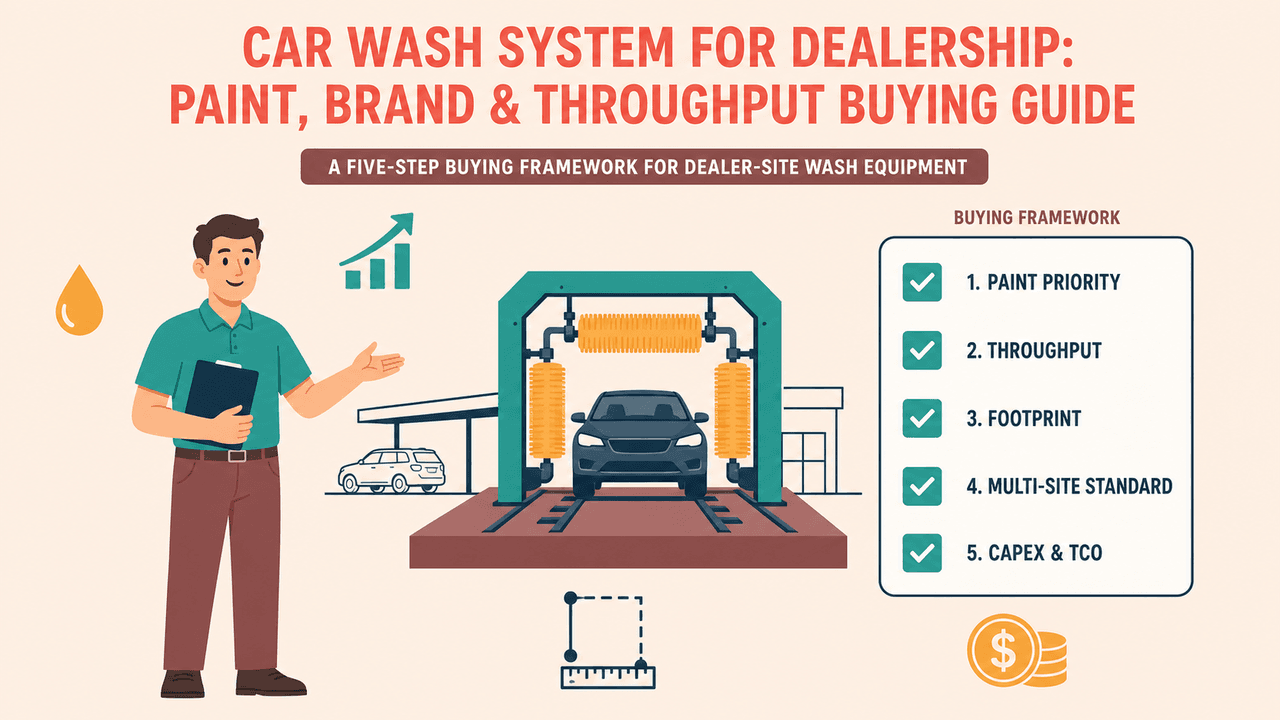
Car Wash System for Dealership: Paint, Brand & Throughput Buying Guide
Choosing a car wash system for dealership operations comes down to paint safety, throughput, and footprint — here's the buying-decision framework.
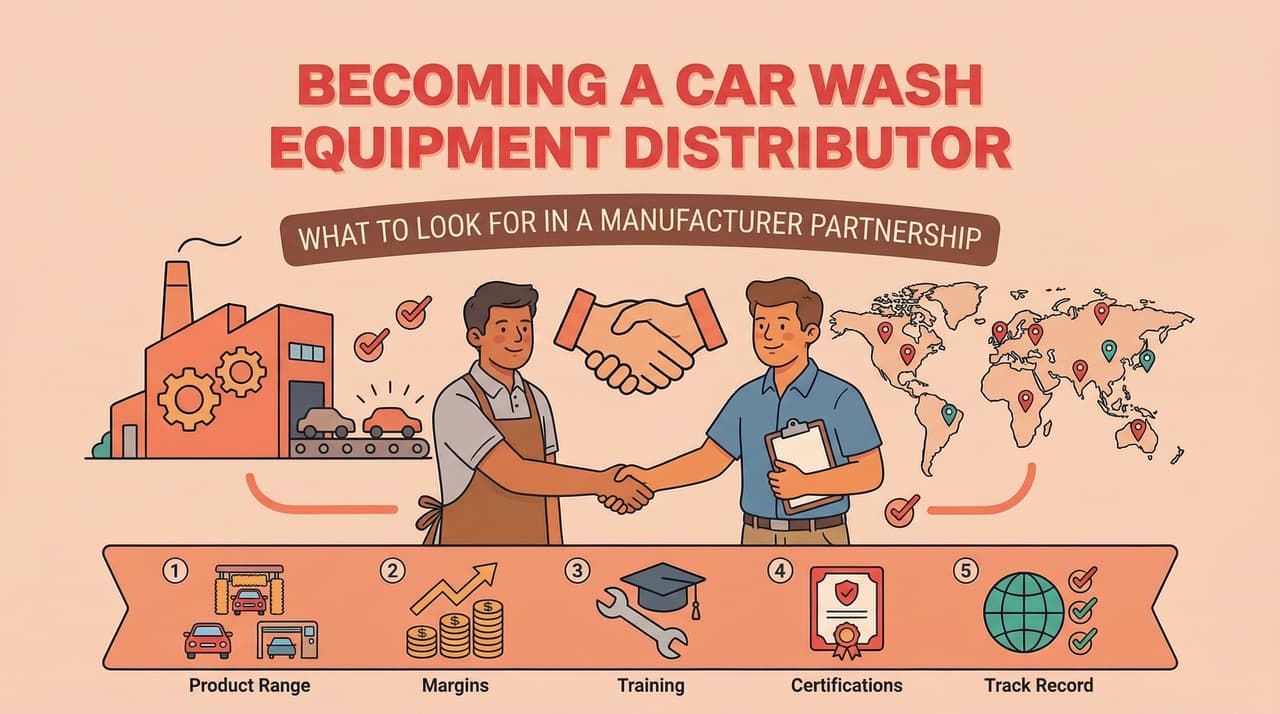
Becoming a Car Wash Equipment Distributor: What to Look for in a Manufacturer Partnership
Evaluating car wash equipment distributor partnerships? Five factors — from product range to global track record — that separate strong manufacturer relationships from risky ones.
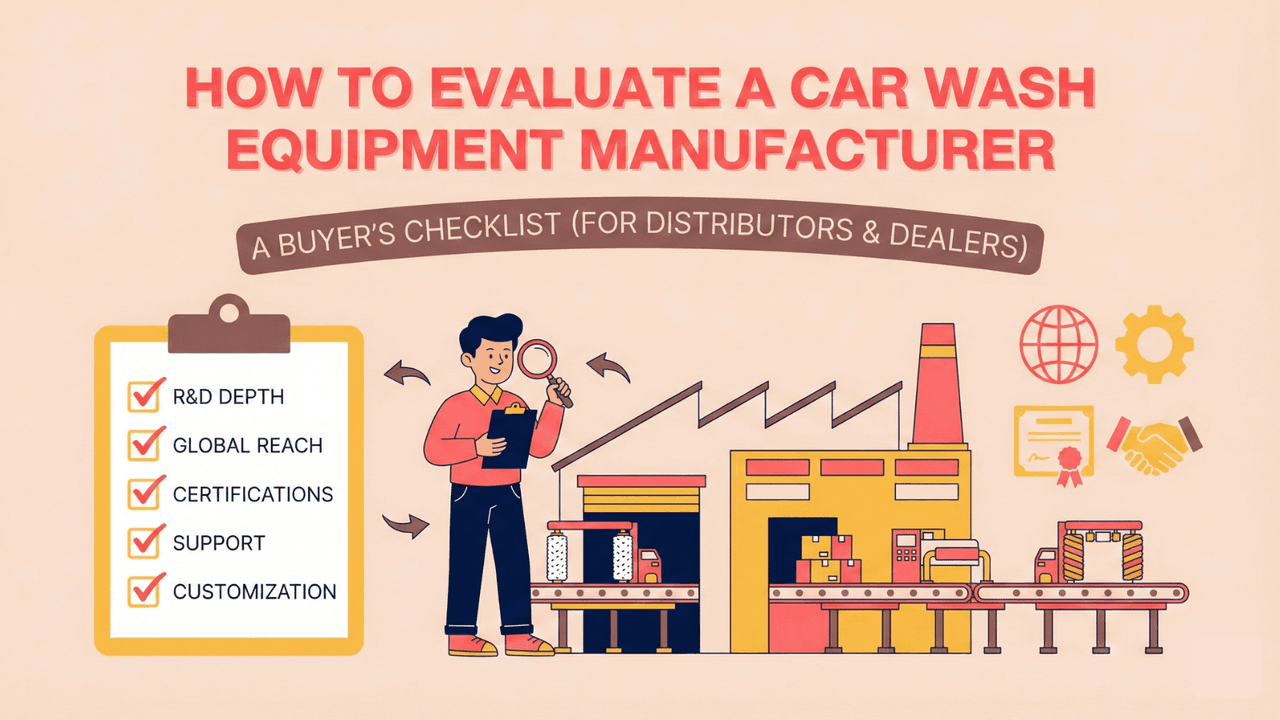
How to Evaluate a Car Wash Equipment Manufacturer: A Buyer's Checklist
A practical buyer's checklist for distributors and dealers evaluating a car wash equipment manufacturer. Learn what to look for in engineering capability, certifications, after-sales support, and global track record before committing to a factory partnership.