
Car Wash System for Dealership: Paint, Brand & Throughput Buying Guide
Car Wash System for Dealership: Paint, Brand & Throughput Buying Guide
Every vehicle on a dealership site is either inventory, a client-owned service vehicle, or a recon trade-in on its way to the front line. Paint damage on any of them gets charged back to the dealer. That's why a car wash system for dealership operations is a fundamentally different purchase from a roadside express tunnel or a fuel-retailer in-bay automatic.
This guide walks the three architectures dealerships actually consider, the paint-safety vocabulary that shifted between 2023 and 2026, the service-drive throughput math, and a five-step framework you can run before talking to any vendor — grounded in what we ship and where it's deployed, including BYD's factory new-vehicle wash standardization.
Why a car wash system for dealership operations is a different decision
A roadside express tunnel washes strangers' cars. A dealership washes its own assets — new inventory waiting to deliver, client vehicles in for service, and recon trade-ins on the way to the front line. The wash equipment touches paint that belongs to either the dealer or a client of the dealer. Mistakes get owned, not absorbed.
Across the US, 16,990 franchised light-vehicle dealers sold 16.2 million new vehicles in 2025 and wrote more than 276 million repair orders, with service and parts sales above $164 billion (NADA Data 2025). Every one of those vehicles passes through a wash decision — at PDI, at service-drive courtesy wash, at trade-in recon.
Three pressures shape the buying decision. Paint safety, because a marred clearcoat on a new delivery or a client's service vehicle is a warranty and trust problem the dealer absorbs. Throughput, because the service drive needs cars moving and the recon yard needs days-to-front-line shrinking. Brand experience, because the finish quality on a delivery walk-around affects close rate. A car wash system for dealership operations has to deliver on all three at once.
What changed in paint-safety vocabulary since 2023
OEM brand-protection guidance hardened between 2023 and 2026 around three vehicle profiles dealerships now see in volume: ceramic-coated finishes, matte paint, and paint protection film (PPF). Detailing trade guidance broadly treats traditional bristle automatic washes as warranty risk for these finishes, and touchless is the lower-risk automated option recommended in the same conversations. Tesla, BMW, and Mercedes detailing guidance lines up the same way.
The trade-press vocabulary has shifted alongside. Two terms matter.
First, brush systems (sometimes called friction wash in older trade press) has moved off bristle and onto closed-cell foam. The current paint-safe answer in 2026 is EVA closed-cell foam — a wide-profile brush material with a linear pressure curve that doesn't easily absorb water or trap dirt inside the pores. EVA closed-cell foam is less likely to drag abrasive grit across paint than PE foam or older bristle; PE foam, while firmer and more durable, can reduce gloss over prolonged use due to higher friction. From here forward, we use brush and paint-safe brush rollover as the working vocabulary.
Second, touchless is a contact type, not an automation type. A touchless system uses no brush at all — high-pressure water, staged detergents, and forced-air drying do the work. That's the architecture detailing guidance is now pointing sensitive finishes toward when ceramic, matte, or PPF are in the inventory mix.
Paint-safe brush car wash: what serious equipment looks like
A serious paint-safe brush rollover specifies the brush material on the page. HyTian's TX-380 tunnel and XL-200 rollover families ship with EVA closed-cell foam brushes, wide-profile with a linear pressure curve that protects modern clearcoats, wipers, mirrors, and accessories at the angles a contact-wash actually touches. Generic catalog rollovers won't tell you what their brushes are made of. That's the equipment-tier divide a dealership operator is making the buy across.
Three architectures dealerships actually consider — and where each fits
Dealerships pick from three architectures. The choice is about which fits the inventory profile, the volume target, and the site — not which is best in the abstract.
Touchless car wash for dealership: brush-free, brand-protection-first
A touchless gantry uses no brush — high-pressure water and staged detergents do the cleaning, forced-air drying finishes. Paint-contact risk is the lowest of the three architectures. HyTian's touchless car wash systems cover this category; the touchless MY-385 runs 120 L/min at 1000 psi on a 380V / 35 kW package inside a 140 × 385 × 290 cm footprint with a 900 cm rail. Right for: ceramic-coated inventory, matte-finish vehicles, premium delivery prep, brand-conscious dealer groups.
Paint-safe brush rollover: faster cycle, in-bay footprint, modern clearcoat-safe
A paint-safe brush rollover is an in-bay automatic with EVA closed-cell foam brushes on an oscillating arm. Cycle time is faster than touchless because contact accelerates soil removal, and water and chemical use is lower. The architecture is clearcoat-safe when the brush material is specified correctly. HyTian's XL-200 family runs 15-20 vehicles per hour in a 220 × 385 × 300 cm bay on a 380V / 17 kW package. The XL-200NET self-service rollover variant adds cashless scan-to-start, cloud management with remote diagnostics, auto-drain for cold-weather sites, and a 5-brush + 4×5.5 kW dryer configuration. Right for: service-drive wash on standard-finish inventory; dealer sites where footprint is tight.
Conveyor tunnel: highest throughput, dealer-group scale
A conveyor tunnel takes vehicles through a linear run, with brushes, high-pressure rinse, and drying stages along the path. HyTian's TX-380 tunnel runs 50-60 vehicles per hour with EVA closed-cell foam brushes, CNC metering pumps holding chemistry dosing to 0.28 mL precision (extending drum life to ~3,000 washes per 20 kg drum), VFD conveyor speed control, and modular tunnel length. Right for: multi-store dealer groups standardizing across sites; flagship dealerships running combined PDI + service-drive + retail-wash volume.
Architecture | Paint-safety profile | Throughput | Footprint | Best fit |
|---|---|---|---|---|
Touchless gantry (e.g. MY-385) | Brush-free, lowest contact risk | ~10-15 veh/hr | 140 × 385 × 290 cm + 900 cm rail | Ceramic / matte / PPF inventory; premium brand-protection sites |
Paint-safe brush rollover (XL-200 / XL-200NET) | EVA closed-cell foam, clearcoat-safe | 15-20 veh/hr | 220 × 385 × 300 cm + 900 cm rail | Service-drive volume; standard-finish inventory; tight footprint |
Conveyor tunnel (TX-380) | EVA closed-cell foam, production-cadence | 50-60 veh/hr | Modular linear length | Multi-store dealer groups; flagship sites; combined PDI + service-drive volume |
Service-drive and PDI throughput math: what dealership wash equipment is actually for
The dealership wash decision is throughput-gated, not amenity-gated. Service-drive wash is a turnover lever; PDI wash is a days-to-front-line lever — and streamlined PDI accelerates inventory turnover and reduces holding costs. Recon wash is a margin lever — every day a trade-in waits on the wash step is a day of inventory depreciation.
A practical framework: estimate daily wash demand from (service ROs per day + PDI deliveries per week + recon trade-ins per week). Map to architecture. Below 20 washes/day, a paint-safe brush rollover is sufficient. Between 20 and 50/day, a high-spec rollover or a compact tunnel both work — choose on inventory paint-sensitivity. At 50+/day, a conveyor tunnel pays back faster on labor and throughput.
The labor math is where the architecture decision lands hardest. A drive-thru wash at 60 cars per hour means roughly one hour of labor washes 50 vehicles; manual hand-wash takes 20-30 minutes per vehicle, with annual dealership labor-savings estimates of $19,000-$53,000 against equivalent manual wash labor. Dealerships running combined PDI + service-drive + retail workflows are the operator profile where that delta compounds the fastest.
Footprint and integration — fitting wash equipment into an existing dealer site
Dealer sites are not greenfield car-wash lots. Wash equipment lives next to a service drive, a detail bay, or a recon yard — and competes with parking inventory for square footage. Footprint is usually the first constraint to disqualify an architecture.
A paint-safe brush rollover fits inside the footprint of a single service-bay drop. XL-200 / XL-200NET at 220 × 385 × 300 cm with a 900 cm rail integrates into existing service-drive geometry without a new building. MY-385 touchless at 140 × 385 × 290 cm is tighter still — the smallest of the three architectures and the most flexible drop into an existing dealership wash bay. A conveyor tunnel is a different conversation: tunnels need a linear run, typically a dedicated wash building. That's right for dealer groups planning a multi-store wash hub or flagship dealerships with the lot space; wrong for an independent operator trying to fit a wash into an existing service bay.
380V three-phase power is standard across all three architectures — XL-200 on 17 kW, MY-385 on 35 kW, TX-380 scaling with length. The utilities constraint at most existing dealer sites is municipal water supply and drainage, not electrical capacity. Water recycling becomes relevant where water is metered or sewer fees are high.
Real deployment: BYD factory new-vehicle wash — OEM-grade paint safety at production scale
The strongest paint-safety credibility anchor available to a dealership operator is OEM-grade factory deployment. HyTian's TX-380 tunnel is the standard for BYD's factory new-vehicle wash, standardized for new-vehicle cleaning across production facilities.
What the deployment proves is the engineering case for the brush specification. BYD selected HyTian for new-vehicle wash on factory-fresh paint — the highest possible paint-safety bar in the automotive industry, where any blemish coming off the line is unacceptable. The architecture is EVA closed-cell foam brushes running at production cadence of roughly 60 vehicles per hour. The same brush material and pressure curve that meets BYD's factory paint standard ships with every TX-380.
The dealership takeaway is direct. If the brush specification works for factory-fresh paint at BYD's production cadence, it's more than paint-safe enough for any dealership service-drive wash, any PDI prep, or any recon turnover. Same brush material, smaller scale, same paint-safety profile. A dealership operator can adopt the EVA closed-cell foam specification BYD trusts on factory-new paint and know the engineering case is already proven at production scale.
HyTian's partner brands include Audi, BMW, BYD, Honda, Hyundai, Lincoln, Mercedes-Benz, and Volvo — names a dealership operator sees on the franchise signage of peer dealer groups.
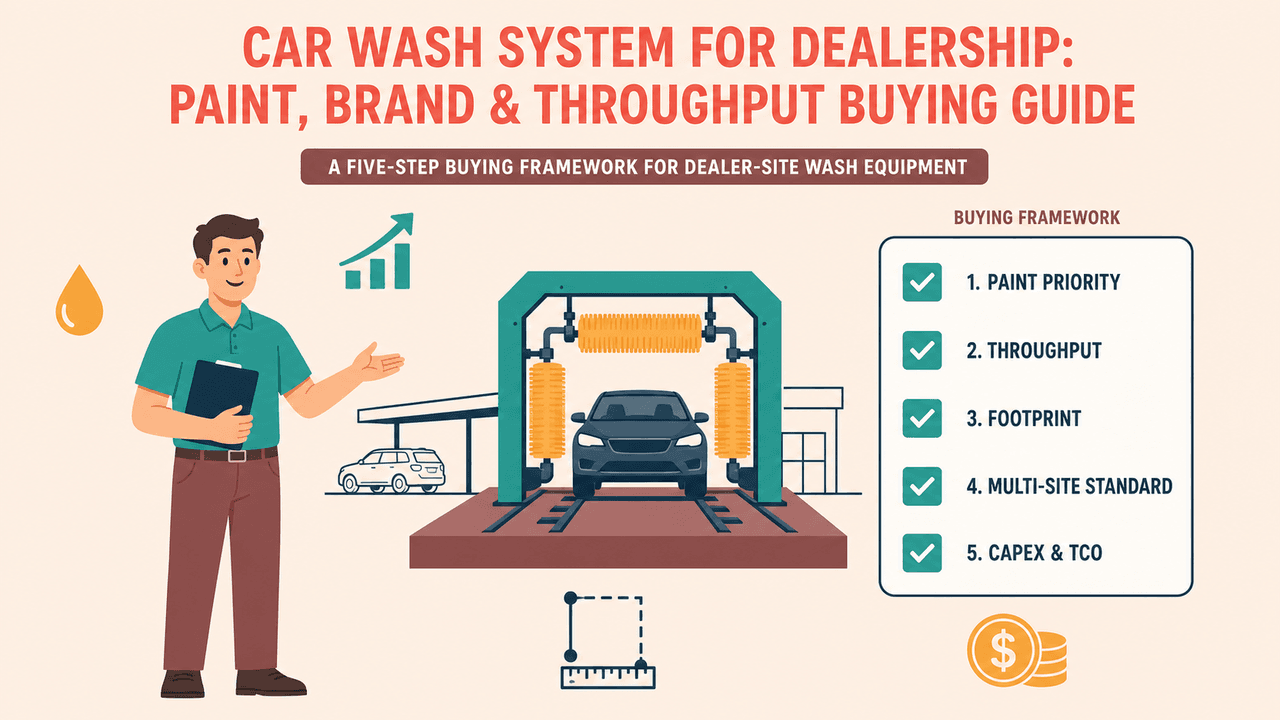
How to choose a car wash system for dealership operations: a five-step framework
Run these five steps before talking to any vendor. The framework is architecture-agnostic — it surfaces the answer the site and operation already imply.
Step 1 — Inventory the wash demand. Add up service ROs per day with a courtesy wash, PDI deliveries per week, recon trade-ins per week, retail-wash volume. The total daily demand drives architecture selection.
Step 2 — Profile inventory paint-sensitivity. What percentage of vehicles passing through the wash are ceramic-coated, matte-finish, or PPF-wrapped? The paint-sensitivity mix determines whether a paint-safe brush rollover is enough or whether touchless should be in the answer.
Step 3 — Survey the site. Measure available footprint. Confirm 380V three-phase electrical capacity, municipal water supply, and drainage. Note integration with existing detail bay and service drive — wash equipment competes with parking and recon staging for square footage.
Step 4 — Set the multi-site standard if applicable. If the operation is a dealer group, decide whether every dealership adopts the same architecture. For factory-fresh-paint adjacent operations and brand-protection-first standardization, BYD's factory new-vehicle wash standardization on TX-380 is the working precedent.
Step 5 — Build the capex + TCO model. Add equipment + install + utilities + chemistry + maintenance over a 5-10 year horizon. The bigger lever in payback math is usually throughput × ticket × utilization, not architecture. Pair this step with the capex and total cost of ownership breakdown, the ROI and payback period model, and the equipment maintenance schedule.
HyTian has been engineering car wash systems for over three decades — since 1992, as Nanjing Haiying Machinery — with 20,000+ systems deployed across 40+ countries under ISO 9001, ISO 14001, and CE conformity.
Key takeaways
Paint safety is non-negotiable. EVA closed-cell foam brushes and touchless high-pressure architecture are the two paint-safe answers in 2026 — and brush-material specificity is the equipment-tier signal.
Architecture fits volume. Paint-safe brush rollover for under 20 washes per day, conveyor tunnel for 50+, with touchless as the brand-protection-first option when the inventory mix leans ceramic, matte, or PPF.
Service-drive, PDI, and recon throughput is the real economic case. Wash equipment is a turnover lever and a days-to-front-line lever — not an amenity.
Footprint decides the install. Paint-safe brush rollover and touchless fit existing service-bay drops; conveyor tunnel needs a dedicated wash building.
OEM-grade paint safety is provable. BYD's factory new-vehicle wash standardization on HyTian TX-380 is the working proof the brush specification holds across high-volume production cadence.
Let's walk the paint-safety, throughput, and footprint math for your dealer site
Weighing a wash bay for your dealer site? Whether you're a single-site operator looking at a paint-safe brush rollover or a dealer group standardizing a wash architecture across stores, our engineering team can walk you through the paint-safety profile of your inventory, the throughput math for your service drive, and the footprint and utilities reality for your site. Start with our dealer and service center solutions overview, then book an engineering conversation about what fits your operation.
Related articles
Explore more insights from the HyTian team.
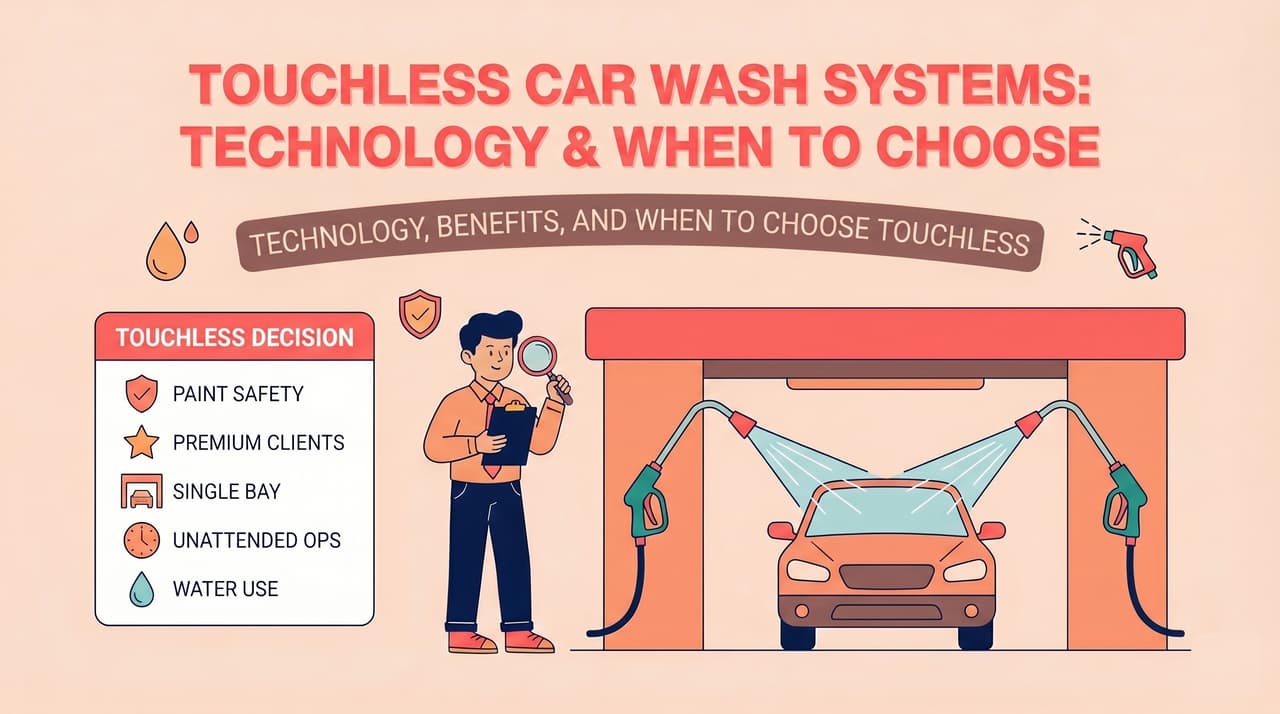
Touchless Car Wash Systems: Technology, Benefits, and When to Choose Touchless
Touchless car wash systems explained: how the technology works, honest tradeoffs vs soft touch, and when touchless is right for your site.
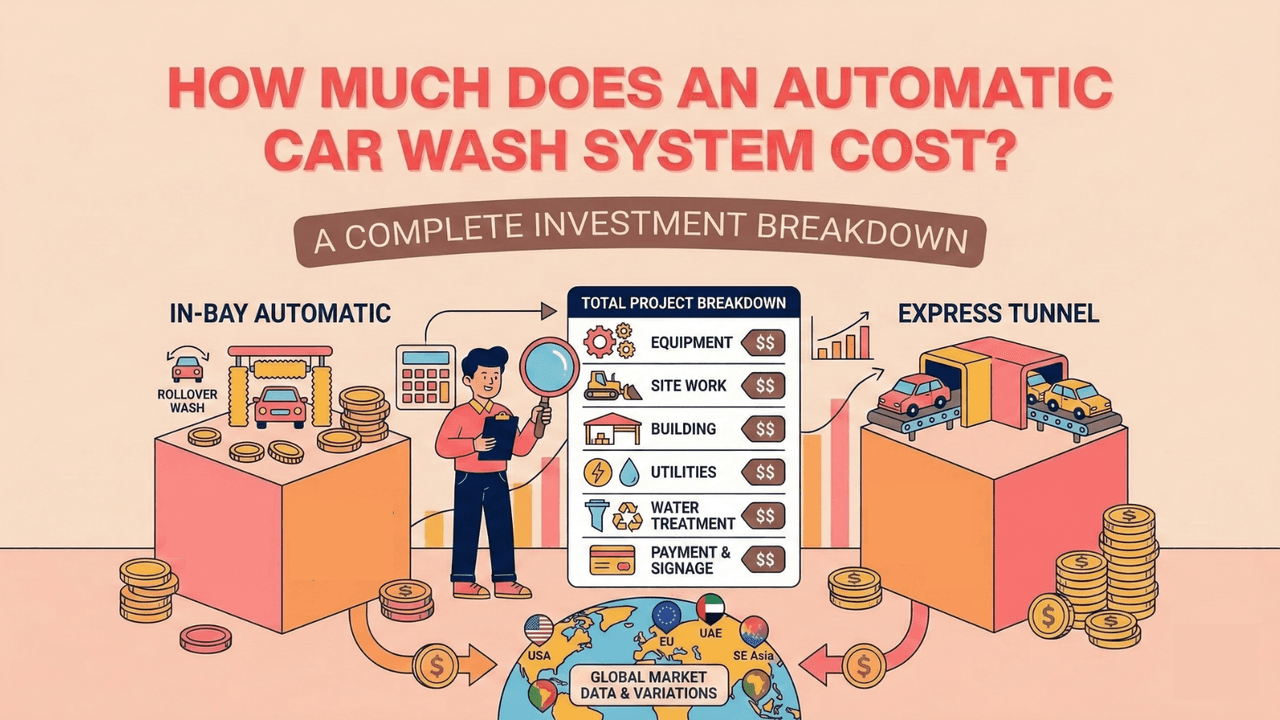
How Much Does an Automatic Car Wash System Cost? A Complete Investment Breakdown
Automatic car wash system costs range from $15,000 to $350,000+ for equipment alone. Here's what drives the price, what the total investment looks like, and how to compare quotes.
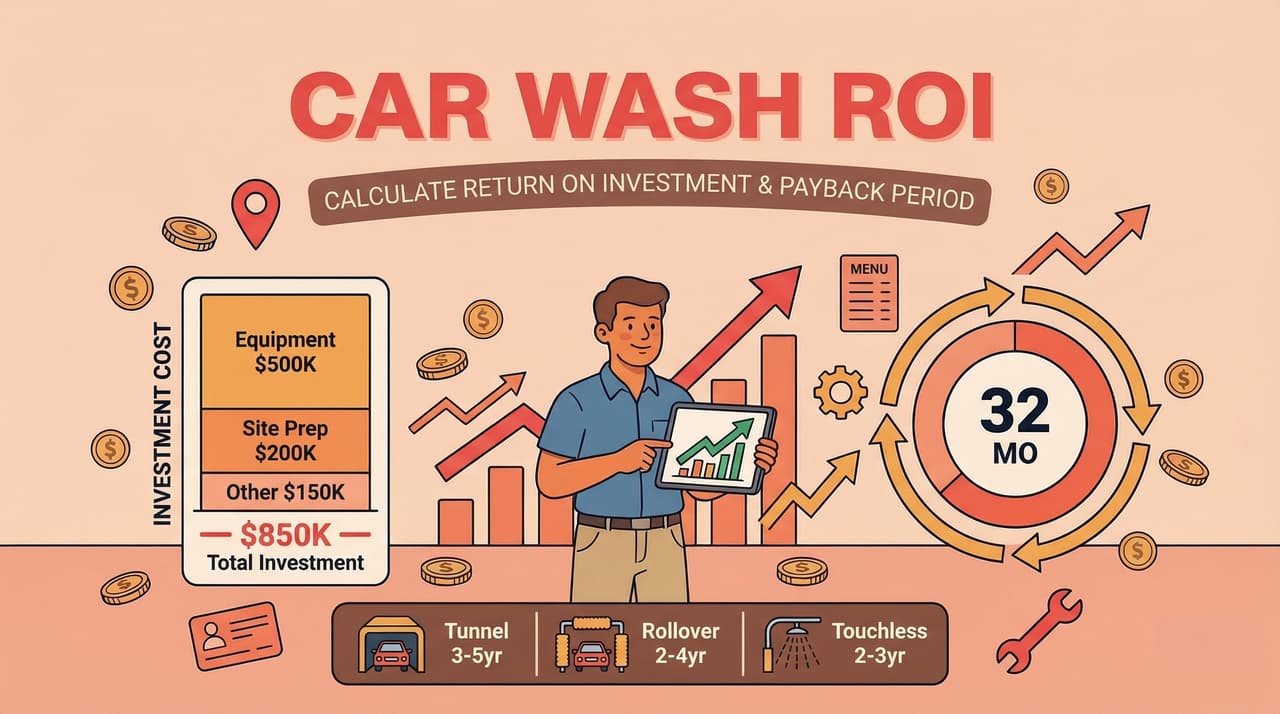
Car Wash ROI: How to Calculate Your Return on Investment and Payback Period
Car wash ROI typically ranges 20–35% annually with 2–5 year payback. Learn how to calculate your return, compare system types, and accelerate break-even.