
Touchless Car Wash Systems: Technology, Benefits, and When to Choose Touchless
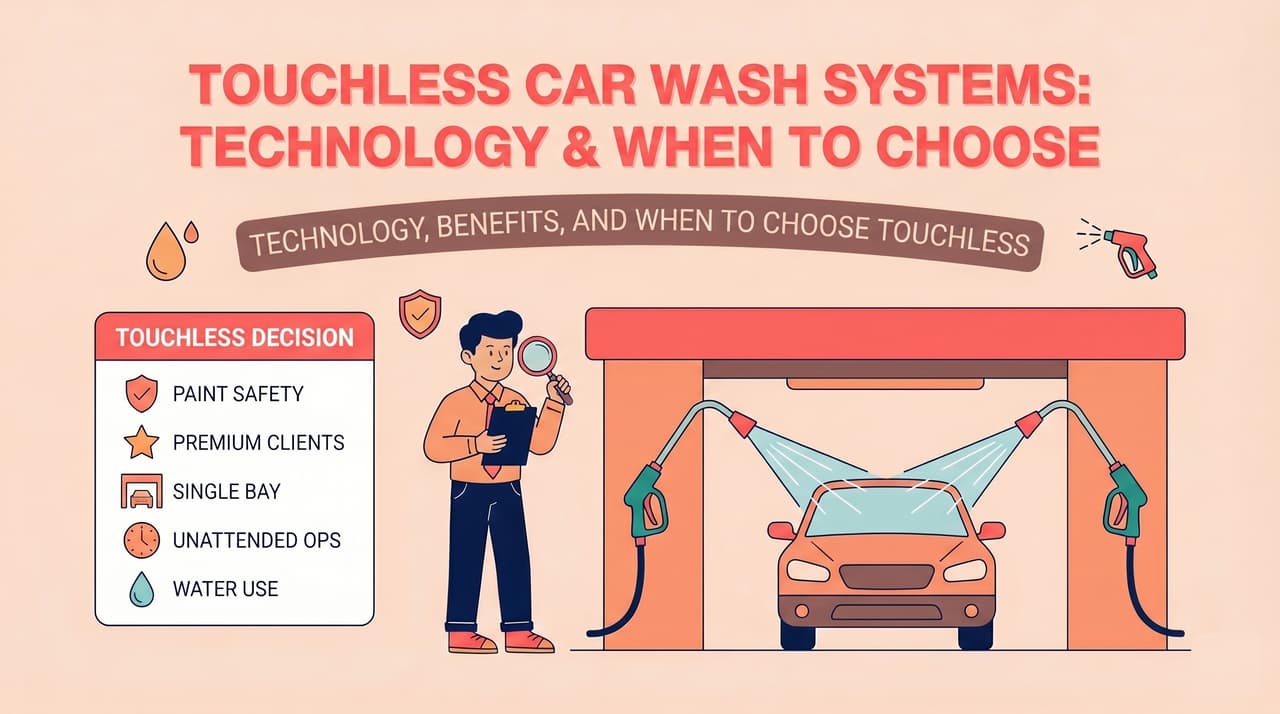
Touchless Car Wash Systems: Technology, Benefits, and When to Choose Touchless
You may be evaluating a touchless car wash system for a new site, a supplementary bay, or a paint-safety-conscious clientele. The category has real pull. Nearly 48% of consumers now prefer touchless or soft-touch over manual or friction-heavy washes. But touchless isn't right for every operation. HyTian engineers the full range of automatic systems — tunnel, rollover, touchless, bus and truck, wheel wash, and custom builds — so we can tell you where touchless genuinely wins and where it doesn't.
What a touchless car wash system actually does
A touchless car wash system cleans a vehicle without any physical contact. Instead of rotating brushes or cloth curtains, it uses a sequence of chemistry and high-pressure water: a pre-soak detergent loosens road film, a dwell phase lets that chemistry do its work, and high-pressure jets strip everything off the paint surface. Some operators also search this category as "brushless car wash" — same thing, different label.
That no-contact approach is the whole argument. It's why touchless appeals to premium markets, paint-safety-conscious clienteles, and any operator whose brand promise leans on "nothing ever touches your car." HyTian touchless systems are engineered for exactly those situations — locations where brush contact is a concern, and premium vehicle service programs where the cost of a single paint complaint outweighs almost any other variable.
But consumer preference cuts both ways. The same research that shows 48% preference for touchless or soft-touch also shows the other half prefers something else. So the honest question isn't "touchless or not?" — it's "touchless for which site, which clientele, which business model?"
Inside a touchless wash cycle
The working principle is a two-stage cleaning sequence. First, an alkaline or acidic pre-soak is applied to the vehicle. The chemistry dwells for 30 to 90 seconds, emulsifying road film, bug residue, and surface contamination. Second, high-pressure water (typically around 1,000 to 1,500 psi) strips that loosened debris off the paint. A final spot-free rinse and air-dry cycle closes the wash.
- Alkaline pre-soak
- Dwell (30–90 sec)
- High-pressure rinse
- Spot-free rinse & air dry
Three variables determine wash quality: pressure, dwell time, and chemistry balance. Push pressure too high and you waste energy. Shorten dwell time and the chemistry hasn't finished its job. Under-dose the detergent and the pressure jets have nothing to strip off. Chemistry discipline matters more on a touchless system than on almost any other configuration. It's the cleaning lever that replaces mechanical friction.
That's also where manufacturer tier shows up in the spec sheet. HyTian's TX-380 tunnel runs CNC metering pumps with 0.28 mL chemical dosing precision. That precision extends drum life to roughly 3,000 washes per 20 kg drum. The same engineering discipline applies to touchless dosing — just with more at stake, because chemistry is doing more of the cleaning work.
Water consumption is the other variable worth understanding up front. Touchless systems typically use between 15 and 70 gallons per wash, depending on system age and efficiency. Newer designs run around 43 gallons. Older in-bay units can consume 70 to 80. Water recycling integration changes that math considerably — more on that below.
Is touchless car wash safe for paint?
Yes, with one caveat operators should know. The no-friction design eliminates the most common source of micro-scratches — grit carryover from under-maintained brushes on friction systems. That's a real paint-safety benefit. The caveat: touchless chemistry is stronger than soft-touch chemistry because it has to do more of the cleaning work, and stronger alkaline detergents can temporarily strip wax or sealant layers. The paint itself isn't damaged — but the protective top layer may need re-application sooner than on a gentler system.
Touchless vs soft touch car wash: honest tradeoffs
Most operators ask the touchless-versus-soft-touch question at the wrong level. The real question isn't "which is better?" — it's "which tradeoff fits your site and your clientele?"
Dimension | Touchless | Soft Touch (Friction) |
|---|---|---|
Cleaning mechanism | High-pressure water + chemistry | Foam brushes + chemistry |
Deep-clean on heavy road film | Moderate | Strong |
Paint-safety perception | Strong | Depends on brush condition |
Chemistry requirement | Stronger detergents | Gentler detergents |
Water usage per wash | 15–70 gal | 20–40 gal |
Wear parts | Nozzles, pumps | Brushes, foam, bearings |
Throughput (single bay) | 10–20 vehicles/hr | 15–25 vehicles/hr |
Typical equipment cost | $15k–$30k (entry) | $30k–$80k (entry) |
Soft touch wins on deep-clean capability. Foam brushes dislodge bonded road film that chemistry alone struggles with — especially in salt-belt climates or markets where vehicles arrive with weeks of accumulated grime. HyTian's EVA closed-cell foam brushes on the TX-380 tunnel system are designed to resist grit carryover and deliver consistent pressure across clearcoats, wipers, and mirrors — a friction system engineered for paint safety, not against it. BYD standardized its factory PDI wash on the TX-380 precisely because paint safety on factory-new vehicles is non-negotiable.
Touchless wins on paint-safety perception and maintenance simplicity. No brushes means no brush wear, no foam replacement, no grit-carryover risk if maintenance slips. For sites where the staff model is minimal or the bay runs unattended overnight, that simplicity matters.
And increasingly, operators run both. Hybrid configurations — a friction primary bay plus a touchless supplementary bay, or vice versa — show up in 2026 market analysis as the fastest-growing configuration. One system doesn't have to win. Depending on your site and clientele, the right answer may be both. A space-constrained single-bay site can also consider rollover or gantry systems as a compact friction alternative.
When to choose touchless (and when not to)
Here's the decision framework we'd walk an operator through.
Choose touchless if:
- Your clientele skews premium — luxury vehicles, ceramic-coated paint, newer clearcoats where any perceived risk is unacceptable
- Paint safety is a marketing differentiator in your market (common in parts of Asia, the Middle East, and premium urban markets)
- Your site footprint is limited to a single bay and you want the simplest maintenance profile
- You operate unattended or with a minimal-staff model and need equipment that forgives a lighter service cadence
- You want to run a touchless bay alongside a friction tunnel to cover paint-safety-conscious clients
Don't choose touchless if:
- You're operating a high-throughput express model — friction tunnels deliver 50 to 60+ vehicles per hour with a deeper clean, which touchless can't match at any price point
- Your clientele expects visibly deep-clean results on heavy road film, mud, or construction grime
- You operate in a region with expensive water or strict wastewater regulations and can't integrate a recycling system to offset the 30–70 gal per-wash reality
If you're not sure which side of that line your site falls on, we'd rather tell you honestly than sell you the wrong system. That's the conversation we have with most operators before any configuration is recommended.
Investment, throughput, and operating economics
Touchless is typically the lowest-capex entry into automatic wash. Core equipment runs $15,000 to $30,000 for most configurations. Fully featured, it can climb to roughly $55,000. That's meaningfully below tunnel territory — and the revenue ceiling is meaningfully lower too. Plan for 10 to 20 vehicles per hour single-bay versus 50 to 60+ for a friction tunnel.
Touchless by the Numbers | |
|---|---|
Equipment cost range | $15,000 – $30,000 (entry); up to $55,000 fully featured |
Throughput (single bay) | 10 – 20 vehicles/hr |
Water usage | 15 – 70 gal/wash (newer systems ~43 gal) |
Retail per-wash pricing | $8 – $12 |
Monthly water/sewer | $800 – $2,500 |
Monthly electricity | $500 – $1,200 |
Monthly chemicals | $400 – $1,000 |
2026 market size | $6.58B, growing 7% CAGR to $12.13B by 2035 |
Those monthly operating ranges (from industry pricing data) add up. Water and sewer is the biggest lever — and where water recycling integration earns its capex. Consider a system running at 60 gal per wash with 1,500 washes per month. That's nearly 90,000 gallons through your meter. Recycling can reclaim a substantial share of that. The result: lower operating cost and less compliance risk in water-constrained markets. HyTian's TX-380 and TH-Series both support integrated recycling for that reason.
For the full payback math, our ROI framework walks through how to model these numbers against your specific throughput and pricing. If you want the broader comparison across all automatic wash categories, the full cost breakdown across system types covers tunnel, rollover, and touchless side by side.
Where HyTian touchless systems fit
Over 20,000 HyTian systems are running across 40+ countries, and touchless deployments cluster around a few distinct application patterns.
Premium dealership and OEM service centers are the cleanest fit. A factory-new vehicle can't tolerate paint risk, and a paint-safe wash is part of the delivery experience. HyTian's paint-safety engineering carries across the product line — BYD standardized its factory PDI wash on the TX-380 friction tunnel precisely because our EVA brushes were engineered to protect factory-new clearcoats, not work against them. Touchless extends that same discipline to service centers handling high-value client vehicles.
Gas stations in paint-safety-sensitive markets are the second pattern. If you're evaluating touchless as part of adding a car wash to your gas station, the appeal is simple: a touchless bay signals care to premium-vehicle clients in markets where brush damage is a live concern.
Standalone single-bay and unattended configurations are the third. When the operating model is 24/7 automated with minimal staffing, touchless simplifies the service cadence — no brushes to inspect, no foam to replace, no grit-carryover risk if maintenance slips by a week.
The fourth pattern is supplementary: a touchless bay inside a multi-bay operation that's otherwise built around a friction tunnel, covering paint-safety-conscious clients without forcing the whole site to commit to one approach.
Service, support, and what to ask before you buy
Touchless maintenance looks different than soft-touch. Fewer moving parts mean fewer wear items — no brushes to replace, no foam bristles to rotate — but more chemistry discipline: concentration, pH, dwell time, and nozzle calibration all need ongoing attention. The maintenance spend shifts from mechanical to chemical.
HyTian's service model is site-first. We start with a site assessment before specifying equipment — throughput targets, footprint, water constraints, clientele profile, staffing model — and recommend the configuration that fits. With 30+ years of manufacturing experience and systems running across 40+ countries, our CE, ISO 9001, and ISO 14001 certifications carry internationally, and our engineering team supports deployment through remote commissioning when local travel isn't practical.
Before you sign a touchless contract — with us or anyone else — ask the following:
- Chemical reclaim and reuse: Can the system recycle pre-soak chemistry or is it single-pass?
- Water recycling integration: What's the recycling capacity, and what's the expected reclaim percentage?
- Spare parts availability: What's the regional lead time on nozzles, pumps, and pre-soak injectors?
- Warranty terms: What's covered, for how long, and what's the service response commitment?
- Regional compliance: CE, ISO 9001, ISO 14001 for most international markets — plus any local certifications your jurisdiction requires.
Key takeaways
- Touchless uses high-pressure water plus stronger chemistry to clean without physical contact — eliminating friction scratches but relying more heavily on chemistry precision.
- Against soft-touch, touchless wins on paint-safety perception and maintenance simplicity; soft-touch wins on deep-clean capability and per-bay throughput.
- Choose touchless for premium-vehicle clienteles, paint-safety-sensitive markets, single-bay or unattended sites; don't choose it for high-throughput express models or heavy-soil expectations.
- Equipment starts around $15,000 with lowest-in-category capex, but water usage (15–70 gal/wash) makes recycling integration a real economic lever.
Thinking about touchless for your site — or weighing it against a friction system? Tell us about your throughput targets, paint-safety concerns, and site constraints, and our engineering team will recommend the right configuration. Talk to our engineering team.