
The Global Car Wash Equipment Market: Size, Growth, and Opportunity by Region
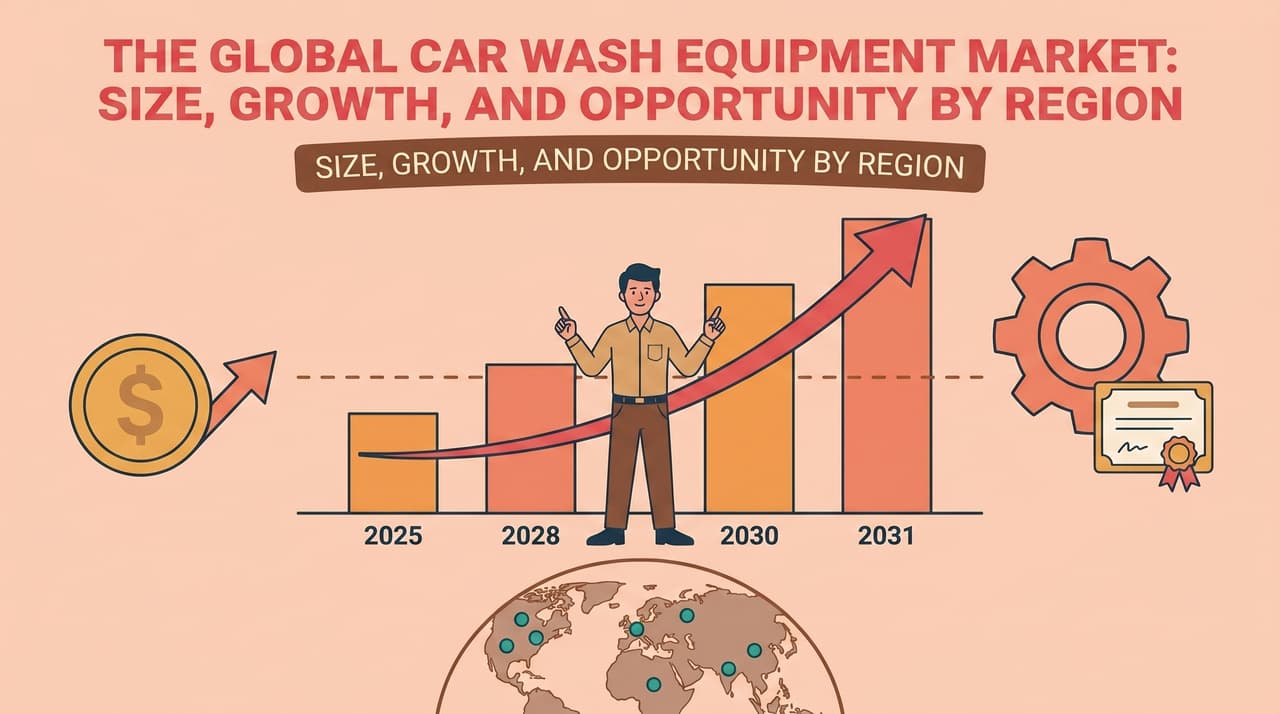
The Global Car Wash Equipment Market: Size, Growth, and Opportunity by Region
Distributors evaluating which markets to enter rarely have the luxury of guessing. Whether you're sizing a single-country opportunity or weighing North America against Asia-Pacific, you need credible numbers — and a read on what those numbers look like at the deployment level. This guide sizes the global car wash equipment market, breaks down growth by region and equipment type, and translates the data into the questions a regional partner has to answer before signing a manufacturer agreement.
We've engineered this view from the operator's seat. With 20,000+ HyTian systems running across 40+ countries — including blue-chip clients like Audi, BMW, BYD, Honda, Hyundai, Mercedes-Benz, Shell, and Volvo — we see where capacity is going in, not just where market-research firms say it should be going.
How Big Is the Global Car Wash Equipment Market — and Why Distributors Should Care
According to Mordor Intelligence's 2025-2031 outlook, the global car wash market grew from $28.07 billion in 2025 toward $30.35 billion in 2026 and is projected to reach $43.65 billion by 2031, advancing at a 7.54% CAGR. That's the car wash equipment market size figure most distributors anchor on first.
The headline hides a useful distinction. "Car wash market" usually refers to the broader services market — what end-users spend on washing vehicles, including labor, real estate, chemicals, and equipment depreciation. The narrower equipment-only market — capex on new and replacement systems — is significantly smaller. FactMR estimates the global car wash systems market at roughly $1.9 billion in 2025, growing toward $3 billion by 2035 at a ~4.6% CAGR.
Market View | 2025 Size | 2031 / 2035 Outlook | CAGR | What It Tells a Distributor |
|---|---|---|---|---|
Global car wash services market | ~$28.07B | ~$43.65B by 2031 | 7.54% | Total demand pool — drives site openings |
Global car wash equipment market | ~$1.9B | ~$3B by 2035 | ~4.6% | Addressable capex — your top line |
Sources: Mordor Intelligence (services), FactMR (equipment).
Both numbers matter, but they answer different questions. Services-market growth signals where new sites are opening. Equipment-market growth is the addressable capex distributors and manufacturers share. Every percentage point of services growth eventually translates into new-site openings — and the equipment dollars that follow.
The strategic question isn't whether the pie is growing, but where to focus inside it. Our 30+ years of manufacturing experience supplying mature North American chains, fast-modernizing Asian markets, regulation-led European deployments, and bespoke Latin American transit projects is the lens we apply to the data below.
Where the Market Is Today: Regional Breakdown and Growth Outlook
Distributors typically scan this section first, so we lead with the comparison view and then dig into each region. The table below is a 2025 services-market snapshot — the layer where regional shares are most reliably published. Equipment capex broadly tracks services, with a lag and a mix shift toward the formats each region favors.
Region | 2025 Share / Position (services market) | Projected CAGR through 2031 | Dominant Equipment Formats | Key Demand Drivers |
|---|---|---|---|---|
North America | ~40.76% — largest share | ~5-6% (steady) | Express exterior tunnels, in-bay automatic | Subscription/membership, multi-site consolidation, fuel-retailer wash adds |
Asia-Pacific | High-growth, regionally fragmented | ~8.43% — fastest globally | Compact rollover, modular tunnel, touchless | Vehicle ownership growth, urbanization, modernization of manual/coin bays |
Europe | Mature, steady | ~4-5% | Rollover/gantry, water-reclaimed tunnel | Regulatory upgrades, EV-compatible wash, sustainability investment |
Middle East & Latin America | Smaller absolute, high-growth pockets | Variable — vertical-driven | Rollover, custom commercial, wheel wash | GCC fuel retail, transit and rail expansion, mining compliance |
Share data: Mordor Intelligence 2025. CAGRs reflect public outlook ranges; equipment-market CAGRs run lower than broader services figures.
The 40.76% figure is North America's share of the services market, not the equipment-only market. Equipment shares track services but diverge with format mix — express-tunnel regions concentrate more capex per site than rollover-heavy ones.
North America — Mature Market, Scale of Incumbents
North America holds approximately a 40.76% share of the global services market in 2025, the largest single regional position. The format mix skews heavily toward express exterior tunnels and subscription/membership business models. Grand View Research confirms subscription growth as a primary engine of mature-market scale — monthly unlimited-wash plans drive recurring revenue per site, justifying tunnel-grade capex per location. Consolidation reinforces the dynamic: multi-site operators standardize equipment across regional networks and add wash to fuel-retail forecourts.
For distributors, the implication is specific:
Mature but high-density. New tunnel greenfields are slowing in absolute terms; volume opportunity sits in retrofits, format upgrades, and parts/service to existing fleets.
Multi-site operators set the spec. A manufacturer without modular, consistent configurations across many sites cannot win these accounts. The HyTian TX-380 tunnel platform was designed for this pattern — configurable tunnel length, multiple conveyor options (heavy-duty chain or slide-rail), configurable dryer arrays, and multiple SKU configurations sized to site volume and power availability. Throughput is 50-60 vehicles per hour, with EVA closed-cell foam brushes engineered for paint safety on modern clearcoats.
Service revenue is the long-tail. Recurring chemical, parts, and maintenance contracts often outpace initial-sale margin over a system's life.
HyTian's North American footprint includes a U.S. subsidiary and annual presence at the ICA show in Las Vegas, where multi-site operators evaluate manufacturers for standardized rollouts.
Asia-Pacific — Fastest Growth, Modernization Driver
Asia-Pacific is the fastest-growing region globally, with Mordor Intelligence forecasting an 8.43% CAGR through 2031. The drivers are structural: rising vehicle ownership, urbanization, and the modernization of manual and coin-operated wash bays into automated formats. Pace varies by country — Japan, Korea, China, Southeast Asia, and Australia each show distinct demand profiles — but the direction is consistent.
Space is the recurring constraint. Many Asian retail and forecourt sites cannot accommodate the long express tunnels typical in North America, favoring compact rollovers, modular tunnels with short footprints, and touchless formats where local water and chemical regulations apply.
Splash N Go is the proof point we cite most often for the region. The client introduced HyTian TX-380 tunnel washes into a Japanese market historically dominated by compact gantry systems, achieving 500+ washes per day during peak periods at flagship sites. The deployment grew into a multi-site franchise network supported by a dedicated HyTian distributor and service team — one of the first imported tunnel washes in Japanese retail car wash shops. Full story in our Japan tunnel deployment case study. HyTian deployments at BYD facilities show factory PDI (pre-delivery inspection) demand inside the region's automotive manufacturing base — industrial capex complementing retail-site capex.
Two practical points for partners evaluating the region:
Supply reliability is non-trivial. Our Nanjing Binjiang plant runs at a 3,000-unit annual capacity — underwriting lead times and product availability for distributors who can't afford to compete on commitment dates.
Local navigation is the gating factor. Country-by-country fragmentation (compliance, language, dealer relationships) makes this the highest-leverage region for partners who can run the local layer well.
Europe — Regulation-Driven, Sustainability-Led
Europe is mature with steady single-digit growth, but the demand pattern is shaped less by site count and more by regulatory upgrades. Water reclamation, ISO 14001 environmental compliance, noise and effluent rules, and sustainability investments are the budget drivers across many sub-markets. EV compatibility — wash configurations safe for the lower ground clearance and sensor housings of modern EVs — is increasingly part of the spec.
The implication is simple: in mature European markets, technical compliance is the gating factor, not price. Manufacturers without the right paperwork are eliminated before the technical evaluation begins.
HyTian operates against a complete compliance stack — CE Conformity for machinery safety (the threshold requirement for EU sales), ISO 9001 for quality management, and ISO 14001 for environmental management (increasingly bid-stipulated in European public-sector and large-fleet procurement). We engage the European distributor channel through trade-show presence at Automechanika Frankfurt.
Middle East and Latin America — Emerging, Custom-Engineering Territory
These regions are smaller in absolute share but contain high-growth pockets that don't always show up in headline regional CAGRs. Three demand drivers stand out: fuel-retailer wash additions in the GCC (where premium-service models and a growing vehicle parc support tunnel and high-spec rollover deployments); public transit and rail expansion in Latin America (where bus, light rail, and metro fleets need depot-rate wash systems for non-standard vehicle geometry); and construction and mining compliance (where wheel-wash systems address regulatory road-cleanliness requirements at site exits).
The Bolivia tram operator project (deployed and exported in 2023) shows how Latin American demand often plays out. The challenge was a streamlined 33.76-meter light rail vehicle with identical front and rear ends and protruding rearview mirrors — geometry no off-the-shelf system could handle. We engineered a custom dual-mode wash: stationary mode for the complex front and rear ends, and tunnel mode for the long body section. The system uses 8 brush groups, including tilting brushes that conform to streamlined head shapes, rotating high-pressure nozzles for windshield areas obstructed by mirrors, and integrated water recycling.
The structural takeaway: emerging-region opportunity often comes through bespoke or vertical-specific deployments rather than commodity tunnel sales. Partners who win in these regions sell engineering capability, not just catalogs. HyTian's regional footprint here includes a Zambia subsidiary, distributor relationships across the GCC, and a construction/mining wheel-wash product line for site-compliance applications.
Car Wash Equipment Market Size by Segment — Where the Growth Is
Region is one cut. Equipment format is the other. A 4% CAGR in tunnel-dominated markets still represents far more dollars than an 8% CAGR in a smaller services market — distributors should weight by absolute equipment demand, not just headline growth percentages.
The five segments we track:
Tunnel / conveyor — Largest absolute revenue concentration, especially in mature markets and consolidation plays. Modular platforms (configurable length, conveyor type, dryer mix) win the multi-site operator pattern. Production-grade tunnel throughput typically lands at 50-60 vehicles per hour.
Rollover / in-bay automatic — Dominant where space, capex, or volume favors a single-bay format. The default for most gas stations, dealerships, and small-chain operators. Steady demand, lower per-site capex, more sites per dollar of total market.
Touchless — A niche but growing segment in paint-sensitive premium service (luxury dealerships, high-end retail) and regions where brush contact triggers operator caution. We cover the broader technology direction in our 2026 industry trends post.
Bus / truck wash — Smaller absolute revenue than retail formats but high-margin and low-competition. Public transit, rail depots, mining, and large-fleet operators need depot-rate throughput. Our TH-Series achieved up to 80 buses per hour at depot peak in our Zhuhai bus fleet deployment, with integrated water recycling and a compact footprint that fit existing depot infrastructure without major rebuild.
Wheel wash — Specialized equipment for construction, mining, and quarry sites where road-cleanliness regulations require wheel cleaning at site exits. Smaller in absolute revenue, but with little crossover competition from car-focused manufacturers.
The portfolio implication is strategic. A region with strong fleet-vehicle demand (Latin American transit, GCC construction) needs bus, truck, and wheel-wash capability beyond the retail product line. A region with premium-service demand needs touchless and modular tunnel options. Single-segment manufacturers force distributors to choose markets that match their one product category — full-portfolio manufacturers let the distributor follow regional opportunity wherever it goes.
The car wash equipment market forecast 2031 through this segment lens: tunnel revenue grows fastest in absolute dollars in mature markets; rollover continues as the volume backbone in fragmented and emerging markets; touchless grows fastest in percentage terms but from a smaller base; bus/truck and wheel wash grow with infrastructure investment cycles. The tunnel car wash market segment is where consolidation is most visible.
What the Data Means for Distributors Evaluating the Opportunity
Headline figures matter, but the decisions distributors make are not headline decisions. The questions that get asked in real partnership conversations look more like this:
Does the manufacturer's product range cover the formats your region actually demands? Regional growth is heterogeneous. A tunnel-only manufacturer won't help where 70% of demand is rollover. The HyTian portfolio is built for full-coverage flexibility — tunnel (TX-380), rollover, touchless, bus/truck (TH-Series), wheel wash, and custom engineering for non-standard requirements. Full-portfolio access lets a distributor follow regional demand across formats without switching suppliers.
Does the manufacturer hold the certifications your region requires? In mature markets, CE, ISO 9001, and ISO 14001 are gating, not differentiators. A manufacturer that can't produce them is filtered out before the technical conversation. In emerging markets, the same certifications accelerate approval for tenders and government-adjacent procurement.
Does the partnership model treat you as a long-term partner or a one-time sale? This is where partnership choices outlast equipment choices. The recurring economics of car wash equipment — service contracts, parts, chemicals — last well beyond the initial system sale. CNC metering pumps with 0.28 mL precision in our TX-380 platform, for example, extend chemical drum life to approximately 3,000 washes per 20 kg drum — a recurring-revenue lever that compounds over years. The Splash N Go deployment in Japan is the clearest example of how this plays out in practice: a multi-year, multi-site relationship with a dedicated HyTian distributor and service team in-country, not a single transactional shipment.
For a deeper view of what to look for when evaluating a car wash equipment manufacturer partnership, our companion guide walks the full criteria list.
Key Takeaways
For a distributor sizing where to focus, four points carry most of the weight:
Distinguish services from equipment. Headline car wash market figures ($28-30B today, $43.65B by 2031) describe end-user services spend. The narrower equipment market ($1.9-3B) is where distributors compete for capex revenue. Track both.
Region first, segment second. North America is mature and tunnel-heavy. Asia-Pacific is fastest-growing and modernization-driven. Europe is regulation-led and compliance-gated. Middle East and Latin America are vertical and custom-engineering territory.
Match portfolio to regional demand. Single-segment manufacturers limit your reach. Look for full-portfolio coverage — tunnel, rollover, touchless, bus/truck, wheel wash, and custom — to follow regional growth across formats.
Partnership economics outlast initial sales. Service, parts, and recurring chemical revenue are where distributor margin compounds. Specify the long-term model up front.
Sizing the car wash equipment opportunity in your region? Let's discuss partnership opportunities — our engineering team can walk you through HyTian's product range, regional support model, and where partners are seeing the strongest pipeline today.
Related articles
Explore more insights from the HyTian team.
2026 Car Wash Industry Trends and Automation Benefits
Automation cuts labor hours per wash, keeps quality consistent and makes uptime plannable. The 2026 car wash industry trends shaping equipment decisions.
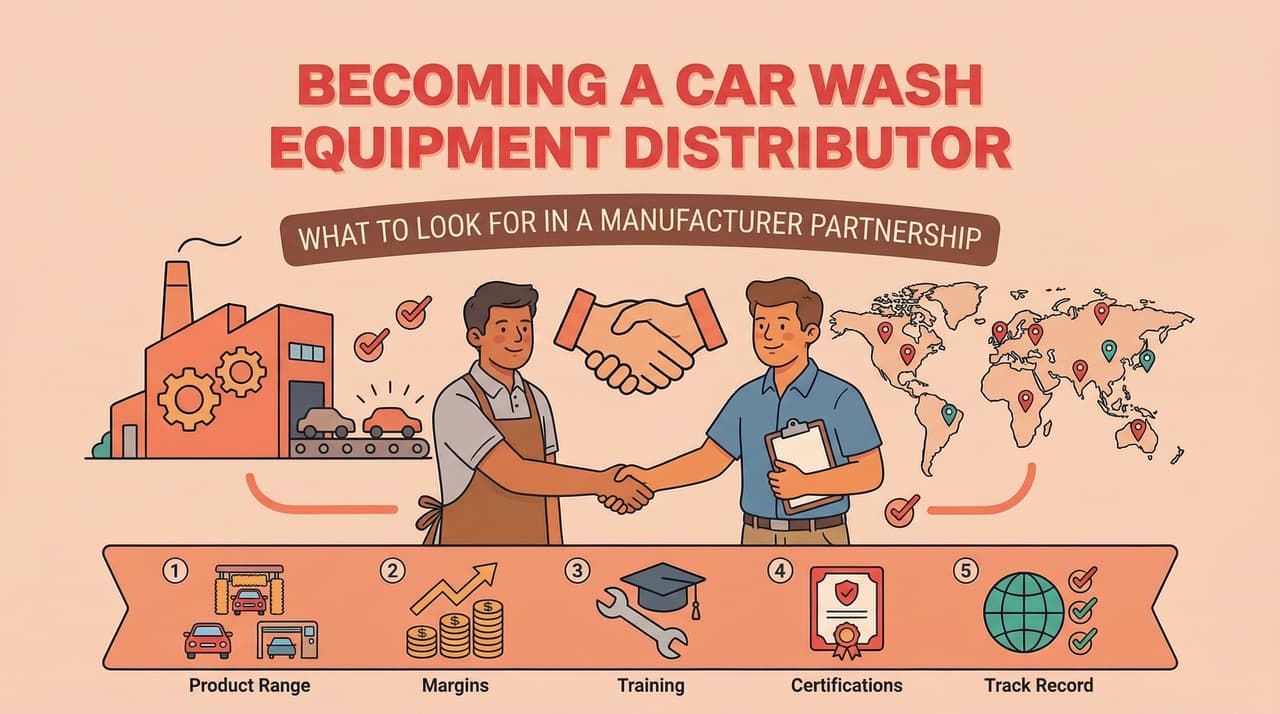
Becoming a Car Wash Equipment Distributor: What to Look for in a Manufacturer Partnership
Evaluating car wash equipment distributor partnerships? Five factors — from product range to global track record — that separate strong manufacturer relationships from risky ones.
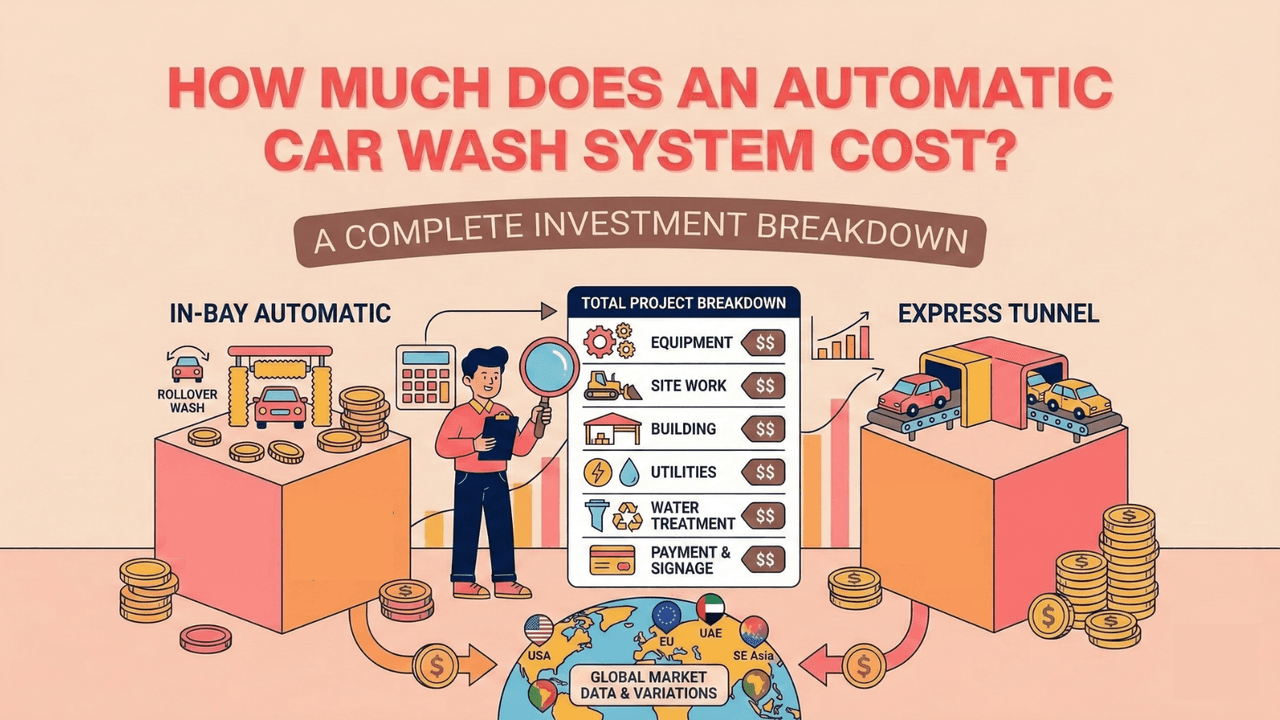
How Much Does an Automatic Car Wash System Cost? A Complete Investment Breakdown
Automatic car wash system costs range from $15,000 to $350,000+ for equipment alone. Here's what drives the price, what the total investment looks like, and how to compare quotes.