
Tunnel vs. Rollover vs. Touchless: How to Choose the Right Automatic Car Wash System
1. Introduction: Why Your Choice of Automatic Car Wash Type Matters
If you operate a gas station, convenience store, dealership, independent car wash or fleet depot, adding or upgrading an automatic car wash system is one of the highest-impact investments you can make. The type of system you choose—conveyor tunnel, rollover / in-bay automatic, or touchless automatic—will dictate:
- How many vehicles you can wash per hour
- What kind of customer experience you deliver
- Your construction and utility costs
- Your ongoing labor and maintenance profile
- Ultimately, your return on investment (ROI)
This guide is written for fuel retailers, C-store owners, car wash investors, dealership and service managers, and fleet operators who are deciding which type of automatic car wash system to buy.
Drawing on industry benchmarks and HyTian’s 30+ years of engineering experience in tunnels, rollovers, touchless machines, bus & truck washers, wheel wash and customized lines, we’ll walk through the major system types, compare them side-by-side, and then apply that to real-world site scenarios.
By the end, you should have a clear shortlist of which system type fits your site—and what to ask manufacturers when you request a quote.
2. Types of Automatic Car Wash Systems at a Glance
Commercial automatic car wash equipment is usually grouped by layout (how vehicles move) and wash method (brush vs touchless). The three core types in this guide are:
2.1 Conveyor tunnel car wash
A conveyor tunnel car wash uses a belt or chain conveyor to pull vehicles through a tunnel where fixed arches and brushes perform pre-soak, washing, rinsing, waxing and drying in sequence. Multiple vehicles are inside the tunnel at once, so throughput is high: industry sources report that tunnels commonly process 40–60 cars per hour, with larger express tunnels designed for up to 100+ cars per hour in peak conditions.
Tunnels are typically used at:
- High-volume express wash sites
- Busy fuel stations and C-stores with strong traffic
- Standalone car wash businesses focused on memberships and high throughput
HyTian’s TX-380 conveyor tunnel series is an example of this category, engineered for high cars-per-hour with modular brush and drying configurations based on site volume and length.
2.2 Rollover / in-bay automatic car wash
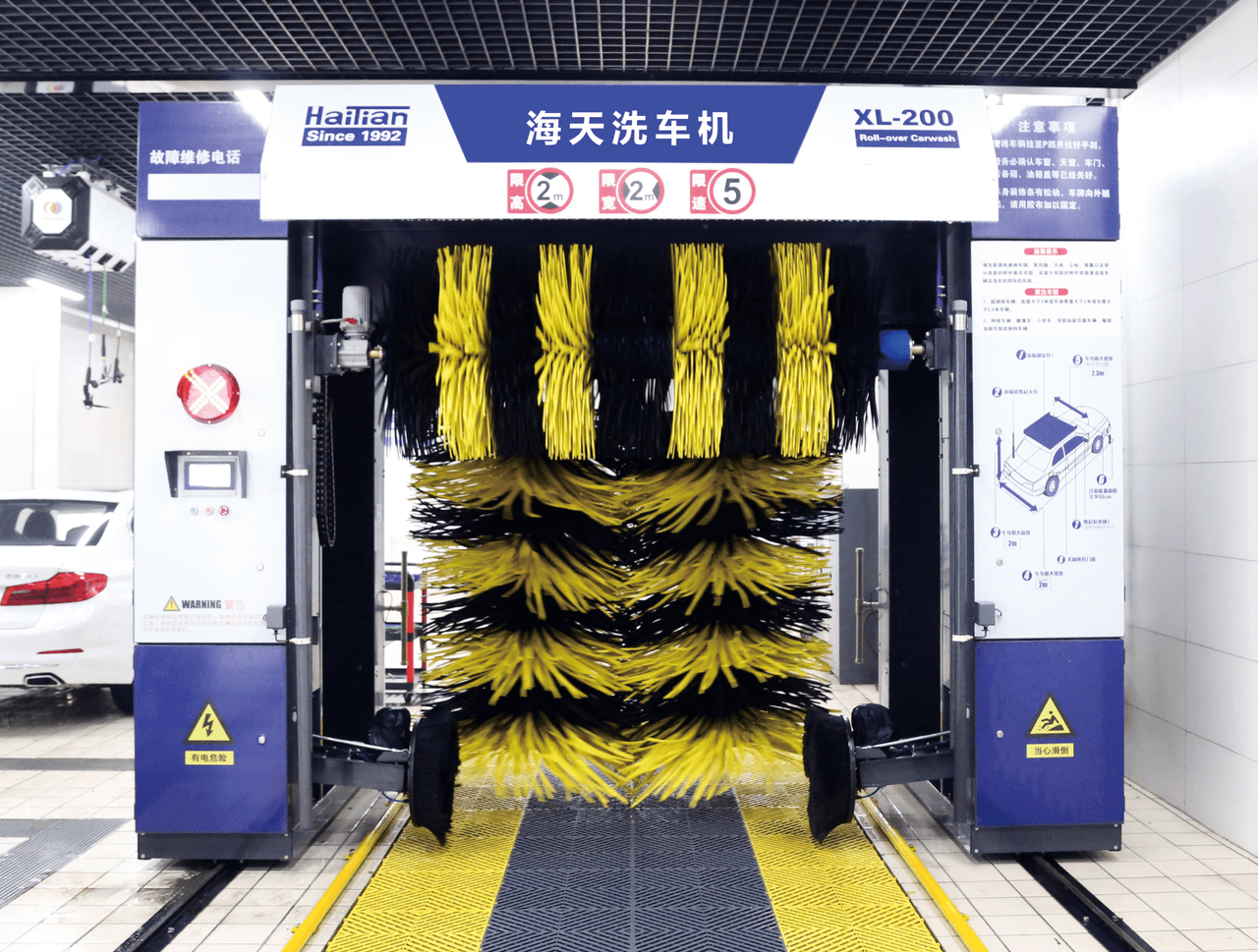
A rollover or in-bay automatic car wash is a gantry system where the vehicle remains stationary in a bay and the machine moves back and forth along rails, performing pre-soak, wash, rinse and dry cycles.
Key points:
- Requires much less space than a full tunnel
- Processes one car at a time, with typical throughput of about 10–15 cars per hour, depending on cycle length and options
- Available as friction (brush), touchless, or hybrid systems that combine both methods
These systems are common at:
- Gas stations and C-stores
- Smaller urban sites
- Dealers and workshop service lanes
- Unattended / self-service wash bays
HyTian’s XL-200 rollover series and XL-200NET self-service model fall into this category.
2.3 Touchless automatic car wash
A touchless automatic car wash (also called touch-free or brushless) uses high-pressure water jets and carefully formulated chemicals to clean the vehicle, with no contact from brushes or cloth.
Touchless can be:
- A touchless in-bay (gantry) system
- A touchless tunnel configuration in some markets
Typical applications:
- Sites serving premium or paint-sensitive vehicles (new dealerships, luxury brands)
- Owners who want to minimize any risk of brush-related damage claims
- Fleets that want consistent, gentle washing of graphics and wraps
Touchless systems tend to rely more heavily on chemistry and precise high-pressure delivery to remove road film and heavy dirt.
HyTian’s MY-385 is an example of a touchless automatic targeted at both retail and fleet applications.
3. Conveyor Tunnel Car Wash Systems
3.1 How a conveyor tunnel works
In a conveyor tunnel system:
- The customer drives onto a conveyor entry module (tire guide or belt).
- Once the vehicle is positioned, the conveyor engages and moves it through the tunnel.
- The vehicle passes sequential stations: pre-soak, high-pressure arches, friction brushes, foam applications, wax or coating, rinse and drying.
- Multiple vehicles occupy the tunnel at once, staggered several meters apart.
Because the tunnel never stops, throughput can be very high. Industry examples cite compact tunnels handling 40–60 cars per hour, while long express tunnels can exceed 100 cars per hour with optimized layouts and stacking.
3.2 Typical site profile & space requirements
A conveyor tunnel makes sense when:
- You have sufficient length (commonly 18–35+ meters / 60–115+ feet) to house tunnel equipment and in-feed/out-feed stacking.
- Your site experiences or can develop high vehicle volume, especially at peak times.
- You want to build an express exterior wash model with monthly memberships.
Common implementations:
- Dedicated express sites
- Fuel stations with high traffic and strong property dimensions
- Multi-lane or combo sites (tunnel plus self-serve bays or vacuums)
HyTian’s tunnel systems are designed with modular frames that can be shortened or extended to match local building constraints, which is especially important in markets with varied property shapes.
3.3 Throughput, customer experience & wash quality
Throughput
Because the tunnel never stops, it can keep processing vehicles as long as there is stack. As a rule of thumb:
- Compact tunnels: ~40–60 cars/hour with typical equipment layouts
- Longer express tunnels: capable of 80–100+ cars/hour in mature markets
This throughput is ideal where queues are a competitive risk or where you’re selling membership plans.
Customer experience
- Perceived as fast and premium, with continuous motion and visual “show” (foam, LED, arches).
- Excellent for upselling packages (foam, coatings, underbody, wheel cleaning).
- Works well with conveyor belt entries that feel safe and easy for customers who dislike rail chains.
Wash quality
- With the right combination of friction brushes, high-pressure arches and chemistry, tunnels can deliver very high wash quality and strong drying, even at high speeds.
- Design flexibility (extra wheel modules, additional high-pressure arches, drying horsepower) allows you to tune performance for your climate and soil conditions.
3.4 Maintenance, water, chemical & energy considerations
- Maintenance:
- More components: multiple motors, brush modules, conveyors, sensors.
- Requires a planned maintenance program, but downtime can be managed by modular design and redundancy.
- Water & chemistry:
- Higher total water and chemical usage per hour because of the throughput.
- Per-car usage can be competitive or even lower than some in-bays when optimized and combined with reclaim systems.
- Energy:
- Higher electrical load (multiple motors and blowers), which must be factored into utility planning.
- Good fit when:
- You’re designing for high volume, membership sales and short queues.
- You can invest in building and utilities upfront to maximize long-term ROI.
4. Rollover / In-Bay Automatic Car Wash Systems
4.1 How a rollover / in-bay automatic works
In a rollover or in-bay automatic car wash:
- The customer drives into a bay and stops at a designated position.
- The vehicle stays stationary; the gantry moves back and forth along rails.
- The gantry performs pre-soak, wash, rinse and drying as it travels over and around the vehicle.
Rollover systems can be:
- Friction (soft-touch) with brushes and foam
- Touchless with high-pressure jets only
- Hybrid with a combination of both
HyTian’s XL-200 and XL-200NET platforms are examples of in-bay machines that can be configured with different wash options, payment interfaces and unattended operation.
4.2 Typical site profile & space requirements
Rollover / in-bay automatics shine when:
- The site has limited footprint—for example, an urban gas station or dealership.
- You want to add a wash bay to an existing building or forecourt.
- Your volume is moderate and doesn’t justify a full tunnel.
Typical bay requirements are roughly:
- Length: ~9–10 meters (~30–33 feet)
- Width: ~4 meters (~13 feet)
- Height: ~3+ meters (~10+ feet)
(Exact dimensions depend on model and local construction norms.)
4.3 Throughput, customer experience & wash quality
Throughput
Because in-bays process one vehicle at a time, throughput is inherently lower. Industry benchmarks indicate:
- Typical in-bay automatics: around 10–15 cars per hour, with real-world averages often closer to 6–12 depending on options and dwell time.
For many fuel retailers and smaller sites, this is acceptable given their site traffic, especially if wash demand is spread across the day.
Customer experience
- Perceived as convenient and simple—especially when integrated with fuel purchase or loyalty programs.
- Customers remain in the vehicle, which many prefer for security and comfort.
- Cycle times are longer than express tunnels; queues can form at peak times.
Wash quality
- Modern friction in-bays can deliver excellent wash results with lower water use per car.
- Hybrid or touchless options allow you to tailor the system to your brand positioning and local soil conditions.
4.4 Maintenance, water, chemical & energy considerations
- Maintenance:
- Fewer moving parts than a full tunnel; easier access in a compact bay.
- Still requires preventative maintenance on gantry drive systems, brushes (if fitted), pumps and dryers.
- Water & chemistry:
- Lower total consumption per hour because of throughput, but per-car consumption may be similar or slightly higher than a well-designed tunnel.
- Energy:
- Electrical loads typically lower than long tunnels but still significant due to high-pressure pumps and dryers.
- Good fit when:
- You have limited space or construction budget.
- Your business model is add-on wash revenue rather than high-throughput express.
HyTian’s unattended XL-200NET adds 24/7 operation with QR/app or card payment and remote monitoring, allowing owners to increase revenue without adding staff.
5. Touchless Automatic Car Wash Systems
5.1 How touchless systems work
Touchless automatic systems—whether tunnel or in-bay—clean vehicles using:
- High-pressure water jets following the vehicle contour
- Carefully dosed detergents and specialty chemicals to break down road film and traffic grime
- Optional drying stages to remove residual water
No brushes or cloths contact the vehicle surface.
HyTian’s MY series touchless washers are based on this principle, using high-pressure pumps, contour-tracking arms and controlled chemical application.
5.2 Typical site profile & applications
Touchless systems are particularly attractive for:
- New car dealerships and premium brands, where any risk of micro-marring or accessory damage is highly sensitive.
- Owners who want to differentiate with a “no-brush” promise for demanding customers.
- Fleets with sensitive graphics, wraps or auxiliary equipment.
They are usually deployed as touchless in-bay automatics, but touchless tunnels also exist in some markets.
5.3 Cleaning performance, chemistry & customer perception
Cleaning performance
- Very effective at removing light to moderate dirt, especially with modern detergents and dwell times.
- On heavy mud, baked-on brake dust or neglected vehicles, pure touchless systems may need longer cycles or may not match the deep mechanical action of brushes, leading some operators to offer pre-wash or hybrid options.
Customer perception
- Customers concerned about paint or delicate trim often prefer touchless options and are willing to pay a premium.
- Others equate “foam and brushes” with a “real wash,” so local expectations should be considered.
5.4 Maintenance and operating considerations
- Chemistry dependence: Touchless systems rely more heavily on detergent performance and precise dosing. This can increase chemical cost per car compared to some friction systems but avoids brush replacement.
- Water & energy: High-pressure pumps draw significant power, and spray volumes must be managed carefully. Water reclaim and modern nozzle design help reduce operating cost.
- Maintenance: Fewer brushes to maintain, but you must keep nozzles, pumps and filtration in top condition to maintain cleaning quality.
Touchless is a strong option where paint safety and customer perception outweigh the need to handle extremely dirty vehicles at maximum speed.
6. Tunnel vs. Rollover vs. Touchless: Side-by-Side Comparison
6.1 Comparison table
The table below summarizes the three system types at a high level. Real performance depends on specific models, configuration and site design, but these ranges reflect typical industry benchmarks.
Criteria | Conveyor Tunnel Car Wash | Rollover / In-Bay Automatic Car Wash | Touchless Automatic Car Wash* |
|---|---|---|---|
Vehicle movement | Vehicle moves on conveyor through fixed stations | Vehicle stops; gantry moves around vehicle | Usually vehicle stops; gantry or arch moves |
Typical site type | Express wash, high-volume gas stations, stand-alone sites | Gas stations, C-stores, dealers, small sites | Premium sites, dealers, fleets, paint-sensitive |
Typical site length | ~18–35+ m (60–115+ ft) | ~9–10 m (30–33 ft) per bay | Similar to in-bay if gantry; depends on layout |
Throughput (cars/hour) | ~40–60 (compact); 80–100+ (long express) | ~10–15 (often 6–12 in practice) | Often similar to in-bay: ~8–15 |
Capex (equipment + build) | Highest (tunnel, conveyor, building) | Moderate (one bay + gantry) | Moderate to high (high-pressure, chemistry) |
Best use cases | High traffic, memberships, short queues | Add-on wash at fuel sites, moderate volume | Premium “no brushes” offer, sensitive fleets |
Key pros | Highest volume, strong upsell potential, show factor | Compact footprint, flexible add-on revenue | No brush contact, strong appeal for sensitive customers |
Key cons | Higher capex and complexity, requires space | Limited throughput; queues in peaks | Heavier reliance on chemistry; may struggle on severe dirt |
Typical wash method | Friction + high-pressure; can add extras | Friction, touchless or hybrid | Touchless (high-pressure + chemistry) |
- Touchless can be implemented as an in-bay or tunnel configuration; in most markets it is primarily in-bay.
6.2 Key trade-offs at a glance
- Space vs throughput: Tunnels demand more length but deliver far higher cars-per-hour; rollovers fit tight sites but cap volume.
- Investment vs revenue potential: Tunnels require more capex but unlock express business models and memberships; rollovers are easier entry points.
- Customer promise: Touchless delivers a clear “no contact” promise; friction tunnels and in-bays focus on maximum cleaning power and visual impact.
- Operational complexity: Tunnels are more complex but can be highly efficient with proper design; in-bays are simpler but more sensitive to peak queues.
7. Which System Fits Your Site? Scenario-Based Recommendations
Let’s apply the comparison to realistic situations you may be planning for.
7.1 Scenario 1: Small urban gas station with 1–2 wash bays
Profile
- Tight urban site, limited land.
- Fuel sales plus convenience store; wash is an add-on revenue stream.
- Daily wash volume is moderate, with small peaks around weekends and good weather.
Typical best fit: Rollover / in-bay automatic (with optional touchless or hybrid)
Why:
- Compact footprint: A single in-bay or two stacked bays can fit where a tunnel cannot.
- Integrated offers: Easy to bundle “fuel + wash” or loyalty programs.
- Capex control: Equipment and construction costs are manageable for a small site.
Where HyTian fits:
- A friction-based XL-200 rollover with modern brushes and drying can provide strong cleaning and uptime.
- If your customer base is sensitive to paint or you want unattended 24/7 operation, an XL-200NET configuration with cashless payment and remote monitoring gives you additional value.
You would avoid a full tunnel here unless the site has an unusually deep lot or you plan to acquire adjacent property.
7.2 Scenario 2: High-volume express site along a busy arterial road
Profile
- Strong traffic counts and good visibility.
- Business model centered on unlimited wash memberships and fast queues.
- Willing to invest in building, conveyor and full site layout (stacking lanes, vacuums).
Typical best fit: Conveyor tunnel car wash
Why:
- Throughput: Handling 40–60+ cars per hour is realistic with a well-designed tunnel, which is critical to hit membership revenue targets and minimize queue abandonment.
- Customer experience: Tunnels allow you to create a branded “show” with foam, lighting and additional services, reinforcing your brand and supporting higher ticket values.
- Labor model: You can design for highly automated operations with minimal prep staff.
Where HyTian fits:
- A TX-380 conveyor tunnel configuration can be tailored to your available length and desired service menu—adding wheel modules, coating arcs and high-efficiency drying as needed.
- With remote diagnostics and modular design, HyTian tunnels are engineered for high uptime, which is critical in an express model.
An in-bay system at such a site would quickly become a bottleneck at peak times and constrain your business model.
7.3 Scenario 3: Fleet depot or logistics yard with fixed daily volume
Profile
- Depot for delivery vans, buses or trucks.
- Predictable daily wash volume tied to route rotation or compliance.
- Focus on safety, compliance and vehicle image rather than retail show.
Typical best fit: Depends on fleet mix, but often rollover or customized drive-through
- For light-duty fleets (vans, pickups, service vehicles), a robust in-bay automatic or compact tunnel can meet daily demand at lower cost than a large tunnel, especially if wash windows are spread across the day.
- For large buses/trucks, specialized bus & truck wash systems or customized drive-through solutions are most appropriate.
Where HyTian fits:
- For light vehicles, a durable XL-200 or touchless MY series installation at your depot can provide predictable, gentle washing.
- For heavy fleets, HyTian’s TH / GH bus & truck washers and customized cleaning lines are engineered specifically for long vehicles, higher clearances and industrial duty cycles.
In these scenarios, the right answer may be a mix of systems—for example, a tunnel at your public site and a separate in-bay or truck wash at the depot.
8. Key Decision Factors Before You Invest
8.1 Footprint and construction budget
- How much linear space can you allocate for wash equipment and stacking?
- Are you retro-fitting an existing building or planning new construction?
- Can the site support conveyor foundations, pits and utility routing?
As a rule:
- Tight urban or legacy sites → rollover / in-bay automatic
- Deep or new-build sites → tunnel is worth serious consideration if volume justifies it
8.2 Expected daily and peak-hour volume
Estimate:
- Average cars per day (weekday vs weekend)
- Peak-hour demand during best wash days
If you realistically expect:
- <50–80 cars/day → An in-bay system may be sufficient.
- 80–200+ cars/day with strong peaks → A tunnel’s 40–60+ cars/hour capacity is much better aligned with demand.
HyTian’s engineering team can model throughput against your traffic data and recommend whether a tunnel or multiple in-bays is more efficient.
8.3 Labor model and level of automation
Decide where you want to sit on the spectrum from fully attended to unattended:
- If your goal is a 24/7 unattended site with minimal staff, pairing an in-bay automatic or compact tunnel with cashless payment, ANPR, and remote monitoring (as in HyTian’s XL-200NET) can make sense.
- If you plan for staff to upsell, prep vehicles or manage complex queues, a tunnel model might fit better.
Automation doesn’t only reduce labor cost—it can also unlock extended hours of operation and more consistent service.
8.4 Positioning your service: budget, standard or premium
Your local market and brand will influence:
- Whether you emphasize speed and price (express tunnel, basic in-bay).
- Or premium care (touchless or hybrid with coatings and detailing upsells).
Examples:
- Value-oriented fuel brand → fast, consistent friction tunnel or in-bay with simple packages.
- Premium OEM dealership → touchless or very gentle friction in-bay with protective coatings.
HyTian systems can be configured with different wash programs, foam and coating options to align with your brand promise.
8.5 Water availability and environmental constraints
Consider:
- Local water cost and any discharge or reuse regulations.
- Whether you plan to install water reclaim systems and sludge handling.
Tunnels and high-volume sites should almost always be designed with water reclaim and efficient nozzles to reduce cost per wash.
Wheel wash systems and customized industrial lines (such as those HyTian provides for construction, mining and waste sectors) also rely heavily on recycling to keep water use manageable.
8.6 How manufacturers like HyTian can support your project
When you engage with a manufacturer like HyTian, you’re not just buying a machine—you’re getting:
- Site layout and system selection consulting (tunnel vs in-bay vs touchless vs fleet solutions)
- Configuration options: brush vs touchless, hybrid, extended modules, upsell options
- Integration with payment systems, license plate recognition and remote platforms
- Lifecycle support: installation, training, spare parts and remote diagnostics
With over 30 years of R&D and installations in more than 40 countries, HyTian’s portfolio—from tunnels to rollovers / in-bay automatics, touchless systems, bus and truck washes, wheel wash and custom lines—is designed to cover the full spectrum of commercial wash needs, so you can choose the system type that truly fits your business model.
9. Conclusion: Turning System Choice into Long-Term ROI
Choosing between a conveyor tunnel, rollover / in-bay automatic and touchless automatic car wash is ultimately a strategic business decision, not just an equipment purchase.
- Tunnels win when you have the space and demand to leverage their throughput and upsell potential.
- Rollovers / in-bays are ideal when you need a compact, flexible wash bay as an add-on profit center.
- Touchless systems give you a strong “no contact” promise for premium cars and sensitive fleets, at the cost of more reliance on chemistry.
The right choice balances:
- Your footprint and build budget
- Your expected volume and growth plans
- Your labor strategy and automation level
- The service promise you want to make to your customers
- Local water and regulatory conditions
Manufacturers like HyTian can help you translate these factors into a concrete system design, with equipment tuned to your site, market and long-term ROI goals.