
How to Evaluate a Car Wash Equipment Dealer: What Operators Should Require
How to Evaluate a Car Wash Equipment Dealer: What Operators Should Require
You've got three quotes on your desk from three car wash equipment dealers. The model numbers look similar, the specs read almost the same, and the prices aren't far apart. What isn't on any of those quotes is who shows up when a pump seizes on a Saturday, who actually installs the system, or who owns a warranty claim once it's filed.
Evaluating car wash equipment dealers means looking past the spec sheet to the relationship you're about to sign up for. This is a requirements checklist for that relationship — what to ask, what a strong answer sounds like versus a vague one, and how to verify it before you commit. It's built to work against any dealer you're considering, not just one brand.
Why the Dealer You Buy From Matters as Much as the Machine
Buying equipment is really two decisions stacked together. The first is which manufacturer's system fits your site, throughput, and budget — a question our manufacturer evaluation checklist already covers, and one this piece won't repeat. The second, separate decision is which dealer you buy it from and rely on afterward, and that decision gets far less scrutiny than it deserves.
For a single-site or small-chain operator, that second decision carries direct weight. A distributor juggling a whole portfolio can absorb one weak manufacturer relationship. You can't absorb one weak dealer relationship the same way, because the system in question is generating this site's daily revenue right now. When it goes down, there's no other location picking up the slack.
Unplanned downtime during peak hours and inconsistent wash quality are the two problems every operator dreads most. Both usually trace back to dealer support, not the machine itself. A well-engineered system with no local technician behind it fails the same way a poorly-engineered one does — slowly, then all at once, on a Saturday afternoon with a line of cars waiting.
This is also a longer commitment than the purchase order suggests. A tunnel or in-bay system runs for years, and the dealer relationship runs alongside it — every parts order, every service call, every warranty question routes through the same company you're evaluating today. Getting the equipment decision right and the dealer decision wrong still leaves you with a multi-year problem.
Evaluating Car Wash Equipment Dealers: The Operator's Checklist
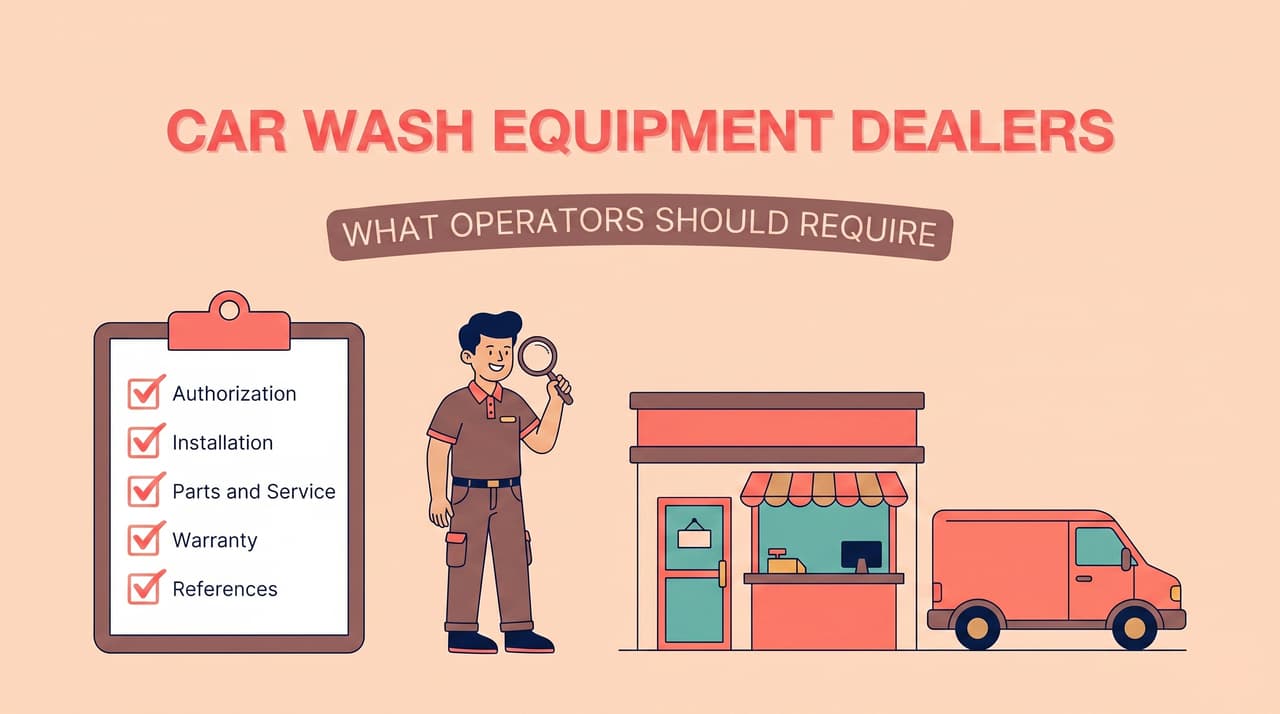
Before you sign with any car wash equipment dealer, walk them through five requirement domains. For each one, ask directly, notice whether the answer is specific or general, and check whether you can verify it independently rather than take it on trust.
Manufacturer Authorization You Can Verify Independently
Require: proof the dealer is actually authorized to sell and service this brand, not just a claim printed on their own website. Ask for a named contact at the manufacturer who can confirm the relationship directly.
A strong answer names that contact without hesitation, or points you to the manufacturer's own published dealer listing. A weak answer is "we're a preferred partner" with no way to check it — a phrase that costs nothing to say and means nothing on its own. According to Arnold Machinery's guidance on choosing a heavy machinery dealer, confirming a dealer is listed as an official partner on the manufacturer's own site is a standard first vetting step — the same logic applies here.
Verify it: contact the manufacturer directly, using contact information from the manufacturer's own site rather than anything the dealer supplied. This is also where it's worth understanding what an authorized dealer relationship looks like from the manufacturer's side — see our manufacturer partnership guide for that view. A dealer who welcomes this check is behaving exactly the way a genuine partner should.
Installation & Commissioning Support
Require: clarity on who performs the site assessment before equipment ships, who installs and commissions it on-site, and whether startup training for your wash attendants is included or billed as an add-on.
A strong answer describes a named sequence — site visit, installation window, commissioning steps, staff training — with a defined timeline. A weak answer is "we'll figure out logistics once it arrives," which usually means you're the one figuring it out. Our installation and training resource covers what a properly staged rollout looks like.
Verify it: ask for the commissioning checklist or process document in writing, not a verbal walkthrough. A dealer with a real process has one written down already.
Local Parts & Service Response
This is the highest-stakes domain on this list, because it's the one that determines whether a breakdown costs you an afternoon or a week. For a single-site operator, every hour a system sits down during business hours is direct revenue you don't get back — not a risk spread across a distributor's whole territory.
Require: what's stocked locally versus shipped in from the manufacturer, whether the dealer has an on-site or regional technician rather than remote-only support, and a written response-time commitment for a down system.
A strong answer comes with that commitment in writing, ideally paired with a defined remedy if it's missed. A weak answer is "we usually get to it pretty fast." For a sense of what a written commitment can look like, MacAllister Machinery's Customer Value Agreements publish next-business-day delivery for covered parts and a two-business-day repair-completion commitment, backed by a credit if the dealer misses it — a heavy-equipment example, not a car wash figure, but the kind of specificity worth holding any dealer to.
Verify it: don't accept a verbal estimate. If a dealer can't put a response-time number in writing, that's the answer — regardless of how confident they sound saying it out loud.
Not every part carries the same urgency, and a good dealer distinguishes between them without prompting. A worn brush or a filter is routine stock; a control board or a drive motor is the kind of failure that actually shuts the site down. Ask specifically about the second category — that's where "we usually have what you need" tends to quietly become "let us check with the factory."
Warranty Pass-Through & Claims Handling
Require: exactly what's covered and for how long, whether the dealer administers claims directly or routes them to the manufacturer, and the actual turnaround once a claim is filed.
A strong answer is a written warranty schedule paired with a defined claims process. A weak answer is "we handle it case by case," which sounds flexible and functions as undefined terms until a claim is actually on the table. Per Arnold Machinery's warranty-vetting guidance, the specific questions worth asking are what's covered — parts, labor, or both — how long coverage runs, and whether maintenance by an authorized technician is a condition of keeping it valid. Our warranty coverage resource is a starting reference.
Verify it: get the terms in writing before you sign anything. Don't assume the dealer's warranty and the manufacturer's warranty are identical without confirming it.
References From Other Operators
Require: contact information for two or three operators — not other dealers or distributors — who bought comparable equipment from this dealer and can speak to how installation and service actually went.
A strong answer supplies those references without hesitation. A weak answer is reluctance, or references who turn out to be resellers rather than operators who actually run the equipment day to day. Nors Equipment's guidance on spotting a legitimate heavy construction parts dealer points to reviews the business can't edit and independent testimonials as verification methods that don't depend on the dealer's own pitch.
Verify it: when you call a reference, ask about their most recent actual service call — response time, what it cost, how it was resolved — not just whether they're satisfied in general.
Checklist Domain | Require | Red Flag |
|---|---|---|
Manufacturer authorization | A named manufacturer contact who confirms the relationship | "We're a preferred partner" with no way to check |
Installation & commissioning | A defined sequence and timeline, in writing | "We'll figure out logistics once it arrives" |
Local parts & service | A written response-time commitment for a down system | "We usually get to it pretty fast" |
Warranty pass-through | An itemized schedule and a defined claims process | "We handle it case by case" |
Operator references | Contact for real operators, supplied readily | Reluctance, or references who are resellers |
How HyTian's Dealer Network Fits This Picture
Here's how HyTian's own answers hold up against the checklist above — and, just as importantly, what we don't centralize and why you should still ask.
HyTian equipment reaches operators through distributors, agents, and regional subsidiaries, including dedicated operations in the United States, Australia, and Zambia. That's the authorization domain in practice: a defined regional structure, not an ad hoc reseller list.
On installation and commissioning, our Japan launch is the clearest evidence. We established a dedicated distributor and service team there as part of a long-term market-development partnership. The first systems went in via remote commissioning during pandemic travel restrictions, without a HyTian engineer on-site.
On certifications, HyTian holds CE Conformity, ISO 9001 (quality management), and ISO 14001 (environmental management), all current — one of the few claims here you can verify directly with us, independent of anything a specific dealer tells you. On scale, HyTian is the international brand of Nanjing Haiying Machinery, a manufacturer with over three decades of continuous production since 1992 and 20,000+ systems installed across 40+ countries.
Now the honest part. HyTian doesn't publish one universal, centralized service-response-time figure that applies to every dealer in every region — that commitment is set locally. It's exactly the kind of specific you should request in writing before you sign, whether you're evaluating a dealer selling HyTian equipment or anyone else's. Holding us to the same standard this checklist just asked you to hold every dealer to is the point, not an inconvenience.
That standard also means being precise about where our coverage is formal and where it isn't. Our regional distributor and subsidiary presence is real and established in the markets named above; in newer markets we're still building out, our footprint currently runs through direct engagements with individual sites rather than a formal dealer network. If a dealer claims regional coverage somewhere HyTian doesn't have an established distributor, that's exactly the kind of claim this checklist tells you to check independently — with us, directly.
Key Takeaways
Treat the dealer relationship as a decision separate from the equipment brand — a strong manufacturer paired with a weak local dealer still leaves you exposed.
Require every commitment in writing: manufacturer authorization, the installation sequence, a parts and service response time, and the warranty terms.
Call operator references directly, and ask about their most recent actual service call, not general satisfaction.
Use this checklist against every dealer on your shortlist, including anyone selling HyTian equipment. If you're instead evaluating the equipment inside a car wash you're acquiring, our equipment due-diligence checklist for buying an existing car wash is the right companion piece — that's a different decision than choosing a new-equipment dealer.
Frequently Asked Questions
What questions should you ask a car wash equipment dealer before buying?
Ask for a named manufacturer contact who can confirm the dealer's authorization, a written installation and commissioning sequence, a written parts and service response-time commitment, and an itemized warranty schedule with a defined claims process. Then ask for two or three operator references and call them about their actual service experience, not just general satisfaction.
How do you verify a car wash equipment dealer is authorized to sell and service a brand?
Contact the manufacturer directly, using contact information from the manufacturer's own website rather than anything the dealer provides, and ask them to confirm the relationship. A dealer's own claim of being a "preferred partner" isn't verification on its own — an independent confirmation from the manufacturer is what actually establishes it.
Ready to start comparing dealers, or want to talk through what to require before you sign? Talk to our team — we can connect you with an authorized dealer in your region. Or, if you're choosing a car wash equipment supplier and want a straight answer from the manufacturer itself, ask us the same questions this checklist raised.