
Buying an Existing Car Wash: The Equipment Due-Diligence Checklist
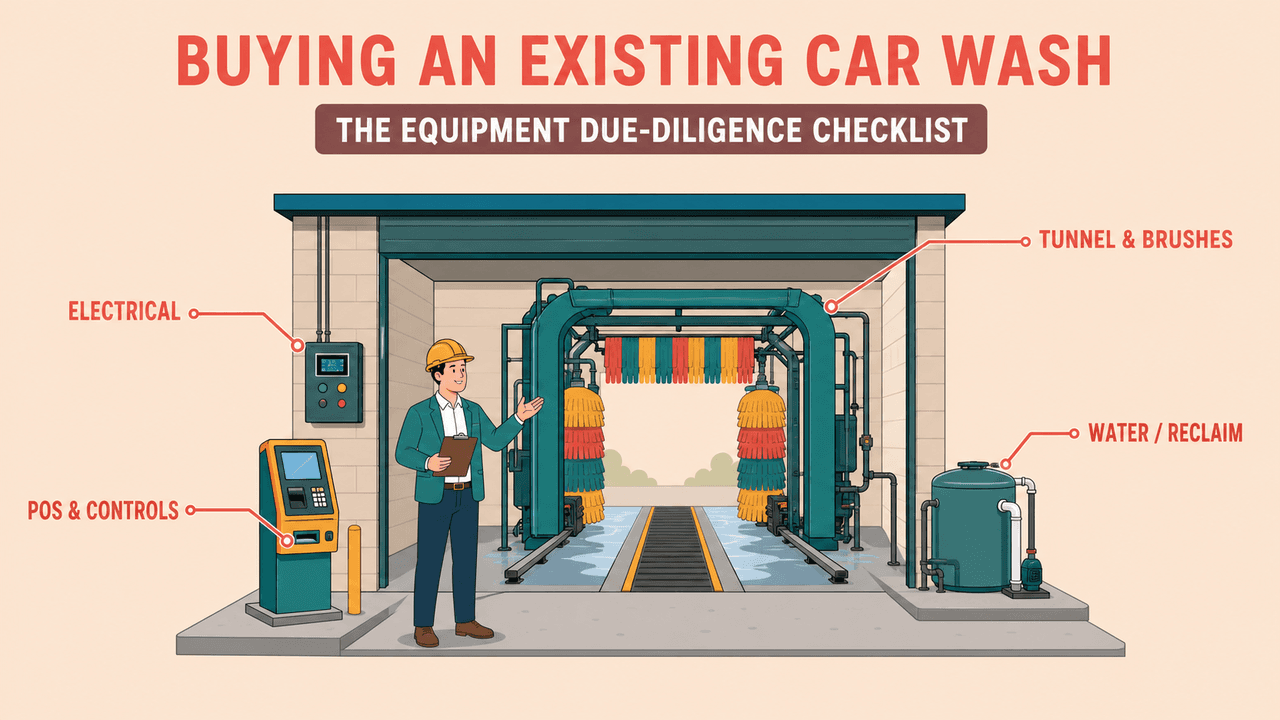
Buying an Existing Car Wash: The Equipment Due-Diligence Checklist
When you find a car wash for sale, the listing tells you what the business earns. It rarely tells you what the equipment will cost you the day you take the keys. Revenue and a clean P&L set the asking price. But the installed equipment runs on a separate clock — one of remaining service life, parts availability, and deferred upgrades — and that clock keeps ticking whether or not it showed up in the seller's numbers.
That gap is where acquisitions go wrong. A wash can look healthy on paper and still hand its new owner a six-figure retrofit in year one.
The good news is that the equipment layer is inspectable, and an independent third-party equipment inspection runs roughly $2,000 to $5,000 — a small price against the surprise it exists to catch. This checklist walks the equipment side of due diligence: what to inspect, what the warning signs mean, and how to price the result into the deal. It applies to any manufacturer's installed systems, not one brand's.
If you're still weighing whether to buy at all versus start a car wash from the ground up, that's a different decision. This guide assumes you have a specific wash in front of you.
How to Read a Wash Before You Sign
Most first-time acquirers inspect equipment the way they'd inspect a used car: does it turn on, does it run a cycle, are there obvious leaks. That test passes far too easily. The real question is not whether the equipment works today — it's how much service life remains and what parts-and-retrofit spend follows over the next two to three years.
Two variables drive that answer. The first is condition and age relative to expected life. The second, which acquirers routinely underweight, is the manufacturer and its parts channel.
Installed systems you'll commonly encounter come from names like Sonny's, MacNeil, Mark VII, Vacutech, and ICS — and a system whose maker has discontinued the line, or whose parts move only through a channel you can't reach, is a liability regardless of how clean it looks. An orphaned machine isn't just old equipment; it's a sourcing problem you inherit at closing.
Architecture matters here too. A modular tunnel — one built with configurable conveyor, brush, and dryer packages — lets you upgrade a single worn sub-system without tearing out the whole line. A monolithic or heavily customized build often forces all-or-nothing decisions. Knowing which one you're buying changes both your risk and your negotiating position.
One clarification so you know you're in the right guide. Buying an existing wash is not the same decision as choosing used versus new equipment for a site you're building, and it's not the repair-versus-replace call you make on gear you already own and know. This is the acquisition lens: judging equipment you're about to inherit, with limited history and a seller across the table.
The Equipment Due-Diligence Checklist for Any Car Wash for Sale
Before you sign, walk the site against the five domains below. For each one, the goal is the same — inspect the hardware, read the remaining-life signal, and translate it into a number you can bring to the negotiation.
Tunnel or Wash System
This is the heart of the asset and the most expensive thing to replace, so it earns the closest look:
Conveyor and drive — check chain or belt wear, roller condition, and drive-motor age. A conveyor near end of life is a scheduled shutdown you'll be paying for.
Brushes and wash media — worn or hardened brush media is two problems at once: a re-media cost, and a paint-damage liability every time a car goes through. Good media stays supple and applies even pressure; brushes engineered for paint safety, such as closed-cell foam with a linear pressure curve, are designed specifically to avoid the marring that a degraded brush causes. Run a cycle and watch how the media contacts the vehicle.
Dryers — blower-motor hours, bearing noise, and airflow. Dryers are rebuildable, but a full set is a meaningful line item.
Manufacturer and parts — confirm the maker still supports the model and that parts are obtainable on a reasonable lead time.
Water Systems
Water is where compliance and operating cost collide. Inspect the reclaim and recycling setup and confirm its actual recovery rate — many jurisdictions now require systems that recover 70–85% of wash water, and a wash that can't meet the local standard is facing a mandatory retrofit. Pull the trailing 24 months of water bills and compare them against vehicle counts and revenue; a bill that's high relative to throughput points to a failing reclaim loop or a leak.
Verify sewer-discharge permits and stormwater compliance while you're at it. For the full picture on what a compliant loop costs to add or upgrade, see our guide to water recycling system cost and compliance.
Electrical and Mechanical
High-power pumps, heated dryers, and conveyor motors draw hard, and the existing service may not have room for the equipment you eventually want to run. Electrical upgrades are one of the most common surprises for first-time buyers — a transformer or panel upgrade can appear out of nowhere. Get a licensed electrician's site assessment before you finalize anything, and inspect pumps, motors, the conveyor drive, and control panels for age and condition.
Payment, POS, and Controls
The point-of-sale and controls hold something more valuable than hardware: the membership and unlimited-plan data that underpins recurring revenue. Check the kiosk age, whether the POS software is still supported, and — critically — that the membership base is real and transferable. A recurring-revenue number you can't verify in the system is a number you shouldn't pay for.
Documentation and Records
Ask for maintenance logs, warranties, and expected-life documentation on the major systems. Well-kept records tell you the equipment was serviced on something like the schedule it should have followed. The absence of records is itself a finding: it means you're valuing the equipment on hope, and you should price it that way.
Retrofit, Run It As-Is, or Replace: The Cost Math
Once you've inspected the equipment, every finding resolves into one of three paths: keep it and maintain, retrofit specific sub-systems, or replace the line. The math decides which.
Retrofitting is usually the cheapest way forward when the bones are sound. Reusing an existing building and its infrastructure can cut costs 20–40% versus new construction, with a building conversion typically landing between $100,000 and $400,000 depending on starting condition. Water recycling is the sub-system buyers retrofit most often: a system runs $50,000 to $300,000, and a wash that was never plumbed for recycling costs more to add it later and runs less efficiently once it's bolted on.
For scale, new equipment sets the ceiling: a full tunnel runs $500,000 to $2 million, in-bay automatic equipment $80,000 to $250,000 per bay, and self-service $30,000 to $80,000 per bay. Against those numbers, a targeted retrofit is almost always the better deal when it's an option.
Path | When it fits | Rough cost |
|---|---|---|
Run as-is + maintain | Equipment mid-life, records clean, parts available | Routine maintenance budget |
Retrofit sub-systems | Bones sound, one or two systems dated (e.g. water, brushes, a dryer set) | Water recycling $50K–$300K; per-system varies |
Replace the line | Orphaned equipment, no parts channel, or multiple systems at end of life | Tunnel $500K–$2M; IBA $80K–$250K/bay |
The point that changes negotiations: modular systems let you retrofit one sub-system — the water loop, a brush package, a dryer set — without replacing the whole line. If the wash you're evaluating is built that way, a scary-looking inspection finding may be a manageable line item rather than a full replacement. Model the payback on whatever spend you land on against the wash's earnings using our car wash ROI calculator, and sanity-check your equipment numbers against current system cost benchmarks.
Red Flags That Should Reset the Price — or End the Deal
Some findings aren't line items to negotiate; they're structural. Treat each of these as either a hard price reset or a walk-away trigger:
Orphaned equipment with no parts channel. If you can't source parts, you can't run the wash. This resets the equipment's value toward replacement cost, not appraised condition.
Non-compliant or absent water recycling in a jurisdiction that requires it. This is a mandatory spend the seller has deferred onto you — price it in fully.
No maintenance records. You're being asked to value the equipment on the seller's word. Discount accordingly.
Electrical service that can't support the equipment. A transformer or panel upgrade is real money and real lead time before you can even change operations.
Environmental exposure. Car washes carry specific concerns — oil-and-water separators, underground tanks, stormwater management, and soil contamination from prior operations. A Phase 1 environmental assessment runs about $2,000–$5,000 and can surface liabilities that dwarf any equipment finding. Do it before you're committed.
Frequently Asked Questions
What should you inspect when buying a car wash?
Inspect five equipment domains: the tunnel or wash system (conveyor, brushes, dryers), the water reclaim and recycling systems, the electrical and mechanical service, the POS and controls, and the maintenance documentation. For each, judge remaining service life and parts availability rather than just whether it powers on — that's what determines your real cost of ownership after closing.
How much does a car wash equipment inspection cost?
An independent third-party equipment inspection typically costs $2,000 to $5,000. Given that it exists to catch retrofit liabilities that can run well into six figures, it's one of the highest-return dollars you'll spend in due diligence. Budget separately for a Phase 1 environmental assessment, which runs a similar $2,000 to $5,000.
Is it cheaper to retrofit or replace car wash equipment?
Retrofitting is usually cheaper when the equipment's core structure is sound — reusing the building and infrastructure can cut costs 20–40% versus new construction. Replacement wins when equipment is orphaned with no parts channel, or when multiple systems have reached end of life at once, making a piecemeal retrofit more expensive than a clean line.
What's the biggest red flag when buying an existing car wash?
Orphaned equipment with no reachable parts channel. Age you can plan around; a maker that has discontinued the line and a parts supply you can't tap turns routine maintenance into an emergency and pushes the equipment's real value toward full replacement cost.
A Manufacturer's View: You're Buying the Equipment, Not Just the Address
From the manufacturing side, the acquisitions that work best treat the installed equipment as a standardizable asset rather than a fixed condition. A wash whose systems can be brought onto a supported, parts-available, modular platform is worth more than a first-pass inspection suggests — because the parts-sourcing and upgrade risk that scared off other buyers is exactly the risk a modern platform removes.
That's the lens worth carrying into a deal. Equipment built with configurable conveyor, brush, and dryer packages, backed by integrated water recycling and a manufacturer with over three decades of continuous production since 1992, gives a new owner upgrade paths instead of dead ends. You don't have to inherit the previous owner's constraints along with their address. If the manufacturer question comes up during your diligence, our guide on how to evaluate a car wash equipment manufacturer covers what to ask.
Evaluating a specific wash and want a second opinion on the equipment? Talk to our engineering team about remaining-life assessment and modular retrofit paths before you sign.