
When to Replace Car Wash Equipment vs. Repair It: A Decision Framework
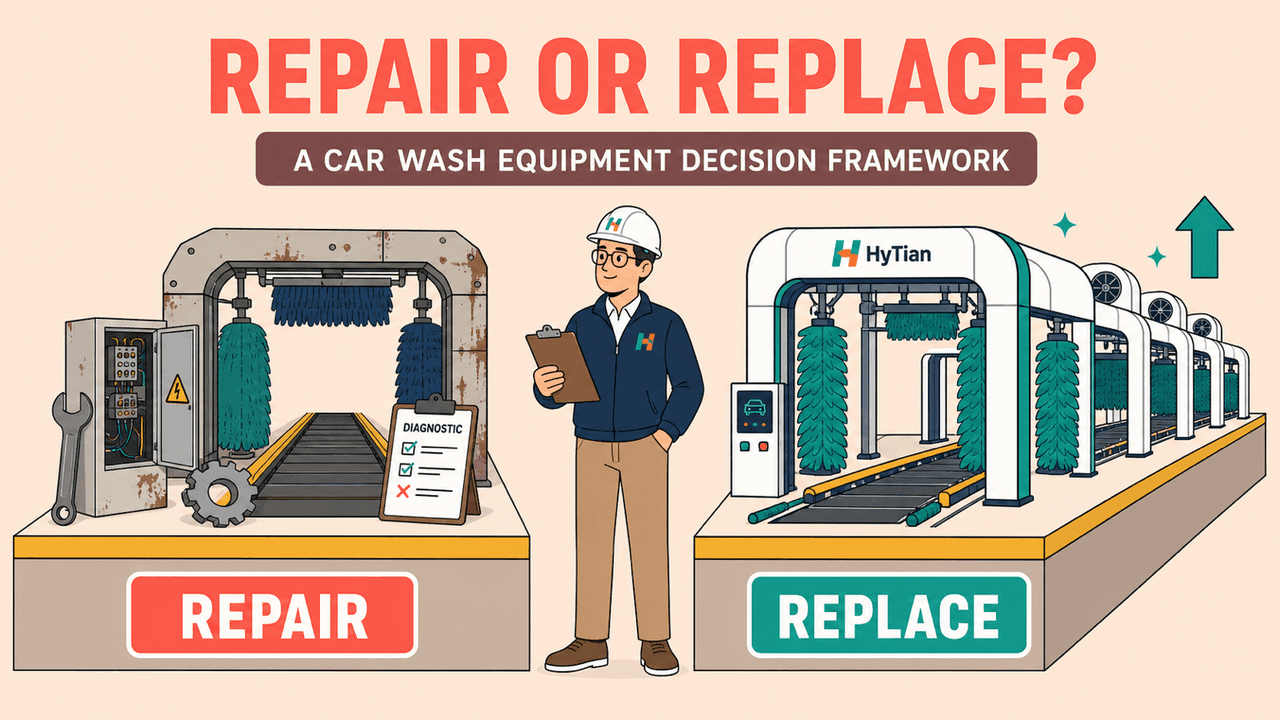
When to Replace Car Wash Equipment vs. Repair It: A Decision Framework
A pump seizes on a Saturday morning. The conveyor trips twice in one week. Your service bill for the quarter is climbing, and the brushes are leaving streaks that show on finished vehicles. At some point every operator faces the same question: keep repairing the equipment you have, or replace it?
Knowing when to replace car wash equipment — versus when a repair or a targeted upgrade is the smarter spend — is one of the highest-stakes calls in your wash program, because it ties up capital either way.
The good news is that this is an economic decision, not a gut call. With a few thresholds and the real numbers in front of you, you can make it on the math. As a manufacturer that builds and services these systems, we'll lay out the framework the way we'd walk a client through it — including the cases where the right answer is don't replace yet.
How Long Does Car Wash Equipment Last?
A well-maintained automatic car wash system typically lasts well over a decade, but service life varies widely by system type and component. These are the ranges most commonly cited across the industry — treat them as planning guides, not guarantees, because maintenance discipline and wash volume move the number more than anything else:
System or component | Commonly cited service life |
|---|---|
Touchless / in-bay automatic | ~10–15 years |
Rollover (gantry) | ~10–20 years |
Conveyor tunnel | ~15–25 years |
Pumps | ~10–20 years |
Brushes / wash media | ~15–25 years (material-dependent) |
Dryers / conveyors | ~10–25 years |
Age in years only tells half the story. Equipment ages by throughput, so wash-cycle count is often the better gauge. Systems generally start showing aging signals around 350,000+ cumulative wash cycles, regardless of the calendar.
The single biggest factor in where your equipment lands in these ranges is upkeep. A disciplined preventive maintenance schedule routinely pushes equipment to the top of its service life — and is far more cost-effective than the alternative. Industry guidance suggests reserving roughly 10–20% of equipment value per year for maintenance. Skip it, and you compress the timeline.
The Repair-or-Replace Math: A Decision Framework
When a major component fails, run the numbers before you authorize the work. Four inputs decide it.
1. The repair-cost ratio (the 50% rule). A long-standing rule for capital equipment: if a repair costs less than about half the price of replacement, repair it; if it costs more, lean toward replacing. The 50% rule is a useful first filter. For older equipment — roughly seven years and up — tighten that threshold to 30–40%, because the probability of a second and third failure climbs as the rest of the system ages alongside the part you're fixing.
2. Repair cost × frequency. A one-time $5,000 fix on an otherwise sound system is routine maintenance. The same $5,000 every two months is a failing system telling you something. Track your trailing 12 months of repair spend. Once you're pushing around $20,000 a year in repairs, replacement usually wins on cost alone — and single major failures on a pump, blower, or conveyor commonly land in the $5,000–$50,000 range, so it adds up quickly.
3. The cost of downtime. This is the input operators most often leave out, and it's frequently the largest. A wash that's down during peak weekend hours isn't just paying for the repair — it's losing the revenue those hours would have produced. Unplanned downtime is the most expensive operational event a wash faces; a couple of peak Saturday hours offline can mean $500 to $1,500 or more in lost throughput. If aging equipment is costing you whole days each quarter, that lost revenue belongs in the replacement column.
4. Book value and depreciation. For tax purposes in the U.S., car wash equipment is generally depreciated over a seven-year schedule (the building shell runs longer, at 15 years). Once a system is largely depreciated, pouring capital into repairs is harder to justify, and bonus depreciation provisions can improve the after-tax math on replacement. This isn't tax advice — confirm the specifics with your accountant — but book value belongs in the decision.
Put together, the framework looks like this:
Signal | Lean Repair | Lean Replace |
|---|---|---|
Repair cost vs. replacement | Under ~50% (under 30–40% if 7+ yrs) | Above that threshold |
Annual repair spend | Stable, predictable | Approaching ~$20,000+ |
Age / wash cycles | Within service-life range | 12+ years or ~350,000+ cycles |
Downtime | Rare, planned | Recurring; full days lost per quarter |
Book value | Significant remaining | Largely depreciated |
If the signals point to replacement, model the return before you commit — our guide to calculating car wash ROI walks through the payback math, and what a new system costs sets realistic expectations (sourcing and project scope drive wide variance).
Signs It's Time to Replace Your Car Wash Equipment
The framework tells you the math. These operational signals tell you the math is about to turn — the practical signs your car wash equipment needs an upgrade rather than another patch:
Age and cycles past the threshold. Equipment beyond about 12 years tends to show fatigue across multiple subsystems at once.
Climbing repair frequency. Emergency call-outs every few weeks are a pattern, not bad luck — and neglected systems compound into larger, costlier repairs.
A throughput ceiling. If your system can't keep pace with demand on your busiest days, the equipment is now capping your revenue. Sometimes the replacement decision is really a throughput decision.
Rising operating cost. Older systems tend to use more water, chemical, and energy per wash than current equipment. The waste is real even when it's hard to see on a single invoice.
Quality you can see. Worn brushes risk paint quality — and the complaints and lost repeat business that follow. As a rule of thumb, brushes showing 30% or more material loss should be replaced — and if media is wearing that fast, the rest of the system deserves a hard look.
Parts you can't get. When spare parts go obsolete or lead times stretch, every repair becomes a gamble on availability.
One or two of these is a maintenance conversation. Several at once is a replacement conversation.
The Third Option: Modular Upgrades
Here's the part most repair-or-replace guides skip: it isn't always a binary. On a well-designed system, you can upgrade individual components — brush packs, high-pressure arches, dryers, dosing and controls — to extend service life and add capability for a fraction of the cost of a full replacement.
This is where a manufacturer's honest view matters. Sometimes the right move isn't a new tunnel; it's a targeted upgrade that buys you another five years and closes the quality gap. We engineer our tunnel systems to be modular by design — configurable conveyor, brush, dryer, and dosing packages — precisely so a component-level upgrade is a real option rather than a teardown. Modern dosing is a good example: precision metering can sharply cut chemical waste, and a controls retrofit can add license-plate recognition or membership integration without replacing the wash line.
Our position with clients is simple, and it's the same one we'd give you here: we recommend the right machine for the situation, not the most expensive one. A modular upgrade that solves the actual problem is a better outcome than a replacement that solves a problem you didn't have.
Making the Call: A Manufacturer's View
Bring the inputs together into one path:
Check age and cycles. Where does the system sit against its service-life range and the ~350,000-cycle mark?
Run the cost test. Repair cost against replacement value — 50%, or 30–40% if the system is 7+ years old.
Add downtime and repair frequency. What is unreliability actually costing you in lost revenue and recurring fixes?
Decide: repair, modular upgrade, or replace — and if the answer is genuinely unclear, that's the moment to have a manufacturer or qualified distributor assess the system's remaining useful life objectively.
If the decision is to replace, the next decision is what to buy — and whether used or new equipment fits your risk tolerance and budget. That's a separate framework worth its own look.
We approach these assessments from more than three decades of building and servicing wash systems (our parent company has manufactured car wash equipment since 1992), with 20,000+ systems deployed across 40+ countries. That field experience is what lets us tell an operator, candidly, when a repair will hold and when it's throwing good money after bad.
Key Takeaways
Repair-or-replace is an economic decision: weigh repair-cost ratio, annual repair spend, age and wash cycles, downtime cost, and book value.
Use the 50% rule as your first filter — and tighten it to 30–40% once equipment is seven or more years old.
Don't ignore downtime cost. Lost peak-hour revenue is often the largest and most overlooked input.
Remember the third option: a modular component upgrade can extend life and add capability without a full replacement.
When several aging signals stack up at once — 12+ years, climbing repairs, throughput ceilings, quality slipping — it's a replacement conversation.
Frequently Asked Questions
How long does car wash equipment last? With routine maintenance, most automatic car wash equipment lasts well over a decade. Commonly cited ranges run about 10–15 years for touchless/in-bay systems, 10–20 for rollovers, and 15–25 for conveyor tunnels, with major components varying within those bands. Maintenance discipline and wash volume are the biggest factors in where a given system lands.
Should I repair or replace my car wash equipment? Repair when the fix costs less than about half of replacement (30–40% if the equipment is 7+ years old), your annual repair spend is stable, and downtime is rare. Lean toward replacement when repair costs cross those thresholds, you're approaching roughly $20,000 a year in repairs, or unreliability is costing you full days of revenue each quarter.
When is car wash equipment too old to repair? There's no single age, but equipment beyond about 12 years or 350,000+ wash cycles often shows fatigue across multiple systems at once. At that point, repeated repairs tend to chase a moving target, and a modular upgrade or replacement usually delivers better economics.
Is it worth repairing car wash equipment over 10 years old? Often, yes — if the system was well maintained, parts are still available, and the repair is small relative to replacement cost. Run the 50% test, factor in downtime, and consider whether a modular upgrade addresses the root issue. Age alone doesn't decide it; the math does.
Not sure whether to repair, upgrade, or replace? HyTian's engineers can assess your system's remaining useful life and run the repair-vs-replace numbers for your specific site. Talk to our team about your configuration — and we'll tell you honestly which way the math points.