
How to Increase Car Wash Throughput Without Expanding Your Site
How to Increase Car Wash Throughput Without Expanding Your Site
It's Saturday morning. The queue is curling out of the entry lane, cycle times are creeping up, and your loader is fighting to keep spacing tight on the conveyor. The reflex is to start thinking about more lanes, a longer tunnel, or a second site. But before you model that capex, it's worth asking a different question: how much throughput is still hiding in the tunnel you already own?
For most sites, the honest answer is 15-25 more cars per hour. This article walks through how to increase car wash throughput without breaking ground — conveyor tuning, loading cadence, queue design, peak-hour strategy — and where optimization genuinely runs out of room so you know when expansion really is the answer. If you first want a realistic baseline for what each system type sustains, see car wash throughput by system type.
How to increase car wash throughput: start with your ceiling, not your equipment
Most operators track their peak-hour throughput as if it were a ceiling. It usually isn't. Peak-hour averages measure what your site currently delivers under current loading, current conveyor speed, and current wash menu. Your theoretical ceiling — what the equipment can sustain under optimized conditions — is usually 15-25% higher.
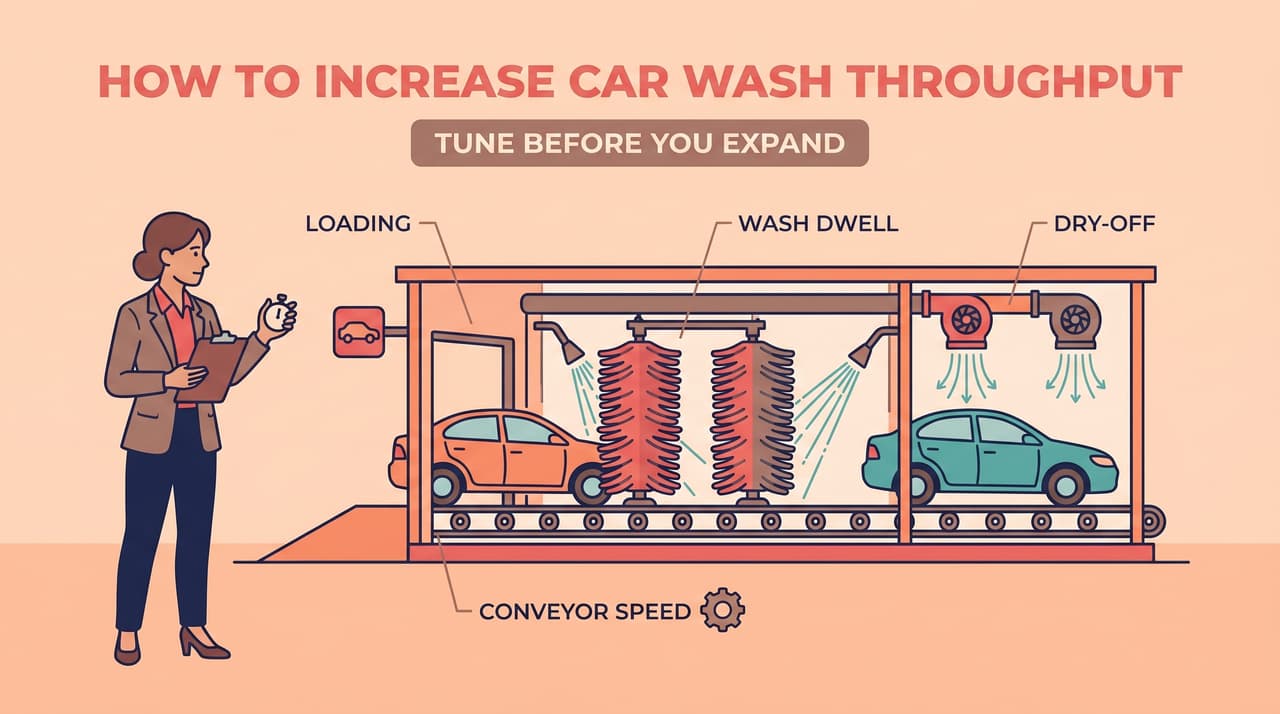
Throughput on any wash site is a chain of four constraints, and the slowest link determines the whole:
Conveyor speed — how fast vehicles move through the tunnel
Loading cadence — how quickly the next car is positioned on the conveyor
Wash dwell time — how long each zone (pre-wash, brushes, rinse, wax) has contact with the vehicle
Dry-off capacity — how quickly vehicles can exit without dragging water onto the lot
Increase one without addressing the others and you create a new bottleneck. Tune them together and you find the headroom.
The benchmarks worth anchoring to — industry figures for optimized operations consistently land in these ranges:
System type | Throughput range (optimized) |
|---|---|
In-bay automatic (rollover / gantry) | 8-12 cars per hour |
Compact tunnel (60-80 ft) | 40-60 cars per hour |
Express tunnel (100 ft+) | 80-120 cars per hour |
HyTian TX-380 tunnel system | 50-60 vehicles per hour sustained |
For context on how these ceilings differ by architecture, see our tunnel vs in-bay comparison. And for proof a well-tuned tunnel can go further than nameplate, our Japan deployment case study is worth a look — Splash N Go sites running the TX-380 process 500+ washes per day during peak periods, well above what a single optimization pass typically delivers.
So how many cars per hour can an automatic car wash actually handle? A modern express tunnel, properly loaded and tuned, handles 80-120 vehicles per hour. A rollover in-bay system handles 8-12. The gap isn't just equipment — it's how aggressively you're willing to tune every link in the chain.
Tune the equipment you already have
Most of the throughput hiding in your site is hiding in equipment settings the operator has stopped thinking about. Commissioning sets conservative defaults on day one; six months in, nobody has revisited them. Three specific areas are worth auditing.
Variable frequency drive (VFD) conveyor speed. If your tunnel has VFD conveyor speed control — and most modern tunnels do, including every TX-380 — the conveyor speed should be a seasonal and menu-driven variable, not a set-once constant. In summer with a light express menu, you can safely run faster than during winter with a longer rinse cycle. Operators who retune their VFD quarterly typically find 5-10% throughput headroom they had no idea was available.
The conveyor speed vs. wash quality tradeoff
Speeding up the conveyor compresses dwell time in specific zones — wheels, rockers, rooftops. If your brush pressure profiles and arch spacing are static, faster conveyor speeds will cost you wash quality in exactly those spots. This is where express car wash tunnel throughput runs into its most honest tension.
The equipment answer is tunable pressure curves and brush technology that preserves contact quality at higher speeds. HyTian's EVA closed-cell foam brushes use a linear pressure curve and resist grit carryover, which keeps cleaning performance consistent as conveyor speed rises. BYD's factory pre-delivery inspection wash is running a TX-380 at 60 cars per hour on factory-new vehicles — an application where any paint damage is unacceptable — which shows high throughput and paint safety are not mutually exclusive when the brush technology is matched to the speed.
Chemical dosing precision. Over-dosing slows dry-off and creates rework, which hard-caps your throughput. If your dosing pumps are old diaphragm-style or not calibrated to vehicle profile, you're probably carrying 10-15% of residual chemical your dryer has to fight through. HyTian's CNC metering pumps dose to 0.28 mL precision and extend chemical drum life to approximately 3,000 washes per 20 kg drum — which matters for operating cost, but more importantly for throughput, because precise dosing keeps dry-off moving and removes a bottleneck operators rarely think to diagnose.
Brush and nozzle condition. Worn brushes force operators to slow down to maintain quality. Grit carryover on non-EVA brush materials forces you to run cycle time longer to compensate. A brush audit is an underrated throughput exercise — if your brushes are 18+ months in on a high-volume site, replacement usually pays back inside a single peak season through throughput alone.
Fix the loading zone before you touch the tunnel
Here is the uncomfortable diagnostic most sites fail: the wash can handle more cars than the loaders are sending it. Before you retune the conveyor, count the gaps.
On a well-run tunnel, there should be 3-4 seconds between tire-drop and conveyor release — no more. Experienced loaders hold that cadence consistently. New hires don't. The throughput gap between an experienced loader and a new loader on the same tunnel is routinely 15-25 cars per hour. That's before you change a single equipment setting.
Three loading-zone moves typically surface more headroom than any tunnel adjustment:
Loader training and shift structure. Put your most experienced loader on the Saturday morning peak, not the Tuesday afternoon lull. This is an obvious move that almost no site actually schedules for.
Full-plate entry guides. The TX-380's full-plate entry guide (and equivalent features on other modern tunnels) removes the small misalignment stops that compound over a busy morning. Every "hold on, reposition" moment is 8-12 seconds of lost throughput, and it happens more often than operators realize.
Queue visibility. Visual queue management systems add roughly 15 cars per hour on busy days by changing driver behavior at the entry. Even without a tech system, a simple painted stack-up lane moves cars into position faster than an unmarked approach.
Peak hour car wash staffing that actually moves cars
Staffing at peak is where most operators spend the most money with the least throughput impact. The default move is to add a second greeter. The better move is to add a dedicated loader and shift greeter duties to the pay station or the preferred-membership lane. One additional loader during the 10am-1pm Saturday peak often delivers the throughput equivalent of two additional generalist staff.
A second principle: peak hours are for washing cars, not for running the business. Preventive maintenance, deep cleaning, cash drops, and training should live in the off-peak windows. Every maintenance task happening at 11am Saturday is an implicit throughput tax.
How do you reduce wait times at a car wash? Four moves, in priority order:
Shorten loading cadence to 3-4 seconds between tire-drop and release
Add queue visibility (signage, lane paint, or a visual system) to move cars into position faster
Separate the pay bottleneck from the wash bottleneck with a dual-lane pay station
Shift maintenance and cleaning work entirely out of peak hours
Reshape peak hours, don't just absorb them
The sites scaling fastest aren't just absorbing peak demand — they're reshaping it. If the underlying problem is volume concentration, staffing harder only goes so far. The higher-leverage move is to spread the curve.
Menu design. During peak, price your express tier aggressively and your premium tier at a small premium. This nudges peak-hour traffic toward shorter cycle times (no tire shine, no clear coat, no triple foam), which raises throughput per car without forcing a single equipment change. Some operators reserve the top tier for off-peak entirely.
Membership economics. Unlimited-plan members are your most predictable traffic — and the most reshapable. App-based reminders for off-peak washes, off-peak-only bonus washes, or off-peak-only premium upgrades can shift meaningful volume out of your Saturday window. Membership visit patterns are a profitability lever beyond throughput. For the broader math on how membership mix affects margins, our profitability guide for car wash operators covers that in depth.
Dynamic peak pricing. Modest peak-hour pricing premiums (10-20% on the top tier) raise revenue per car and naturally shorten queue length by deflecting the most price-sensitive traffic. Most owner-operators find dynamic pricing counterintuitive at first and load-bearing by year two.
Operational discipline. Keep preventive maintenance, PM walkdowns, chemical restocking, and all non-wash work out of your peak four hours. Treat that window the way a restaurant treats the dinner rush.
When optimization stops increasing car wash throughput (and expansion starts)
Optimization has a ceiling. Part of running a site well is recognizing when you've hit it. Four diagnostic signs usually show up together:
Queue consistently overflows the property despite good loader cadence
Conveyor is already at maximum safe speed for your vehicle mix
Wash quality complaints rise every time you push speed further
Your most experienced loader is fatigued by Sunday and throughput degrades on back-to-back weekend days
At that point, the ROI math shifts. Another 15-20 cars per hour through further optimization is hard-won and diminishing. Another 60+ cars per hour through a longer tunnel or an added lane is structural. For a full breakdown of the ROI math on expansion — payback periods, investment thresholds, and system-type comparisons — our ROI guide covers the decision framework in depth.
Worth noting: expansion doesn't always mean a full rebuild. Between optimization and new construction, there are mid-path options:
Tunnel extension. Adding 20-40 feet to an existing tunnel can lift throughput meaningfully without the land cost of a new site. Modular tunnel designs (including the TX-380) are engineered for this retrofit path.
Parallel IBA for overflow. Installing a rollover in-bay unit alongside a tunnel gives you a second lane for members or a failover during maintenance.
Detailing-bay conversion. Converting an underused detailing bay to an express bay unlocks revenue from a footprint already paid for.
The Japan deployment is a useful proof point here: Splash N Go's sites use custom TX-380 tunnel lengths engineered to fit space-constrained Japanese sites, which shows a tunnel can be reconfigured for a specific footprint rather than rebuilt from scratch. If your current site has more headroom in tunnel length than in lot expansion, a custom retrofit is often the cleaner path.
Key takeaways
Measure your theoretical throughput ceiling, not the current peak-hour average — your real headroom is usually 15-25% higher than you think
VFD conveyor tuning, CNC-precision chemical dosing, and EVA brush technology let you run faster without trading away wash quality
Loading cadence is the most commonly missed bottleneck — fix loader training and queue visibility before touching conveyor speed
Peak-hour design (menu tiers, membership nudges, dynamic pricing) reshapes demand rather than absorbing it
When diagnostic signs point to a structural ceiling — queue overflow, max safe speed, quality complaints, loader fatigue — expansion is cheaper than the tenth round of optimization
Pushing your current site toward its throughput ceiling? Our engineering team can walk through your tunnel configuration, conveyor settings, and loading workflow — and identify where you have 10-20 more cars an hour hiding in plain sight. Talk to our engineering team about your specific site.