
Used vs New Car Wash Equipment: How to Decide (TCO + Risk Framework)
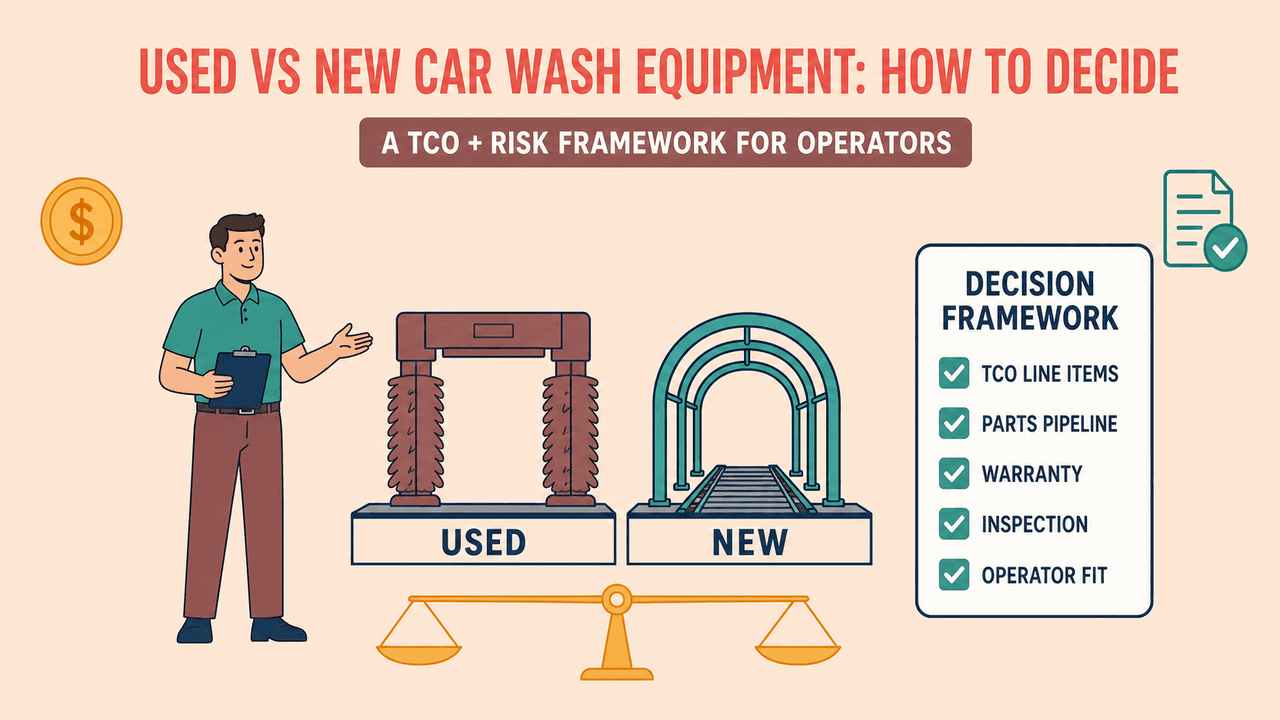
Used vs New Car Wash Equipment: How to Decide (TCO + Risk Framework)
Headline pricing for new car wash equipment varies depending on sourcing and project scope — equipment-only OEM quotes, dealer-channel turnkey installations, fully-built site packages, and regional market differentials all sit on different points along the same spectrum. Industry references peg fully equipped commercial tunnel installations in mature US and EU markets at $1.2 million to $7 million, reflecting site work, dealer margins, customization, and financing layered on top of the base equipment. Open the same week's consignment-marketplace listings for used car wash equipment and you'll see comparable systems at roughly a third of new-equipment pricing at the turnkey-installed reference point. The capital-allocation math feels obvious on that gap — until install, training, parts, warranty, and control-board lifecycle land on the same line.
This guide walks three questions for deciding whether used car wash equipment fits your operation: the actual TCO comparison once those line items are in the math, the risk categories used adds that new amortizes, and the operator profiles where used is genuinely the right call. The framing is from a new-equipment manufacturer's seat — not a pitch against operators buying used, but the honest analyst view the consignment marketplaces and refurbisher pages won't write.
Why the used car wash equipment decision is harder than it looks
Used and new aren't the same product class. A new-equipment quote is a package: equipment plus install, commissioning, training, initial spares, warranty, and current-spec compliance. A consignment-yard purchase is typically a single line — the equipment itself. The other items shift to the operator's side of the ledger.
Operating life is the second dimension. Operator benchmarks put rollover systems at 10-20 years and tunnel brush systems at 15-25 years with proper maintenance. But many operators report systems becoming functionally obsolete within 5-7 years of installation — water recycling, chemistry dosing, IoT, and LPR move fast enough that 5-7-year-old equipment can be structurally behind even when mechanically sound. Remaining-useful-life math has to account for both.
The third dimension is the secondary market itself. Used isn't a single thing — three distinct quality grades with prices and risk profiles varying by an order of magnitude. The TCO and risk frameworks both depend on which grade you're shopping.
TCO comparison: line items a new-equipment quote bundles and a used purchase doesn't
Headline savings on used are real — consignment listings often run 30-50% of comparable-new, and factory-refurbished from the OEM typically 50-70% because warranty and inspection are included. The comparable-cost math has to add back six line items the new package bundles by default.
Install and commissioning. A new package ships with the manufacturer's engineering team handling site assessment, plumbing and electrical adaptation, conveyor anchoring, and first-fill commissioning. Consignment ships to a yard — that scope lands on the operator. Multi-week for a tunnel; multi-day for an in-bay.
Chemistry calibration. New is dosed to local water hardness, conductivity, and chemistry-vendor compatibility at commissioning. Used carries the previous site's calibration.
Operator training and documentation. Manufacturers ship training and current-spec documentation with new equipment. Used may or may not transfer documentation; training falls on whoever runs the new site.
Initial spare-parts kit. New ships with critical spares — solenoids, nozzles, sensors, consumables for the first 6-12 months. Used ships with whatever the previous owner left.
Control-board firmware. PLC firmware, ladder logic, and HMI software get updated to current-spec on new at commissioning. Used carries whatever was on the board when pulled — supportable, paid-update-required, or locked into a discontinued version.
Warranty. New ships with manufacturer warranty on workmanship and component failure. Consignment is typically as-is.
Tax framing applies on both sides. Section 179 expensing in 2025 allows up to $2.5 million deducted in the year placed in service and applies to used as long as it's new to the taxpayer. Car wash equipment qualifies for MACRS 5/7/15-year accelerated depreciation under cost segregation. The lower used-purchase depreciation base produces a smaller absolute tax shield. Pair this with the new-equipment capex breakdown and the equipment maintenance schedule.
Risk taxonomy: where used car wash equipment can become a trapped cost
Five risk categories ranked by how much each one converts front-end savings into trapped cost.
1. Parts pipeline and control-board obsolescence. The highest single risk category. When an OEM discontinues a product line, parts move through three phases: surplus, remanufactured-only, obsolete. Mechanical wear items — bearings, motors, solenoids, brush sections — often survive into the remanufactured phase because aftermarket rebuilders serve them. PLC and control-board electronics are harder. Locating obsolete parts for legacy machinery is "exceptionally challenging due to supply chain instability, longer lead times, and consolidation" — a single control-board failure on an obsolete unit can turn a $2,000 board into a $20K+ rebuild-or-replace. Confirm the OEM still supports the product line and control-board version before any used purchase.
2. Warranty and recourse. Most consignment is as-is. The DetailXPerts consignment-shop analysis flags this as the single biggest risk — almost all consignment stores sell items as a final sale, regardless of condition. Factory-refurbished from the OEM is a different product class; warranty is typically included.
3. Inspection and unknown-history risk. Used turns over for various reasons — site closure, foreclosure, an upgrade, or a problem the seller didn't price in. Maintenance history is often incomplete. High-stress wear categories most likely to fail soon after purchase: motors, pumps, solenoids, bearings, brush assemblies. A third-party inspection — not affiliated with the seller — catches a lot of these.
4. Install and commissioning scope. Consignment typically doesn't include site assessment, plumbing or electrical adaptation, or first-fill commissioning. The operator inherits that scope, and it's non-trivial on tunnel and high-pressure systems. A failed install is harder to recover — no manufacturer engineering team to escalate to.
5. Compliance and certification. Used carries the certifications it had when manufactured. Local code may have moved on electrical, water discharge, chemical storage, or noise. New ships current-spec; used may need inspection-and-remediation before commissioning.
Maintenance discipline lives across all five categories. Proper maintenance can drastically improve a tunnel car wash's life expectancy — used inherits the previous owner's discipline, not your own.
Refurbished car wash equipment: factory-refurbished vs consignment vs DIY rebuild
Not all used equipment is the same product. Three quality grades with materially different price and risk profiles.
Factory-refurbished car wash equipment
The OEM pulls a used unit, inspects to factory spec, replaces wear components, restores firmware, and ships with factory warranty. The Oasis Car Wash Systems Pre-Owned program is the canonical example — refurbished units are described as "good as new" and come with factory warranty coverage included, positioned as "save you a bundle over the cost of one straight off the assembly line." Typical pricing 50-70% of comparable-new. Lowest risk — the OEM stands behind the unit and warranty gives the operator recourse on workmanship.
Car wash equipment consignment
Brokered listings — equipment sold on behalf of the previous owner, generally as-is. Carwashconsignment.com is the dominant marketplace; autowashonline.com and trade-press classifieds also participate. Pricing 30-50% of comparable-new. Some listings note "new parts installed" — helpful, but doesn't carry an OEM warranty. Inspection, install scope, and parts-pipeline recourse all sit with the operator. Highest risk grade, deepest inventory.
DIY rebuild and non-OEM remanufacture
Third-party rebuilders or operators buying components and restoring on-site. Quality varies widely. Warranty depends on the rebuilder. Parts substitutions — non-OEM motors, generic seals, third-party control boards — can introduce compatibility risk hard to diagnose until something fails. Risk is highest when the rebuilder isn't the OEM.
Grade | Price vs comparable-new | Warranty | Inspection responsibility | Parts pipeline | Recourse on failure |
|---|---|---|---|---|---|
Factory-refurbished (OEM) | 50-70% | Factory warranty included | OEM inspects to factory spec | OEM-supported, current-spec | OEM-backed warranty claim |
Consignment (brokered) | 30-50% | None — as-is, final sale | Operator carries inspection burden | Depends on OEM still supporting the product line | None typically; reseller may help informally |
DIY rebuild / non-OEM | Highly variable | Rebuilder warranty if any | Operator or rebuilder | Depends on parts substitutions in the rebuild | Rebuilder reputation; no OEM recourse |
When buying used car wash equipment makes sense — and when new wins
The honest answer is that used fits specific operator profiles. Naming them separates this framework from new-equipment marketing.
Used wins when:
The operation is short-term — test site, lease site, or planned exit within 5-7 years where new-equipment salvage value won't be recovered.
The bay is secondary or supplemental, not the revenue-generating primary.
Capital is the binding constraint and a new quote isn't financeable but a used purchase opens the project.
The operator has in-house technical capability for install, commissioning, and ongoing maintenance.
The equipment category has a deep secondary market with well-supported parts — older mechanical rollovers, basic touchless pumps, conveyor sections.
New wins when:
The operation is high-volume and uptime drives revenue — every hour of downtime costs more than the up-front discount.
The project is multi-site standardization — chains and dealer groups need identical equipment, current-spec parts pipelines, and unified service contracts.
The inventory is paint-sensitive (ceramic-coated, matte, PPF), where current-spec paint-safe brush material or touchless architecture is load-bearing.
Warranty, install support, and a documented parts pipeline need to come bundled, not managed separately.
Technology is moving fast enough that 5-7-year-old equipment is structurally behind on water recycling, chemistry dosing, IoT, or LPR.
The buy used vs new car wash equipment call lands on these profiles, not on a generic ranking. Payback math reinforces it — tunnel payback periods are running 3-4 years in 2025, down from 4-5 in 2024 as throughput rises. Long-horizon argues for new; short-horizon argues for used. Pair this with the ROI and payback period model.
An operator's checklist: questions to ask before any used car wash equipment purchase
Eight questions apply to consignment, factory-refurbished, and DIY rebuild equally — they answer differently in each case.
Model age, run hours or cycles, original installation date? Map to remaining-useful-life against industry lifespan benchmarks.
Is the OEM still in business and supporting this product line? A discontinued line drops the parts pipeline to surplus-only or obsolete-only.
PLC and control-board version, and firmware support status? Discontinued control boards are the highest single trapped-cost risk.
What's included — equipment only, or install, commissioning, training, spares? Add missing items to the used-side TCO.
Is there a warranty, and what does it cover? Factory-refurbished typically yes; consignment typically no; DIY varies.
Has it been inspected by a third party not affiliated with the seller? Especially for consignment and DIY-rebuild grades.
What chemistry calibration and water-hardness profile was it last commissioned for? Local-water adaptation may require recalibration.
Does it carry current local certifications — electrical, water-discharge, chemical-storage, noise? Used carries original-spec; current code may require inspection-and-remediation.
This pairs with our manufacturer evaluation checklist — that covers the broader vendor-evaluation questions on the new side; this is the used-equipment-specific overlay.
A manufacturer's view: where the new-equipment package earns its premium
The perspective in this section is from a new-equipment manufacturer's seat. Five items the new package bundles that the used math has to add back in: install and commissioning by the manufacturer's engineering team; operator training and current-spec documentation; an initial spare-parts kit and active OEM-backed parts pipeline; warranty coverage on workmanship; current-spec compliance with electrical, water-discharge, and noise codes wherever shipped.
Why those items matter — and why parts pipeline and component lifecycle are the load-bearing risks on used — sits in the manufacturing details. HyTian has been engineering car wash systems for over three decades — since 1992, as Nanjing Haiying Machinery — with 20,000+ systems deployed across 40+ countries under ISO 9001, ISO 14001, and CE conformity. Equipment like the modular tunnel architecture (TX-380) — CNC metering pumps holding chemistry dosing to 0.28 mL precision and EVA closed-cell foam brushes — is engineered for 10-25 years of operating life. Those components only hold their value when the OEM still supports them with parts, firmware, and engineering recourse. Used from a manufacturer that still ships the line carries a structurally different risk profile than used from a discontinued line.
The point isn't "buy new from HyTian." When those five package items are load-bearing — high-volume primary bay, multi-site standardization, paint-sensitive inventory, warranty-and-install-support — new wins. When they're not — short-term operations, secondary bays, capital-constrained pilots, well-supported equipment categories — used wins. The framework, not the new-equipment vendor, is the answer.
Key Takeaways
Headline savings on used (30-70% off comparable-new) are real. TCO is the real comparison — install, training, parts, warranty, and control-board lifecycle are line items the used side adds back in.
Risk taxonomy: parts pipeline and control-board obsolescence, warranty and recourse, inspection and unknown history, install and commissioning scope, compliance and certification.
Three quality grades: factory-refurbished (OEM, warranty, lowest risk), consignment (as-is, highest risk), DIY rebuild (varies). Pricing tracks the grade, not just the equipment.
Used wins for short-term operations, secondary bays, capital-constrained pilots, well-supported equipment categories. New wins for high-volume primary bays, multi-site standardization, paint-sensitive inventory, and projects where warranty and install support are load-bearing.
The eight-question operator checklist applies to all three grades — it just answers differently in each case.
Talk through the used-vs-new math for your specific project
Working through a used-vs-new decision for a specific project? Whether the math lands on a factory-refurbished rollover for a secondary bay or a new tunnel for a multi-site standardization, our engineering team can walk you through the TCO line items, the parts-pipeline reality, and the operator-fit profile of your project. No catalog pitch — just an engineering conversation about what fits your operation.
Start a conversation: Request a quote or talk to an engineer about your project's TCO and equipment fit.
Related articles
Explore more insights from the HyTian team.
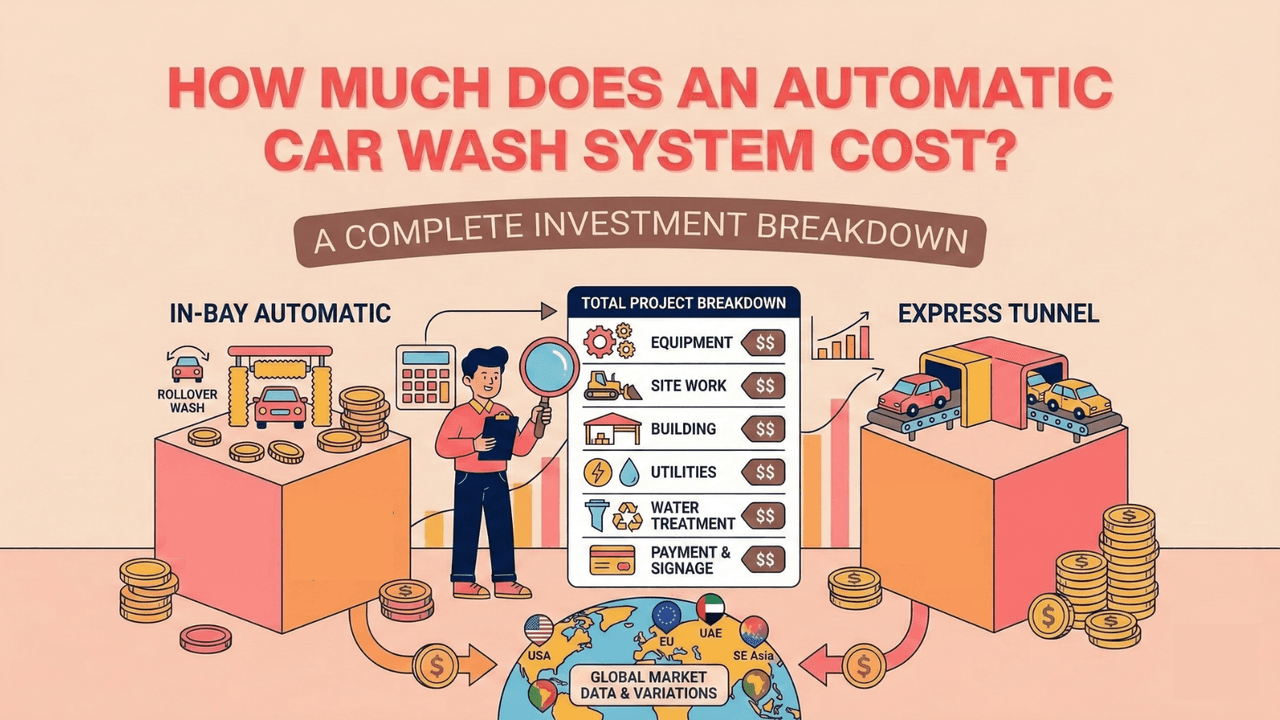
How Much Does an Automatic Car Wash System Cost? A Complete Investment Breakdown
Automatic car wash system costs range from $15,000 to $350,000+ for equipment alone. Here's what drives the price, what the total investment looks like, and how to compare quotes.
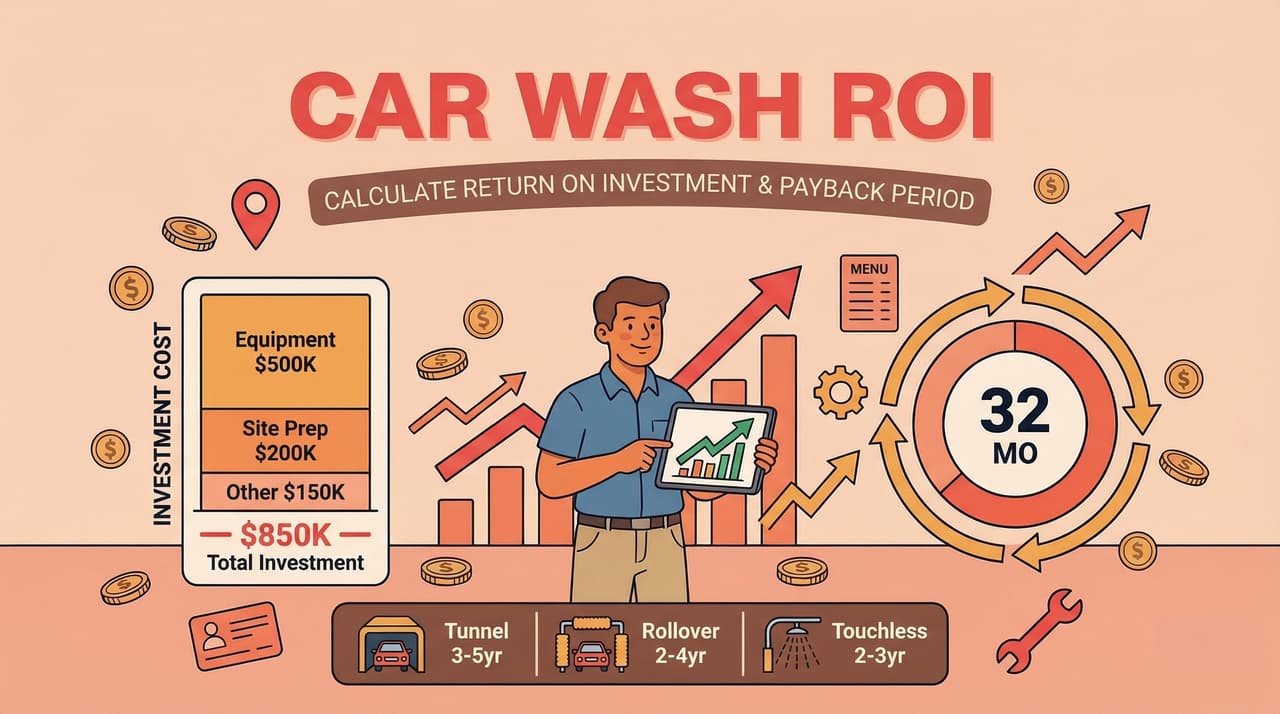
Car Wash ROI: How to Calculate Your Return on Investment and Payback Period
Car wash ROI typically ranges 20–35% annually with 2–5 year payback. Learn how to calculate your return, compare system types, and accelerate break-even.
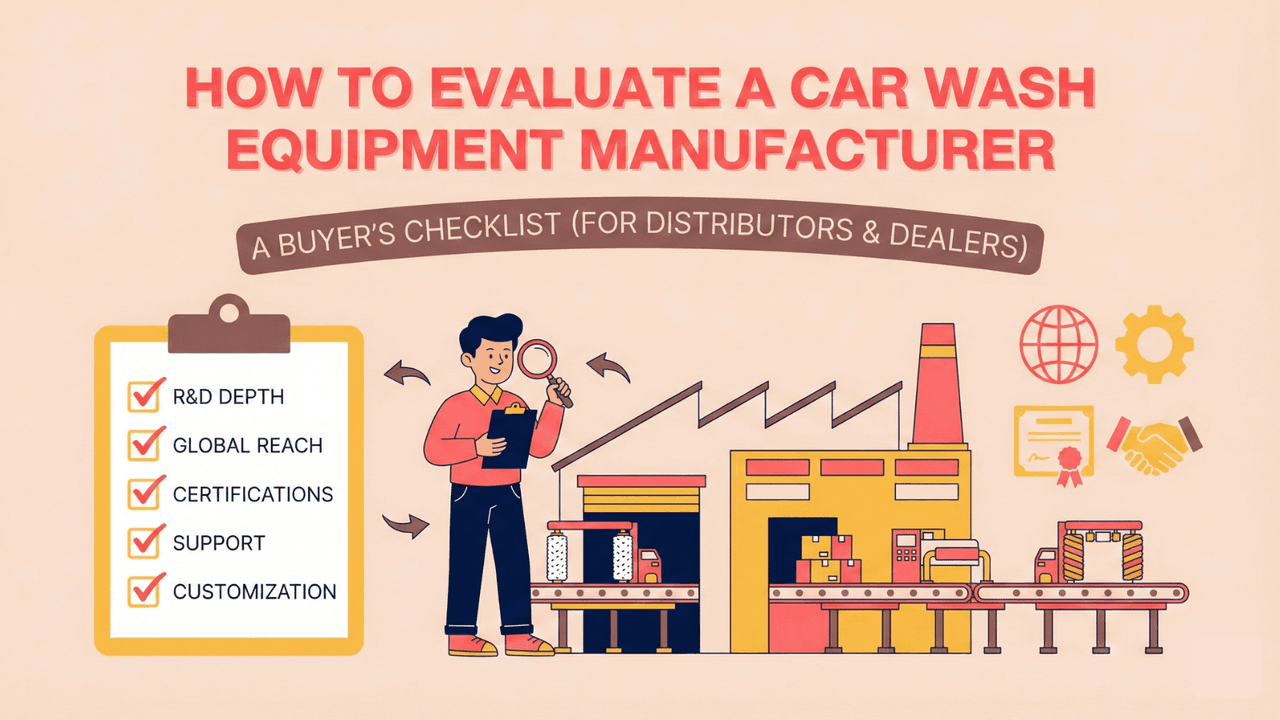
How to Evaluate a Car Wash Equipment Manufacturer: A Buyer's Checklist
A practical buyer's checklist for distributors and dealers evaluating a car wash equipment manufacturer. Learn what to look for in engineering capability, certifications, after-sales support, and global track record before committing to a factory partnership.