
How to Start a Car Wash Business: A Step-by-Step Guide from Site Selection to Launch
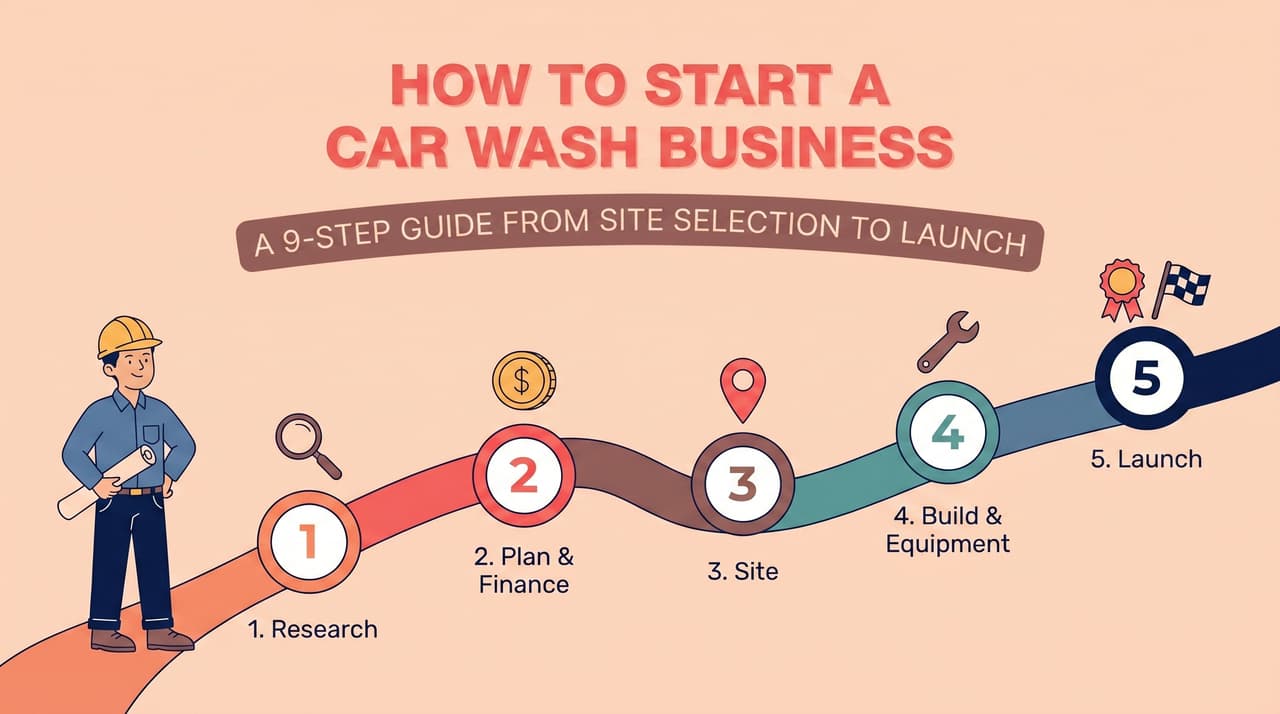
How to Start a Car Wash Business: A Step-by-Step Guide from Site Selection to Launch
Starting a car wash is a capital-intensive real-estate-and-equipment commitment, not a quick-flip service shop. Depending on the model, you'll put $150,000 to more than $3 million into the ground before the first wash, and you should plan for 12 to 18 months before volume stabilizes. This guide walks the full nine steps of how to start a car wash business, with extra depth on the build-out phase most generic guides skim over.
Is a Car Wash Business Right for You? An Honest Starting Point
Before learning how to start a car wash business in detail, set expectations. The U.S. car wash services market was valued at $15.28 billion in 2025 and is projected to reach $15.75 billion in 2026 — meaningful single-digit growth, not a gold rush. The industry has matured, and the bar for new entrants is higher than it was a decade ago.
Is owning a car wash profitable? Yes, for well-run sites — within a realistic range. Operators hitting stable volume typically see mid-teens to 20%+ net margins, with owner income varying by model: a single in-bay automatic site averages around $86,000; multi-site express tunnel operators commonly clear $350,000 or more. For a deeper look, see our car wash profit margin benchmarks and car wash ROI and payback periods guides.
What trips up first-time operators is the ramp. New sites take 12 to 18 months to reach stabilized volume, and memberships take another 6 to 12 months to build a meaningful base. SBA lenders know this; optimistic year-one projections get discounted in underwriting. If you can carry conservative working capital through the ramp, you have a viable business.
The 9-Step Car Wash Startup Roadmap
Step | Focus | Typical duration |
|---|---|---|
1 | Market research and business model | 1–2 months |
2 | Business plan | 1–2 months |
3 | Financing | 2–4 months |
4 | Site selection | 3–6 months |
5 | Permits and zoning | 2–6 months (often concurrent) |
6 | Equipment selection | 1–3 months |
7 | Build-out and installation | 6–12 months |
8 | Hiring and training | 1–2 months |
9 | Launch and ramp | 12–18 months to stabilize |
Steps overlap in practice: financing happens in parallel with site scouting, and equipment selection often informs final permit applications.
Step 1: Research Your Market and Pick a Business Model
Your business model is the first and most constraining choice in how to start a car wash business. It drives capital, staffing, revenue ceiling, and site criteria. Three models dominate:
Self-serve. Operator-paced bays where drivers wash their own vehicle. Lowest capex, lowest ceiling. Typical revenue: $41K–$80K per year.
In-bay automatic (IBA). Single-bay automated system, often added to gas stations or small retail sites. Revenue: $80K–$250K per bay.
Tunnel / express. Conveyor-driven, high-throughput, membership-driven. Revenue: $300K–$686K for standard tunnels; $700K–$2M+ for express sites with strong membership programs.
Here's how the three stack up:
Self-serve | In-bay automatic | Tunnel / express | |
|---|---|---|---|
Total startup cost | $150K–$400K | $375K–$700K | $1.5M–$7M |
Equipment cost | $50K–$150K | $400K–$450K | $1M+ |
Throughput | 2–4 vehicles/hour per bay | 8–12 vehicles/hour | 50–60+ vehicles/hour |
Typical lot size | 0.25–0.5 acre | 0.3–0.5 acre | ~1 acre |
Ramp to stabilized volume | 6–12 months | 12–18 months | 12–18 months |
The economic lever at the top of the range is membership. At Mister Car Wash, the largest US express chain, members made up about 75% of wash revenue by the end of 2024 — an express tunnel is effectively a subscription business with car washes as the delivery mechanism.
Scout the competitive landscape before committing. A three-mile radius in urban markets and roughly eight miles in rural ones is the buffer where an existing operator starts cannibalizing a new entrant's capture rate. If you're eyeing a fuel-retail site, see our guide on adding a car wash to a gas station; if you're weighing tunnel against in-bay, the tunnel vs. in-bay automatic comparison breaks down when each wins.
Step 2: Write Your Car Wash Business Plan
A lender-ready car wash business plan covers eight sections: executive summary, market analysis, model rationale, site plan, equipment plan, financial projections, staffing plan, marketing plan. Financial projections are where most plans fall apart in underwriting — not because the math is wrong, but because the assumptions are too optimistic.
The revenue projection lenders expect follows this formula:
Annual revenue = (cars per hour) × (operating hours per day) × (days per year) × (average ticket) × (capture rate)
A tunnel engineered for 55 vehicles per hour does not produce 55 every hour of its operating day — capture rate separates peak throughput from weighted-average. Most operators see blended capture rates of 25–40% of theoretical peak. Model accordingly.
Build a 12 to 18 month ramp into your projected income statements. Construction budgets tend to run 10–20% over initial estimates — utility hookups, permit delays, site-prep surprises — so include that contingency as a line item, not an assumption. The plan should stay cash-flow-solvent through the conservative scenario, not just the base case.
Step 3: Secure Financing — How Much You Actually Need
How much does it cost to start a car wash business? Roughly $150K–$400K for self-serve, $375K–$700K for an in-bay automatic (per bay, touchless on the high end), and $1.5M–$3M for a standard tunnel — premium express builds run $2.5M–$7M. Equipment alone is $400K–$450K for IBA and $1M+ for tunnel, which is why car wash startup costs concentrate so heavily in hard assets. For a detailed line-item breakdown, see our guide on what an automatic car wash system costs. That is the cost of building independently — a franchise route carries a different fee structure entirely, and we unpack it in car wash franchise cost vs. independent.
Where the Money Actually Goes
Across models, startup capital typically allocates:
Land / lease: 15–30% of total.
Site prep and building: 20–35% — grading, utilities, structure, signage.
Equipment package: 25–50% — biggest swing factor, driven by model.
Chemicals and consumables: 2–5% upfront, ongoing thereafter.
Working capital: 10–15% — carries operations through the 12–18 month ramp.
Permits, legal, marketing: 3–8%. Easy to under-budget.
SBA Financing and Credit Requirements
The two dominant financing paths are SBA 7(a) and SBA 504. The SBA 7(a) program provides up to $5 million covering real estate, equipment, working capital, and goodwill in a single loan — the simpler option for most first-time operators. SBA 504 is structured for larger real-estate-focused deals with fixed-rate terms up to 25 years, and usually makes sense when buying land as well as building.
Lenders typically require a minimum credit score of 680, with 720+ reducing friction. Expect 10–20% equity, industry or adjacent operating experience, and 24 months of projected statements modeled against the realistic ramp. Applicants from adjacent industries — fuel retail, quick-lube, property management — tend to be underwritten more favorably than first-time business owners.
Step 4: Choose a Location — the Single Biggest Decision You'll Make
Site quality sets the ceiling of your business. A great operator in a poor location loses to an average operator in a great one every time. How do you choose a car wash location? Evaluate against these benchmarks:
Traffic count: 15,000–25,000 vehicles per day passing the site. Below 10,000 is difficult for any model; above 25,000 is premium.
Demographics: 30,000–50,000 people within a 3-mile radius. Higher density supports tunnel economics; lower density favors IBA.
Traffic speed: 25–45 mph at the frontage. Above 50 mph, capture rates fall sharply.
Physical site: ~1 acre with ~225 feet of road frontage, flat topography, multiple access points.
Adjacent anchors. Grocery, fuel, fast food, and pharmacy co-tenants drive impulse visits.
Competitive buffer. 3 miles urban / 8 miles rural from the nearest comparable operator.
A site that checks five of the six is a strong candidate. Three is a coin flip. One or two is a deal to walk away from, even if the lease economics look attractive.
Step 5: Navigate Permits, Zoning, and Environmental Compliance
What permits do you need to open a car wash? Confirm zoning permits car wash use before committing capital. This is where deals die quietly — a lease signed in enthusiasm becomes an expensive education in municipal planning. Common permits for a ground-up site:
Building permit (construction and plumbing).
Conditional use permit (many jurisdictions treat car washes as conditional).
Stormwater management permit (most states require an engineered plan).
Wastewater discharge permit (coordinate with the local sewer authority).
Signage permit (pylon, monument, façade).
Certificate of occupancy (final approval).
Environmental compliance is where first-time operators most often underestimate cost. Water discharge, chemical storage, and stormwater management are regulated locally and aggressively enforced in regions with water stress. Water reclaim systems run $50,000–$100,000 and are increasingly mandatory — the upside is a 60–80% reduction in fresh water consumption.
If you're sourcing equipment from outside the U.S., confirm the manufacturer holds ISO 14001 environmental-management certification. HyTian holds ISO 14001 alongside ISO 9001 and CE — these are the baseline credentials any serious manufacturer should be able to show you.
Step 6: Select Your Equipment — the Phase Most Guides Skip
Equipment selection is where generic startup guides run thin, and where most of your long-term operating economics actually get decided. The wrong system costs you for the next ten years in energy, chemicals, downtime, and service calls. This section isn't about a specific vendor — it's about what to evaluate when you talk to any manufacturer.
Five Variables That Drive Equipment Selection
Business model (Step 1). Self-serve, IBA, and tunnel use fundamentally different equipment families.
Site throughput target. Peak-hour demand and what the system needs to deliver during the top 20% of hours.
Available footprint. Tunnel length, bay dimensions, reclaim-area space.
Chemical economics. Dosing precision is a hidden operating-cost lever most operators underweight.
Service and parts availability — especially critical for sites outside major metros and for international deployments.
Price is one input among five.
Throughput: Match System Capacity to Peak Demand
Throughput is the number most commonly quoted in marketing and most commonly misinterpreted in practice:
Self-serve: 2–4 vehicles per hour per bay.
In-bay automatic: 8–12 vehicles per hour.
Tunnel / express: 50–60+ vehicles per hour.
As a concrete reference, the HyTian TX-380 conveyor tunnel is engineered for 50–60 vehicles per hour with configurable tunnel length and a VFD-controlled conveyor. When any manufacturer quotes a throughput number, ask what conditions produced it — vehicle mix, cycle time, operator load. A figure measured on sedans on a clean day reads differently than one measured on a Saturday afternoon with SUVs, trucks, and weather.
Brush Technology and Paint Safety
Brush material matters more than most first-time operators realize. Older cloth and nylon brushes can abrade paint over repeated cycles — fine for most retail washes, problematic for premium or pre-delivery inspection (PDI) applications.
EVA closed-cell foam brushes are the current standard where paint safety matters. The TX-380 uses EVA foam that BYD standardized for factory PDI wash across its Zhuhai plant at 60 cars per hour — an OEM would not sign off on brush material it didn't trust on new paint. Ask every manufacturer what the brush material is and who uses it for paint-sensitive applications.
Chemical Dosing: the Hidden Operating-Cost Lever
Dosing precision directly changes your cost per wash. A pump that over-doses by 10% wastes 10% of your chemical budget every day for the life of the site.
What precise looks like: the TX-380 uses CNC metering pumps with 0.28 mL dosing precision, extending drum life to roughly 3,000 washes per 20-kilogram drum. The question to push every vendor on is: "What's your dosing precision, and what does it translate to in cost per wash at 50 vehicles per hour?"
Water Recycling Is No Longer Optional
Regulatory pressure, water costs, and ESG expectations all point the same direction. Plan for water reclaim from day one — the retrofit cost is meaningfully higher than the initial install. Budget $50,000–$100,000 if it isn't bundled. The benchmark is a 60–80% reduction in fresh water consumption.
Manufacturer Evaluation Checklist
These criteria matter more over a ten-year equipment life than headline price:
Certifications. CE, ISO 9001, ISO 14001. Baseline, not optional.
Spare parts. Ask for typical wear-part lead times. Two weeks is acceptable; two months is a red flag.
Reference deployments. Three clients you can call — not three logos on a slide.
Remote commissioning capability — critical for sites far from service hubs.
Manufacturing scale. HyTian's 20,000+ installations across 40+ countries, backed by its parent Nanjing Haiying Machinery since 1992, is one benchmark of what a globally proven manufacturer looks like.
For a more structured framework, see our guide on how to evaluate a car wash equipment manufacturer.
Pressure-testing an equipment shortlist? Our engineering team is happy to have a technical conversation at the research stage — no quote pressure.
Step 7: Build Out Your Site and Install Equipment
Build-out typically runs 6 to 12 months from permit approval to soft opening. The critical path is usually utility connections — water, sewer, and three-phase power — which gate the schedule more than the construction itself. Start utility conversations the day your permit is approved.
The equipment commissioning sequence is consistent across vendors: factory acceptance testing → site installation → water and chemical setup → staff training → test wash cycles. Insist on documented quality benchmarks at handover: verified dosing accuracy, measured reclaim throughput, signed operator training records.
If your manufacturer is overseas, remote commissioning is now standard — HyTian used it with Splash N Go in Japan during pandemic-era travel restrictions, running calibration and training remotely without delaying the launch. It's a fair capability to require from any international partner.
Step 8: Hire and Train Your Team
Staffing scales with business model:
Self-serve: 1–2 attendants for site supervision and cash handling.
In-bay automatic: 1–2 operators per shift.
Tunnel / express: 4–10 across greeter, equipment monitor, prep, detail, and maintenance roles.
At an express tunnel, the greeter is the highest-leverage hire. Membership conversion happens at the point of sale — a greeter who can sell a $29.99 monthly plan in a 45-second conversation is worth significantly more than one who just takes payment. Hire for that capability.
Document SOPs early — open and close routines, cycle monitoring, chemical refill, safety procedures, service-recovery scripts. Maintenance tech capacity should be on staff or contracted with guaranteed response times; peak-hour downtime is pure revenue loss, and a two-hour fix vs. a two-day fix can be several thousand dollars.
Step 9: Launch, Ramp, and Build the Membership Base
Open soft before you open grand. Two to four weeks of limited hours give you time to calibrate equipment under real use, catch training gaps, and tune chemical dosing to your actual traffic mix — before local media and promotional pricing bring crowds that punish loose ends.
The grand opening should combine price promotions, local media outreach, and co-marketing with adjacent anchor tenants. A launch that captures your neighbors' Saturday traffic is worth more than a paid ad campaign.
If your model is express, start enrolling members at the soft opening. The base takes 6 to 12 months to build to a meaningful subscriber count, and every month of delay compounds. Track these KPIs from day one:
Cars per hour (actual vs. capacity).
Average ticket and membership conversion rate.
Equipment uptime percentage.
Chemical cost per wash.
Revenue per square meter.
Revisit the plan at 6 months and again at 12. Most first-year adjustments are pricing, labor shift coverage, and membership tier structure. If your 12-month numbers are on track, the 12-to-18-month stabilization tends to follow.
Key Takeaways
If you're deciding how to start a car wash business and want the five things that matter most:
Pick the business model first. Self-serve, IBA, and tunnel have fundamentally different economics, staffing, and site requirements. Every downstream decision follows from this one.
Site selection is your highest-leverage decision. Traffic count, speed, demographics, footprint, and competitive buffer beat operator skill over the long run.
Budget a 10–20% contingency on construction. Utility connections, permitting, and site prep are the usual overruns.
Equipment selection deserves deeper due diligence than most guides give it. Throughput under real conditions, brush material and paint safety, chemical dosing precision, certifications, and parts availability all matter more than headline price.
Plan for 12–18 months to stabilized volume. Memberships take 6–12 months to build. Your financing has to carry you through both.
Talk to an Engineering Team, Not a Salesperson
Planning a car wash build — or still deciding if it's the right move? Our engineering team at HyTian can walk you through system options matched to your target site, traffic, and business model. No pitch: just an honest conversation about what fits. Start with our car wash business solutions overview, or discuss your project with our engineering team directly.