
Car Wash Water Recycling: Compliance, Cost Savings, and System Options
Car Wash Water Recycling: Compliance, Cost Savings, and System Options
Water and sewer rates are climbing in most US markets, discharge enforcement is sharpening, and drought-state agencies have turned temporary conservation orders into permanent rules. If you run a wash site, the practical question is no longer whether to think about reclamation — it is whether your site triggers compliance, what reclaim depth fits your wash type, and how fast a car wash water recycling system pays back at your local water rate. This is the operational read: regulatory triggers, system options, and the cost math. For the broader values-and-reporting angle — energy, chemicals, and environmental management — see our companion piece on sustainable car wash operations.
Why Water Recycling Became an Operating-Cost Lever, Not a Values Statement
Three shifts have rewritten the math, and none of them are about image.
The first is price. US water and sewer bills rose about 24% over the five years to 2024, and combined rates have been escalating roughly 3-4% a year with no sign of slowing. The increases are not evenly spread, but they are broad: San Diego raised water rates 14.7% on January 1, 2026, and smaller utilities have pushed double-digit jumps of their own. Every gallon you stop drawing fresh is a gallon you stop paying for twice — once on the supply meter, often again on the sewer charge.
The second is regulation. Drought-state water boards have converted emergency conservation into standing policy, and a wash that recycles is frequently exempt from outdoor-use restrictions that would otherwise constrain it. The same dynamic is playing out outside the US: our South Africa water recycling guide walks through how drought restrictions and municipal by-laws stack up there.
The third is enforcement. Local treatment authorities are tightening discharge limits on the constituents a wash bay produces. For an owner-operator, the question stopped being "should we be greener." It became operational: do I have to install reclamation, what does it cost to add, and what does it return per year.
Car Wash Water Reclamation Requirements: What Actually Triggers Compliance
Car wash water reclamation requirements live in three layers, and you need to read all three before assuming none of them apply to your site.
Federal floor — EPA pretreatment. Under the General Pretreatment Regulations at 40 CFR Part 403, any business that discharges process water to a publicly owned treatment works (POTW) is prohibited from sending pollutants that "pass through or interfere" with the plant. The EPA explicitly classifies an industrial user as anything from a chemical plant down to "an automated, coin-operated car wash." Petroleum and mineral oil that causes interference is specifically prohibited. Your POTW sets the local oil-and-grease, total-suspended-solids, and pH limits, and whether it classifies your wash as a Significant Industrial User determines if mandatory pretreatment and monthly self-monitoring apply.
Stormwater overlap — the storm-drain failure mode. This is the trap that catches operators who believe they are compliant. Per state stormwater guidance built on EPA rules, "the EPA considers wash water to be a non-stormwater discharge (i.e. illicit discharge); therefore, wash water from a facility must be directed to a sanitary sewer or treated on-site prior to discharge." Vehicle washing generates oil, grease, sediment, metals, solvents, and detergents — none of which belong in a municipal storm sewer that drains untreated to a creek. A site can be in good standing with its POTW on the sanitary side and simultaneously out of compliance if wash water reaches a storm drain.
State and local layer — drought rules and permit conditions. On top of the federal floor, drought-state agencies run their own use-restriction frameworks, and some municipalities now require reclamation as a condition of issuing a new car wash permit. These rules vary widely by jurisdiction.
The honest framing is that compliance is jurisdiction-specific, and no national rule of thumb replaces a conversation with your local authority. But an operator who can name "40 CFR Part 403," "Significant Industrial User classification," and "illicit discharge to the storm sewer" walks into that conversation with the right vocabulary. It also makes the case for itself: a car wash water recycling system is often the cleanest path to staying inside all three layers at once.
How a Closed-Loop (Zero-Discharge) Car Wash Water Recycling System Works
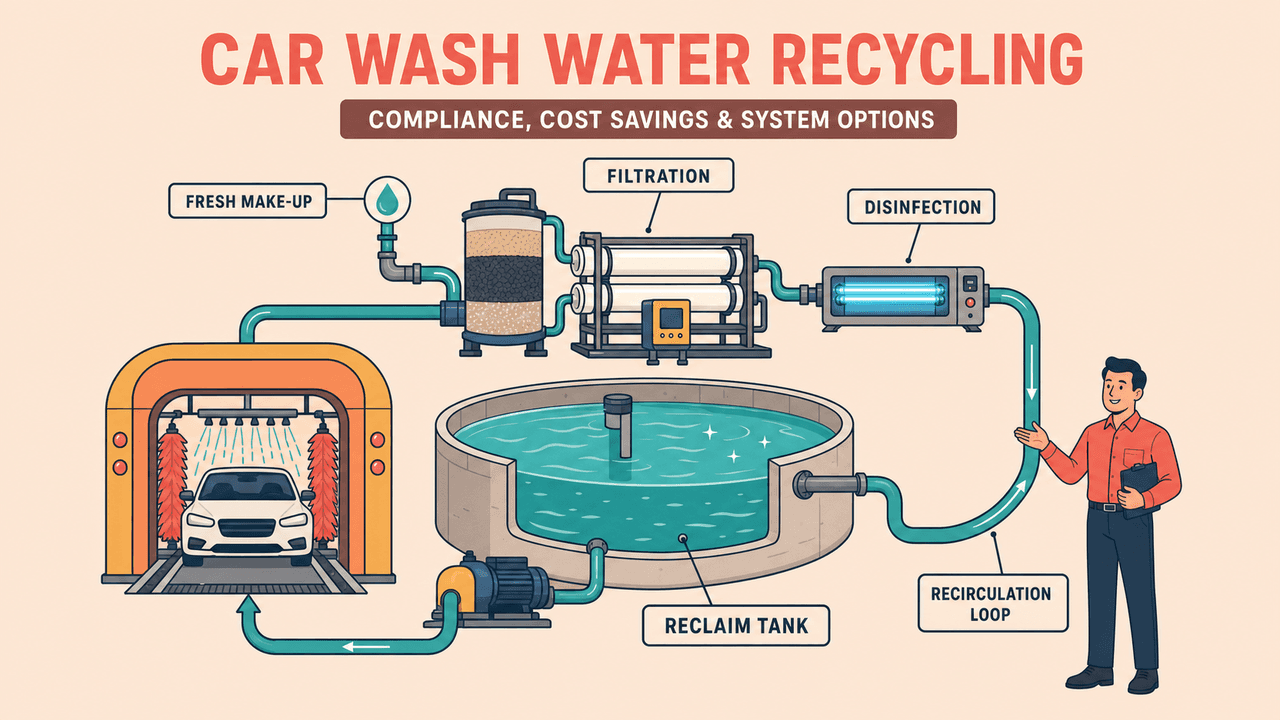
A closed-loop system treats used wash water and returns it to the wash instead of sending it to the sewer. Water cycles through settling, filtration and disinfection, then goes back to the bay — with only a small bleed of fresh make-up water replacing what leaves as sludge, carryover on vehicles, and evaporation.
The loop runs in four stages, each doing work the next one depends on:
Settling and oil/grit separation — drops heavy solids and skims hydrocarbons. Returns roughly 50-60%, good for chassis and undercarriage pre-rinse.
Sand filtration plus activated carbon — removes finer solids and the dissolved organics that cause odour. Takes reuse to about 60-70%, covering full pre-rinse and brush-wash.
Ultrafiltration plus disinfection (UV or ozone) — strips bacteria and the last fine solids, reaching roughly 80-90%, covering every stage except final spot-free rinse.
Reverse-osmosis polishing — only where it earns its place. RO takes a system past 90% and lets reclaimed water serve the spot-free rinse itself, which is what makes a loop genuinely closed.
What actually leaves the loop. "Zero discharge" describes the wash water, not the site. Sludge still gets hauled, filter media and membranes still get replaced, and a small blowdown volume still goes out to keep dissolved solids from concentrating. A closed-loop wash has no process-water discharge, not no waste.
When a site actually needs one. Closed-loop is the answer when discharge is constrained rather than merely expensive: a permit that caps volume or loading, a sewer surcharge that scales with what you send, water scarcity or drought restrictions, or no sewer connection at all. Where discharge is simply costly, a mid-tier system usually returns more per dollar than going closed. The decision frame below works through matching depth to wash type. For how reclaim differs from recycling as a category, see our reclaim system guide.
How a Car Wash Water Recycling System Works
A car wash water recycling system pulls used wash water from the bay drains, runs it through a sequence of filtration and disinfection stages, and routes the reclaimed water back to the wash stages that do not require fresh feed. How much it reclaims depends on how many stages it runs: basic filtration typically recovers around 50-60% of water, while ultrafiltration or reverse osmosis installed after precision filtration raises overall recovery to 80-90%. The EPA's WaterSense program notes that vehicle-wash stations can save at least 50% of the water they use through reclaiming and reuse.
The table below maps the common tiers. Capex moves with reclaim depth, so the right system is the one matched to your wash type and water rate — not the deepest one a vendor can quote.
Reclaim tier | Typical reuse | Reclaimed water is good for | Relative capex | Key operating cost |
|---|---|---|---|---|
Settling + oil/grit separation | ~50-60% | Chassis / undercarriage pre-rinse | Low | Sludge haul-off |
Sand filtration + activated carbon | ~60-70% | Full pre-rinse and brush-wash stages | Low-Mid | Media replacement |
Ultrafiltration + UV/ozone disinfection | ~80-90% | Every stage except final spot-free rinse | Mid | Membrane + lamp/ozone service |
UF + reverse-osmosis closed-loop | 90%+ | Including spot-free rinse | High | RO membrane replacement |
Stage 1 — Settling and Oil/Grit Separation
Settling tanks, oil-water separators, and a sludge-discharge subsystem capture the heaviest solids, sand carryover, and surface oils. A gravity oil/water separator simply gives oil droplets enough residence time to rise and be skimmed off. This stage carries the lowest capex, and its reclaimed output is acceptable for chassis pre-rinse and undercarriage flush — not for body wash or final rinse.
Stage 2 — Sand Filtration Plus Activated Carbon
A sand bed removes finer suspended solids, and activated carbon adsorbs the dissolved organics and odor-causing compounds that settling alone leaves behind. Together these polish the water enough to feed full pre-rinse and brush-wash stages, lifting the practical reuse rate toward 70%.
Stage 3 — Ultrafiltration Plus Disinfection (UV or Ozone)
Ultrafiltration membranes catch residual particles down to roughly 0.01 micron, and a UV or ozone disinfection step controls bacterial regrowth in the storage tank — the failure mode that otherwise turns reclaimed water black and gives a bay that telltale smell. This is the practical sweet spot for most commercial sites and the foundation of any genuinely eco friendly car wash system: 80-90% reuse, water clean enough for every stage except the final spot-free rinse.
Stage 4 — Reverse Osmosis Polishing (When It Earns Its Place)
For a closed loop that includes the final rinse, a reverse-osmosis polishing stage removes the dissolved solids that otherwise leave spotting on dried paint. RO rarely earns its place except in extreme water-cost markets or hard-water regions where you are already running RO for spot-free rinse anyway. And even a 90%-plus system is not zero-water: it still draws fresh make-up for the spot-free rinse, evaporation, and periodic purge cycles. Reclamation is closed-loop in steady state, not closed-loop forever. If a vendor pitches "100% closed-loop," ask them to define exactly what stays inside the loop and what remains on fresh feed.
Cost Savings: What Reclaim Returns and How Fast It Pays Back
Reclaim savings come from two places, and both scale with your local water-and-sewer rate.
The first is fresh-water volume. A conventional wash uses roughly 30-70 gallons of fresh water per vehicle; the EPA's WaterSense guidance targets 35-40 gallons per vehicle for conveyor and in-bay automatic systems before any reuse. A reclaim system can pull that down to as little as 10-20 gallons of fresh water per car. The second is the sewer-fee offset: in many rate structures, water you do not draw fresh is also water you do not pay to discharge, so the savings land twice.
What does that mean in dollars? Independent industry figures are a better guide than any single vendor's claim. One worked operator example puts a 100-car-per-day wash at about 40 gallons per car near $1,200 a month in water charges, with a 75% reclaim rate cutting that toward $300 a month. The same source cites an operator whose water-and-sewer bill fell from roughly $2,500 to $600 a month after installing reclaim. Across the industry, reported payback periods commonly land in the 9-18 month range, with lifecycle water-related savings often cited in the $15,000-$25,000 range over five to eight years. Your numbers will track your own water rate, your wash volume, and your reclaim depth — high-rate, high-volume sites pay back fastest.
Two honest caveats keep the math credible. First, operating costs are real: filter-media replacement, UV-lamp or ozone-generator service, UF and RO membrane replacement, and incremental pump electricity all subtract from gross savings, so price them into the payback rather than around it. Second, many municipalities offer rebates for installing reclaim systems, which pull payback forward — worth checking with your utility before you size anything.
For the full picture of how reclaim flows through to the bottom line, see our car wash ROI and what an automatic car wash system costs breakdowns, alongside the broader car wash operating cost breakdown.
What moves the price of a recycling system. There is no single price for a reclaim system — the tiers above are genuinely different machines. Four things drive where a quote lands. Flow rate is the first and largest: a system is sized to gallons per minute at peak, and a tunnel needs several times the throughput of a single in-bay. Stage count is the second — each tier in the table adds vessels, pumps and controls. Whether reverse osmosis is included is a step change rather than an increment: RO brings its own pressure set, membrane housings and reject handling. And automation depth — automatic backwash, dosing and remote monitoring versus manual service — moves both the capital number and the labour it takes to run.
Ask any vendor to quote against your peak flow rate and your target reuse percentage rather than against a tier name. Where European discharge rules are the driver rather than water cost, our guide to European water-recycling regulations covers what the thresholds actually require.
Matching Reclaim Depth to Your Wash: A Decision Frame
The most common reclaim mistake is buying the wrong depth — over-specifying RO for a low-volume site, or under-specifying a settling skid where the discharge rules demand more. Work the decision in this order:
Read your jurisdiction first. Compliance sets the floor. Confirm whether your wash water must be pretreated before it reaches the sanitary sewer, and confirm it is not reaching a storm drain at all. This is the non-negotiable minimum; cost optimization comes after.
Match reclaim depth to wash type and volume. A self-serve or in-bay automatic site with modest draw is often well served by settling plus sand-and-carbon filtration. A high-volume express tunnel — where absolute water draw is largest — usually justifies ultrafiltration with disinfection, because the absolute savings are largest there too. Premium spot-free or hard-water operations are the main case for adding RO.
Check your water rate. The same system pays back in months in a high-rate coastal market and in years in a low-rate inland one. A vendor quote promising a fast payback at low volume in a low-cost-water market deserves a second look. Compare against your own typical water and power consumption baseline.
Decide at new-build if you can. Integrating reclaim during a new build or major refit is consistently more cost-effective than retrofitting later, because tank placement and plumbing routing are designed in rather than worked around. If a refit is on your horizon, specify reclaim now.
Reclaim technology is still advancing, too — 2026 field deployments of nanobubble-assisted reclaim report 35-50% fresh-water reductions, with one site reporting about three million gallons saved per year. The fundamentals above still govern the decision, but the ceiling on what reclaim can deliver keeps rising.
Reclamation Engineered Into the System, Not Bolted On
The cleanest reclaim outcomes come from systems where recycling was designed into the wash rather than added afterward. That is the engineering principle behind how HyTian approaches it across its catalog. The TX-380 tunnel platform supports water recycling as a configuration option, integrated most cleanly at new-build. The TH-Series drive-through bus washers ship with water recycling integrated as standard — the deployment at Zhuhai Public Transport, which processes up to 80 buses per hour, is the fleet-scale reference. Custom systems, like the multi-stage closed-loop reclamation engineered for a light-rail tram wash in Bolivia, are built around the discharge constraints of the site. And HyTian's grate and roller wheel-wash systems already operate at just 3-5 liters per vehicle through integrated water recycling and automatic sludge discharge — reclaim as the baseline, not the upgrade.
That engineering sits inside an ISO 14001 environmental management framework, and it is backed by more than 20,000 systems operating across 40-plus countries — drawing on parent company Nanjing Haiying Machinery's manufacturing experience over three decades since 1992. The point is not the badge; it is that reclamation engineered as part of the wash, for the specific water rate and discharge rules of the site, is what makes the payback math hold up.
Key Takeaways
Compliance lives in three layers — federal pretreatment (40 CFR Part 403), the storm-drain illicit-discharge rule, and state or local drought and permit conditions. Read all three before assuming none apply.
Reclaim depth scales with stages: about 50-60% reuse from basic settling and filtration, 80-90% with ultrafiltration plus disinfection, and 90%-plus only when reverse osmosis genuinely earns its place.
Payback commonly lands in the 9-18 month range and accelerates as water and sewer rates climb — but only after you subtract real operating costs and check for utility rebates.
Size to your wash type, water rate, and permit conditions, and integrate reclaim at new-build whenever the option exists.
Reclamation works best when it is engineered into the wash from the start, sized to your water rate, wash type, and local discharge rules. Want to map the right reclaim depth for your site? Talk to our engineering team about your specific configuration.
Related articles
Explore more insights from the HyTian team.
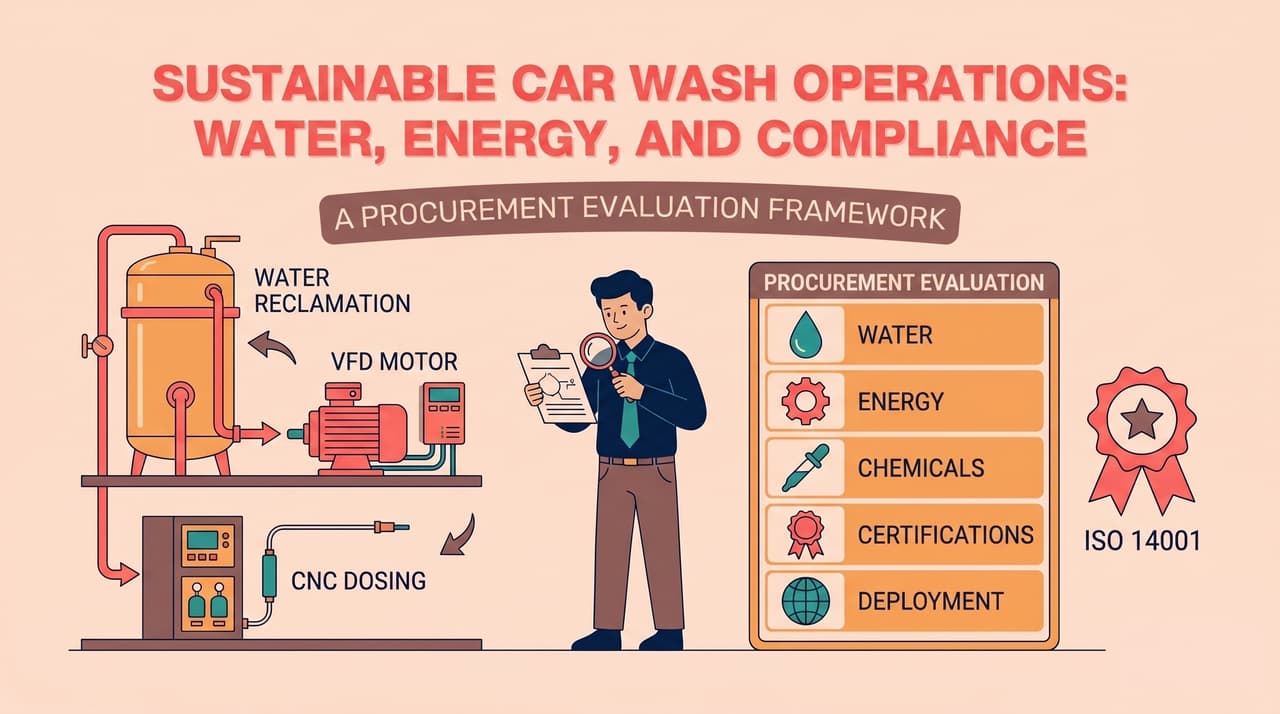
Sustainable Car Wash Operations: Water, Energy, and Compliance for Procurement Teams
Sustainable car wash operations evaluated like a procurement reader: water reclamation, energy efficiency, chemical dosing precision, and ISO 14001 in scope.
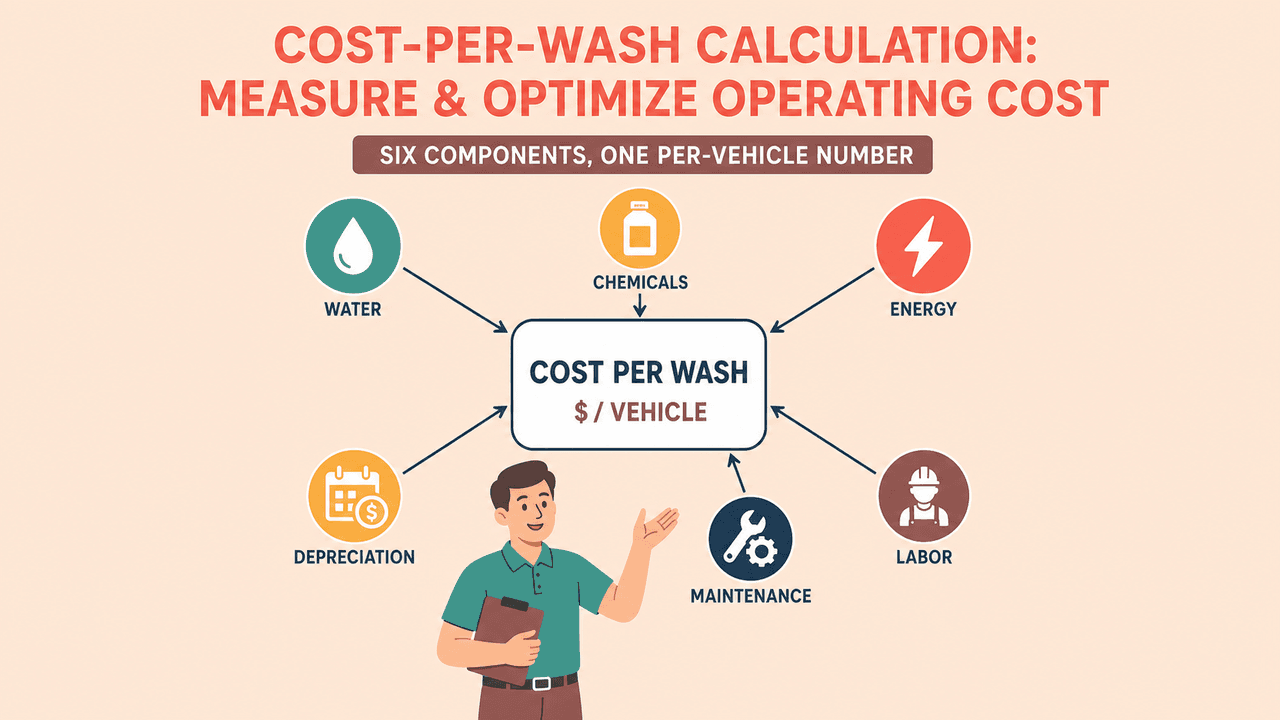
Cost-Per-Wash Calculation: How to Measure and Optimize Your True Operating Cost
Calculate true cost-per-wash across six components — water, chemicals, energy, labor, maintenance, and depreciation — and learn how equipment design shifts every line.
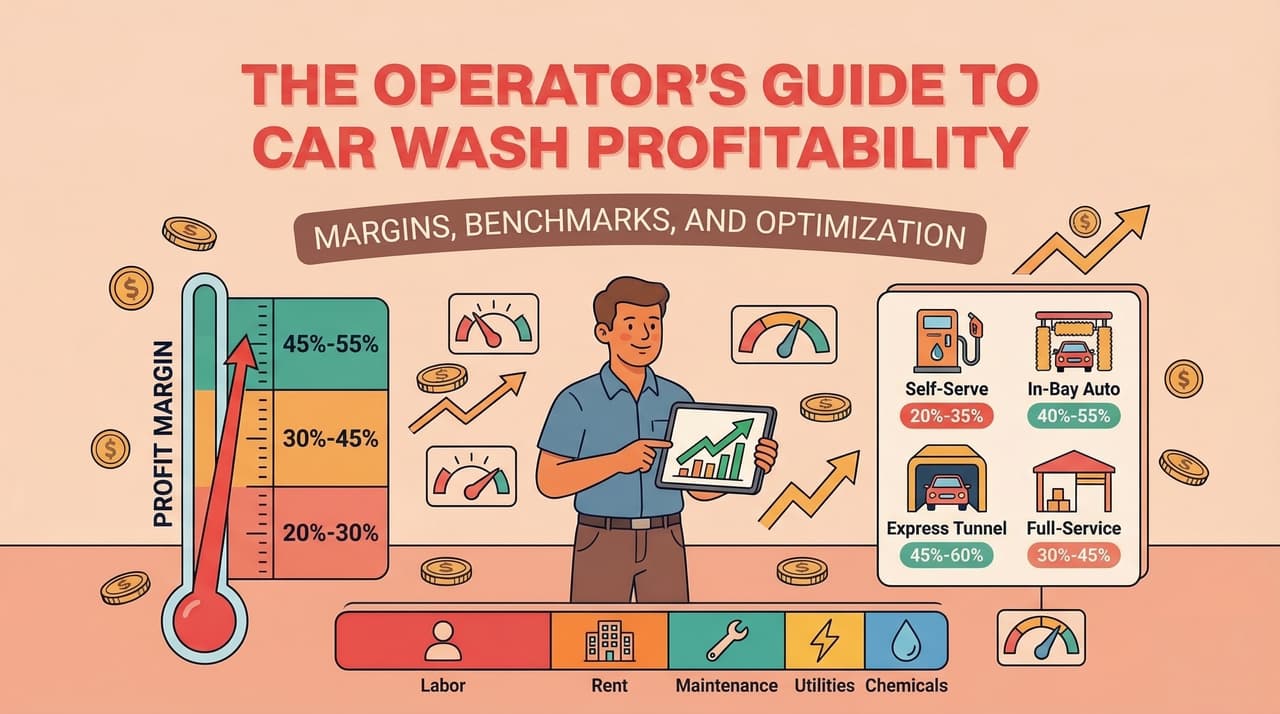
The Operator's Guide to Car Wash Profitability: Margins, Benchmarks, and Optimization
Car wash profit margins by format: 35–55% self-serve, 30–50% in-bay automatic, 25–40% express tunnel, 30–45% full-service with detailing, and what moves each.