
Car Wash Water Reclaim Systems: Cost, Compliance & How Reclaim Differs from Recycling
Car Wash Water Reclaim Systems: Cost, Compliance & How Reclaim Differs from Recycling
Search "car wash water recycling" and "car wash reclaim system" back to back, and you land on overlapping vendors, overlapping spec sheets, and no clear answer for what actually separates the two terms. If you're evaluating a wash site's water strategy, that vocabulary gap isn't just an annoyance. It can send a car wash reclaim system conversation with a vendor or a regulator sideways before you've compared a single quote.
This piece untangles the terms. It gives you a realistic read on system cost, tells you when chemical-free operation is genuinely possible, and shows where compliance actually enters the picture.
Reclaim, Recycling, Reclamation: One Practice, Three Names
Start with the official answer, because it settles more than it seems to. The U.S. EPA's own framing is blunt: "water reuse, also called water recycling or water reclamation, is the treating and repurposing of 'waste' water... for alternative uses". At the federal regulatory level, these aren't three different technologies. They're three names for the same practice — taking water that has already done a job and treating it well enough to do another one.
So why do the words feel different when you're comparing car wash equipment? Because equipment makers use "reclaim" or "reclamation" as the name for the onsite hardware — the tank, filtration train, and pump set installed inside the wash. "Recycling" tends to describe the broader practice or program, the way an operator might describe a site as having "water recycling" the same way they'd describe it as having LED lighting.
Some water-treatment specialists draw an even narrower technical line. Recycled water is water reused repeatedly within the same process; reclaimed water specifically describes feedwater recovered from a secondary treatment stage — water that would otherwise be rejected. That distinction matters more to a wastewater engineer than to a wash operator. It explains why both terms show up on the same spec sheet, though.
For your purposes as an operator, treat "reclaim system," "recycling system," and "reclamation system" as the same purchase decision described by three overlapping vocabularies. Our companion guide on car wash water recycling systems covers the deep end of that decision — the full compliance-layer breakdown and payback math. This piece covers what that guide leaves out: the terminology itself, a realistic system-cost range, and whether you can run a reclaim loop without adding chemicals to it.
Is a Car Wash Reclaim System the Same as a Recycling System?
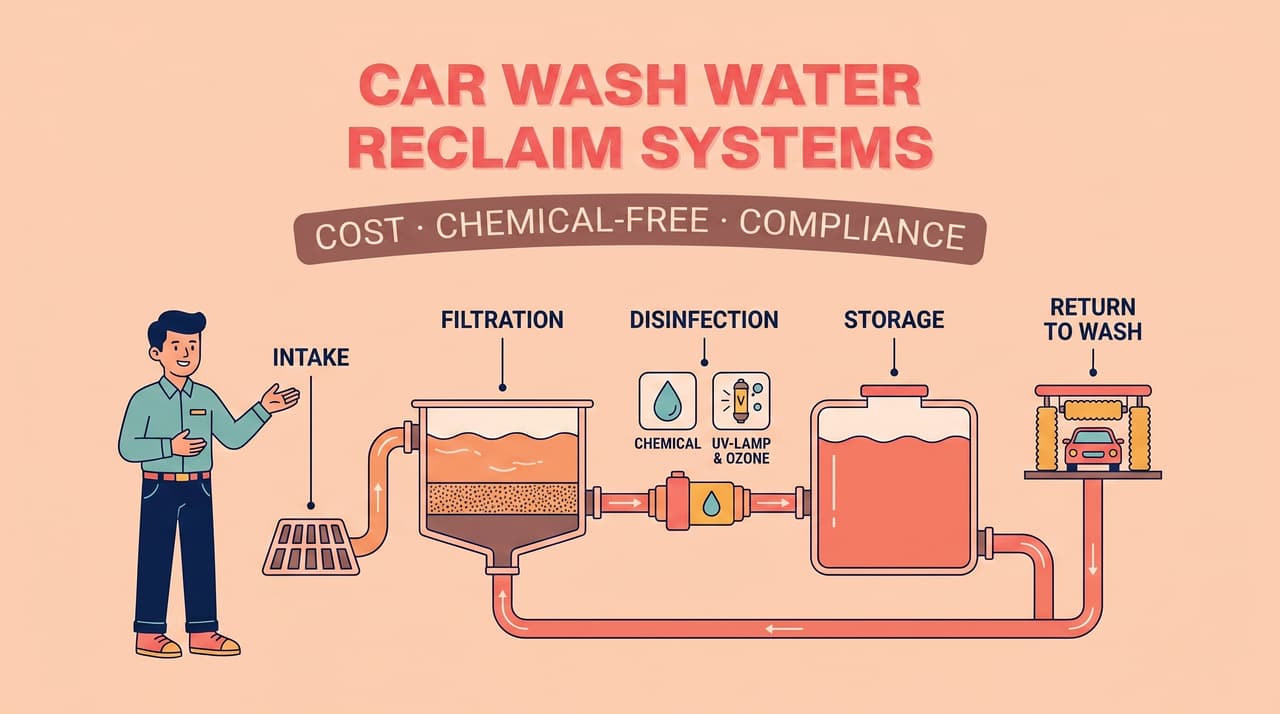
For practical shopping purposes, yes. A water reclamation system for car wash operations and a car wash water recycling system describe the identical piece of equipment. Both are a treatment train that captures used wash water, filters and disinfects it, and routes it back into the wash cycle instead of down the drain. The difference sits almost entirely in which word a given vendor, region, or regulator prefers — not in what the hardware does.
Where the terms genuinely diverge is scope. "Recycling" sometimes gets used loosely for water-saving practices in general — a low-flow nozzle, a shared rinse arch — while "reclaim system" almost always refers specifically to the treatment-and-reuse hardware. If a quote or spec sheet says "reclaim" and you expected "recycling," you're very likely still looking at the right category of equipment.
How Chemical-Free Water Recycling Works in a Car Wash
Chemical free car wash water recycling is a real, buyable configuration — but "chemical-free" describes the disinfection stage, not the whole treatment train. Every reclaim loop still needs mechanical separation (settling, filtration) to pull out solids and oil. The real question is what keeps the stored, reused water from growing bacteria and turning cloudy or foul-smelling between washes.
Two disinfection paths handle that job. One uses chemical dosing, typically chlorine-based. The other uses UV light or ozone gas, and both count as genuinely chemical-free.
UV disinfection uses ultraviolet light to disrupt microorganisms' genetic material so they can't reproduce, with no substance added to the water at all. Ozone works by oxidation and is roughly 3,000 times faster than chlorine at killing microorganisms. It breaks down into plain oxygen almost immediately, so it leaves no residue. That also means it avoids the byproducts that can form when chlorine reacts with organic material in reused wash water.
The trade-off isn't cost-free, it's just a different kind of cost. Chemical dosing systems are lower-cost to install but carry an ongoing chemical-purchase and calibration cost — the same dosing-precision discipline covered in our chemical dosing and cost-per-wash guide. UV and ozone systems cost more upfront and need lamp or generator servicing, but they remove an entire consumable line from your monthly chemical spend. For an operator already running tight dosing controls on the wash-chemical side, chemical-free disinfection on the reclaim side is a natural pairing, not a duplicate discipline.
What Does a Car Wash Water Reclaim System Cost?
Realistic budgeting starts with a range, not a single number. Across the equipment market, a car wash water reclaim system typically runs $5,000 to $25,000. Basic settling-and-filtration skids sit at the low end. Systems adding ultrafiltration or reverse-osmosis polishing sit toward the top.
That spread exists because car wash water reclaim system cost scales with how much of your water loop the system actually reclaims. A settling tank and sand filter that only handles pre-rinse reuse sits well below the middle of that range. A system that pushes treated water through finer filtration and disinfection — clean enough for every stage but the final spot-free rinse — sits toward the top.
Site prep and plumbing routing also move the number. So does whether the reclaim loop is designed in at new build or retrofitted into an existing bay. Retrofits generally cost more, because tank placement and drain routing have to work around what's already there.
We deliberately don't quote a single HyTian system price here. Your actual number depends on wash type, throughput, local discharge rules, and site layout, and any fixed figure would mislead more than it would help. For the full breakdown of what reclaim returns over time — the payback math, not just the sticker price — our companion guide above walks through it. Our cost-per-wash calculation framework places that spend in your broader operating budget.
Comparing Quotes: Questions the Vocabulary Should Prompt
Because "reclaim," "recycling," and "reclamation" get used loosely, the exact words in a vendor's proposal are worth double-checking before you compare price against price. A few questions keep the comparison honest:
What stage does the reclaimed water actually feed? A quote covering pre-rinse reuse only is a different product than one covering every stage but the spot-free rinse, even if both use the word "reclaim."
Chemical or chemical-free disinfection? Ask specifically whether the quote includes UV, ozone, or chemical dosing for the reused water, and what the ongoing consumable cost looks like either way.
Is reclaim designed into the wash, or added to it? A system engineered alongside the wash equipment routes plumbing and tank placement more efficiently than one bolted onto an existing bay after the fact.
What does the quote leave out? Site prep, plumbing routing, and disposal of the sludge or reject stream from filtration are common gaps between a system's sticker price and its installed cost.
Ask the same four questions of every vendor, regardless of which term sits on the cover page, and you're comparing the equipment — not the vocabulary.
Compliance: Where "Reclaim" Shows Up in the Rules
Regulators tend to favor "reclamation" and "reuse" as the formal terms. You'll see "reclaimed water" in permit language more often than "recycled water" — one more reason the vocabulary matters beyond marketing copy. The substance of the compliance question doesn't change with the word choice, though.
Does your discharge reach a sanitary sewer under a federal pretreatment framework? Could it reach a storm drain instead, a separate and stricter problem? Does your state or municipality layer on its own drought or permit conditions?
We've written the full three-layer compliance breakdown — federal pretreatment rules, the storm-drain trap, and state and local drought conditions — in the companion guide linked above. The short version here: read your jurisdiction before you size equipment. Compliance sets the floor, and cost optimization only happens after that.
Reclaim Built Into the Wash, Not Bolted On
The cleanest reclaim outcomes come from systems designed with reclaim as part of the wash, not added afterward. That pattern holds across HyTian's deployed installations. The TX-380 tunnel platform that launched Splash N Go's entry into Japan's retail wash market shipped with water recycling integrated into the build. That network now runs 500+ washes per day at individual sites during busy periods.
The TH-Series drive-through bus washers deployed with Zhuhai Public Transport Group ship with water recycling as standard, not an add-on, at a depot processing up to 80 buses an hour. The pattern holds at the smaller and the more unusual ends of the catalog, too.
HyTian's DCX-100T grate wheel-wash system is built for construction and mining sites, where regulators care about track-out, not paint finish. It runs on just 3-5 liters of water per vehicle, through integrated recycling and automatic sludge discharge. That's a different compliance conversation than a retail wash bay's, but the same underlying principle applies: reclaim engineered in at the design stage, not added to satisfy an inspector later.
A Bolivia tram operator needed a custom wash for 33.76-meter light-rail vehicles with a geometry no catalog system could handle. HyTian's engineered-to-order line built a dual-mode wash-and-dry system with integrated water recycling, designed around that site's discharge constraints from the start.
That engineering discipline sits inside an ISO 14001 environmental management framework. It's backed by over three decades since 1992 of manufacturing experience and more than 20,000 systems operating across 40-plus countries. For the sustainability case beyond water alone — energy, chemicals, and environmental reporting — see our sustainable car wash operations guide.
Key Takeaways
"Reclaim," "recycling," and "reclamation" describe the same practice. The EPA treats them as synonyms, and for shopping purposes, so should you.
Chemical-free disinfection is real and buyable. UV and ozone both replace chemical dosing in the reclaim loop, trading ongoing chemical purchases for higher upfront equipment and service cost.
System cost typically runs $5,000-$25,000, scaling with how much of the wash cycle the reclaim loop actually covers.
Compliance sets the floor, not the vocabulary. Read your jurisdiction's rules before optimizing for cost.
The strongest reclaim outcomes come from systems designed in, not retrofitted on — true whether you're running a retail tunnel or a custom transit wash.
Frequently Asked Questions
Is a car wash reclaim system the same as a recycling system? Yes, for practical purposes. Both describe a treatment train that captures used wash water, filters and disinfects it, and routes it back into the wash cycle. The EPA treats "reuse," "recycling," and "reclamation" as interchangeable terms for the same water-treatment practice.
How much does a car wash water reclaim system cost? Typically $5,000 to $25,000, depending on how much of the water loop the system reclaims. Basic settling-and-filtration systems sit at the lower end; systems adding ultrafiltration or reverse osmosis for near-total reuse sit toward the top.
Can car wash water be recycled without chemicals? Yes. UV light and ozone gas both disinfect reclaimed wash water without adding chemicals, replacing chlorine-based dosing. They cost more to install and need periodic lamp or generator servicing, but they remove chemical purchasing from the reclaim loop's ongoing operating cost.
Every wash's reclaim math runs on its own water rate, wash type, and local discharge rules — not a generic guide. Talk to our engineering team about matching reclaim depth, chemical-free options, and compliance to your specific site.