
Car Wash Chemical Dosing: Cutting Cost-Per-Wash Without Sacrificing Quality
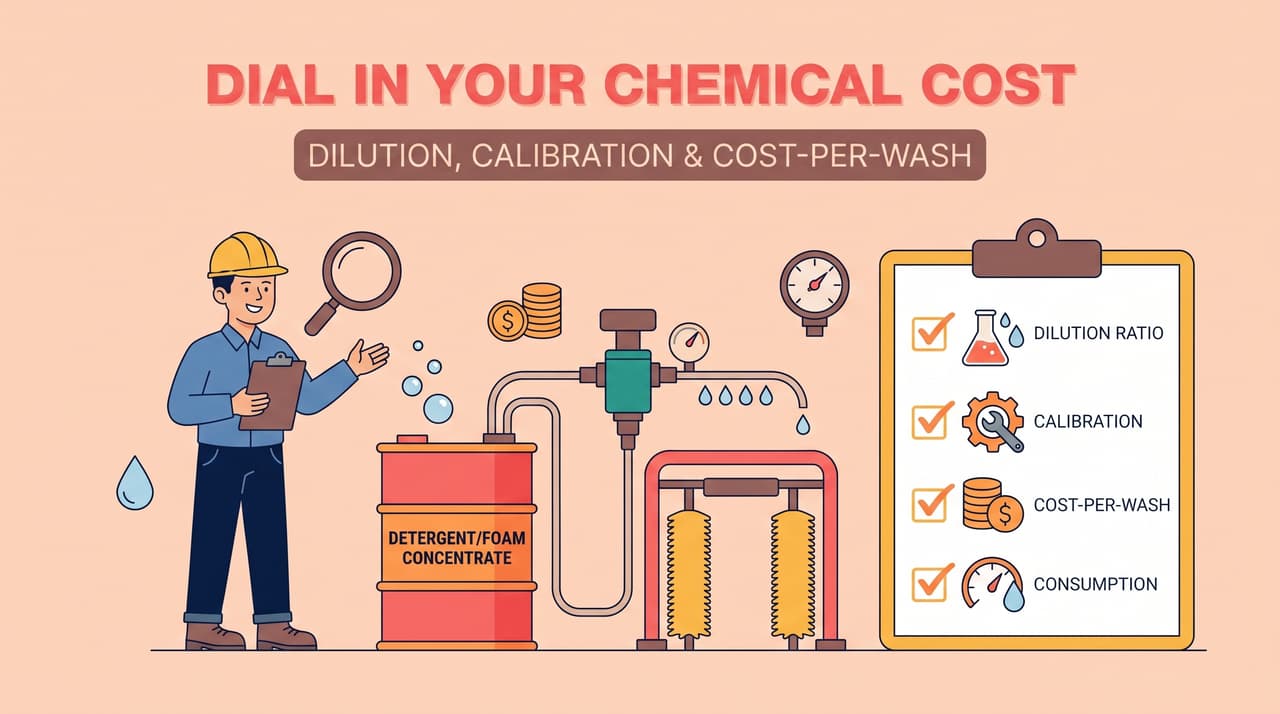
Car Wash Chemical Dosing: Cutting Cost-Per-Wash Without Sacrificing Quality
Presoak, foam, wheel cleaner, drying agent — the chemistry running through your arches is one of the largest variable costs in your wash program, and one of the few you can move this quarter without spending a dollar on new equipment. Dial it in and you protect margin on every car. Get it wrong and you either wash money down the drain or send out streaky vehicles that stop coming back.
Car wash chemical dosing optimization is the discipline of finding those hidden cents and keeping them — through the right dilution ratios, an accurately calibrated proportioner, and consumption you actually track. And most of that waste really is invisible: it never shows up as a line item labeled "over-dosing." It hides inside your dilution ratios and your proportioners, quietly adding cents to every wash.
As a manufacturer that builds and services wash systems, we'll walk through it the way we'd walk a client through it: the real cost math, the working dilution ranges, the calibration procedure, and the one counterintuitive rule that trips up more operators than any other.
Where Your Chemical Money Actually Goes
Here's the mistake that costs operators the most: judging chemistry by the price on the drum. What matters is diluted cost per car — what the chemical actually costs you after it's mixed with water and applied to a vehicle. A lower-cost drum run at a poor dilution ratio can easily cost more per car than a pricier super-concentrate that stretches ten times further.
A few terms, since we'll use them throughout. A proportioner (also called an injector or, in older setups, a hydrominder) is the device that mixes concentrated chemical with water at a set ratio before it hits the arch. The dilution ratio — sometimes called the draw ratio — is how much water each part of concentrate is mixed into, written as something like 100:1 (100 parts water to 1 part concentrate). Every dollar of chemical waste in your wash traces back to one of three things: the wrong dilution ratio, a proportioner that isn't delivering the ratio you set, or usage you never noticed drifting upward.
Those three levers are the whole of car wash chemical dosing optimization. Chemistry is commonly cited as roughly 8-15% of a wash's operating cost, and on many wash menus the variable-chemistry share runs higher once premium tiers and tire products are in the mix. It sits right alongside water and energy as a controllable operating expense — the kind of line that decides whether a site clears its operating costs comfortably or on a knife's edge. The good news: unlike rent or labor, this one responds to a screwdriver and a stopwatch.
What Are the Right Car Wash Detergent Dilution Ratios?
There's no single number — the correct car wash detergent dilution ratio depends on the product class and the specific formulation. Always follow the chemical manufacturer's data sheet as the source of truth. That said, these are the working ranges commonly cited across the industry, useful as a sanity check on what your proportioners should be drawing:
Product class | Commonly cited dilution ratio | Notes |
|---|---|---|
Presoak / prep | ~90:1 to 300:1 (some up to ~400:1) | Higher pH removes road film; ratio varies by soil load and water hardness |
Body / foam detergent | ~120:1 to 360:1 (foam often ~100:1) | The workhorse cost line — small ratio errors here add up fastest |
Wheel & tire cleaner | ~20:1 to 90:1 | Richest draw on the menu; also the biggest single overspend risk |
Drying agent / rinse aid | ~500:1 to 1000:1+ | Tiny draw, big surface effect; over-dosing shows as spotting |
Super-concentrate (any class) | up to ~1000:1 | Ships as a fraction of the volume for the same washes |
Concentrates and the case for going stronger
The single biggest structural lever on chemical cost is concentration. In a super-concentrated formulation the dilution can reach 1000:1, which means a 55-gallon-equivalent of working solution can ship in a 5-to-10-gallon container — less freight, less storage, fewer drum changes. The economics are linear and unforgiving in your favor: moving from a 250:1 product to a 500:1 product makes the concentrate last twice as long per drum. That's real foam concentrate optimization — same clean, half the drums.
One caveat that sets up the rest of this article: a higher-dilution product only saves you money if the proportioner actually delivers that ratio. A 1000:1 concentrate drawn by a drifted injector at an effective 600:1 is just an expensive way to over-apply. And if your site runs hard water, expect higher chemical consumption and weaker foam regardless of ratio — a water softener often pays for itself in chemistry saved.
How to Calculate Your Real Cost-Per-Wash
To make dosing an economic decision instead of a guess, put a number on it. The chemistry cost for a single product on a single car is straightforward once you have two inputs — the concentrate's price per gallon and how many ounces of concentrate the car actually consumes:
(concentrate cost per gallon ÷ 128) × ounces of concentrate used per car = chemistry cost per car
The 128 is simply the number of fluid ounces in a gallon. To find ounces of concentrate per car, convert your dilution ratio to ounces per gallon of mixed solution — divide 128 by the water portion of the ratio — then multiply by your arch's flow rate and run time. A 64:1 tire cleaner, for example, draws 2 ounces of concentrate per gallon of solution (128 ÷ 64); an arch running 5 gallons per minute is pulling 10 ounces of concentrate every minute it's on.
Here's a worked example across a simple menu. The prices below are illustrative, not any specific manufacturer's — plug in your own invoice numbers:
Product | Concentrate $/gal | Diluted draw | Concentrate per car | Cost per car |
|---|---|---|---|---|
Presoak | $18 | ~128:1 | ~0.75 oz | ~$0.11 |
Foam detergent | $22 | ~150:1 | ~0.55 oz | ~$0.09 |
Wheel & tire | $30 | ~64:1 | ~0.90 oz | ~$0.21 |
Drying agent | $28 | ~512:1 | ~0.20 oz | ~$0.04 |
Total | ~$0.45 / car |
That per-car total is the number to manage — and it lines up with the industry, where chemical spend commonly averages around $0.60 per car and runs from roughly $0.40 up past $1.50 on premium menus. Now watch the leverage. A seemingly trivial $0.04-per-car overspend at 300 cars a day adds about $4,380 a year — from one loose proportioner setting. That's why the drum price is a distraction and the diluted-per-car number is the whole game. (For the full operating-cost picture beyond chemistry, our guide to how to calculate cost-per-wash walks through every component, and water reclaim is the other big variable-cost lever worth pairing with this one.)
Proportioner Calibration: Where the Savings Are Won or Lost
You can pick the perfect dilution ratio on paper and still bleed money if the proportioner isn't delivering it. Calibration is where car wash chemical dosing optimization actually happens — the difference between a ratio you set and a ratio your cars actually get — and proportioners drift silently, which is exactly why the waste is so easy to miss.
Two broad types are in the field. Older venturi injectors and hydrominders rely on stable water pressure to hold their ratio; when pressure swings — and on a busy site it swings all day — their dilution drifts and they're prone to clogging. Water-powered proportioners (the Dosatron-type piston designs) use the water flow itself to drive dosing, so they hold ratio more consistently through pressure and flow fluctuations. Neither is maintenance-free, and both need verifying on a schedule.
The bucket test, in five minutes
You don't need special instrumentation to check a proportioner — you need a graduated container and a stopwatch. Place the container under the discharge, collect the mixed solution for exactly 60 seconds, and compare the volume drawn against what the ratio and flow rate say it should be. For a tighter check, draw separately from the water and concentrate sources over a timed interval and measure each. If the numbers don't match your manifold dial, you've usually found a clogged check valve or a metering tip that needs cleaning.
How often? Verify calibration monthly, and any time wash quality changes. Re-check after winterization or any extended idle period — seals and springs take a set during dormancy and come back out of tune. Fold it into your preventive maintenance schedule so it happens on the calendar, not after a complaint.
Learn to read the symptoms, because they tell you which way the ratio has slipped. Over-dilution — chemistry too weak — leaves soapy residue, streaking, and cars that re-soil fast. Under-dilution — too strong — is worse for the wallet: it wastes concentrate on every car, spikes your cost, and can even risk surface damage or create safety hazards in the chemical room. A proportioner whose output no longer matches its dial setting is telling you a valve or tip needs attention now, not next quarter.
Catching Leaks and Drift: Trend Your Consumption
Here's the move most operators skip entirely. Track how much of each product you go through per unit of volume — drums per thousand cars, or gallons per week against car counts — and log it over time. A slow leak, a stuck-open solenoid, or a proportioner creeping out of calibration all show up as a number climbing on your consumption chart long before they show up as a crater in your monthly P&L.
Keep it simple: a consumption log or chart per product does the job, and volumetric metering tracks real usage more accurately than titration because it measures what actually left the drum. Connected or "smart" dosing systems take this further — they self-correct for water-pressure, drum-level, temperature and viscosity swings and report cost-per-car for each chemical. In field tests, connected chemistry cut chemical cost by about 27%, with the biggest gains on tire cleaner, the richest draw on most menus. You don't have to buy a system to get the benefit, though — a paper log and a monthly bucket test catch most of the same problems. The point is to make consumption visible.
There's a maintenance dividend too. A sudden climb in chemical draw is often an early maintenance signal — a worn metering tip, a failing solenoid, a hairline leak — that you'd otherwise catch only when something stops working. Your dosing data doubles as reliability data.
And the one rule that undoes more chemical budgets than any drift or leak: dose to spec, not by feel. Doubling the soap does not clean better — it leaves a film, and it burns through concentrate at twice the rate. Over-pumping wastes cash fast; over-diluting wrecks quality. Chemistry performs best at the manufacturer's recommended dilution — no richer, no leaner. "More soap equals cleaner cars" is the most expensive myth in the wash bay.
A Manufacturer's View: Precision Is Designed In
Everything above is within an operator's control on any wash, with any chemistry. But there's a layer underneath it that most operators only think about when they're buying: how accurately the machine itself meters in the first place. Your dilution discipline is only ever as good as the hardware executing it. The tighter and more repeatable the dosing built into the system, the less your careful ratios erode between calibration checks.
That precision is an engineering choice. On our TX-380 tunnel systems, chemical delivery runs through CNC metering pumps engineered for 0.28 mL dosing accuracy — tight enough that a single 20 kg drum stretches to roughly 3,000 washes. We mention it not as a pitch but as an illustration of what accurate on-machine dosing looks like when it's designed in rather than bolted on. Consistent metering is what lets a higher-dilution concentrate actually deliver the cost-per-wash the spec sheet promises.
Our honest advice to operators is the same one we'd give here: the lowest-cost chemical win is almost always tuning what you already run — the ratio, the proportioner, the log — not switching chemistry or buying hardware. We've built and serviced wash systems for over three decades since 1992, with 20,000+ systems deployed across 40+ countries, and the pattern holds nearly everywhere: precision beats volume. The operators who win on chemical cost aren't buying more soap. They're wasting less of it.
Key Takeaways
Manage diluted cost per car, not drum price. A low-cost drum at a poor ratio can cost more per car than a pricier super-concentrate. Run the (cost/gal ÷ 128) × oz-per-car math on your own numbers.
Use the right ratio per product, and consider super-concentrates. Follow the data sheet; going from 250:1 to 500:1 doubles drum life for the same clean.
Calibrate monthly and after any idle period. A five-minute bucket test catches drift before it costs you thousands — a $0.04/car error is ~$4,380/year at 300 cars a day.
Trend your consumption. Log usage per thousand cars so leaks, stuck solenoids, and slow miscalibration surface as a number, not a surprise.
Dose to spec, not by feel. More soap doesn't clean better — it leaves film and burns concentrate. Over-pumping wastes cash faster than over-diluting saves it.
Frequently Asked Questions
How much do car wash chemicals cost per car? Chemical spend commonly averages around $0.40 to $1.50 per car for express washes, rising toward $2.50 on premium tiers, and is often cited at roughly 8-15% of a wash's operating cost. Your real number depends on your dilution ratios, water quality, and how accurately your proportioners deliver — which is why measuring diluted cost per car per product matters more than the drum price.
What dilution ratio should I use for car wash detergent? It varies by product class and formulation, so the chemical manufacturer's data sheet is always the source of truth. As commonly cited working ranges: presoaks run about 90:1 to 300:1, body and foam detergents about 120:1 to 360:1, and wheel and tire cleaners about 20:1 to 90:1. Super-concentrates can reach 1000:1.
How often should I calibrate my chemical proportioner? Verify calibration monthly and any time wash quality changes, plus a re-check after winterization or any extended idle period, since seals take a set during dormancy. Use a graduated container and a stopwatch: catch the discharge for 60 seconds and compare it against what your ratio and flow rate should produce.
Does using more soap clean the car better? No. Beyond the recommended dilution, extra soap leaves a film rather than cleaning better, and it burns through concentrate at a faster rate — so you pay more and send out worse-looking cars. Chemistry performs best at the manufacturer's recommended ratio. Over-application is one of the most common and costly dosing mistakes.
Dialing in cost-per-wash on your site? Talk to our engineering team about dosing accuracy and the metering that fits your configuration — and we'll help you find the saving without touching wash quality.