
How to Reduce Car Wash Downtime: An Operator's Checklist
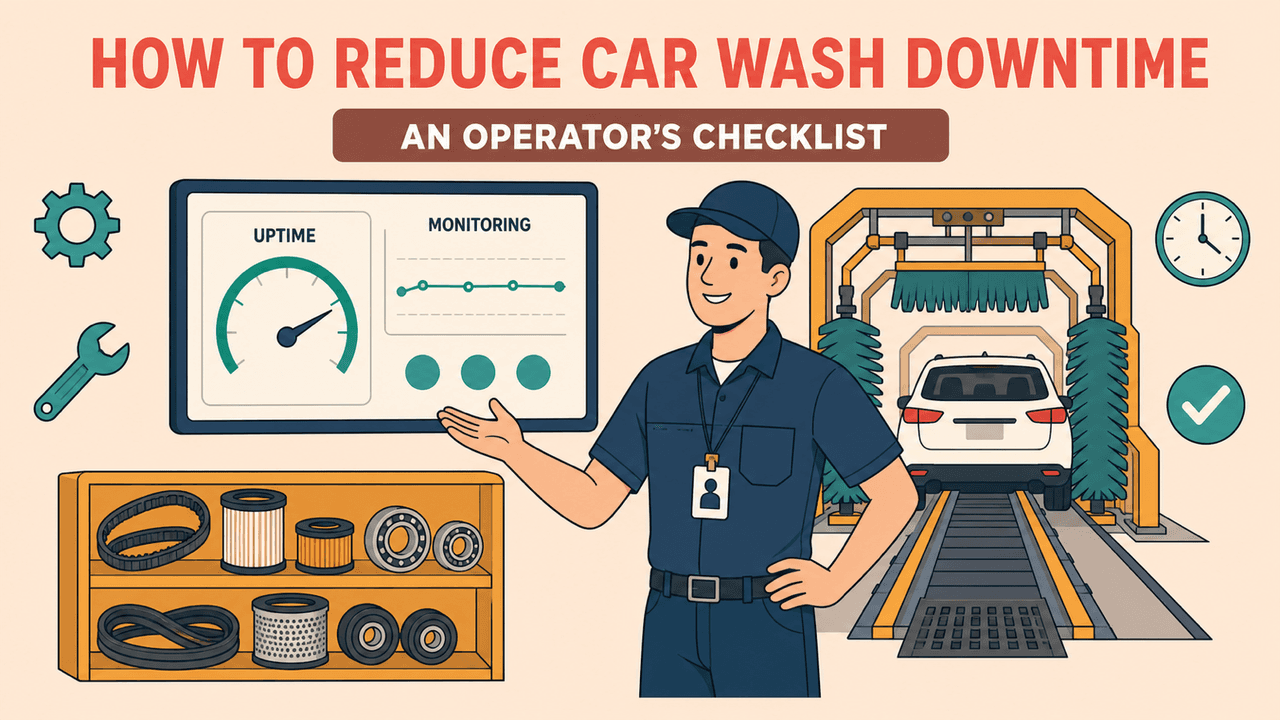
How to Reduce Car Wash Downtime: An Operator's Checklist
Meta: Learn how to reduce car wash downtime with an operator's checklist covering uptime tracking, preventive maintenance, redundancy, spares, and monitoring.
A car wash makes its money in bursts. The Saturday-morning rush, the after-work surge, the first clear day after a week of rain — those are the hours that carry your week. When a system goes offline in the middle of one of them, the cars in line don't wait. They drive off, and that revenue never comes back. Learning how to reduce car wash downtime is really about protecting the hours that matter most. The good news: most downtime is predictable and preventable with a system, not luck. This operator's checklist walks through the five levers that keep your wash running — understanding what downtime costs, building preventive maintenance, designing for redundancy, stocking the right spare parts, and adding remote monitoring.
What Car Wash Downtime Actually Costs (and Where It Comes From)
Most operators track cars per hour. Fewer track car wash equipment uptime — the percentage of your open hours that the system is actually available to wash vehicles. It deserves equal billing, because uptime is where throughput turns into revenue. A site that runs at 98% uptime and one that limps along at 90% can have identical equipment and very different P&Ls.
The cost of an outage is simple to frame, even if the exact number varies by site: lost wash revenue during the outage, plus the repair cost (parts, labor, and any expedited shipping), plus the knock-on effects you don't see on the invoice — a member who cancels after one too many "closed" signs, or a first-time visitor who never comes back. Industry estimates put the lost-revenue side alone at roughly $200 to $500 for every hour a wash sits closed. Stack the repair bill and the churn on top, and a single bad breakdown during peak hours can erase a week of margin.
So where does it come from? Across industrial equipment, equipment failure is the single largest source of unplanned downtime, responsible for roughly 42% of incidents. That's the headline an operator should internalize: most of your downtime risk lives in the machinery itself, which means it responds to engineering and maintenance — things you can control.
Two terms are worth defining before we go further. Preventive maintenance is scheduled service performed before something breaks; reactive maintenance is fixing it after it fails. And mean time to repair (MTTR) is the average time it takes to diagnose, repair, and return a failed system to service. Lower MTTR means shorter outages — and as we'll see, several items on this checklist exist purely to drive it down. The economics favor prevention heavily: reactive, run-to-failure maintenance tends to cost three to five times more than preventive maintenance once you account for the downtime and the collateral damage a hard failure causes to surrounding components.
Build a Preventive Maintenance Routine That Catches Failures Early
The first lever is the most familiar and the most underused: stop waiting for parts to break. A preventive maintenance routine inspects and services wear items on a schedule, so you replace a worn belt during a planned ten-minute stop instead of during a Saturday rush with a line of cars behind it.
The payoff is well documented. Preventive maintenance programs reduce unplanned downtime by roughly 30 to 50% compared with reactive approaches — and the practice is now standard, with around 88% of manufacturers running some form of preventive maintenance. For a wash, the wear points to plan around are predictable: brushes and cloth, drive belts, bearings, seals, high-pressure nozzles, pumps, and conveyor or drive motors. Each has a service interval; the job is to know it and hold to it.
A few details separate a routine that works from one that drifts. Log every inspection so you can spot a component that's wearing faster than expected. Keep consistency in the parts of the system that drive wear — chemical dosing is a good example. On HyTian tunnel systems, CNC metering pumps dose to 0.28 mL precision, which keeps chemistry consistent wash after wash and stretches drum life to roughly 3,000 washes per 20 kg drum. Consistent dosing isn't only a cost story; erratic chemistry accelerates wear on brushes and surfaces, so precision on the input side reduces variability on the maintenance side.
This checklist covers the why of prevention. For the when — the day, week, month, and quarter service cadence by component — work from a dedicated preventive maintenance checklist and adapt it to your equipment and volume.
Design for Redundancy So One Failure Doesn't Stop the Line
Prevention reduces how often things fail. Redundancy reduces how much a failure hurts when it does. The principle is straightforward: when subsystems are independent and serviceable, a fault in one stage doesn't have to halt the entire wash.
In practical terms, that means favoring equipment you can isolate, bypass, or swap quickly. If a single dryer fan fails on a system with multiple fans, you want to finish the day at slightly reduced drying rather than close the bay. If a brush set needs service, you want to pull and replace it as a module, not dismantle half the tunnel. This is where build quality and architecture directly shape your downtime exposure.
It's also where engineering decisions made at purchase pay off for a decade. HyTian's high-throughput tunnel systems use a modular design — configurable conveyor (heavy-duty chain or slide-rail), brush, and dryer packages — so subsystems can be specified, serviced, and replaced independently. Variable frequency drive (VFD) control on the conveyor and industrial-grade drive components are built for sustained duty cycles, the kind a high-volume site puts on equipment every weekend. The reliability question to carry into any purchase decision is this: when a component fails, how much of the system goes down with it, and how fast can one technician bring it back? That second half is MTTR — and modular, serviceable design is one of the biggest levers you have on it.
Stock the Right Spare Parts Before You Need Them
Here is the most overlooked lever an operator fully controls. When something fails, the clock on MTTR is dominated by one question: is the replacement part on site, or are you waiting days for it to ship? Having the right part in stock locally can cut MTTR by more than 50% — sometimes turning a multi-day outage into a same-afternoon fix.
You don't need to warehouse a second car wash. You need to prioritize. Separate the critical, failure-prone, long-lead-time parts from the commodity items you can source anywhere. Keep an on-site kit of fast-wear consumables — filters, belts, bearings, seals, and nozzles — so routine wear never triggers a parts-procurement delay. For the bigger-ticket components, know the lead time and decide deliberately whether to stock a spare or accept the risk.
Spare-parts strategy is also a manufacturer question, and it's worth asking before you buy: How available are parts? What are the lead times to my region? This is where a manufacturer's scale matters to your uptime. HyTian builds at a capacity of 3,000 units per year and supports 20,000+ systems across 40+ countries, so the parts pipeline behind your equipment is a production line, not a last-known shipment. Over three decades of manufacturing since 1992 means the components on your system are part of a supported, in-production catalog.
Use Remote Monitoring to Catch Problems Before They Become Outages
The final lever closes the loop. Remote monitoring shifts you from reacting to failures to anticipating them. Sensors track the vital signs of your equipment — vibration, temperature, pressure, and electrical current — and flag anomalies that precede a hard failure, so a bearing that's beginning to fail shows up as a trend before it seizes mid-cycle. IoT sensors stream this data to cloud systems that alert managers in real time, which means fewer lost wash hours during peak periods and a faster response when something does go wrong.
The results are significant where it's applied well: predictive maintenance built on IoT monitoring can reduce downtime by up to 45% and cut breakdowns by as much as 70%. For a high-volume operator, that's the difference between a planned service visit and an emergency closure.
HyTian builds this capability into connected systems. The rollover XL-200NET system, for instance, offers cloud management with remote diagnostics, so issues can be assessed without a truck roll — and includes auto-drain for cold-weather sites, a concrete example of designing out a common failure mode (frozen lines) before it can cause an outage. Think of monitoring as the data layer that makes the rest of this checklist measurable: it's how you actually track uptime and MTTR, and how you know whether your maintenance and spares strategy is working.
Reliability Engineering Proven at Deployment Scale
These principles aren't theory — they're how durable systems are built and how they perform in the field. In Japan, Splash N Go runs HyTian tunnel systems at 500+ washes per day during peak periods, the kind of sustained high-volume duty that exposes any weakness in reliability engineering. And when BYD set out to standardize new-vehicle washing across its factories, it deployed the TX-380 at 60 cars per hour on factory-fresh paint, where the EVA closed-cell foam brushes — engineered with a linear pressure curve that resists grit carryover — protect finishes that can't tolerate a single blemish. Equipment that holds quality and availability at that cadence, on that surface, is equipment built for uptime.
Your Car Wash Downtime Reduction Checklist
Pull it together into actions you can take this quarter:
Track uptime and MTTR as core metrics. You can't reduce what you don't measure. Put uptime next to cars-per-hour on your dashboard.
Run a preventive maintenance schedule on wear items. Service brushes, belts, bearings, seals, nozzles, and pumps on a fixed cadence — and log every inspection.
Choose modular, serviceable equipment. Limit how much of the system any single failure can take down, and how fast one technician can restore it.
Stock critical spares on site. Prioritize failure-prone, long-lead parts and keep an on-site kit of fast-wear consumables.
Add remote monitoring with real-time alerts. Catch the trend before the breakdown, and make your uptime measurable.
Confirm parts availability and support response with your manufacturer. Reliability is a purchase criterion, not an afterthought — ask about lead times and diagnostics before you buy.
Talk Through an Uptime Strategy for Your Site
Reliability starts with the right system for your site — its volume, its climate, and the failure modes that matter most to your operation. Want to map out an uptime strategy for your wash program? Contact our engineering team to talk through your configuration, spare-parts plan, and monitoring options.
Related articles
Explore more insights from the HyTian team.
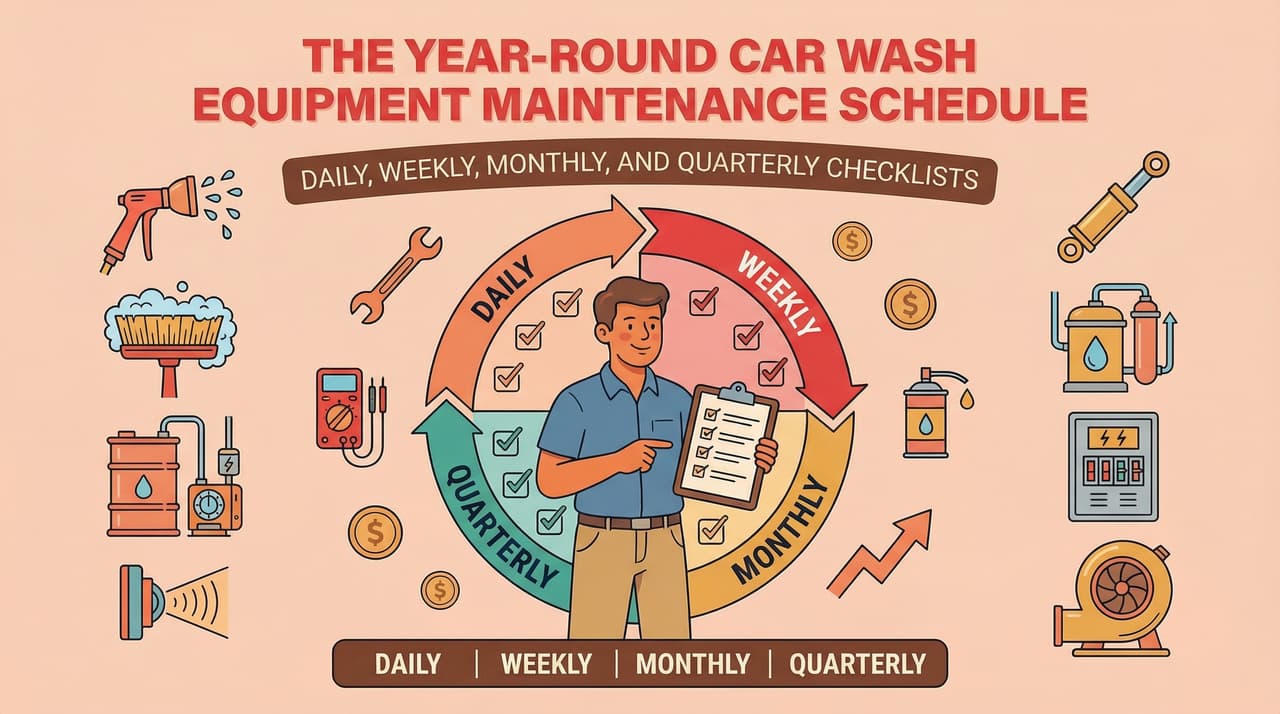
The Year-Round Car Wash Equipment Maintenance Schedule: Daily, Weekly, Monthly, and Quarterly Checklists
Car wash equipment maintenance schedule from an engineer's perspective. Daily, weekly, monthly, and quarterly checklists to prevent downtime and cut repair costs.

How to Increase Car Wash Throughput Without Expanding Your Site
Before you expand, learn how to increase car wash throughput with VFD conveyor tuning, loader cadence, and peak-hour design — up to 15-25 more cars per hour.
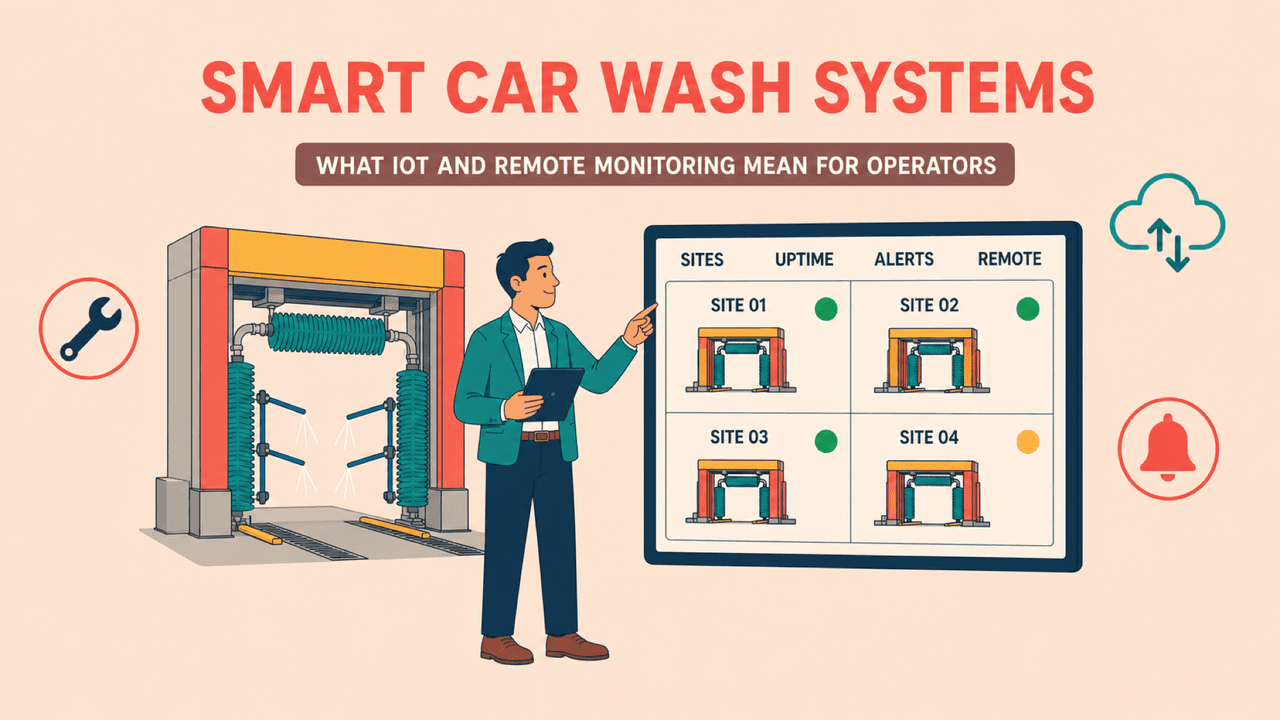
Smart Car Wash Systems: What IoT and Remote Monitoring Mean for Operators
A smart car wash system IoT layer turns sensor data into fewer breakdowns, faster fault response, and viable after-hours operation. Here's how it works.