
Smart Car Wash Systems: What IoT and Remote Monitoring Mean for Operators
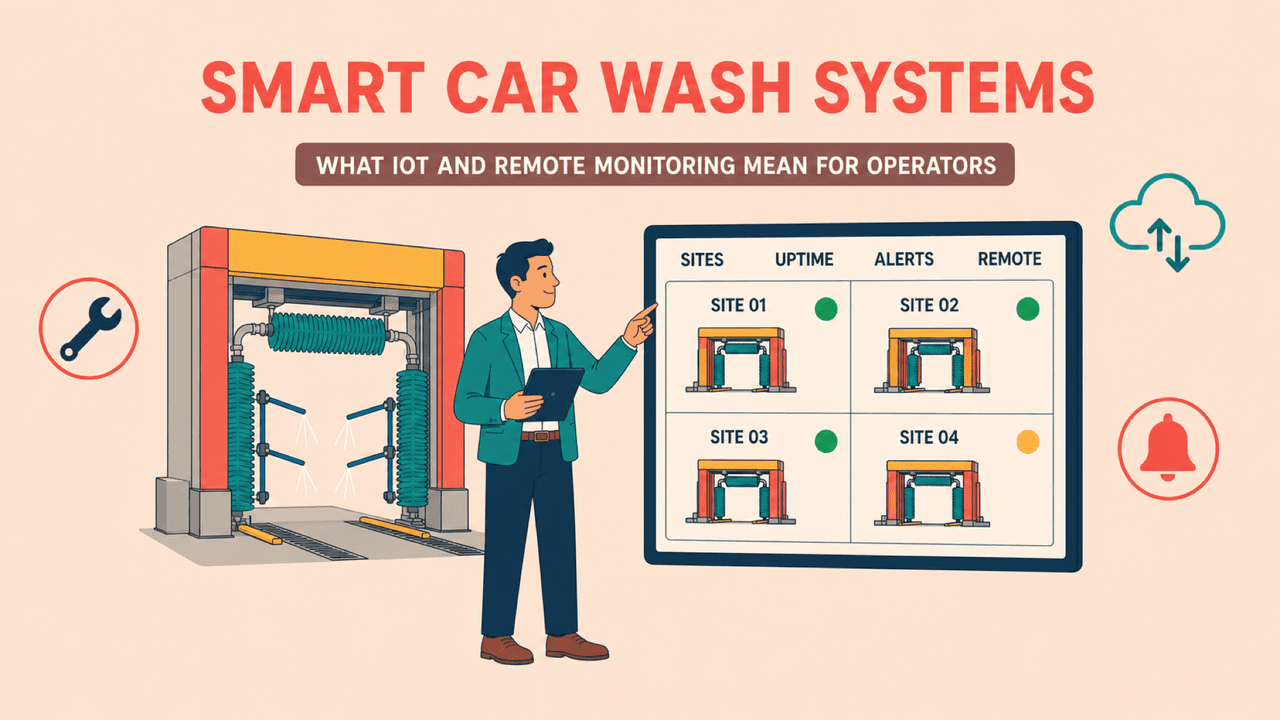
Smart Car Wash Systems: What IoT and Remote Monitoring Mean for Operators
Meta: A smart car wash system IoT layer turns sensor data into fewer breakdowns, faster fault response, and viable after-hours operation. Here's how it actually works.
Labor costs are climbing, operating hours are stretching later, and unplanned downtime still costs you the same revenue it always did — except now the bay you can't see in person costs more to staff than ever. That is why "smart" car wash equipment is suddenly worth a second look, even from operators who have learned to discount vendor buzzwords. A smart car wash system IoT layer is not magic. It is sensors, a networked controller, a dashboard, and rules that change how you see your bay. This article breaks down what that actually delivers — and where IoT stops and AI begins.
Why operators are paying attention to remote monitoring
The industry has been pitched "smart" equipment for about five years. Most operators have learned to wait until vendors talk in operator language — minutes of downtime avoided, mean-time-to-detect-fault, after-hours bay-hours unlocked — before paying attention.
Three changes have moved IoT from optional curiosity to operator-relevant. First, networked PLC controllers are now standard on modern wash equipment, including HyTian's rollover and tunnel systems. Second, the labor math has shifted: every minute of unattended-but-monitored bay-time you can run is a minute you do not pay for. Third, the cloud-dashboard experience has finally caught up with what an operator on a phone actually needs — live state, fault alerts, water and chemical levels, and a basic activity feed.
What still gets confused: "smart" can mean five different things, and most of them are bundled into a single marketing word. The next section unbundles them.
What "smart" actually means in car wash equipment
Strip the marketing away and a smart car wash system IoT layer is four things stacked together.
Sensors on the equipment. Temperature, pressure, flow, vibration, motor current draw, position. They measure what is happening, in real time, at the parts of the system that fail.
A controller that connects them. A networked PLC reads the sensors, runs the wash program, and exposes equipment state to the next layer. HyTian's XL-200NET rollover, for example, ships with an integrated PLC controller and CAN bus architecture — networked control is on the shipped product, not on a roadmap slide.
A network that carries the data off-site. Industrial protocols carry telemetry from the controller out to a cloud service. The protocol matters: open standards mean your data is yours; proprietary stacks mean you are renting visibility from the vendor.
A dashboard the operator actually uses. Phone, tablet, or browser. Live state, fault codes, today's throughput, today's chemical use, recent alerts. This is where the value lands, because data that nobody reads is a cost, not a benefit.
That stack — sensors, controller, network, dashboard — is the IoT plumbing. It is what gives you the data stream. AI, machine learning, computer vision, and the rest of the application layer are separate capabilities that may run on top of that data stream. Some of them are mature, some of them are early, and they belong to a different conversation. We cover them in our companion piece on AI-powered features in modern car wash systems.
For now, the question worth answering is what the IoT layer alone delivers — because the IoT layer alone is what most operators will actually buy first.
What remote monitoring looks like in practice
Picture an operator on a Wednesday afternoon at a second site twenty miles away, looking at a tablet.
The dashboard shows three layers of data. Real-time state: is the bay running, is there a fault code, what is the current cycle. Short-term trending: today's throughput so far, today's chemical use, today's water consumption. Long-term patterns: week-over-week wear trends, month-over-month uptime, alerts grouped by component.
Then a notification hits: motor current on the side-brush drive has spiked 18% above its rolling baseline for the last six cycles. The bay is still running. No driver would notice anything is wrong. But the controller has flagged a wear trend, and the operator has a choice — schedule the brush-drive service this evening, before peak Friday traffic, instead of waiting for the bearing to fail mid-cycle on Saturday morning.
That is what remote monitoring delivers in operator terms: cutting the time from fault to operator-aware from "when the next car queues up frustrated" to "within seconds of the sensor reading drifting." Mean-time-to-detect-fault drops from minutes-of-downtime to seconds-of-warning.
The same plumbing also makes after-hours unmanned operation viable. A bay you can monitor from a phone is a bay you can run when the team is not on site, because the alert system catches problems faster than a human walking the floor would. Some operators use this to extend hours into the late evening; others use it to cover early-morning fleet windows. Either way, every additional bay-hour you unlock without staffing it is margin you keep.
One scope note: this is not "AI watching the bay." It is sensor data presented to the operator with rules-based alerts. The AI layer — vision-based vehicle classification, paint-condition detection, model-based fault prediction — is a separate capability that runs on the same plumbing. Worth knowing about, but a different article.
Predictive maintenance: turning sensor data into fewer breakdowns
Predictive maintenance is where the operator-value of IoT compounds. Instead of servicing equipment on a calendar — every 30 days, every 90 days, every 1,000 cycles — you service it based on what the sensors say.
Here is how it works in plain language. The controller continuously reads motor current, vibration, water flow, chemical-pump output, and the rest. Each sensor has a learned baseline. When a reading sustains a drift outside that baseline — not a transient spike, but a trend — the system alerts the maintenance team. The team intervenes before a hard failure.
Be honest about the line between IoT-grade and AI-grade prediction.
IoT-grade predictive maintenance is threshold and trend-based detection. Motor current trending up over two weeks indicates a bearing wearing in. Water flow dropping at the rinse arch suggests a clogged nozzle or a failing pump. Chemical-pump cycles falling behind the wash cycle count points to a metering issue. These patterns are clear in the sensor data once you are looking at it, and rules-based alerting catches them.
Model-based prediction — the kind that learns failure signatures across hundreds of bays and predicts a specific component will fail in seven days — is AI/ML territory. Some manufacturers offer it; some ship it as IoT and let operators assume it. The two are different capability layers, and the evaluation question below is the one that separates them.
For most operators, IoT-grade predictive maintenance is the floor that matters first. It pairs naturally with the broader maintenance discipline you already run — see our preventive maintenance checklist for the foundation work that IoT then multiplies. The sensor layer doesn't replace your maintenance program. It raises its ceiling. According to <a href="https://www2.deloitte.com/us/en/insights/focus/industry-4-0/using-predictive-technologies-for-asset-maintenance.html">Deloitte's research on predictive technologies for asset maintenance</a>, well-implemented predictive maintenance programs can reduce unplanned downtime materially in industrial equipment — though the actual gain depends heavily on the maintenance discipline already in place when the sensor layer is added.
Remote commissioning: real proof this is not a slide
The fastest way to tell whether a manufacturer's "cloud-connected" claim is real or rented is to ask how they handle a site they cannot physically reach.
When Splash N Go entered the Japanese market in 2020, pandemic travel restrictions blocked HyTian engineers from attending the on-site commissioning. Standard playbook says you wait. The team did not wait. They commissioned the TX-380 tunnel system remotely — operating the controllers across the network, validating sensor outputs, tuning the wash program, and walking the local team through the configuration without a flight ticket.
That deployment is the IoT-relevant proof point. The plumbing that lets you monitor your bay from a phone is the same plumbing that lets a manufacturer-grade engineer do a full commissioning session from another country. It is one architecture, used at two different intensities.
The result was not a hand-off and a fingers-crossed exit. The Japanese sites grew into a multi-site franchise network reaching 500+ washes per day during peak periods, with a dedicated HyTian distributor and service team established in-country. See our Japan deployment case study for the full picture.
For operators evaluating equipment, the takeaway is operational, not marketing. Ask any vendor: how do you support a site you cannot reach in 24 hours? The answer reveals how seriously the cloud-connectivity claim is engineered. Vendors with real remote-monitoring capability have a remote-commissioning history. Vendors without it have a brochure.
How to evaluate IoT claims when shopping equipment
When the sales deck says "smart" or "connected," five questions separate real capability from buzzword stacking. Bring this list to your next vendor conversation.
1. What sensors are actually on the equipment, and what do they measure? A real answer names the sensors and the parameters: motor current on the drive, vibration on the brush spindles, flow at the rinse arch, pressure at the chemical pumps. A vague answer ("a full sensor suite") means the marketing is ahead of the engineering.
2. What protocol does the controller speak, and where does my data live? Open industrial protocols mean your data is portable. Proprietary stacks mean you are renting visibility from the vendor. Ask whether you can pull telemetry into your own dashboard or BI tool — and whether you keep the data if you switch vendors.
3. What happens when the network drops? A bay that bricks without internet is a brittle bay. Local operation should continue uninterrupted; only the off-site visibility should pause. The controller stores telemetry locally and syncs when the network returns.
4. What is included in the dashboard out of the box, and what is an upsell? Cost predictability matters. Real-time state, fault alerts, daily throughput, and basic trending should be included. Multi-site rollups, custom reporting, and integrations are commonly priced separately — that is fine, but you want to know up front.
5. Where is the line between IoT-grade and AI-grade capability? A vendor who can explain that line is engineering-honest. A vendor who blurs it ("our smart system uses AI to predict everything") is selling brochure language. Real capability is named precisely; buzzword stacking is named vaguely.
These questions extend the broader manufacturer evaluation framework you should already be running. The IoT layer adds a fifth axis to that framework — and the questions above are how you score it.
Key takeaways
IoT in car wash equipment is plumbing, not magic — sensors on the gear, a networked controller, a dashboard, and rules-based alerts. Modern HyTian rollover and tunnel systems already ship with networked PLC architecture.
Remote monitoring's operator-value lands in three places: faster fault detection, viable after-hours unmanned operation, and condition-based maintenance.
Predictive maintenance via IoT (threshold and trend-based) and via AI/ML (model-based) are different capability layers — buy the IoT visibility layer first; the AI layer is a separate decision and a separate article.
Real proof of cloud-connectivity capability shows up in remote-commissioning history. The Splash N Go Japan tunnel deployment was commissioned across the network during the 2020 travel restrictions and grew into a multi-site franchise reaching 500+ washes per day at peak.
When evaluating vendors, ask about sensors, protocols, network resilience, dashboards, and the IoT-vs-AI line. Vague answers reveal the engineering behind the marketing.
Want to see how cloud-connected wash equipment fits your site and your remote-monitoring expectations? Talk to our engineering team about the controller architecture and dashboard options on our tunnel and rollover systems.
Related articles
Explore more insights from the HyTian team.
AI in Car Wash Equipment: What Actually Works in 2026 (A Manufacturer's Take)
A manufacturer's breakdown of AI car wash equipment in 2026 — what actually ships, what is still demo-stage, and how to evaluate vendor claims.
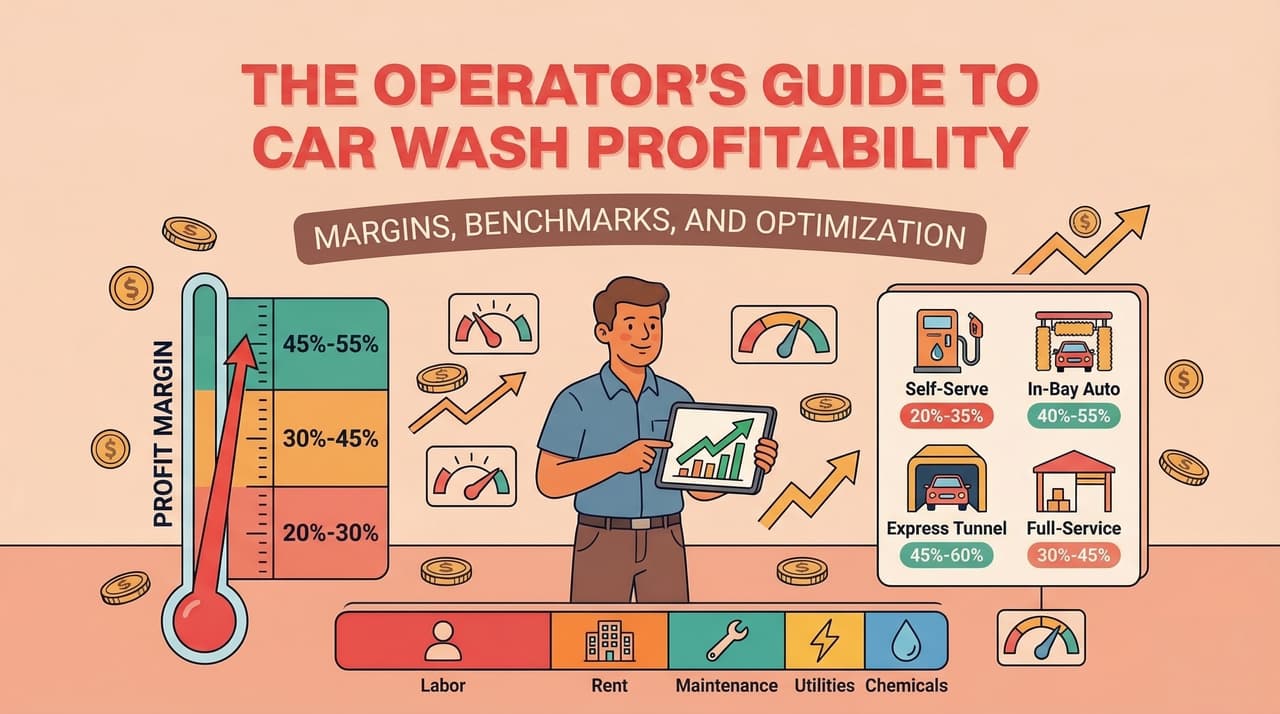
The Operator's Guide to Car Wash Profitability: Margins, Benchmarks, and Optimization
Car wash profit margins range 20–55% by business model. See realistic benchmarks, operating cost breakdowns, and five optimization levers operators control.
Scaling a Car Wash Chain: The Equipment & Operations Standardization Playbook
Multi-site car wash operations run on equipment standardization, cloud management, and centralized support — not site-by-site improvisation. Here's the playbook.