
Wheel Wash Systems for Construction Sites: Compliance, Track-Out Prevention, and ROI
Wheel Wash Systems for Construction Sites: Compliance, Track-Out Prevention, and ROI
Every heavy vehicle that leaves an unpaved or muddy area of a construction or mining site carries some of that site with it. Mud, aggregate, and debris packed into tire treads end up on the public road the moment the vehicle turns out of the gate. That's track-out, and it's rarely just a housekeeping problem. It's a stormwater compliance exposure, an inspector's talking point, and — often first — a complaint from whoever lives or drives near your site entrance.
A wheel wash system construction site teams install at the exit gate solves the mechanical half of that problem directly. It cleans tires and undercarriages before a vehicle ever reaches the road. This piece covers what track-out compliance actually requires, how a wheel wash system meets that requirement, which HyTian configuration fits which site, and how to build the ROI case.
If your organization is evaluating this for the first time — ahead of a permit renewal, an inspector's finding, or a neighbor's call to the site office — the mechanical fix and the compliance framing behind it are worth understanding together. If you're weighing wheel wash systems generally, our overview of the full wheel wash lineup is a useful starting point alongside this guide.
What Track-Out Compliance Actually Requires
In the US, most construction sites disturbing an acre or more of land — or smaller sites that are part of a larger common plan of development — fall under an NPDES-style Construction General Permit framework. That framework requires a Stormwater Pollution Prevention Plan (SWPPP) built around best management practices. Track-out control sits inside it: the accepted approach is restricting vehicle exit to designated points and ensuring sediment removal happens before a vehicle leaves the site. Wheel washing is recognized as an accepted control method for meeting it.
Two things are worth being direct about. First, a SWPPP rarely names a specific piece of equipment. It specifies the outcome — no sediment tracked onto public roads — and a wheel wash exists to deliver that outcome mechanically rather than through a laborer with a hose.
Second, enforcement isn't uniform. States, counties, and individual project permits layer their own stormwater and public-works rules on top of the federal framework, and the specific trigger points and penalties vary by jurisdiction. This guide won't pretend otherwise by inventing a number that applies everywhere — check your site's specific permit and local ordinance for the exact requirement that governs you.
What's consistent across jurisdictions is the documentation expectation. Inspectors and auditors generally want to see that a track-out control measure exists and is actually maintained in working order, not just written into the SWPPP and forgotten. A wheel wash system that runs every shift is easier to document as an active control than a gravel pad or a periodic manual wash-down. For construction and mining applications specifically, our construction and mining wash solutions page covers the operational side of that compliance picture.
How a Wheel Wash System Stops Track-Out on a Construction Site
Every vehicle that needs to exit the site passes through the wash at low, induction-start speed. High-pressure jets running at 3-4 kg/cm² strip mud and aggregate from the wheels and undercarriage in a single pass. Integrated water recycling and automatic sludge discharge keep the system running through a full shift without constant manual intervention.
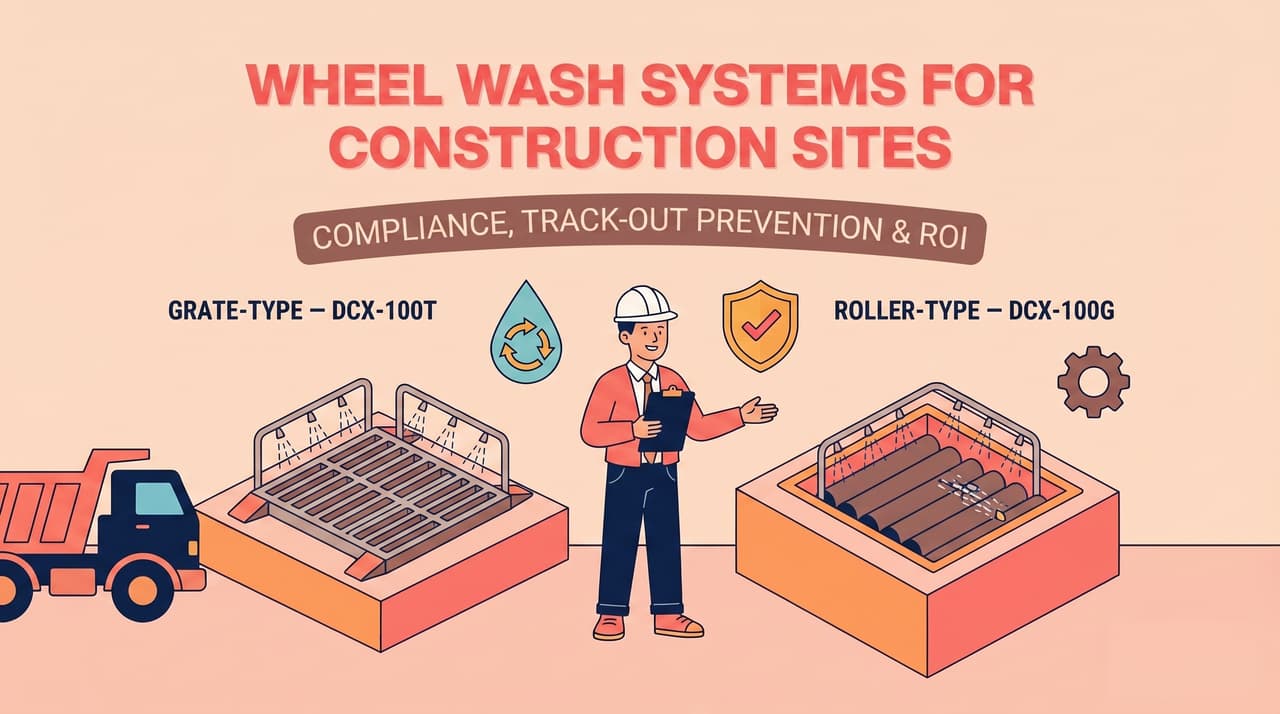
HyTian's DCX-100T and DCX-100G wheel wash systems are both engineered for this exact application — construction and mining vehicles up to 100 tons, a 45-60 second cycle time, and a 225×535×100 cm footprint. They get there through two different mechanical approaches, and the right one depends on your site layout.
Grate-Type: The DCX-100T
The Grate Wheel Wash DCX-100T is a drive-through grate design. The vehicle passes over the grate at induction-start speed while high-pressure jets clean the wheels from below and the sides. It draws 380V/50Hz at 17 kW total and uses 3-5 liters of water per vehicle. For sites with tighter footprints or shorter project durations, the compact DCX-20T variant adds an external mud-discharge system that simplifies servicing without a below-grade installation.
Roller-Type: The DCX-100G
The Roller Wheel Wash DCX-100G takes a different mechanical approach. It's a pit-type roller-drive design: powered rollers rotate the vehicle's wheels through the wash cycle, giving full-surface contact rather than a single pass. It runs at the same 45-60 second cycle and footprint as the DCX-100T, draws slightly more power at 380V/50Hz, 20 kW, and is controlled by a Mitsubishi PLC. Because it's pit-installed, it suits a permanent yard entrance more naturally than a temporary or relocatable site — and the powered-roller action handles packed clay and heavy mud more thoroughly than a single-pass grate system.
DCX-100T (Grate) | DCX-100G (Roller) | |
|---|---|---|
Cycle time | 45-60 seconds | 45-60 seconds |
Footprint | 225×535×100 cm | 225×535×100 cm |
Power | 380V/50Hz, 17 kW | 380V/50Hz, 20 kW |
Install type | Above-grade, drive-through | Pit-installed, roller-drive |
Best fit | Temporary or space-constrained sites (DCX-20T compact variant available) | Permanent yard entrances, packed clay/heavy mud conditions |
Sites handling heavy mineral or clay buildup can add an automatic mud removal system to either configuration. It collects mineral material from the wash cycle rather than requiring manual clearing. Either configuration also avoids a common failure mode of ad hoc manual wash-downs: uneven pressure or a rushed pass that leaves mud packed in wheel wells and behind dual-tire assemblies — exactly the material that falls off ten minutes down the road. The 3-4 kg/cm² jet pressure is calibrated to clear that material consistently, cycle after cycle, without depending on how thorough the person holding the hose feels that day.
Certifications That Matter for a Compliance-Driven Purchase
A procurement team building an internal case for a compliance-driven purchase needs manufacturer credentials, not just a spec sheet. HyTian's wheel wash systems are built under the same quality and environmental framework as the rest of the product line: CE Conformity (meeting EU machinery safety, health, and environmental standards), ISO 9001 (quality management), and ISO 14001 (environmental management) — all current certifications, not legacy claims. That matters beyond Europe: a manufacturer that has navigated multiple regulatory regimes across 40+ countries has, by necessity, built equipment that holds up to more than one jurisdiction's compliance standard — a relevant signal if your organization operates more than one site.
The ISO 14001 environmental management certification is worth flagging specifically here: it covers the same discipline that governs how a wheel wash system's water recycling and sludge handling are designed, which is directly relevant to a purchase justified on compliance grounds.
The ROI Case: What a Wheel Wash System Actually Saves
Sourcing and project scope drive real variance in what a wheel wash system costs to acquire and install, so this section won't hand you a single number to plug into a spreadsheet. For actual payback modeling, our car wash ROI resource and typical ROI timeline guide walk through that math for your specific site. What's worth laying out clearly here are the real cost levers.
The comparison that matters most is manual versus automatic cleaning. A cost analysis from Stanton Systems, cited in Stormwater Solutions, found manual truck and wheel cleaning runs roughly five times the cost of purchasing and operating an automatic wheel-wash unit — a gap driven mostly by labor. That tracks with what operators report directly: one contractor in the same coverage noted that not needing a laborer stationed at the exit gate for over a year was, in their words, a meaningful saving.
Beyond labor, the levers compound. Fewer road-cleanup and street-sweeping calls. Less accumulated tire and undercarriage wear from uncleaned mud. And a cost that's easy to underweight until it isn't: protected relationships with neighbors and the public-works office that fields their complaints.
HyTian's integrated water recycling adds one more real lever — reclaiming wash water reduces the ongoing water and sewer cost of running the system, rather than pulling fresh water and discharging it every cycle.
For a procurement team evaluating this across more than one active site, the case compounds. A single wheel wash purchase solves one gate. A standardized specification — the same DCX-100T or DCX-100G configuration deployed everywhere it's needed — means one set of training materials, one parts and service relationship, and one compliance story to tell an auditor or corporate EHS lead across the whole portfolio, rather than a different ad hoc control measure at every location.
Sizing the Right System for Your Site
Three variables drive the right configuration. First, vehicle weight class: both the DCX-100T and DCX-100G handle vehicles up to 100 tons, so heavy haul trucks and mining equipment are within spec either way. Second, throughput and site permanence. A 45-60 second cycle sets your practical gate throughput, and whether the installation is a permanent yard entrance (favoring the pit-installed DCX-100G's roller-drive) or a temporary, relocatable site (favoring the above-grade DCX-100T or the compact DCX-20T) changes which mechanical approach fits.
Third, power availability — both systems run on 380V/50Hz service, with the DCX-100G's roller drive drawing a few kW more than the DCX-100T's grate design. Water reclaim tie-in to your existing site water management is worth planning alongside whichever unit you select, since both systems run on recycled water rather than continuous fresh-water draw.
Built for Heavy-Duty, Global Deployment
We don't have a construction- or mining-specific case study to point to here, and rather than force one that doesn't fit, it's worth being direct about that. What does apply is scale and track record. HyTian has been manufacturing car wash equipment for over three decades since 1992, with more than 20,000 systems installed across 40+ countries and 3,000 units of annual manufacturing capacity at our Nanjing headquarters.
That's the same engineering and manufacturing base behind the DCX-100T and DCX-100G — equipment built to the same standard as the systems running fleet washes, dealership programs, and municipal fleet operations worldwide, not a separate or lesser product line built just for this application. Learn more about HyTian and the manufacturing base behind the equipment.
Frequently Asked Questions
Is a wheel wash system legally required on construction sites?
Not universally, and not usually by name. In the US, sites disturbing an acre or more typically operate under a Construction General Permit requiring a Stormwater Pollution Prevention Plan with best management practices for track-out control. Wheel washing is a recognized way to meet that requirement, but the permit specifies the outcome — no sediment on public roads — rather than mandating a specific machine. State, county, and project-level rules vary, so check your site's specific permit.
How much does a wheel wash system cost?
It depends on the configuration, site preparation, and installation scope. Sourcing and project scope drive significant variance, and there's no single figure that applies across sites. Talk with our team about your entry/exit layout and vehicle class for a scoped estimate.
What's the difference between a grate and a roller wheel wash system?
A grate-type system, like the DCX-100T, is a drive-through design where the vehicle passes over the grate at low speed while high-pressure jets clean the wheels. A roller-type system, like the DCX-100G, is pit-installed with powered rollers that rotate the wheels through the cycle for full-surface contact — better suited to packed clay or heavy mud and to permanent yard installations.
Managing track-out on a construction or mining site? Talk to our engineering team about sizing a DCX-100T or DCX-100G wheel wash system for your entry/exit layout and vehicle class.