
Municipal & Government Fleet Wash Systems: Corrosion Control, Compliance & Budget
Municipal & Government Fleet Wash Systems: Corrosion Control, Compliance & Budget
Every winter, your public works trucks, plows, and transit buses drive straight into the thing that destroys them fastest: road salt. The brine that keeps roads safe also packs into frame rails, brake lines, fuel tanks, and suspension, quietly corroding publicly funded vehicles from the undercarriage up. For a fleet manager answering to a council or finance office, that corrosion is a line-item liability — and the strongest case for the wash program you may be trying to justify.
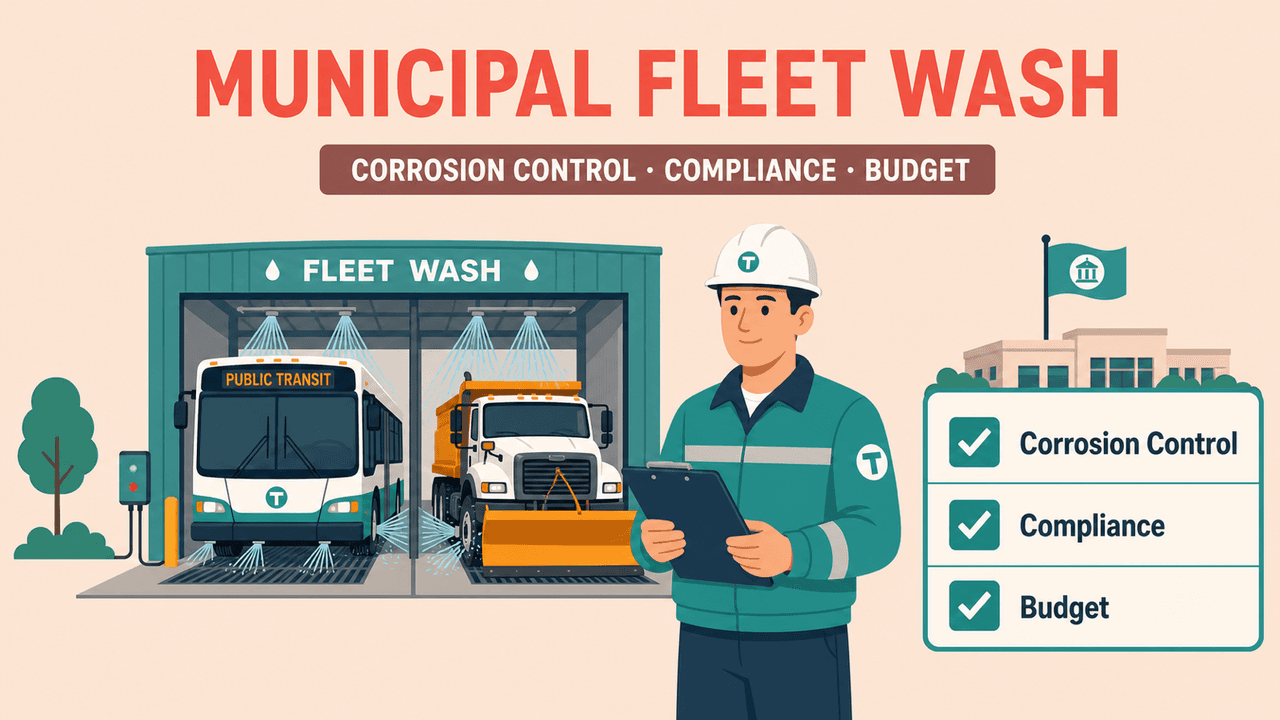
Specifying a municipal fleet wash system is, at its core, three decisions in one: corrosion control, regulatory compliance, and budget. Get the spec right and you protect the asset, stay clear of a Clean Water Act violation, and make a case that survives public-money scrutiny. This guide walks through all three, from the perspective of a manufacturer that builds and deploys these systems for public fleets.
What Road Salt Does to a Public Fleet (and Why Undercarriage Washing Matters)
Chloride-driven corrosion is not slow: salt holds moisture against metal, accelerating oxidation on any surface that stays wet and unrinsed. The undercarriage is the worst-hit zone, because salt-laden slush is thrown off the road and packs into the lowest, least-accessible parts of the vehicle. According to AAA, the components most affected are brake lines, fuel tanks, exhaust systems, and the chassis itself — the systems a fleet cannot afford to fail.
The financial scale is well documented. AAA's research found that U.S. drivers paid an estimated $15.4 billion in rust repairs over five years — roughly $3 billion a year, at nearly $500 per repair, with 22 million drivers reporting de-icer corrosion damage. The EPA puts the total higher, estimating road salt's corrosive effect on cars, trucks, bridges, and roads at about $5 billion in annual repairs. A municipal fleet concentrates that exposure: every vehicle runs the same salted routes, every winter, for decades.
The operational consequence is more unplanned downtime, shorter vehicle life, and higher lifecycle cost — all on a budget that has to justify every repair. The engineering takeaway shapes the spec: salt has to be removed, not merely rinsed off the panels you can see, which means flushing the underbody and wheels where it actually collects. A wheel wash with integrated recycling targets exactly this zone — the packed, low-lying salt that hand-rinsing and a standard drive-through pass tend to miss. For construction and mining sites, where the problem is track-out rather than road salt, see our guide to wheel wash systems for construction sites.
Wash frequency depends on conditions — industry sources commonly recommend every two weeks or so in heavy-salt conditions and about monthly in northern climates — but treat any single number as guidance for sizing throughput, not a guarantee (see the FAQ below).
What a Municipal Fleet Wash System Must Do: A Procurement Spec
Translate the corrosion problem into requirements you can put in an RFP, and the spec for government fleet vehicle wash equipment becomes concrete. Six criteria carry the most weight for a public-sector fleet:
Salt and corrosion removal, including the underbody. High-pressure wash plus dedicated undercarriage and wheel coverage. Salt collects low; a system that only cleans the sides leaves the corrosion problem in place.
Depot-scale throughput. Vehicles have to clear the wash fast enough that they do not bottleneck the yard at shift change; drive-through layouts avoid the reversing and queuing that slow a busy depot.
The right vehicle envelope. Buses, plows, dump trucks, and utility vehicles need height and length clearance and brush configurations sized to your actual fleet mix.
Durability and serviceability for a 10+ year asset life. Public vehicles stay in service a long time; the wash system should too, with parts availability and support that address procurement's vendor-lock-in concern.
Water and utility economics. Integrated recycling controls fresh-water draw and sewer charges — which ties straight into both compliance and the budget case below.
Certification and de-risking. Recognized ISO and CE marks signal the equipment meets accepted quality, safety, and environmental standards — which matters when the purchase has to survive a formal review.
Because this application is backed by real deployments, the equipment that meets these criteria is worth naming. For depot-scale transit, the TH-350 drive-through bus wash processes 40 to 80 buses per hour at roughly 150 liters per vehicle on 12 kW under Mitsubishi PLC control, handling vehicles up to 350 cm tall; its TH-350S variant reaches similar throughput in a smaller footprint with 3.5 m or 4.2 m clearance options. For depots without a drive-through layout, the GH-500 rollover bus wash uses a rail-mounted gantry to clean full-size buses and trucks up to 12 meters long. For the undercarriage and wheel problem, the DCX-100T grate wheel wash runs a 45-to-60-second cycle on just 3 to 5 liters per vehicle — with high-pressure jets, integrated water recycling, and automatic sludge discharge — and supports vehicles up to 100 tons. And for non-standard government or transit vehicles, an engineered-to-order system combines modular brush packs, high-pressure arches, chassis rinse, and blow-dry with multi-stage water reclamation.
The table below maps fleet type to the equipment family and the spec that matters most:
Fleet Type | Recommended System Family | Key Spec for the Fleet Manager |
|---|---|---|
Transit buses (depot scale) | TH-Series drive-through (TH-350 / TH-350S) | 40–80 buses/hour; integrated water recycling |
Public-works trucks & plows | TH-Series drive-through / GH-500 rollover | Drive-through speed or gantry fit for constrained depots |
Heavy off-road & utility (undercarriage focus) | DCX wheel wash (DCX-100T) | 45–60 s cycle; underbody/wheel salt removal, recycling, auto sludge discharge |
Non-standard transit & rail | Custom-Made (engineered-to-order) | Bespoke geometry; multi-stage water reclamation |
On the question every council eventually asks — what will it cost — the honest answer is that public procurement varies widely. Sourcing and project scope drive significant variance, and an OEM-direct, equipment-only quote looks very different from a fully installed turnkey project. Spec the capability first; price the configuration second. If you are still deciding which system type fits your fleet, our guide to how to choose a bus or truck wash system covers that selection in detail.
Staying Compliant: EPA & Clean Water Act Rules for Fleet Wash Water
Fleet wash water is not clean water going down a drain. It carries oil, grease, heavy metals, sediment, and detergents stripped off the vehicles — which is exactly why where it goes is regulated. The following is regulatory orientation, not legal advice; specifics vary by state and municipality, so always confirm your obligations with your local authority before you build or operate a wash.
Under the Clean Water Act, the governing question is the destination of the water. There are three compliant paths, and the distinction matters:
Discharge to a waterway (a "point source" to waters of the U.S.). This requires a permit under the National Pollutant Discharge Elimination System (NPDES). Per EPA's NPDES Permit Basics, it is unlawful to discharge a pollutant from a point source to navigable waters without one.
Discharge to the municipal sanitary sewer (a POTW). The same source notes this generally does not require an NPDES permit — but it is subject to the municipality's own pretreatment and permit rules. This is the "confirm locally" path; your city's requirements govern.
Contained on-site capture, treatment, and recycling. Wash in a designated, contained area, capture the wash water, treat or recycle it, and keep it out of storm drains. This is the approach EPA describes in its stormwater best-management practice for municipal vehicle and equipment washing, which notes that such wash water can contain nutrients, metals, and hydrocarbons and should be captured and recycled where feasible.
One precision point separates a credible compliance read from a careless one. You may hear a vendor cite the EPA's Transportation Equipment Cleaning (TEC) effluent guidelines at you. Those guidelines, codified at 40 CFR Part 442, govern the interior cleaning of tanks and containers — tank trucks, rail tank cars, tank barges, intermodal containers — not general exterior washing of a fleet. If someone applies that rule to your bus-and-plow wash, they are citing the wrong regulation, and knowing the difference protects you from both over-engineering and a misinformed purchase.
The compliance decision, simplified:
Where does the wash water go? | Compliance path |
|---|---|
To a waterway (point source) | NPDES permit required |
To the municipal sanitary sewer (POTW) | No NPDES permit, but confirm local pretreatment/permit rules |
Contained on-site, captured & recycled | Follow EPA BMP; keep wash water out of storm drains |
Compliance and budget intersect on one feature: water recycling. Closed-loop reuse keeps wash water out of storm drains and cuts the volume you draw and discharge — so the same investment that helps you comply also lowers a recurring cost. For the environmental side, see water, energy, and ISO 14001 compliance; for the economics, how water recycling pays back.
Making the Budget Case: Throughput, Water Recycling, and Lifecycle Cost
For a public agency, the wash system is most persuasive framed not as an expense but as a cost-avoidance asset. Three levers carry the argument to finance.
Corrosion avoidance protects the fleet's capital value. Against the $3–5 billion in annual national salt-corrosion repair cost cited above, systematically removing salt — including from the undercarriage — directly extends the service life of vehicles the public has already paid for. Every extra year of life on a plow or bus is capital you do not have to re-appropriate.
Water recycling is a recurring-cost lever. Reclaim reduces both fresh-water draw and sewer charges versus once-through washing. The exact figures depend on the system and should be treated as ranges, not guarantees: industry sources commonly cite conventional automated washing at around 43 gallons per vehicle versus roughly 10–20 gallons with reclaim, with reuse reaching up to ~85% on some systems. HyTian's fleet systems are built around this — the TH-Series and GH-500 ship with integrated recycling and the DCX wheel wash recycles with automatic sludge discharge — so the compliance feature and the cost-saving feature are the same hardware.
Throughput is an uptime lever. Depot-scale wash speed returns plows and buses to service faster, and that matters most during the exact storms when the fleet is needed and the salt is heaviest. A wash that clears dozens of vehicles an hour does not become the bottleneck that keeps trucks idle.
Tie it together with total cost of ownership over the 10+ year life of a public asset — the frame procurement and finance respond to. Recognized certification de-risks the purchase: HyTian equipment is CE, ISO 9001, and ISO 14001 certified, and the company brings over three decades of manufacturing experience (its parent company has built this equipment since 1992), with 20,000+ systems across 40+ countries. That track record lets a public agency defend the decision on durability, compliance, and support — not just sticker price. Explore the full range on our fleet and transit wash systems hub.
Proven in Public-Sector Fleets
The municipal spec is not theoretical for HyTian — it reflects systems already running in public fleets. The clearest transit example is the Zhuhai Public Transport Group, which deployed HyTian TH-Series drive-through bus washers across its depots. The systems handle up to 80 buses per hour at peak, integrate into existing depots on a compact footprint without a major rebuild, and run integrated water recycling — under a long-term partnership. That is depot throughput and water reuse demonstrated at full public-transit scale.
For non-standard vehicles, the Bolivia light-rail tram project shows the engineered-to-order capability government fleets sometimes need. HyTian designed a custom dual-mode wash-and-dry system for 33.76-meter streamlined trams whose identical aerodynamic front and rear profiles and protruding mirrors defeated standard equipment. The eight-brush system conforms to the streamlined nose sections, washes the long body in a tunnel-style pass to reduce cycle time and wear, and runs an integrated water-treatment loop that reuses treated wastewater for the pre-rinse and brush stages. Deployed in 2023, it proves that bespoke geometry, depot efficiency, and closed-loop recycling can be engineered together. Both deployments map back to the spec: depot throughput, integrated recycling, and the ability to handle whatever the fleet is.
Key Takeaways
A municipal fleet wash system is corrosion control first. Removing salt — especially from the undercarriage and wheels — protects taxpayer-funded vehicles against the $3–5 billion in documented annual salt-corrosion repair across U.S. fleets and infrastructure.
Compliance is a "where does the water go?" question. NPDES permit for a point-source discharge to a waterway, sanitary-sewer discharge subject to local rules, or contained capture-and-recycle per EPA's BMP — and the TEC rule (40 CFR Part 442) does not apply to general fleet exterior washing.
The budget case is throughput, water recycling, and lifecycle cost. Spec for depot-scale speed, integrated recycling that cuts recurring water and sewer cost, and a 10+ year service life backed by recognized certification.
Frequently Asked Questions
Do you need an EPA permit to wash fleet vehicles? It depends on where the wash water goes. Discharging it from a point source to a waterway requires an NPDES permit under the Clean Water Act. Discharging to a municipal sanitary sewer generally does not, though it is subject to your municipality's pretreatment rules. Many fleets sidestep the question by washing in a contained area and capturing or recycling the water per EPA's stormwater best-management practice. Always confirm requirements with your state and local authority.
How often should fleet vehicles be washed in winter? There is no universal figure, so treat any single number as guidance. Industry sources commonly recommend washing salt-exposed vehicles roughly every two weeks in heavy-salt conditions and about monthly in northern climates. The right cadence depends on your routes and local de-icing chemistry.
How much does road salt corrosion cost? At a national level it is substantial. AAA estimates U.S. drivers paid about $3 billion a year in rust repairs from de-icing chemicals, at nearly $500 per repair, with 22 million drivers affected over five years. The EPA puts road salt's corrosive impact on cars, trucks, bridges, and roads at roughly $5 billion in annual repairs. A public fleet concentrates that exposure across every vehicle.
Can fleet wash water be recycled? Yes — and for municipal fleets it is often the preferred path because it serves compliance and budget at once. Closed-loop recycling captures wash water, treats it, and reuses it for stages like pre-rinse and brush washing, keeping contaminated water out of storm drains while cutting fresh-water draw and sewer charges. HyTian fleet and wheel-wash systems are built with integrated recycling for exactly this reason.
Specifying a wash system for a public works, transit, or government fleet? HyTian's engineers can size a corrosion-focused, compliance-ready system to your fleet mix, depot layout, and budget. Talk to our team about your site — and we'll help you build a spec that holds up to both road salt and a procurement review.