
Sizing Car Wash Pumps: PSI, GPM & Avoiding Costly Over/Under-Specification
Sizing Car Wash Pumps: PSI, GPM & Avoiding Costly Over/Under-Specification
Something about your pump is telling you it's wrong for the job. Wash quality has gotten inconsistent, the pump is louder or hotter than it used to be, or the power bill doesn't match what you're actually running through the site. Maybe you're staring at a spec sheet for a retrofit and trying to figure out if the numbers on it are even the right numbers to be looking at.
Car wash pump sizing PSI GPM math isn't guesswork, and it isn't a single number you can look up and trust across every wash method. PSI and GPM measure two different things, and a pump has to hit the right combination of both for your specific configuration — not just score high on either one. This piece walks through the variables that actually size a pump, a worked example using real equipment data, and what over- and under-specification cost when the sizing is wrong.
Everything here is engineering method you can apply to any manufacturer's equipment. Where it's useful, we'll illustrate it with real, published specs — because precise numbers teach the method better than abstractions do.
What PSI and GPM Actually Measure — And Why the Right Wash Needs Both
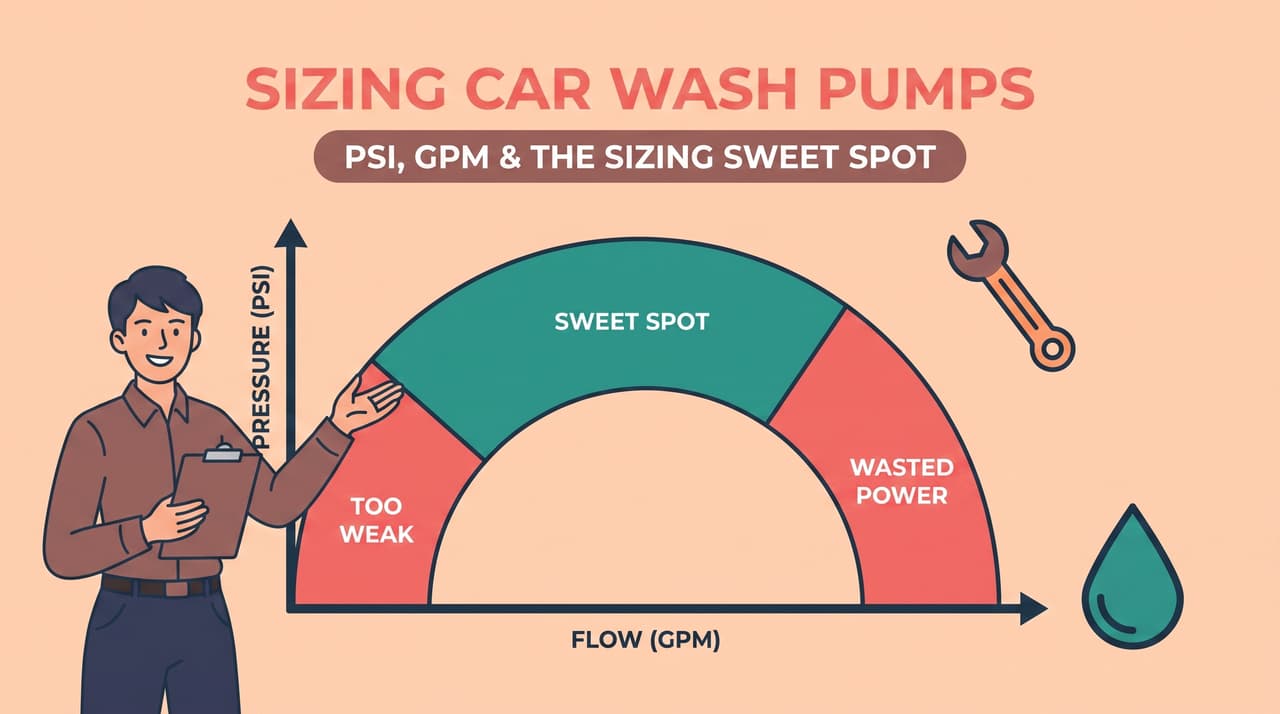
PSI measures pressure: the force the water applies at the point of contact. GPM measures flow rate: the volume of water delivered per minute. Neither number alone tells you whether a pump fits its job — a high-PSI pump can still deliver too little volume, and a high-GPM pump can be too weak to do useful work. Both dimensions matter, and they matter differently depending on the wash method.
That's because the target combination of PSI and GPM shifts with how the wash actually removes dirt. A brush or contact system splits the cleaning work between mechanical agitation and water — the brush does part of the job, so water pressure doesn't have to do all of it. A touchless system has no brush at all. Water pressure combined with detergent chemistry has to do the entire job that brush contact would otherwise share, which is why touchless systems run at meaningfully higher pressure.
You can see this inside a single manufacturer's own catalog. HyTian's MY-385 touchless system runs its high-pressure water at 120 L/min at 1000 psi, because it has no brush to lean on. The DCX-100T and DCX-100G wheel-wash units, by contrast, run high-pressure jets at 3-4 kg/cm² — roughly 43 to 57 psi using the standard 1 kgf/cm² ≈ 14.2233 psi conversion. That's roughly 20 times the pressure, on the same product line.
A wheel-wash jet stripping mud off a tire in a 45-60 second cycle isn't the same job as a touchless arch replacing an entire brush pass. Pressure is a function of the job, not a universal setting to maximize.
The Four Variables That Size a Pump
Sizing a pump correctly isn't picking a PSI number off a chart. It's computing what your specific configuration actually demands, one variable at a time.
Variable | What to Measure | If You Get It Wrong |
|---|---|---|
Simultaneous flow demand | Per-outlet flow × outlets running at once | Pump under-delivers the moment every arch or station fires together |
Target pressure by wash method | PSI needed for brush-assisted vs. touchless | Wrong PSI target for the wash method — weak cleaning or wasted force |
Pressure drop / line losses | Supply-line diameter and run length at full flow | Pressure correct at the pump, short at the far nozzle |
Duty cycle | Continuous vs. intermittent operation, hours per shift | Motor and seals wear faster than the rated pump life suggests |
Simultaneous Flow Demand
Total GPM demand is the flow rate per outlet multiplied by the number of outlets running at the same time — not the rating printed on a single nozzle. If eight nozzles each flow roughly 1.3 GPM, the system needs to supply about 10.7 GPM the moment all eight are open together, not 1.3 GPM.
This is why pump architecture varies even within one product family. HyTian's GH-500TL rollover bus wash specifically lists "1 hi-pressure pump + 2 brush sets" as a distinguishing spec against the GH-500 and GH-500S variants. The number of simultaneous high-pressure draws one pump has to feed is itself a configuration choice, not a fixed property of the wash type. A tunnel system's multi-arch pre-wash runs on the same logic at larger scale: every arch firing together adds to one pump's total demand.
Target Pressure by Wash Method
Pick the PSI target for your wash method first — brush-assisted or touchless, as covered above — then size flow rate around that target. Reversing the order, starting from a flow number and hoping the pressure works out, is a common way to end up with an under-performing system.
Pressure Drop Through the Supply Line
A pump's rated output isn't what arrives at the last nozzle in a run. As total flow through shared supply piping increases, pressure drop across that piping increases too, and the pressure actually delivered at the outlet falls below the pump's rated output. A pump specified correctly at the manifold can still under-deliver at the far end of a long line if the piping itself wasn't sized for the flow running through it.
Duty Cycle
Continuous-duty equipment — a tunnel or touchless system running for hours at a stretch during peak periods — sizes differently than intermittent-duty equipment, even at similar peak pressure. HyTian's DCX-100T and DCX-100G wheel-wash units cycle in 45-60 seconds per vehicle; a tunnel or touchless pump runs far longer per cycle and far more often per shift. Duty cycle changes how hard a motor and its seals work over a day, which is a real input to sizing, not an afterthought.
A Worked Sizing Check, Using Published Equipment Data
Here's what applying that method looks like against a real spec sheet — the same steps you can run against your own equipment's documentation.
Step 1 — convert to a common unit. MY-385's rated flow is 120 L/min. Converted to US gallons (120 ÷ 3.785), that's approximately 31.7 GPM.
Step 2 — apply the standard hydraulic horsepower formula. Hydraulic horsepower equals flow in GPM multiplied by pressure in PSI, divided by 1714. At 31.7 GPM and 1000 psi, that's (31.7 × 1000) ÷ 1714 ≈ 18.5 HP of theoretical combined hydraulic output.
Step 3 — compare to installed capacity. MY-385's published spec is two 15kW pumps — roughly 40.2 combined HP once converted (1 kW ≈ 1.341 HP). That's noticeably more installed capacity than the 18.5 HP theoretical minimum. Some of the gap is ordinary: piston-pump efficiency losses, motor starting torque, and duty-cycle headroom all eat into the theoretical number before you reach a real spec. The system's published 35kW total also covers loads beyond the two pumps, like the dryer array. The exact internal allocation isn't published, so treat this comparison as the method — how to sanity-check a spec — not a precise engineering breakdown of HyTian's design margin.
Step 4 — know what a spec sheet doesn't tell you. TX-380 and XL-200 both list "1 piston pump" as a spec line item, with no published PSI or GPM figure for that pump. That's a real gap, and it's a common one across the industry — plenty of published spec sheets name a pump without publishing the number that actually determines whether it fits your site. When a load-bearing figure is missing, the right move is to ask the manufacturer directly, not to assume a plausible-sounding number and move on.
The Cost of Getting Pump Sizing Wrong
Over- and under-specification both cost money — just through different mechanisms, and an oversized pump is not a safety margin. It's its own expensive failure mode.
Over-Specification
An oversized pump gets forced to run away from its best-efficiency point, and operators typically control the excess with a throttled valve. That energy still gets generated by the pump and then dissipated as heat and turbulence across the valve instead of doing useful work. It's closer to driving with the accelerator down and the brake controlling your speed than to efficient operation.
The symptoms show up as excessive noise and vibration, accelerated bearing and seal wear, more frequent component replacement, and a power bill that runs high relative to actual throughput. A variable-frequency drive, which matches motor speed to real-time demand instead of throttling a fixed output, is the standard efficient alternative.
Under-Specification
An undersized pump can't deliver its target flow and pressure at the point of use, and the first symptom is usually inconsistent wash or rinse quality. Push it further and you invite cavitation: inadequate net positive suction head produces a distinctive rumbling, growling, or gravelly noise along with flow that runs lower than expected. Undersized or overly long suction piping is a common contributing cause, which means the pump itself can be correctly sized and still cavitate if the plumbing feeding it wasn't sized to match.
A Different Failure Mode: The Dosing Pump
Not every pump on a wash line is a high-pressure pump, and sizing them wrong looks different. HyTian's TX-380 uses a CNC metering pump holding 0.28 mL precision for chemical dosing, extending drum life to roughly 3,000 washes per 20 kg drum. An imprecise or mis-sized chemical dosing setup doesn't show up as lost pressure — it shows up as wasted chemical and inconsistent wash chemistry, a completely separate line item from a high-pressure pump problem.
Troubleshooting Signals That Trace Back to Sizing
If you're already seeing symptoms rather than specifying new equipment, three patterns point back to the variables above:
Pressure drops noticeably when multiple arches or stations run together. That's simultaneous-draw math catching up with you, not necessarily a failing pump.
The pump runs hot, loud, or "gravelly." Check cavitation and suction-side sizing — line length, diameter, and tank level — before assuming the pump itself needs replacing.
Power draw runs high relative to throughput. That's the signature of a throttled, oversized pump doing more work than the wash actually needs, which is worth confirming before you accept it as normal downtime risk.
Frequently Asked Questions
What PSI does a car wash need?
It depends entirely on wash method. Brush and contact systems can run at moderate pressure because brushes share the cleaning work mechanically. Touchless systems have no brush to lean on, so they typically run in the four-figure PSI range, with water pressure and chemistry doing the entire job alone. There's no single correct PSI across wash types — the number follows the method.
How do I calculate GPM for a car wash?
Multiply the flow rate of each outlet by the number of outlets that run simultaneously. Use the manufacturer's rated flow at your actual operating pressure, not a catalog reference pressure. A pump sized to a single-nozzle rating instead of the full simultaneous-draw total will under-deliver the moment every arch or station fires at once.
What happens if a car wash pump is oversized?
It runs away from its efficient operating point, typically controlled with a throttled valve that turns the excess energy into heat instead of cleaning work. Expect higher energy cost relative to throughput, faster bearing and seal wear, and more noise and vibration — oversizing isn't a safety margin, it's a distinct and avoidable cost.
What are the signs of an undersized car wash pump?
Inconsistent wash or rinse quality is usually the first sign, followed by cavitation symptoms if the shortfall is severe — a rumbling or gravelly noise and flow that measures lower than expected. Undersized suction piping can cause the same symptoms even with a correctly sized pump, so check the supply side before replacing the pump itself.
Key Takeaways
PSI and GPM are different measurements, and the right combination depends on wash method — touchless needs pressure a brush system doesn't.
Size for simultaneous flow demand (every outlet running at once), not the rating of a single nozzle.
Duty cycle and line losses are real sizing inputs, not afterthoughts — a pump correct at the manifold can still under-deliver at the far nozzle.
Oversizing has real costs (energy, wear) just like undersizing does — "bigger" isn't a safe default.
When a spec sheet omits a load-bearing number, ask the manufacturer directly rather than assuming.
A Manufacturer's View: Sizing the Pump to the Job, Not the Spec Sheet
Sizing correctly means matching the pump to the wash method and duty cycle in front of you — not defaulting to the largest motor on the price list. That discipline shows up across HyTian's own range. It includes piston-pump architecture on the tunnel and rollover lines, a dual 15kW high-pressure pump pair purpose-built for the brush-free touchless system, and a CNC metering pump engineered to 0.28 mL precision for chemical dosing. That's an entirely separate sizing problem, and three pump categories — each engineered to its own job rather than one spec stretched across every use case.
That precision comes from over three decades of continuous manufacturing since 1992. HyTian builds tunnel and touchless systems where the pump is specified for the job it actually does, not the biggest number that would fit on a spec sheet. The same discipline extends to the water side: matching reclaim depth to wash volume feeds the pump a consistent supply instead of a variable one, which is its own sizing input worth getting right.
Not sure whether your pump is matched to your wash's actual demand? Talk to our engineering team about sizing the right pump — and the right motor — for your configuration.