
Car Wash Throughput by System Type: Gantry, Rollover and Tunnel Cars-Per-Hour
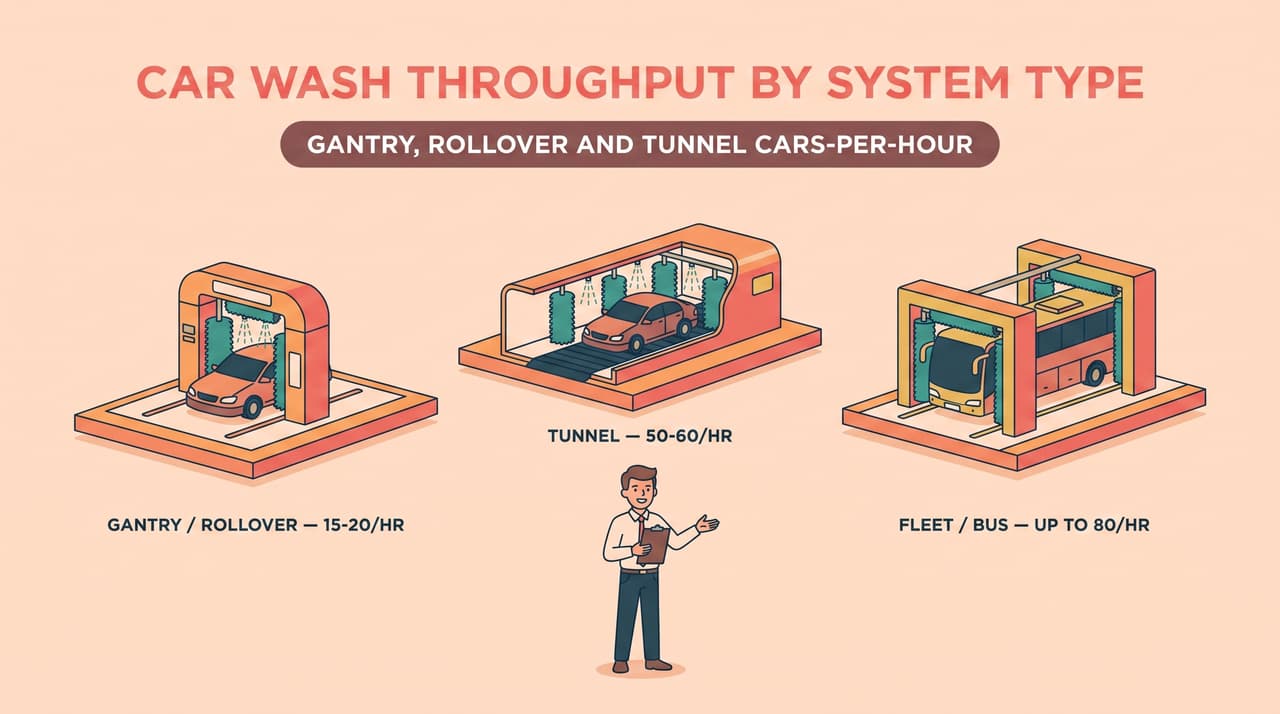
Car Wash Throughput by System Type: Gantry, Rollover and Tunnel Cars-Per-Hour
Search "gantry car wash throughput cars per hour" or "rollover car wash throughput cars per hour" and you'll get three different answers depending on where you look. A spec sheet says one number, a forum thread says another, and a competitor's marketing page says a third. None of them are lying — they're measuring different things.
This article separates the two numbers that actually matter for your site: the rated ceiling a manufacturer engineers a system to hit, and the sustained rate a normally-staffed site actually delivers across a real shift. We'll walk through gantry and rollover systems, tunnel systems, and fleet-scale variants of both, with every figure sourced and labeled as rated or sustained.
Rated Throughput vs. What a Site Actually Sustains
Every automatic car wash falls into one of two structural categories, and the category — not the vehicle it's washing — sets the throughput ceiling. That's really what "car wash cars per hour" means as a search: the honest number changes completely depending on which architecture you're asking about.
Gantry and rollover systems clean one stationary vehicle at a time. An arch-shaped frame moves back and forth over the car (or the frame stays put while a smaller carriage does the work), completing a full wash cycle before the next vehicle can enter the bay. Tunnel systems move multiple vehicles continuously through a series of fixed wash zones on a conveyor. The vehicle moves; the equipment stays in place.
That single mechanical difference explains almost every number in this article. A single-bay system's throughput is capped by one vehicle's full cycle time. A tunnel's throughput is capped by conveyor speed and how tightly vehicles are spaced — a fundamentally different constraint.
Here's the quick-reference version before the detail. Every figure below is sourced and labeled in the sections that follow.
System Type | Representative Model | Rated (Manufacturer Spec) | Sustained / Real-World |
|---|---|---|---|
Rollover (car-scale) | HyTian XL-200 / XL-200NET | 15-20 vehicles/hour | 6-12/hour typical across independent sources |
Gantry (bus/truck-scale) | HyTian GH-500 | 15-20 vehicles/hour | Not independently documented at fleet scale |
Tunnel | HyTian TX-380 | 50-60 vehicles/hour | 60 cars/hour sustained (BYD factory PDI) |
Drive-through (bus/truck) | HyTian TH-350 / TH-350S | 40-80 / 80 buses/hour | Up to 80 buses/hour (Zhuhai transit depot) |
Worth clearing up before the numbers: "gantry" and "rollover" usually describe the same architecture from two angles. "Rollover" names the action — the machine rolls over a parked vehicle; "gantry" names the structure — a bridge-like frame that spans it. HyTian's own product line groups them under one category, Rollover / Gantry Systems, and rates its car-sized rollover unit and its bus-sized GH-500 rail-mounted gantry bus wash at the identical 15-20 vehicles-per-hour band — same mechanism, different vehicle scale.
Gantry Car Wash Throughput Cars Per Hour: What Rollover Systems Actually Deliver
HyTian's XL-200 rollover system and its self-service sibling, the XL-200NET, are rated at 15-20 vehicles per hour. That's the manufacturer's ceiling: continuous cycling, no queue gap, no payment delay between washes.
Independently sourced figures for this system category run lower, and the spread is instructive. Car Wash Advisory puts in-bay automatic wash time at 6-10 minutes per car, which works out to roughly 6-10 cars per hour. HyTian's own system-selection guide — a separate page built for buying decisions, not benchmarking — states a "typical throughput of about 10-15 cars per hour" for rollover and in-bay automatic systems. It then adds that "real-world averages often closer to 6-12" once you account for site conditions.
That's a genuinely honest admission from a manufacturer's own content, and it's worth taking at face value rather than smoothing over. At the higher end, Petit Auto Wash rates its Accutrac 360-i in-bay automatic at up to 29 cars per hour, based on 2-3 minute wash cycles.
The arithmetic behind every one of these numbers is the same: cars per hour equals 60 divided by minutes per cycle. A cycle includes three steps — positioning the vehicle in the bay, running the wash program, and clearing payment and exit. Because only one vehicle occupies the bay at a time, there's no continuous line to average a slow step away. Add 30 seconds to positioning on a self-service unit with a hesitant driver, and you've lost real throughput for that cycle, full stop.
That's why the rated 15-20 vehicles-per-hour figure and the generalist 6-15 range both belong in the same conversation instead of contradicting each other. The rated number is what the hardware can do. The lower range is what a typical bay does once you add realistic positioning time, self-service payment flow, and driver behavior that no spec sheet controls.
Tunnel Systems: Throughput That Scales With Length and Line Speed
HyTian's TX-380 tunnel system is rated at 50-60 vehicles per hour — roughly three to four times a single-bay rollover system, and the mechanism explains why. Express car wash tunnel throughput climbs further still once tunnel length and conveyor speed increase, which is the pattern the next few figures make explicit.
KKE Wash Systems, an independent tunnel manufacturer, publishes length-tiered specs that make the pattern explicit. A 12-meter compact tunnel processes 20-30 cars per hour, an 18-meter mid-volume tunnel processes 50-60 (matching TX-380's rated band almost exactly), and a 30-meter express tunnel processes 100-120. Hover Architecture corroborates the upper end, citing 100-200+ vehicles per hour for express tunnels in the 120-150 foot range.
Tunnel throughput scales with length because a longer line holds more vehicles moving through simultaneous wash zones — not because any single zone works faster. A pre-wash arch cleans one car at a time whether the tunnel is 40 feet or 150 feet; a longer tunnel just has more zones running in parallel at any given moment.
Is that rated ceiling achievable in practice, or does it face the same real-world discount as gantry and rollover systems? The clearest answer in HyTian's deployment history comes from a BYD factory case study. A TX-380 running new-vehicle wash at BYD's manufacturing facilities sustains 60 cars per hour at factory production-line cadence — the top of the rated range, held consistently, in an application where any paint damage is unacceptable.
That's a meaningfully different proof point than a marketing claim. Factory line cadence is externally paced and unforgiving; a tunnel hitting its rated ceiling under that discipline says the number is real, not aspirational. A second data point, HyTian's Japan deployment, reports 500+ washes per day during peak periods at Splash N Go sites. That's a daily figure, not an hourly one — but it's directionally consistent with sustained operation near the top of the rated band across a busy shift.
None of this means a tunnel automatically runs at its rated ceiling. Unlike a single-bay system, a tunnel's throughput is governed less by any one wash zone and more by how consistently vehicles are fed onto the conveyor. Our throughput optimization playbook covers loading cadence, conveyor tuning, and peak-hour design in depth — that's the "how to close the gap" article; this one is the "here's what the gap looks like" article.
Bus and Fleet-Scale Washing: Same Physics, Bigger Vehicles
The gantry-versus-tunnel divide isn't a car-wash-specific rule. It repeats at fleet scale, with the same mechanics driving the same gap.
HyTian's GH-500 is a rail-mounted gantry system built for buses and trucks — single vehicle, one wash cycle at a time — rated at 15-20 vehicles per hour, identical to the car-scale rollover band. The drive-through TH-350S, by contrast, is a continuous-line system rated at 80 buses per hour, with the base TH-350 rated across a wider 40-80 range depending on configuration.
A real transit depot confirms the top of that band holds under operational pressure. HyTian's Zhuhai transit case study reports the TH-Series sustaining up to 80 buses per hour at depot peak operations — a public transit system running fleet washing at scale, not a controlled demonstration.
Line up the numbers and the pattern from the car-scale section repeats exactly: a gantry mechanism tops out around 15-20 vehicles per hour whether it's washing sedans or buses, and a continuous-line system multiplies that ceiling by four to five times. Vehicle size doesn't change the physics. Architecture does.
How to Measure Your Own Site's Real Throughput
Every figure in this article is either a manufacturer's rated spec or a documented case-study result. Neither one tells you what your specific site delivers — for that, you need to measure it yourself.
Pick a genuinely busy hour, not an average one. Count every vehicle that completes the wash process from the start of that hour to the end, and that raw count is your sustained rate. The method is simple; the part operators skip is deciding what to count.
If you're diagnosing site capacity — how many clients you can serve during a Saturday peak — start the clock when a vehicle enters the queue, so payment and wait time count against your number. If you're comparing your equipment's mechanical ceiling against a rated spec, start the clock when the vehicle enters the wash cycle itself, excluding queue and payment time. The two methods produce different numbers from the same site, and conflating them is how operators end up arguing with their own equipment's spec sheet.
Once you know your real number and where it sits relative to the rated ceiling for your system type, the next question is what to do about the gap — and that's a longer conversation than this article can cover. Our throughput optimization playbook walks through conveyor tuning, loading cadence, and peak-hour design for exactly that follow-up.
What Disciplined Operations Actually Sustain
Two case studies anchor this article's central claim: a rated ceiling is achievable, not just a nameplate number, when loading is consistent and staffing is disciplined.
The BYD factory deployment sustains 60 cars per hour on a TX-380 tunnel at production-line cadence — the top of a 50-60 rated band, held in an application with zero tolerance for paint damage. The Zhuhai transit depot sustains up to 80 buses per hour on the TH-Series drive-through line — the top of its rated band, under real public-transit operating pressure. Both results come from named, verifiable deployments, not internal projections.
That track record sits on top of over three decades of continuous manufacturing since 1992, with 20,000-plus systems deployed across 40-plus countries. When a rated spec traces back to that kind of deployment history, it's a reasonable planning number — not a marketing ceiling you should discount before you've even measured your own site.
Frequently Asked Questions
How Many Cars Per Hour Does a Rollover Car Wash Do?
A rollover car wash is typically rated 15-20 vehicles per hour by manufacturers, though independently reported real-world averages run closer to 6-12 per hour once positioning time, payment flow, and driver behavior are factored in. Higher-end in-bay automatic units can rate up to 29 cars per hour on faster 2-3 minute wash cycles, so the honest answer depends on which specific system and which number — rated or sustained — you're asking about.
How Many Cars Per Hour Does a Tunnel Car Wash Do?
Tunnel throughput scales with length: compact tunnels around 12 meters process roughly 20-30 cars per hour, mid-length tunnels around 18 meters process 50-60, and express tunnels of 30 meters or more can process 100-200-plus. A documented factory deployment sustains 60 cars per hour on a mid-length tunnel at production-line cadence, confirming the top of that band is achievable under disciplined loading.
What's the Difference Between a Gantry and a Rollover Car Wash?
Little to none mechanically — both describe an arch-shaped unit that washes one stationary vehicle at a time, with "rollover" naming the action and "gantry" naming the structure. The terms tend to diverge more by vehicle scale in practice: "rollover" is more common for car-sized units and "gantry" for larger rail-mounted systems built for buses and trucks, but the throughput physics are identical either way.
Key Takeaways
Rated and sustained are different numbers, and both matter. A gantry/rollover system rated 15-20 vehicles/hour sustains closer to 6-15 in daily practice; a tunnel rated 50-60 has been documented sustaining the top of that band under disciplined loading.
Architecture, not vehicle size, sets the throughput ceiling. The same gantry-vs-continuous-line gap that separates rollover from tunnel car washes repeats identically at bus and fleet scale.
Cycle time explains single-bay throughput arithmetic. Cars per hour equals 60 divided by minutes per cycle — positioning, wash, and payment/exit all count.
Tunnel throughput scales with length, because a longer line holds more vehicles in simultaneous wash zones, not because any one zone runs faster.
Measure your own site before trusting any spec sheet — and decide upfront whether you're measuring site capacity or equipment ceiling, because the two methods produce different numbers.
Sizing a system to a target cars-per-hour number for your own site plan? Talk to our engineering team about matching a system's rated ceiling to your layout, vehicle mix, and staffing model.