
Commercial Transit Wash Systems: Specifying Equipment for Bus and Coach Fleets
Commercial Transit Wash Systems: Specifying Equipment for Bus and Coach Fleets
A solicitation that asks for "an automated bus wash system" is not a specification — it's a category. Every manufacturer in the category can answer it, and no two answers will be comparable. When the bids come back, your committee is left scoring apples against oranges, and the eventual award is hard to defend if anyone asks why one proposal beat another.
A commercial transit wash procurement holds up under scrutiny when the specification does the work RFP language usually skips. That means numeric vehicle-envelope requirements, a throughput figure tied to your actual peak window, named utility loads, required certifications, and a scoring method that weighs all of it together. This guide walks through each line item, using a real manufacturer's product family as the worked example — the variance within one line proves why "bus wash system" alone was never specific enough to write into a contract.
Why a Commercial Transit Wash Spec Can't Be Generic
Public transit and coach fleet purchases don't operate like a retail equipment sale. In the United States, agencies spending FTA assistance on third-party procurements are bound by FTA Circular 4220.1G, which requires full and open competition unless a sole-source justification clears the agency's approval chain. Outside the US, most public and municipal operators answer to comparable competitive-bidding rules. Either way, the practical consequence is the same: your evaluation criteria have to live in the written specification, not in a conversation with a preferred vendor afterward.
That's the argument for precision. If your committee hasn't yet settled on a system type, our guide to choosing between drive-through, rollover, touchless, and hybrid systems covers that decision. This piece picks up from there — it assumes the system type is decided, or close to it, and now needs to become a specification and a scoring method.
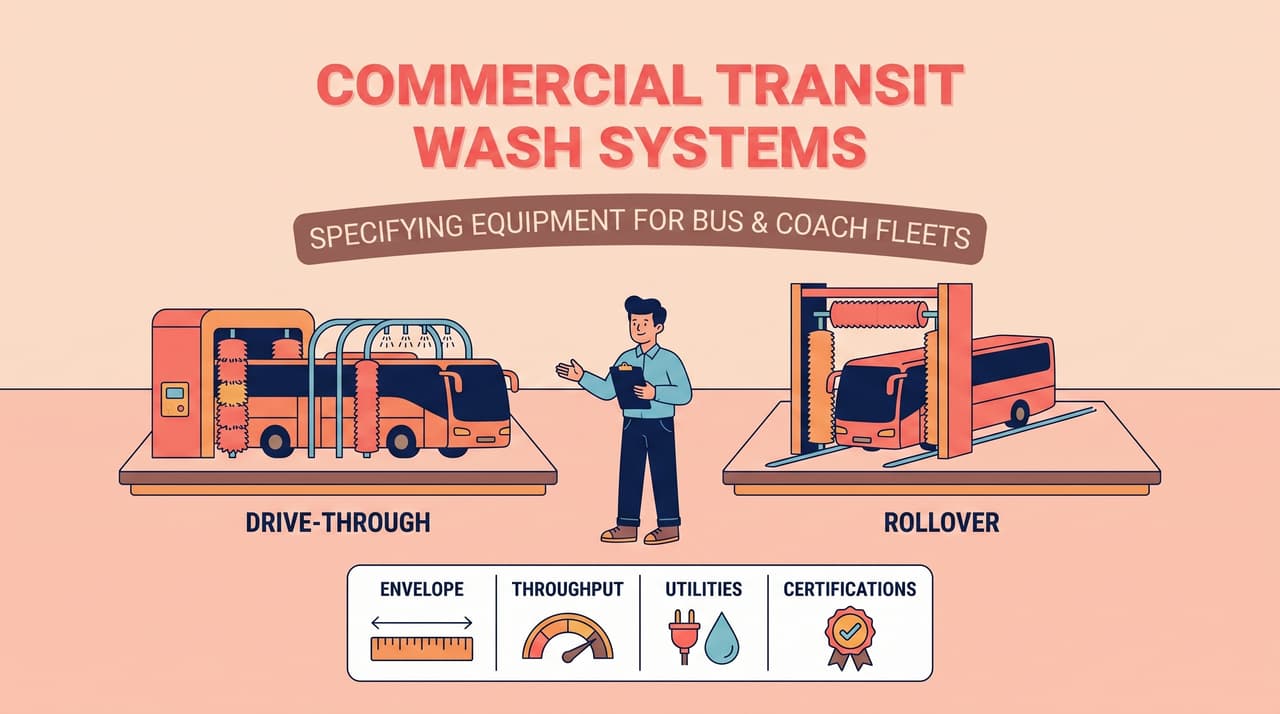
Five domains carry most of a defensible commercial bus wash specification: vehicle envelope, throughput and duty cycle, utilities and controls, compliance and documentation, and the vendor relationship behind the equipment. Each one is where a vague requirement quietly becomes an expensive surprise after award.
Vehicle Envelope: The Line Item That Eliminates Unqualified Bids
Start with the fleet you actually run, not a generic vehicle profile. A spec should state maximum vehicle length, height, and width as hard numbers — and if your fleet mixes standard buses, articulated buses, double-deckers, or motorcoaches, the envelope has to accommodate the largest one, not the average one.
The point is easiest to see inside a single manufacturer's own line. HyTian's TH-350 drive-through bus washer clears vehicles up to 350cm (3.5m) in height within an 880×462×402cm structure. The compact TH-350S ships in 3.5m or 4.2m clearance variants depending on configuration, inside a smaller 500×520×510cm footprint. Two systems built for the same application, from the same manufacturer, clear different vehicles — which is exactly why "handles buses" cannot be the requirement your committee scores against.
Rollover and gantry systems carry their own envelope ceiling that a spec often misses. The GH-500 rollover gantry supports vehicle lengths up to 12 meters, a limit set by its rail-mounted travel path rather than by height clearance. Articulated buses commonly run 18-20 meters. If your fleet includes articulated vehicles, verify a rollover or gantry system's rail length against your longest unit before it goes into the spec — or specify a drive-through architecture instead, where length is rarely the binding constraint.
Brush coverage belongs in the envelope discussion, not as a separate line item added later. A vehicle profile with a tall roofline, extended mirrors, or a wrapped livery needs specific brush zones covered — roof, both sides, front and rear — and the required zones should trace directly to your fleet's actual geometry and soil profile.
That variance runs deeper than height and length. Within the TH-Series line alone, brush configuration ranges from three sets on the TH-350S (one top, two side) to four sets on the base TH-350 (four long-side brushes) to six sets on the TH-350LS (two short-side, four long-side). Each combination is built for a different vehicle profile, not a fixed default — specifying "brush wash system" without naming the required coverage zones leaves that choice to the vendor instead of your fleet.
Throughput: Specify the Peak Window, Not the Daily Average
A daily-average throughput number hides the constraint that actually matters. Most transit depots wash during a narrow overnight or shift-change turnaround window, not spread evenly across 24 hours — so the spec should state vehicles-per-hour at peak demand, not vehicles-per-day averaged out.
Here again, one manufacturer's family makes the argument better than any general statement could. The TH-350 is rated 40-80 buses per hour depending on configuration, and the compact TH-350S reaches up to 80 buses per hour in its own right. The GH-500 rollover, built for depots that can't accommodate a drive-through layout, is rated 15-20 vehicles per hour. Same application, three legitimate numbers — which means a spec that just asks for "high throughput" gives every bidder room to define the term favorably.
Don't take a vendor's stated rate on faith. Build a witnessed acceptance test into the evaluation process: a timed demonstration run at the proposed configuration, observed by your team, before final award. It's the only way to confirm a spec-sheet number holds up under your actual conditions rather than a manufacturer's test bay.
Real deployments are the other form of proof. Zhuhai Public Transport Group Company operates TH-Series drive-through washers at its depots and runs them up to 80 buses per hour at peak — the same figure the spec sheet claims, demonstrated at public-transit scale rather than in a lab. See how that deployment held those numbers under real overnight-turnaround pressure.
Utilities, Controls, and Water Reclamation
Power and water draw need exact figures in the spec, not a range the vendor fills in after award. A depot's electrical service and water supply have to be sized before installation, and discovering a mismatch on delivery day is an expensive way to learn about it.
The same product family shows the spread clearly. The TH-350 draws 12kW and uses 150 liters per vehicle, while the TH-350S draws 12-13kW (configuration-dependent) and runs at 130 liters per minute. The GH-500 runs on a 380V, 15kW supply at 80 liters per minute. None of those figures are interchangeable, and a spec that omits them leaves the site's electrical and water planning to guesswork.
Control systems belong in the spec too, and not as an afterthought. The TH-350 runs on Mitsubishi PLC control. Naming the PLC platform matters: it determines what your depot's maintenance staff can service directly versus what needs a vendor callout, and it signals whether spare controller boards will stay available for the life of the contract.
Water reclamation should be a stated minimum recovery rate with supporting test data required in the proposal, not a marketing claim in the narrative section. EPA guidance on commercial vehicle washing documents reclamation systems capable of recovering up to roughly 90% of wash water as an achievable best-management practice — a defensible benchmark to write into the requirement rather than accepting "eco-friendly" as sufficient.
Compliance and Documentation: What to Require of the Manufacturer
Equipment can hit every performance number in the spec and still be a risk. If the manufacturer behind it can't document quality, environmental, and safety practice, that risk is real. Certifications belong in the qualification section as a gate, not a preference — require them, don't just note them as a plus.
Three certifications are worth naming outright: ISO 9001 for quality management, ISO 14001 for environmental management, and CE conformity for machinery safety. A manufacturer holding all three has proven documented process control, not just a working product. That distinction matters when your committee has to justify the award later.
Real solicitations show what a documented spec looks like in practice. A published transit bus-wash RFQ from Valley Regional Transit structures its requirements around a firm completion date, itemized equipment/materials/labor pricing, Safety Data Sheets for every chemical used on the property, and evaluation criteria that weigh more than price alone. That structure exists because it survives an audit. It's worth adapting even if your fleet is a coach operator, not a transit authority.
If you want a broader framework for scoring manufacturers before you write your own qualification section, our manufacturer-evaluation checklist covers the criteria beyond certifications — support model, parts channel, and track record.
Building a Comparison Matrix Your Committee Can Defend
Once the domains above are written into the spec, the next problem is scoring bids without defaulting to price. Total cost of ownership, or whole-life costing, is the standard public-sector method for this. It weighs equipment cost, installation, ongoing water/power/chemical/maintenance spend, and expected service life — not just the price on the bid.
A simple weighted matrix turns the domains in this guide into a scorable structure:
Criterion | Sample weight | Why it matters |
|---|---|---|
Vehicle envelope fit | 20% | Disqualifying if the system can't clear your longest or tallest vehicle |
Throughput at peak window | 25% | Determines whether the depot clears its fleet before service resumes |
Utility and site fit | 15% | Power/water mismatches drive change orders after award |
Certifications and documentation | 15% | Qualification gate; supports audit defensibility |
Total cost of ownership | 25% | Purchase price alone misrepresents the real 10-year cost |
Applied to the earlier examples, this gets concrete fast: an 18-meter articulated coach fleet with a tight overnight window scores a TH-350 drive-through well on envelope and throughput, while a compact-footprint depot with mixed shorter vehicles might score the TH-350S or a GH-500 rollover higher on site fit. The right answer depends on your fleet, not on any manufacturer's preferred configuration. For a parallel worked example in a different fleet vertical, our specification guide for logistics truck fleets applies the same weighted approach.
Proof at Fleet Scale
A specification is only as good as the deployment behind it. Zhuhai Public Transport Group Company needed to wash its municipal bus fleet at depot-peak rates without expanding its existing footprint. HyTian's TH-Series drive-through washers were engineered to integrate with the depot's current infrastructure, reaching up to 80 buses per hour without a major rebuild.
Detail-aware cleaning stages adjusted automatically across the fleet's mix of standard and articulated buses, and an integrated water reclamation system met local environmental requirements while cutting fresh-water draw. The deployment runs as a long-term partnership rather than a one-time sale — ongoing parts availability, system optimization, and maintenance training for depot staff, which is the vendor-relationship line item a spec should also capture, not just the equipment purchase.
Fleet geometry doesn't always fit a catalog configuration, and that's worth specifying against too. HyTian's engineered-to-order line builds custom systems for non-standard vehicles — proof of that capability comes from a deployment far outside the bus category: a Bolivia tram operator running 33.76-meter streamlined light-rail vehicles with protruding mirrors, geometry no standard wash could accommodate. The resulting system used eight brush groups in a dual-mode configuration — the machine moved around the vehicle for the complex nose sections, then the vehicle moved through a stationary line for the regular body — the kind of engineering depth a standard spec sheet won't cover. If your coach fleet includes an unusual profile or livery, ask any manufacturer under consideration what they've actually built outside their catalog.
That depth traces back to the manufacturer, not just the model line. HyTian's parent company, Nanjing Haiying Machinery, has manufactured wash equipment continuously for over three decades since 1992, with systems deployed in 40+ countries and more than 20,000 installations in the field. For a fleet that needs a system to perform for a decade or more, that track record is itself a specification criterion worth writing down. And for procurement teams managing more than one vehicle category — a coach operator that also runs a passenger shuttle or rental fleet, for instance — specifying a wash system for a passenger rental fleet walks through the same rigor applied to a different vehicle class.
Frequently Asked Questions
What should a bus wash RFP specify?
A defensible bus wash RFP specifies five things as numeric requirements for any bus wash systems under consideration: maximum vehicle envelope (length, height, width), throughput at peak turnaround window, power and water draw, minimum water-reclamation rate with test data, and required manufacturer certifications (ISO 9001, ISO 14001, CE). Naming a system type alone — "automated bus wash system" — is not sufficient, because throughput and envelope vary widely even within a single manufacturer's product line.
How many buses per hour does a transit depot need to wash?
The right figure depends on fleet size divided by your peak turnaround window, not a daily average. A depot cycling 60 buses through a two-hour overnight window needs roughly 30 buses per hour of sustained throughput, which rules out lower-throughput rollover systems (15-20 vehicles per hour) in favor of a drive-through configuration rated 40-80+ per hour. Size the requirement to your shift pattern, then require a witnessed acceptance test at that rate before final award.
What certifications should a bus wash equipment manufacturer have?
At minimum, require ISO 9001 for quality management, ISO 14001 for environmental management, and CE conformity for machinery safety, treating all three as a qualification gate rather than a preference. These certifications document that a manufacturer's production and compliance practices are audited and current, which matters for a public procurement that has to withstand review after the award is made.
Key Takeaways
Write vehicle envelope as a hard number, not a category — mixed transit or coach fleets need the requirement sized to the longest and tallest vehicle, not the average one.
Specify throughput at your peak turnaround window, and require a witnessed acceptance test rather than trusting a spec-sheet figure alone.
Name power, water draw, and control-system platform explicitly so the depot's utility infrastructure is sized correctly before installation, not after.
Treat certifications as a qualification gate — ISO 9001, ISO 14001, and CE conformity — not a narrative claim in a proposal cover letter.
Score bids on total cost of ownership, weighted across envelope fit, throughput, utilities, and certifications, so the award survives review months or years later.
Next Step
Drafting an RFP for your depot? Our engineering team can talk through your fleet mix and throughput targets and translate them into spec-ready line items before you publish the solicitation.