
Truck Wash Systems for Logistics Fleets: Throughput, ROI & Specification
Truck Wash Systems for Logistics Fleets: Throughput, ROI & Specification
Every tractor in your fleet is a high-cost asset running on thin margins. By 2024, the marginal cost of operating a truck reached approximately $2.26 per mile, with non-fuel operating costs at a record high of about $1.78 per mile, according to the American Transportation Research Institute. When the math is that tight, anything that quietly shortens vehicle life or steals a truck out of the rotation lands on the P&L — yet most fleets treat the wash bay as a cosmetic afterthought rather than the operational lever it is.
That is the wrong frame. Specifying a truck wash system for a logistics fleet is a throughput, ROI, and specification decision, sitting at the intersection of three pressures: corrosion control, uptime, and brand image. With roughly 3.9 million Class 8 trucks in operation across the U.S., thousands of fleet managers face this question — and the equipment vendors rarely answer it honestly. This guide does, from the perspective of a manufacturer that builds and deploys these systems.
What a Dirty Fleet Actually Costs
The most expensive consequence of a dirty fleet is not appearance — it is corrosion. Road salt and de-icers (sodium, calcium, and magnesium chloride) drive electrochemical corrosion on any metal that stays wet, and the undercarriage holds salt-laden slush against the frame, brake lines, fuel tanks, exhaust, and suspension long after the truck is parked. Aluminum trailers are not immune. The undercarriage is the worst-hit zone because it is the lowest, least-accessible part of the vehicle, where slush packs in and stays.
The national scale of that damage is well documented. AAA found that U.S. drivers paid an estimated $15.4 billion in rust repairs from de-icing over five years — roughly $3 billion a year, at nearly $500 per repair, with 22 million drivers reporting de-icer corrosion damage. The EPA puts the total higher, estimating road salt's corrosive effect on cars, trucks, bridges, and roads at about $5 billion in annual repairs. A logistics fleet concentrates that exposure: every tractor runs the same salted corridors, week after week, across a long service life.
Corrosion is only the first cost. The second is uptime: a truck idling in a slow manual wash line — or sidelined for a corrosion-driven brake or frame repair — is not earning. Washing has to fit the duty cycle, so the wash bay can never become the bottleneck that delays dispatch.
The third cost is harder to quantify, and we will not pretend otherwise: livery is rolling advertising, and well-maintained equipment is a recognized factor in driver morale and retention. We present that as a qualitative reality, not a fabricated statistic.
One word on what we will not claim: vendors often assert that a clean truck improves fuel economy by a fixed percentage, or that washing raises DOT and CSA inspection scores. Neither traces to a citable source — cleanliness is not a CSA scoring criterion — so we leave them out. The case for a fleet wash system stands on corrosion, uptime, and labor, without invented numbers.
Manual vs. Automated Truck Washing: An Honest Comparison
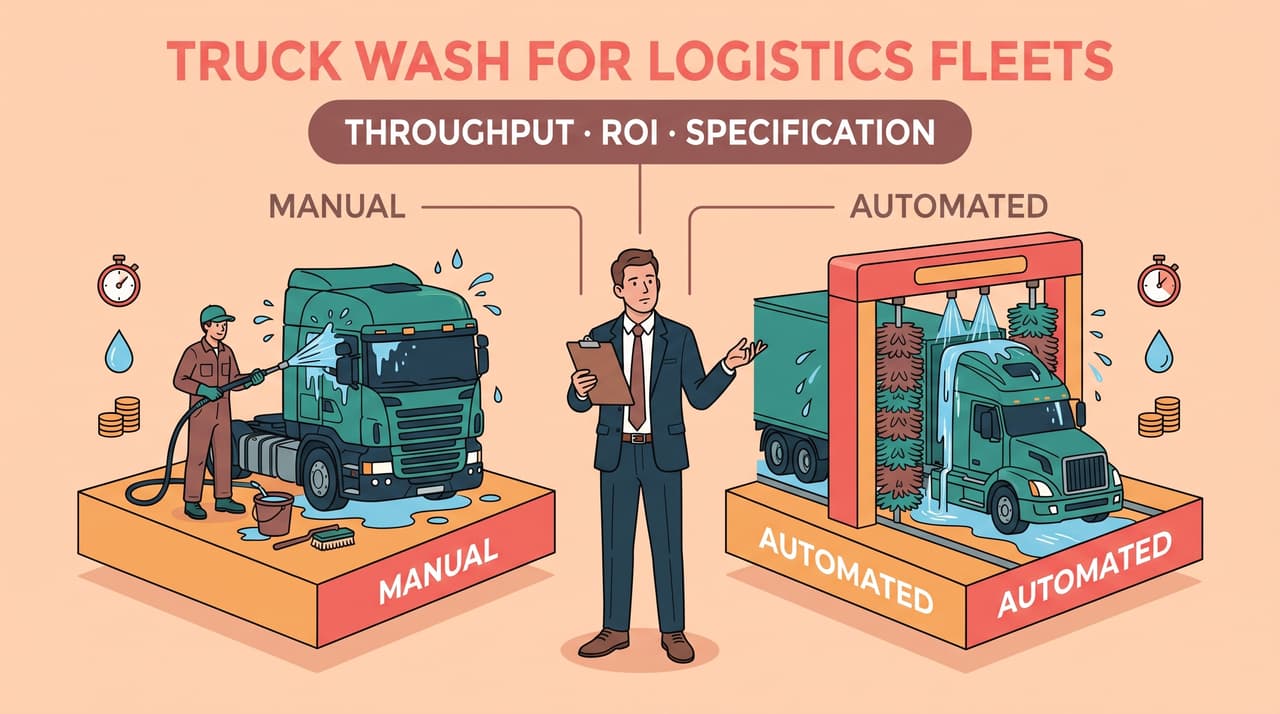
For most fleets the real decision is not whether to wash but how — by hand or with an automated system. Vendor pages tend to skew this comparison, so here it is straight, anchored in real specs rather than inflated savings claims.
Labor and time. Hand-washing a tractor-trailer is commonly cited at roughly 45 to 90 minutes of labor per vehicle, with automated gantry systems often quoted around 10 to 15 minutes and drive-through systems around 3 to 5 — treat those manual ranges as industry guidance, not guaranteed figures. On the automated side, HyTian's published throughput is concrete: the TH-Series drive-through clears 40 to 80 vehicles per hour and the GH-500 rollover gantry roughly 15 to 20, though those figures are framed against bus-sized vehicles and actual throughput on full tractor-trailers depends on vehicle length and soil loading.
Consistency. An automated brush or touchless cycle delivers the same wash on every pass; manual results vary by crew, shift, fatigue, and weather.
Water and chemistry. Manual pressure-washing is water-hungry and uncontrolled — commonly cited at roughly 50 to 200 gallons per hour of operation. Automated systems meter detergent precisely and, critically, can recycle water: HyTian's TH-350 uses about 150 liters per vehicle and its DCX wheel wash just 3 to 5 liters — figures that compound across the whole roster at fleet scale.
Throughput at fleet scale. This is where the economics shift. The governing math is wash-bay capacity versus fleet size multiplied by wash frequency: a manual line that handles a handful of trucks a shift forces a staffing decision that an automated bay sized to the fleet sidesteps.
The honest trade-off: an automated system is a capital decision with footprint and utility requirements, and the break-even depends on your fleet size, wash frequency, and local labor and water cost. Settle it by running the cost-per-wash math for your own fleet — not by trusting a blanket "60% labor savings" claim that no source supports.
Factor | Manual Hand-Wash | Automated (HyTian) |
|---|---|---|
Time per truck | ~45–90 min (commonly cited) | Drive-through ~3–5 min; gantry ~10–15 min |
Labor model | One or more washers per truck, full cycle | Supervise an automated cycle |
Wash consistency | Varies by crew, shift, and weather | Same metered cycle every pass |
Water use | ~50–200 gal/hr of operation (commonly cited), once-through | Metered per vehicle (TH-350 ~150 L), recyclable |
Throughput | A few trucks per shift | TH-Series 40–80 veh/hr; GH-500 ~15–20 veh/hr |
Manual figures are commonly-cited industry ranges, attributed above; automated figures are HyTian published specs and vary with vehicle size and soil loading. No pricing is implied.
What a Logistics Truck Wash System Must Do: A Procurement Spec
Translate the problem into requirements you can put in front of operations and finance, and the spec for heavy duty truck wash equipment becomes concrete. Six criteria carry the most weight.
Depot-scale throughput. The wash must clear the fleet inside the shift window without bottlenecking the yard; drive-through layouts avoid the reversing and queuing that slow a busy depot.
The right vehicle envelope. Class 6–8 tractors, box trucks, and full-length trailers need height and length clearance — up to roughly 12 meters — and configurations sized to your fleet mix.
Undercarriage and wheel coverage. Salt and brine collect low and pack into wheels and frame rails, so dedicated high-pressure undercarriage washing is a corrosion-control requirement, not an upsell.
Finish and livery protection. Paint-safe cleaning — closed-cell EVA foam brushes or brush-free touchless — protects cab paint, decals, and trailer wraps, the rolling brand you paid to apply.
Integrated water economics. On-board recycling controls fresh-water draw and sewer charges, which feeds straight into the ROI case below.
Durability and automation. The system should last as long as the trucks, with the parts and support that answer finance's vendor-lock-in concern, plus license-plate recognition and PLC control for low-staff operation.
Because this is the proof pillar, it is worth naming the equipment that meets each criterion. For depot-scale throughput, a high-throughput drive-through system — the TH-350 — runs 40 to 80 vehicles per hour under PLC control, with a compact TH-350S variant offering 3.5 m or 4.2 m clearance options. For depots without a drive-through layout, the GH-500 rollover for full-size trucks uses a rail-mounted gantry to clean vehicles up to 12 meters. And for the undercarriage, a wheel wash with integrated recycling — the DCX-100T — runs a 45-to-60-second cycle with high-pressure jets, automatic sludge discharge, and support for vehicles up to 100 tons. For livery, the MY-385 touchless line cleans with no brush contact on cab graphics or trailer wraps; for non-standard vehicles, an engineered-to-order system adds modular brush packs and multi-stage water reclamation.
The table below maps fleet need to the system family and the spec a fleet manager actually cares about:
Fleet Need | Recommended HyTian System | Key Spec |
|---|---|---|
Depot-scale yard throughput | TH-350 / TH-350S drive-through | 40–80 veh/hr; integrated water recycling |
Full-size & trailer envelope, no drive-through layout | GH-500 rollover gantry | Vehicles up to 12 m; ~15–20 veh/hr |
Undercarriage & wheel salt/brine | DCX-100T wheel wash | 45–60 s cycle; recycling + auto sludge discharge |
Livery & paint safety | MY-385 touchless | Brush-free; high-pressure + forced-air dry |
Non-standard fleet vehicles | Custom-Made (engineered-to-order) | Bespoke geometry; multi-stage reclamation |
If you are still deciding which system type fits your operation, our guide to how to choose a bus or truck wash system by type covers that selection in detail. Whatever the configuration, spec the capability before you price it — sourcing and project scope drive significant variance.
Building the ROI Case: Throughput, Labor, Water, and Lifecycle
Reframed for finance, a wash system is not an expense — it is a cost-and-uptime asset, and the honest way to justify the capital is a defensible method, not a fabricated payback period. Four levers carry the argument.
Throughput times frequency. Size the system to your fleet count and wash cadence so trucks get washed on schedule without queuing at the yard. Faster cycles return trucks to dispatch sooner, and that recovered uptime is the most direct ROI line a fleet manager controls.
Labor. Automation shifts wash labor from per-truck hand-washing to supervising a cycle. Rather than trust a blanket savings figure, quantify it: the unit metric that matters is total annual cost — amortized capex plus labor, water, chemistry, and maintenance — divided by washes performed. Our guide to measure your true cost per wash lays out the method.
Water recycling as a recurring-cost lever. Reclaim cuts both fresh-water draw and sewer charges versus once-through washing. Vehicle wash-water reclamation is commonly cited as recycling roughly 80 to 95% of wash water — treat that as an industry range, not a HyTian guarantee. What HyTian can state plainly is that its fleet systems ship with integrated recycling: the TH-Series and GH-500 reclaim wash water, and the DCX wheel wash recycles with automatic sludge discharge. If wash-water discharge is a question for your site, rules vary by locality — confirm with your local authority before you build.
Lifecycle and corrosion avoidance. Regular salt and brine removal protects expensive tractors and trailers across a long service life — the durability argument finance responds to, since every extra year of usable life on a truck is capital you do not have to re-spend. Recognized certification reinforces it: HyTian equipment is CE, ISO 9001, and ISO 14001 certified, backed by over three decades of manufacturing (its parent company has built this equipment since 1992) and 20,000+ systems across 40+ countries — a track record that de-risks the decision on durability and support, not sticker price. On price itself, capex varies widely by configuration, installation, and site, so spec the capability first and scope the project second. Explore the range on the fleet and commercial-vehicle wash systems hub.
Proven at Fleet Scale
The spec above is not theoretical — it reflects HyTian systems already running at fleet scale in transit, OEM manufacturing, and rail. These are not long-haul trucking deployments, and we will not imply otherwise; they are proof that the throughput, paint safety, recycling, and custom geometry a logistics fleet needs are demonstrated in the field.
The clearest throughput proof is the Zhuhai Public Transport Group, which deployed HyTian TH-Series drive-through systems and now scales fleet washing at up to 80 vehicles per hour. The systems integrate into existing depots on a compact footprint without a major rebuild and run integrated water recycling — depot throughput and water reuse at full fleet scale.
For finish protection, the BYD factory new-vehicle wash shows paint-safe washing at factory throughput: a HyTian TX-380 running 60 vehicles per hour on factory-fresh paint using EVA closed-cell foam brushes. That is direct evidence that automated brushes clean at high throughput without harming a finish — the assurance a fleet manager needs before running branded cabs and wrapped trailers through a brush system.
And for non-standard geometry, the Bolivia light-rail tram project demonstrates a custom-engineered transit wash system: a bespoke dual-mode design for 33.76-meter trams with a closed-loop that reuses treated wastewater for the pre-rinse and brush stages, deployed in 2023. Across all three, the throughline maps straight back to the logistics spec — throughput, paint-safe cleaning, integrated recycling, and the ability to handle whatever the fleet is.
Key Takeaways
A logistics truck wash system is an economics decision — corrosion control, uptime, and brand image, justified on throughput and ROI rather than treated as a cosmetic nicety.
Manual vs. automated comes down to labor, consistency, water, and throughput at fleet scale. Run the cost-per-wash math for your own fleet rather than trusting a blanket savings claim.
Spec for the duty cycle: depot throughput, the Class 6–8 and trailer envelope, undercarriage salt removal, paint-safe livery cleaning, integrated water recycling, and a service life that matches the trucks.
Frequently Asked Questions
How much does a truck wash system for a fleet cost? There is no single figure: cost is driven by configuration, site conditions, and how the project is sourced. An OEM-direct, equipment-only system looks very different from a fully installed turnkey project. Spec the throughput, vehicle envelope, and undercarriage coverage your fleet needs first, then scope the installation — and use the cost-per-wash case to compare options like for like.
Is an automated truck wash worth it for a fleet? It depends on your fleet size, wash frequency, and local labor and water cost — but for most fleets washing regularly, automation shifts labor from scrubbing each vehicle to supervising a cycle. The honest way to decide is the cost-per-wash method: total annual cost (amortized capex plus labor, water, chemistry, and maintenance) divided by washes performed. That beats any blanket savings claim, because it reflects your actual fleet.
How often should logistics fleets wash their trucks? Industry guidance commonly recommends washing long-haul tractors roughly weekly to bi-weekly and urban or delivery trucks every one to two weeks, with more frequent washing in salt-belt regions after de-icer exposure. Treat that as a starting point for sizing throughput, not a guaranteed threshold — the right cadence depends on your routes and climate.
How long does it take to wash a semi truck? By hand, a tractor-trailer is commonly cited at roughly 45 to 90 minutes of labor per vehicle. Automated systems are far faster — gantry systems are often quoted around 10 to 15 minutes and drive-through systems around 3 to 5 minutes, with actual times depending on vehicle size and soil loading. At fleet scale, that difference compounds across every truck.
How much water does a truck wash use? Manual pressure-washing is commonly cited at roughly 50 to 200 gallons per hour of operation, used once and sent to drain. Automated systems meter water per vehicle and can recycle it — HyTian's TH-350 uses about 150 liters per vehicle and its DCX wheel wash about 3 to 5 liters, and integrated reclaim is commonly cited as recovering roughly 80 to 95% of wash water.
Specifying a wash system for a logistics or long-haul fleet? HyTian's engineers can size a throughput- and corrosion-focused system to your fleet mix, yard layout, and duty cycle — and help you build the cost-per-wash case for capex approval. Talk to our team about your depot, and we'll engineer a spec that holds up to both road salt and a finance review.