
Rental-Car Fleet Wash Systems: Throughput, Finish Protection & Turnaround
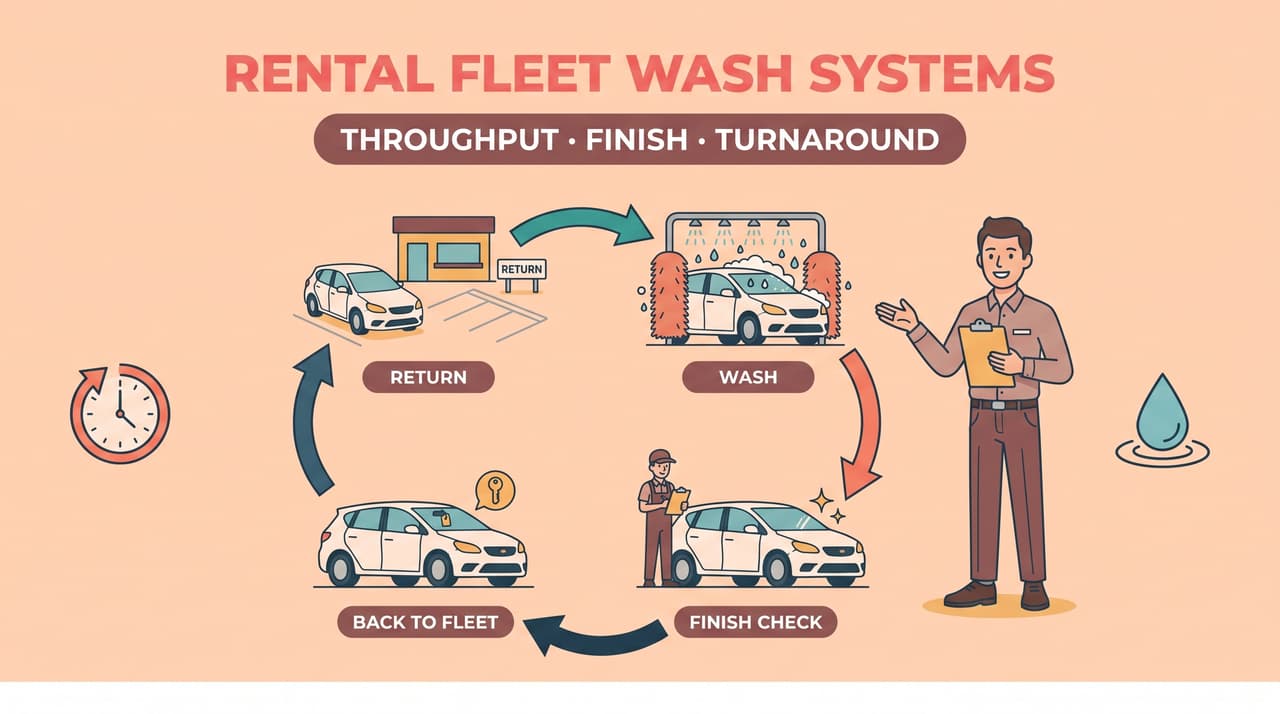
Rental-Car Fleet Wash Systems: Throughput, Finish Protection & Turnaround
For a rental operation, a clean car isn't a courtesy — it's the product. The wash bay sits on the critical path between a car that just came back and a car that's ready to rent again, and every hour a returned vehicle waits to be cleaned is an hour it can't earn. Choose the wrong rental car fleet wash system and you either bottleneck turnaround on your busiest days or, worse, quietly damage the finish on assets you plan to resell.
Rental fleets ask more of a wash than almost any other operation. You're washing the same vehicles again and again, to a consistent appearance standard, against a turnaround clock — and every one of those cars is a resale asset whose paint you can't afford to dull. This guide breaks the decision into the three levers that actually matter for a fleet: throughput, finish protection, and turnaround consistency.
Why Rental Fleet Washing Is a Different Problem
It's tempting to treat fleet washing like dealership prep or a retail car wash, but the economics are different enough to change the equipment decision.
Dealership prep is largely a one-time event — a thorough detail before delivery, at modest volume. A retail wash sells individual washes to the public. A rental fleet does neither. It washes a large, captive population of vehicles repeatedly, on a schedule set by rentals coming back and going out, and it measures success by how fast and how consistently it turns a dirty return into a rentable car. (If your operation is closer to service-drive or pre-delivery work, our guide to a car wash system for a dealership covers that case.)
That reframing changes what "good" looks like. Effective rental fleet vehicle washing equipment has to sustain volume during peak return waves, hold a uniform appearance standard across hundreds of cars, and protect the finish on vehicles headed for remarketing. Get those three right and the wash stops being a chokepoint and becomes part of your inventory-velocity engine.
Throughput: Matching Wash Capacity to Your Turnaround Clock
Rental returns don't arrive evenly. An airport branch sees waves — a bank of flights lands, thirty cars come back inside ninety minutes, and every one needs to be cleaned, inspected, and back on the ready line before the next rental rush. Your wash has to be sized to that peak, not your daily average.
The math is the same one the express car wash industry uses. Car rental wash throughput scales with system type and, for tunnels, with length: commonly cited industry planning ranges put a compact tunnel around 60 cars per hour and a full-length express tunnel well past 120, and trade guidance notes an 80-foot tunnel can wash roughly 100 cars per hour with strong equipment and an experienced operator. An in-bay rollover, by contrast, cleans one car at a time — useful capacity for a neighborhood branch, but not for a hub clearing a return wave.
A conveyor tunnel that processes 50 to 60 vehicles per hour turns a ninety-minute return crush into a manageable flow; a single in-bay unit running 15 to 20 an hour turns it into a queue. Model your busiest hour, not your daily count, and size from there. Our guide to increasing car wash throughput without expanding your site covers the levers that move that number.
Throughput is ultimately an inventory-velocity question, and rental operators already track it. Fleet utilization — the share of vehicles out earning rather than sitting idle — is the metric the industry lives by, and trade coverage such as Auto Rental News follows it closely across a national fleet measured in the millions of vehicles. A faster, more reliable wash lifts the ceiling on how quickly returns re-enter your rentable pool.
Finish Protection: Brush Control, Chemistry, and Resale Value
Here's the lever fleet managers underestimate most: every wash is a small transaction with the resale value of the car. Rental vehicles cycle out of the fleet into the used market, and their condition at remarketing sets what they fetch. A wash program that leaves swirl marks, brush scratches, or dulled clearcoat is quietly discounting your own remarketing revenue, one cycle at a time — and because a rental car goes through the wash far more often than a privately owned car, small per-wash damage compounds fast.
This is where brush design and chemistry stop being spec-sheet trivia and become an asset-protection decision. Two things govern whether repeated washing protects or degrades a finish:
Brush media and pressure. Modern soft-touch systems use closed-cell foam brushes that ride the vehicle's contours at a controlled, even pressure rather than raking grit across the paint. HyTian's tunnel systems use EVA closed-cell foam brushes with a wide profile and a linear pressure curve, engineered to resist grit carryover and protect clearcoats, wipers, and mirrors. That bar isn't theoretical: BYD standardized new-vehicle washing across its factories on our TX-380 tunnels, where the brushes run on factory-fresh paint and any blemish is unacceptable. Paint-safe at OEM scale is the standard a rental fleet should hold its wash to.
Chemistry and dosing. The detergents — and their concentration — matter as much as the brushes. Under-dosed chemistry leaves cars dirty; over-concentrated or wrong-pH chemistry can haze trim and strip protectant. Precise, repeatable dosing keeps every wash in the safe, effective band. Our tunnels meter chemistry with CNC pumps accurate to 0.28 mL, which also stretches a 20 kg chemical drum to roughly 3,000 washes and keeps cost-per-wash predictable.
If your fleet skews premium, or you simply want to take brush contact off the table entirely, a brush-free touchless car wash system cleans with high-pressure water and staged detergents instead of media — trading a little cleaning aggressiveness for zero mechanical contact with the paint.
Consistency at Fleet Scale: Appearance Standards and Automation
A rental brand promises a consistent experience, and the car's appearance is the first thing a driver sees. Holding a fleet wash appearance standard across hundreds of vehicles and multiple shifts is hard when washing depends on who's working that day and how much time they have. Manual washing is variable by nature — the same crew produces different results under a return-wave crush than on a slow Tuesday.
Automation is how you make the standard the default. Pre-rental vehicle wash automation replaces "however the attendant did it today" with a single, repeatable, equipment-driven process: the same brushes, the same chemistry, the same dwell time, every car, every cycle. That's precisely the shift BYD made when it moved factory washing from variable manual work to a standardized tunnel line — the payoff wasn't only speed, it was consistency.
Consistency also depends on the wash being available when the returns arrive. A wash that's down during a Friday-evening rush isn't a standard; it's a bottleneck. Reliability comes from industrial-grade components and, just as much, from disciplined upkeep — a preventive maintenance schedule that catches wear before it stops the line is part of the appearance-standard equation, not separate from it.
What Fleet-Scale, Paint-Safe Deployment Looks Like
No single spec sheet proves a wash will hold up at fleet scale — deployments do. HyTian doesn't yet publish a named rental-fleet case study, but the fleet-relevant behavior a rental operation cares about is documented across adjacent, demanding deployments:
Fleet-scale throughput. At a Zhuhai public-transit depot, our TH-Series drive-through washers clean up to 80 buses per hour with integrated water recycling — captive-fleet volume against a turnaround clock, the same problem shape a rental hub faces. See our Zhuhai bus fleet deployment for the detail.
Paint-safe at OEM scale. BYD standardized factory new-vehicle washing on TX-380 tunnels running about 60 cars per hour on factory-fresh finishes.
Sustained high volume. A Splash N Go tunnel deployment in Japan runs 500+ washes a day at peak.
Behind those numbers is over three decades of building wash systems since 1992, more than 20,000 installations across 40+ countries, and ISO 9001, ISO 14001, and CE certification. For a fleet, that track record matters as much as any single spec — the wash has to run every day for years.
Matching a system to your operation comes down to shape and scale. A high-volume airport or hub branch clearing return waves is tunnel territory. A neighborhood branch with steadier, lower volume is often well served by a compact in-bay rollover. A premium or paint-sensitive fleet may prefer touchless. If your rental mix extends to cargo vans and box trucks, our bus and truck fleet wash guide covers the larger-vehicle end. And because the case rests on how fast better turnaround and protected resale value repay the equipment, model it explicitly — our car wash ROI guide walks through that math.
Key Takeaways
Size the wash to your peak return wave, not your daily average. A tunnel at 50–60 vehicles per hour clears an airport crush that a single in-bay unit at 15–20 would turn into a queue.
Treat finish protection as resale protection. Repeated washing compounds; closed-cell foam brushes with controlled pressure and precise chemistry dosing protect the paint you'll remarket — or go touchless for zero contact.
Make the appearance standard automatic. Equipment-driven washing holds a uniform result across shifts and return waves that manual washing can't.
Buy uptime, not just throughput. A wash that's down during a rush is a bottleneck; industrial components plus preventive maintenance keep it available.
Match the system type to your branch shape. Hub/airport → tunnel; neighborhood branch → in-bay rollover; premium/paint-sensitive → touchless.
Frequently Asked Questions
What is the best wash system for a rental car fleet? It depends on volume and how peaked your returns are. High-volume hub and airport branches clearing return waves are best served by a conveyor tunnel (roughly 50–60+ cars per hour); steadier neighborhood branches often fit a compact in-bay rollover; and premium or paint-sensitive fleets may prefer a brush-free touchless system.
How do you protect resale value when washing fleet cars? Use soft-touch closed-cell foam brushes that apply controlled, even pressure instead of dragging grit across the paint, and dose chemistry precisely so it's effective without hazing trim or stripping protectant. For zero mechanical contact, a touchless system cleans with high-pressure water and staged detergents.
How fast can an automated fleet wash clean cars? A conveyor tunnel typically processes 50 to 60 vehicles per hour, and longer express tunnels can reach 100 or more under commonly cited industry planning ranges. An in-bay rollover handles roughly 15 to 20 cars per hour — enough for a small branch, but not for peak-wave turnaround at a hub.
Every fleet has its own return pattern, appearance standard, and remarketing math. Tell us your fleet size and turnaround targets, and our engineering team will help you size the throughput, brush and chemistry package, and system type to fit. Contact our engineering team to talk through your operation.