
Europe Car Wash Water Recycling Regulations: Germany, the Netherlands & the EU
Europe Car Wash Water Recycling Regulations: Germany, the Netherlands & the EU
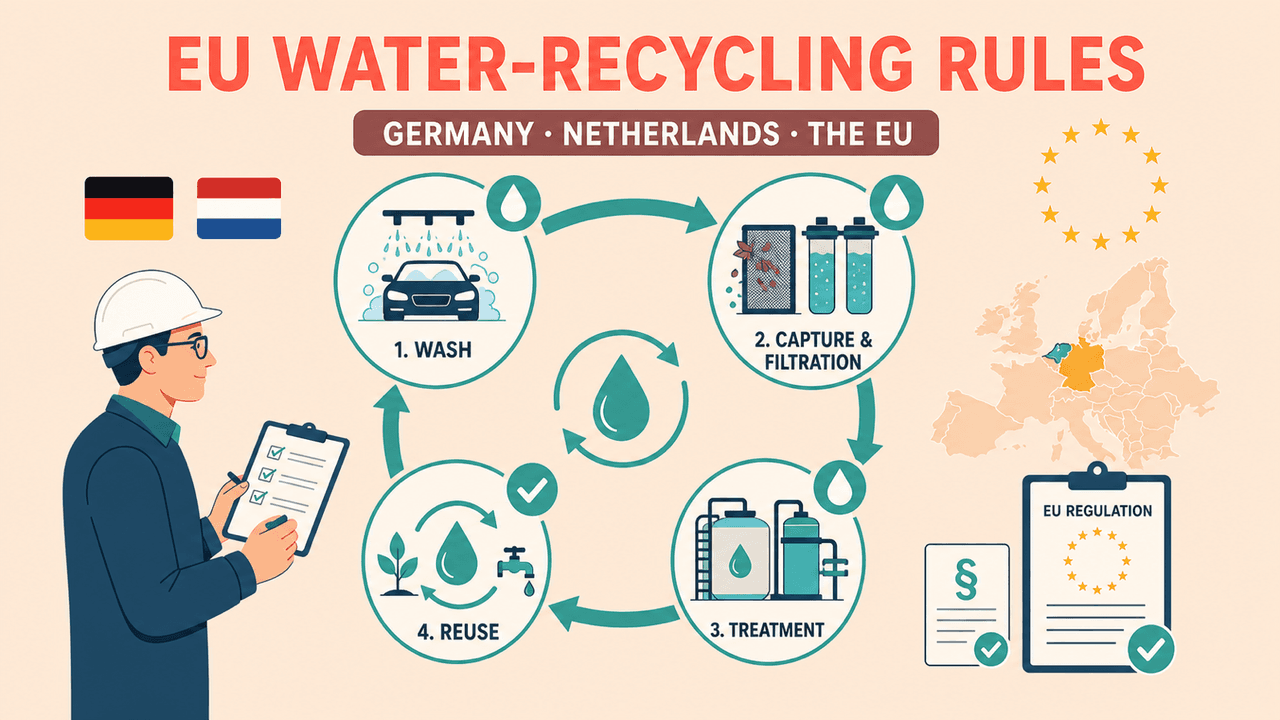
Across much of Europe, you can no longer specify a car wash system without specifying how it handles water. Closed-loop recycling, fresh-water limits, and effluent discharge are regulated — not optional extras you bolt on for marketing. For a procurement or facilities lead writing an equipment spec for a European site, that turns a sustainability talking point into a compliance requirement that has to survive review.
The catch is that Europe car wash water recycling regulations are not one law. They are a moving baseline set at EU level, layered over national and local rules that differ sharply between Germany, the Netherlands, and their neighbors — and the EU layer is tightening through 2027 as the revised Urban Wastewater Treatment Directive enters into force. So a procurement team needs the actual requirements, country by country, not vendor "eco" claims.
This guide maps what the rules in Germany, the Netherlands, and the wider EU actually require — citing the legal instruments themselves — then connects that picture to the equipment specs and certifications a wash system has to carry to meet it. It sits alongside our look at the global car wash equipment market by region; here the lens is regulatory, not market-sizing.
How Europe Car Wash Water Recycling Regulations Work: Two Layers
There is no single "EU car wash water law." Compliance is the intersection of two layers, and you have to satisfy both.
The first layer is the EU framework — directives and regulations that set the direction every member state must implement. A directive (like the Urban Wastewater Treatment Directive) sets goals and deadlines each country writes into its own national law; a regulation (like the Water Reuse Regulation) applies more directly. The second layer is national and local rules — the operating requirements a specific site actually has to meet, set by a country's environmental ordinances and, often, its regional water authority. In practice, the binding requirement at any site is the toughest applicable rule across both layers.
Two concepts are worth defining plainly, because the regulations turn on them. Closed-loop (or process-water) recirculation means treating wash water and reusing it on site, so the system draws far less fresh water per vehicle. Discharge to sewer means sending effluent to the municipal treatment plant — which is allowed only within pretreatment limits on what the water may contain.
The water volumes explain why regulators care. A commercial wash commonly uses on the order of 150 litres of water per car, with suppliers putting the broader range at 150 to 350 litres per vehicle wash depending on the program and self-service averaging roughly 80 litres. Reclaim systems change that math: depending on the treatment method, suppliers report fresh-water savings of up to 85 to 98 percent. That gap — between a high-fresh-water site and a recirculating one — is exactly what European rules are built to close.
Germany: The Closed-Loop Water Recycling Requirement
Do car washes have to recycle water in Germany? In practice, yes. Vehicle-wash wastewater falls under Annex 49 (Anhang 49) of the federal Wastewater Ordinance (Abwasserverordnung), which requires the fullest possible closed-loop recirculation of wash water for mechanical vehicle-wash facilities. There is no single statutory reuse percentage, but operators commonly target around 80% reuse to run compliantly.
Among the major European markets, the German car wash water recycling requirement is the most prescriptive on recirculation — so it is the right place to start.
The precise legal wording matters here, because it is easy to overstate. Anhang 49 requires "weitestgehende Kreislaufführung des Waschwassers" — the fullest possible closed-loop recirculation of wash water — for facilities that mechanically wash vehicles. What it does not do is set a fixed reuse-percentage performance standard. A 2024 study of process-water quality in German and Dutch car wash facilities in the IWA journal Water Science & Technology reflects that: with no fixed threshold in the ordinance, real-world recirculation quality varies system to system. So the widely-quoted ~80% figure is a practical, industry target — cited by regulatory observers for Germany and Austria — not the number written into the law. Getting that distinction right is the difference between a spec that survives compliance review and one that invites questions.
One operational detail belongs in any German spec: for closed-loop wash systems, the ordinance permits wastewater discharge only from the process-water reservoir (the Betriebswasservorlage), not from arbitrary points in the loop. That shapes how the treatment and buffer tanks are plumbed.
What none of this tells you is how a system actually hits a high recirculation rate. That is an equipment question — and it is the subject of our companion piece on how a car wash water recycling system treats, buffers, and reuses wash water in practice.
The Netherlands: Water Reuse Rules and Fresh-Water Limits
The Netherlands car wash water reuse rules take a different shape from Germany's. The Dutch approach is framed less around a recycling percentage and more around two duties: cap the fresh water you draw, and control what you discharge. Washing motor vehicles is a regulated discharge activity, and a fresh-water consumption ceiling of about 70 litres per car is commonly cited as the benchmark for compliant operation.
The legal foundation changed recently, so it is worth stating correctly. Since 1 January 2024 the Environment and Planning Act (Omgevingswet) is in force, and the general rules for activities — including vehicle washing and its discharges — now sit in the Besluit activiteiten leefomgeving (Bal), one of the core decrees under the Act. Discharging wash water is treated as a regulated activity: depending on where the water goes, an operator must report the discharge or hold a permit, and is bound by a general duty of care. Discharge to the sewer, to surface water, and to soil each follow different routes, and the rules expect effluent to be cleaned of oils and suspended solids before it leaves the site.
For a spec-writer, that translates into a clear implication: a reclaim-ready system paired with correct oil and particle separation is what keeps a Dutch site inside both the fresh-water ceiling and the discharge rules at the same time. The two duties are satisfied by the same engineering — recirculate to cut the draw, pretreat to clean the discharge.
The EU Framework Reshaping the Baseline Through 2027
Above the national rules, two EU instruments set the direction of travel — and both are central to EU car wash effluent compliance over the next few years.
The first is the revised Urban Wastewater Treatment Directive, Directive (EU) 2024/3019, adopted 27 November 2024. Member states must transpose it into national law by 31 July 2027, and it applies from 1 August 2027, replacing the 1991 directive (91/271/EEC) it supersedes. It tightens treatment standards, phases in advanced (quaternary) treatment to remove micropollutants, and extends the polluter-pays principle through an extended-producer-responsibility scheme under which producers fund a minimum of 80% of the cost of that additional micropollutant treatment. The practical knock-on for a wash operator: as municipalities face stricter treatment obligations and cost pressure, they tend to scrutinize non-domestic discharges — car wash effluent among them — more closely.
The second is the EU Water Reuse Regulation, Regulation (EU) 2020/741, adopted 25 May 2020 and in application since 26 June 2023. Its binding minimum requirements target reclaimed water for agricultural irrigation, leaving on-site process and industrial reuse to be governed by national rules — but it establishes, at EU level, the principle and quality framework for putting treated water back to use rather than discharging it.
The procurement takeaway from the EU layer is directional. Even where a country has no car-wash-specific reuse percentage today, the entire trajectory of EU policy points one way: less discharge, more reuse, and stricter effluent quality. Belgium, for its part, has been moving toward a requirement that around 70% of car wash wastewater be recycled. Specifying reclaim-ready equipment now is not gold-plating — it is getting ahead of a baseline that is still rising.
The map, at a glance:
Jurisdiction | Governing instrument | Core requirement | Commonly cited practical figure |
|---|---|---|---|
Germany | Anhang 49, Wastewater Ordinance (AbwV) | Fullest possible closed-loop recirculation of wash water; no fixed statutory reuse % | ~80% reuse target* |
Netherlands | Environment and Planning Act (Omgevingswet) + Besluit activiteiten leefomgeving (Bal) | Fresh-water ceiling + discharge duty of care; permit/notification by discharge route | ~70 L/car fresh water* |
EU framework | Directive (EU) 2024/3019 (from 1 Aug 2027) + Regulation (EU) 2020/741 | Stricter treatment, polluter-pays, direction toward more reuse | — |
*The ~80% (Germany) and ~70 L/car (Netherlands) figures are commonly-cited market/practice benchmarks reported by regulatory observers, not statutory thresholds. The German ordinance mandates closed-loop recirculation but sets no fixed reuse percentage.
From Compliance to ROI: Specifying Equipment That Meets the Rules and Pays Back
Here is what makes the compliance map a procurement advantage rather than a cost: the same closed-loop recirculation that satisfies Germany's Anhang 49 and the Dutch fresh-water ceiling also cuts the single largest variable utility in a wash — water, along with the chemical and energy it carries. Compliance and operating-cost reduction point the same way, which is rare in equipment buying.
A short, vendor-neutral checklist captures what a compliant European spec needs:
Closed-loop / process-water recirculation sized to your wash volume, so fresh-water draw stays inside national limits.
Oil and particle separation that meets local discharge rules for effluent sent to the sewer.
Documented water-quality maintenance for the recirculation loop, so reused water stays within spec.
Supplier evidence of EU conformity — CE conformity for the machinery and ISO 14001 environmental management as proof the partner can meet European requirements.
What this section deliberately does not do is re-derive the payback. The water-and-chemical savings that compliance unlocks are real, but the math depends on your volume, tariffs, and labor — so it belongs in a dedicated model. For that, see the operating-cost math, including water and chemicals, and for the capital side, what an automatic car wash system costs (sourcing and project scope drive significant variance, so treat any single figure with caution).
If you are scoping a system against a specific national requirement, this is the point where a requirements-first conversation with an equipment engineer pays off — before the RFP is written, not after.
A Manufacturer's View: Building for EU Water Compliance
A closing note from the manufacturing side, since the rules above ultimately have to be met by a machine. At HyTian, water recycling is supported and integrated across the product range rather than treated as an add-on — the systems are built to recirculate process water on site, which is what the German and Dutch rules effectively demand. We do not publish a single guaranteed reuse percentage, because real recirculation performance depends on the system configuration, the wash program, and the site, and an honest spec reflects that.
For European procurement, two certifications carry the most weight, and HyTian holds both: ISO 14001 for environmental management, and CE conformity, which means the equipment meets EU safety, health, and environmental standards. Those are the credentials a compliance reviewer looks for as evidence that an equipment partner can actually meet EU requirements.
The engineering stance behind that is straightforward: match the system to the site's regulatory and volume requirements rather than push a one-size configuration. It is the same approach that has put 20,000+ systems across 40+ countries over more than three decades of manufacturing (our parent company has built vehicle-wash equipment since 1992), with an ongoing European trade presence at events like Automechanika in Frankfurt. For how reclaim capability ties into the broader environmental picture, including ISO 14001, see our piece on sustainable car wash operations and ISO 14001.
Key Takeaways
There is no single EU car-wash water law. Compliance is the EU framework — Directive (EU) 2024/3019 and Regulation (EU) 2020/741 — layered over the toughest applicable national rule.
Germany requires the fullest possible closed-loop recirculation of wash water under Anhang 49 of the Wastewater Ordinance, but sets no fixed reuse percentage — the commonly-cited ~80% is a practical target, not the statutory number.
The Netherlands enforces a fresh-water ceiling (commonly cited at ~70 litres per car) plus a discharge duty of care under the Environment and Planning Act in force since 2024.
The EU baseline is tightening through 2027 toward less discharge, more reuse, and stricter effluent quality — so reclaim-ready equipment is future-proofing.
Specifying CE- and ISO 14001-backed, reclaim-ready equipment satisfies the rules and cuts the largest controllable utility cost at the same time.
Frequently Asked Questions
Do car washes have to recycle water in Germany? In practice, yes. Germany's federal Wastewater Ordinance (Anhang 49) requires the fullest possible closed-loop recirculation of wash water for mechanical vehicle-wash facilities. It sets no fixed reuse percentage, though operators commonly target around 80% reuse to run compliantly.
What are the EU rules on car wash wastewater? There is no single car-wash-specific EU law. Car wash effluent is governed by national rules implementing the EU framework — chiefly the revised Urban Wastewater Treatment Directive (EU) 2024/3019, which applies from August 2027, and the Water Reuse Regulation (EU) 2020/741. Both push toward stricter treatment and more on-site reuse.
How much water can a car wash use in the Netherlands? A fresh-water consumption ceiling of about 70 litres per car is commonly cited as the benchmark for compliant operation. Washing vehicles is also a regulated discharge activity under the Environment and Planning Act, with a duty of care on what reaches the sewer, surface water, or soil.
What certifications does car wash equipment need for the EU market? The two that matter most are CE conformity — confirming the machinery meets EU safety, health, and environmental standards — and ISO 14001 for environmental management. Together they signal to a procurement reviewer that the equipment and the supplier can meet European compliance requirements. HyTian's systems carry both.
Specifying a wash system for an EU site? HyTian's engineers can help you match reclaim capability and the right certifications to Germany's, the Netherlands', or the wider EU's water requirements — and to your operating-cost targets. Talk to our team about your site, and we'll work the requirements first.