
Scaling a Car Wash Chain: The Equipment & Operations Standardization Playbook
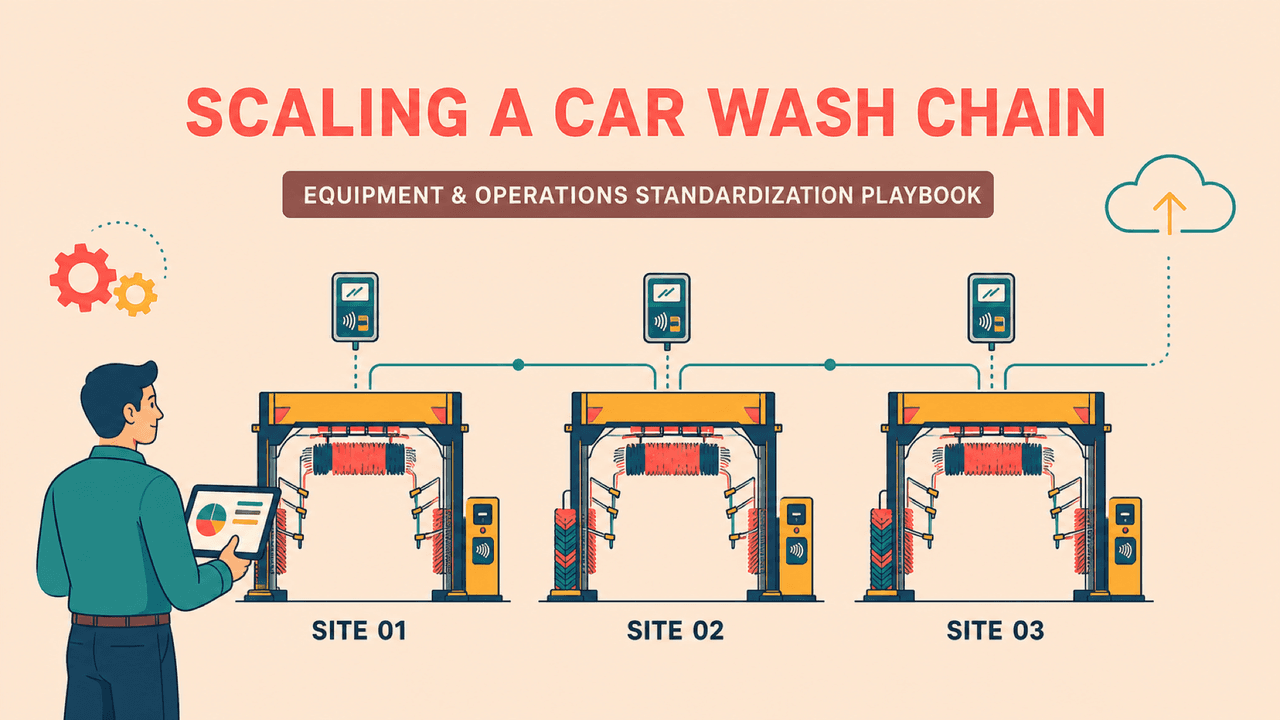
Scaling a Car Wash Chain: The Equipment & Operations Standardization Playbook
You signed the lease on site 4 last quarter. Sites 1-3 run well — you know the staff, you know the equipment, you know which Saturdays bring the volume. But standing on the asphalt at site 4, the operating model that worked across three sites suddenly feels like it's about to fracture. That fracture has a name: multi-site car wash operations is not three single-site operations stitched together. It is a different discipline.
The chains scaling fastest in 2026 — Whistle Express past 530 sites, Tidal Wave Auto Spa near 290, Driven Brands rolling out Take 5 Car Wash, and Mister Car Wash continuing its national footprint — did not get there by treating each site as an independent business. They scale by locking in a small equipment loadout, building a centralized operations stack around it, and replicating the pattern site by site. This guide walks that playbook from the equipment layer up: SKU lock-in, the cloud-managed satellite model that collapses front-of-house staff to zero, centralized chemical management, and the support architecture that lets you open site 8 without rebuilding from scratch.
The Chain-Operator Inflection Point: Where Single-Site Thinking Breaks
At site 1-2, you are on-premises. Operations is tactical — the rollover throws a fault, you walk over and look at it. Equipment selection is a per-site decision driven by the lot you bought and the budget you have.
At site 4-5, that model breaks. You cannot be on-premises everywhere. Operations stops being tactical and becomes architectural. Every decision you made site by site early on is now a multi-site cost: five different rollover models on five sites means five parts shelves, five troubleshooting workflows, and five chemical procurement contracts. The labor cost of running a chain that way is not just front-of-house staff. It is the maintenance manager who can only cover three sites because each one runs different equipment.
The dominant 2026 expansion pattern proves the alternative works. Whistle Express, Tidal Wave, and Mister Car Wash scale on standardized SKUs at standardized site formats — a discipline that lets one regional operations director cover 8-12 sites instead of 3. With 20,000+ systems deployed across 40+ countries, we have watched both versions play out — the chains that locked in standardization early and the ones that backfilled it later. Backfilling is more expensive.
The thesis: scale car wash business growth on equipment standardization and remote operations first; hiring and marketing come second.
The Standardization Playbook: Lock the Equipment Loadout Before the Lease on Site 4
Standardization is the discipline that makes everything else feasible. Once you cross three sites, the loadout you lock in determines the operating model you can actually run. The principle: one tunnel SKU, one rollover SKU, one touchless SKU per site role across the chain — maximum.
Here is the loadout pattern we see working across HyTian-deployed chains, mapped to site role:
Site role | Throughput target | Staffing model | HyTian product | Why this fits |
|---|---|---|---|---|
High-volume flagship tunnel | 50-80 cars/hr | 2-4 staff | TX-380 tunnel | Anchors regional traffic; modular SKU options right-size capex |
Low-density unmanned satellite | 5-20 cars/hr | 0 on-site | XL-200NET rollover | Cashless, cloud-managed, auto-drain — designed for satellite ops |
Brand-conscious / premium touchless | 8-15 cars/hr | 0-1 attendant | MY-385 touchless | Brush-free, paint-safe — fits luxury and EV-adjacent positioning |
Fleet / depot wash (if applicable) | 40-80 vehicles/hr | 1-2 operators | TH-350 drive-through | High-throughput drive-through for transit and fleet contracts |
The reason this matters operationally: when site 7's tunnel throws a fault, the maintenance technician has touched the same hardware at sites 1-6. The chemical drum at the central warehouse fits every site. The spare parts box on every site is identical. The training video that onboarded your loader at site 3 onboards your loader at site 8. Each is a small saving. Stacked across a 10-site chain, they compound into the difference between a 1.0x and a 1.4x operating-margin trajectory.
The TX-380 is the express tunnel anchor in this loadout. High-throughput tunnel systems at 50-60 vehicles per hour, EVA closed-cell foam brushes that protect modern clearcoats, VFD conveyor speed control, full-plate entry guide for consistent loading, and CNC metering pumps with 0.28 mL precision that extend a 20 kg chemical drum to roughly 3,000 washes. Modular SKU configurations let a chain right-size capex per location within a single product family — different tunnel lengths, different conveyor types, different dryer arrays — without leaving the family. Standardization holds where it matters; flexibility lives where the site demands it.
The XL-200NET is the satellite anchor. The product page lists "multi-site networks needing cloud control" as a target application. More on that in the next section.
The MY-385 is the optional premium SKU for sites where paint-safe positioning matters — luxury markets, EV-heavy markets, any location where a brand-conscious clientele expects no brush contact. A touchless premium configuration running 380V/35 kW on 2×15 kW pumps at 120 L/min and 1000 psi.
The honest caveat: standardization has limits. Site 7 might have a different footprint, lower power input, or harder water than sites 1-6. Build a "standard plus exceptions" loadout policy — define the standard SKU per role, and define the conditions under which an exception is permitted. Operators who fight every exception waste energy. Operators who pretend standardization is universal end up with five different rollovers and a parts shelf they cannot manage.
BYD's factory deployment shows the same logic at industrial scale. TX-380 systems standardize the PDI wash workflow across BYD's production line at 60 cars per hour, replacing a variable manual process with a consistent equipment-driven one. That is the chain-operator pattern compressed into a single facility.
Cloud Management and Remote Diagnostics: The Layer That Makes the Chain Run Lean
A multi-site chain cannot afford an attendant on-site at every location every operating hour — the math falls apart by site 5. The alternative is a satellite model: unmanned or near-unmanned sites that run on cloud-managed equipment with remote diagnostics. That only works when the equipment is genuinely built for it.
The XL-200NET is built for it. The differentiators that matter at chain scale: cashless scan-to-start payment removes the cashier role entirely. Cloud management lets a maintenance technician monitor every satellite site from a central dashboard. Remote diagnostics means a fault at site 7 shows up on the tech's laptop with an error code before the tech ever drives there — and in many cases resolves with a remote reset, no truck roll required. Auto-drain handles cold-weather freeze protection without an on-site routine. The system runs on 380V at 17 kW total with a 5-brush plus 4×5.5 kW dryer config, throughput 15-20 vehicles per hour — sized for the satellite role.
The operating-model implication is the headline number for chain operators: one maintenance technician can cover 5-8 unmanned satellite sites at a regional radius, instead of one tech per site. That is a structural reduction in the maintenance-headcount line on the chain's P&L — and it only exists because the equipment is wired for it. A satellite site running a generic in-bay automatic without remote diagnostics still requires a tech to visit for every fault. The XL-200NET's self-service rollover with cloud management is engineered to compress that workflow.
The complement at high-volume tunnel sites is the central dashboard layer. Even a manned express tunnel benefits from remote monitoring of throughput, chemical drum levels, fault codes, and uptime. Centralizing that data across the chain — instead of asking each site manager to phone in issues — is what lets a regional operations director run 8 sites instead of 3. The same dashboard that monitors a satellite XL-200NET monitors a flagship TX-380 — one data layer, one workflow, replicated across roles. This is what multi-site car wash operations look like when the cloud-management layer is doing real work.
Centralized Chemical Management: The Per-Wash Cost the Chain Operator Can Defend
Chemical cost is the operating-cost line that varies most without central control. Each site manager dosing manually drives 2-3x variance in chemical-per-wash across the chain — same equipment, same vehicle mix, same wash menu, but a per-site cost band so wide that chain-level financial planning becomes guesswork. Centralized procurement plus precision metering closes the variance.
Precision metering is the equipment-side lever. The TX-380's CNC metering pumps dose at 0.28 mL precision — a 20 kg chemical drum lasts roughly 3,000 washes. The difference vs. manual dosing is the difference between writing a $0.18 chemical-per-wash line into next year's chain budget and writing a $0.18-to-$0.42 range. The first is a financial plan. The second is a guess.
Centralizing the SKU bank is the procurement-side lever. One shampoo SKU, one wax SKU, one wheel cleaner SKU across the chain. Negotiating volume pricing on three SKUs across 10 sites beats negotiating eight — suppliers reward simplicity. One drum delivery cadence to a central warehouse, redistributed by route.
The margin lever is real. Operators who treat chemical procurement as a per-site decision give up roughly 10-15% of margin on the chemical line compared to operators who centralize it. On a chain doing $3M-$5M in chemical spend per year across 10 sites, that is $300K-$750K recovered annually — without changing equipment, menu, or staff. HyTian's ISO 14001 certification matters here too: multi-site chemical handling and disposal create real regulatory exposure across jurisdictions, and manufacturer-grade environmental compliance reduces that exposure at every site at once.
Support Contracts and Training Portability: The Layer That Lets You Open Site 8 Without Rebuilding From Scratch
Standardized equipment makes a chain-level support contract feasible. One contract covers the same SKU loadout across all sites — instead of negotiating bespoke service terms every time a new lease closes. That contract is a working-capital and risk-management instrument: defined response windows, defined parts shipping commitments, a single point of escalation when something goes wrong.
Training portability is the human-capital version of the same logic. When every site runs the same TX-380 tunnel and the same XL-200NET rollover, a wash technician trained at site 2 can step into site 7 on day one. The training video, the troubleshooting checklist, the chemical-loading procedure — all identical. Hire a tech for the chain, not for the site. Cover sick days at site 8 with someone from site 6, no half-day onboarding required.
Spare parts strategy follows the same pattern. A central spares warehouse stocking the standardized loadout — conveyor parts, brush replacements, dryer motors, control boards — covers 24-hour parts response across the chain. Without standardization, each site needs its own spares shelf, a working-capital tie-up multiplied across 10 sites.
The framework for evaluating a manufacturer's support infrastructure at chain scale lays out the questions to ask before locking in a loadout. HyTian's CE conformity, ISO 9001, and ISO 14001 certifications matter at chain scale as procurement-grade credentials — a 10-site chain often has a procurement function involved by site 4-5, asking for the same documentation a corporate procurement team would.
The Splash N Go Japan deployment is the multi-site proof point. What started as a single TX-380 tunnel installation grew into a multi-site franchise network across Japan, with 500+ washes per day at peak per location and a dedicated HyTian distributor and service team established in-region. One SKU, replicated across sites, supported by a service infrastructure that scaled with the network. That is the playbook in execution — and the model behind a sustainable car wash chain expansion strategy.
Planning the Rollout: The Sequence That Prevents Site 4 From Becoming an Anchor
The decision sequence that prevents site 4 from becoming an operational anchor is straightforward — but most operators run it backwards.
Step 1 — Define the chain-level menu and ticket strategy. Express exterior at $9-15. Full-service at $25-40. Hybrid express + premium at varied tickets per format. Low-density unmanned at $5-12. The menu is a chain-level decision, not a per-site one. Once you have it, the equipment loadout becomes a forced choice, not an opinion.
Step 2 — Lock the equipment loadout against the menu. TX-380 for the express tunnel role. XL-200NET for the unmanned rollover satellite role. MY-385 if the premium touchless role is part of the menu. Define the standard SKU per role plus the exception conditions.
Step 3 — Build the centralized operations stack. Cloud management dashboard. Centralized chemical procurement on the standardized SKU bank. Chain-level support contract with the manufacturer. Spares warehouse strategy. Training curriculum. Back-office, slow, unglamorous — but what the rollout depends on.
Step 4 — Then start adding sites. Site selection runs against a known operating model. The lease closes faster because the financial model is known. Commissioning is faster because the equipment, procurement contract, and support agreement are already in place.
The common mistake is steps 1 through 3 collapsing into "make decisions at each site as we go." That works for sites 1-3. By site 5, you have five different rollover models, three different chemical contracts, and a maintenance manager who can only cover three sites. Backfilling at that point slows the next three openings by months.
A pattern that works well: a flagship-and-satellite hybrid. Two or three high-volume TX-380 express tunnels anchor the chain at the highest-traffic locations; a network of XL-200NET unmanned satellites covers lower-density catchment areas. The flagships drive volume; the satellites drive coverage and footprint. Both run on the same operations stack. For the underlying chain-level ROI math and the operating cost structure across business models, single-site margin logic compounds at chain scale when standardization holds.
Key Takeaways
- Standardization beats variety once you cross three sites. One tunnel SKU, one rollover SKU, one touchless SKU per site role — maximum. Shared parts, shared training, shared maintenance playbook, predictable per-wash cost.
- The XL-200NET satellite model is the maintenance-headcount lever for multi-site car wash operations. Cloud management plus remote diagnostics lets one technician cover 5-8 unmanned satellites instead of one tech per site — structural, not tactical, and it only exists because the equipment is built for it.
- Centralized chemical management is a 10-15% margin line on the chemical spend. Precision metering (CNC pumps at 0.28 mL on the TX-380) plus a centralized SKU bank turns chemical from a guess into a defensible per-wash cost.
- The chain-level support contract and central spares warehouse are working-capital decisions. Standardized equipment makes both feasible.
- Plan in the right sequence. Menu → loadout → centralized operations stack → site rollout. Skipping any step turns site 4 into an anchor.
Talk to Us About Your Chain Loadout
Planning the equipment loadout for a chain that needs to scale from 1-3 sites to 5-20 without operations becoming the bottleneck? Our engineering team can walk through your site-mix strategy, the standard-plus-exceptions policy that fits your geography, and the cloud-management architecture that ties the network together. Talk to our engineering team about the loadout that fits your rollout.
Related articles
Explore more insights from the HyTian team.
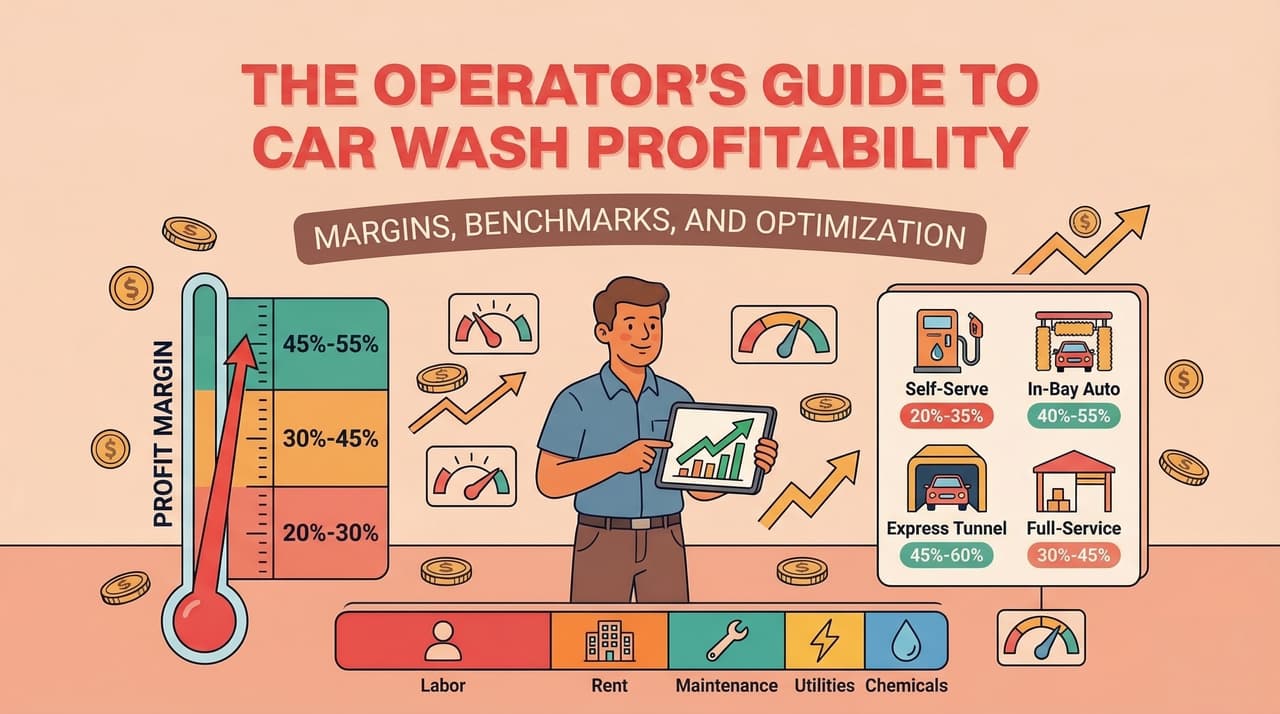
The Operator's Guide to Car Wash Profitability: Margins, Benchmarks, and Optimization
Car wash profit margins range 20–55% by business model. See realistic benchmarks, operating cost breakdowns, and five optimization levers operators control.
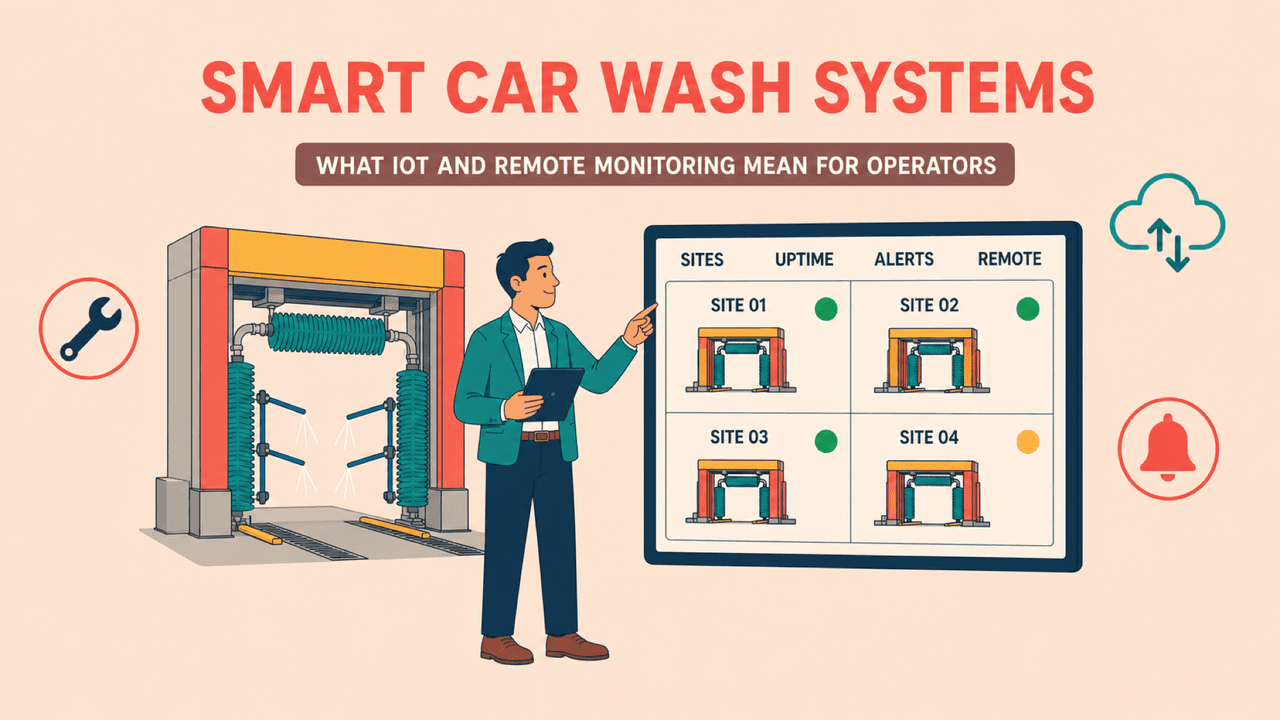
Smart Car Wash Systems: What IoT and Remote Monitoring Mean for Operators
A smart car wash system IoT layer turns sensor data into fewer breakdowns, faster fault response, and viable after-hours operation. Here's how it works.
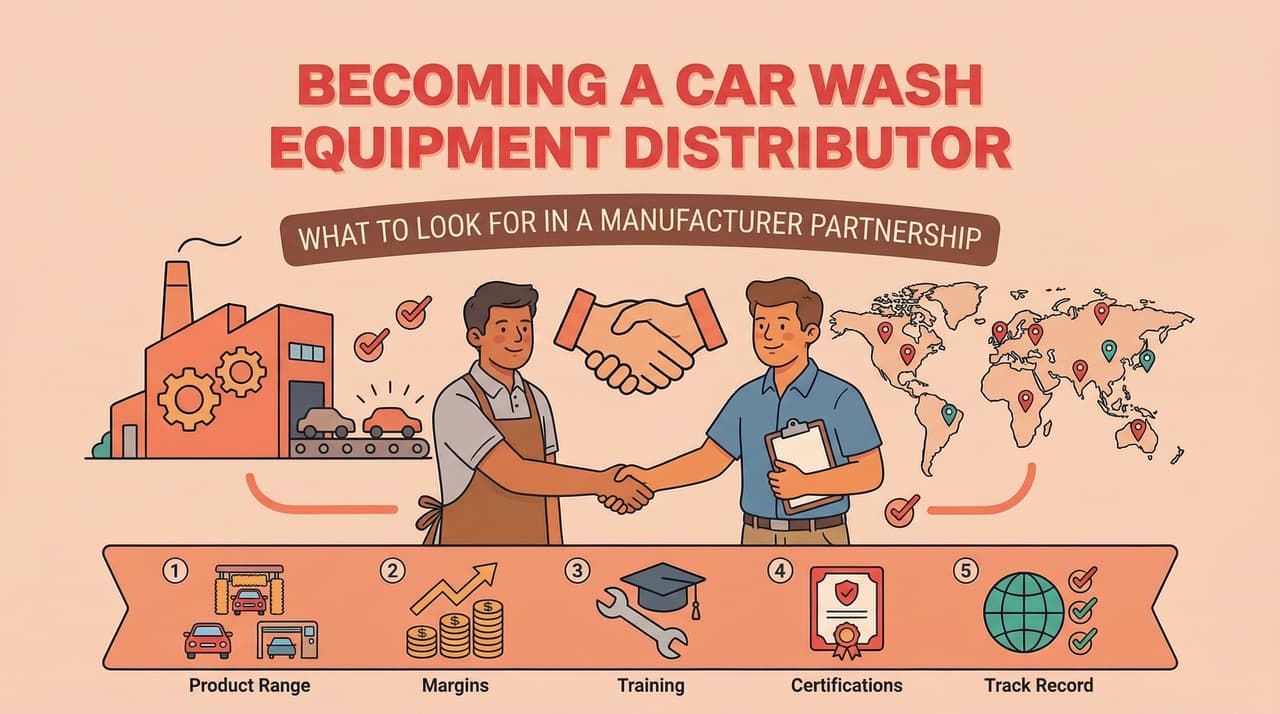
Becoming a Car Wash Equipment Distributor: What to Look for in a Manufacturer Partnership
Evaluating car wash equipment distributor partnerships? Five factors — from product range to global track record — that separate strong manufacturer relationships from risky ones.