
Car Wash Equipment in Australia: Water-Scarcity Compliance & Sustainable Systems
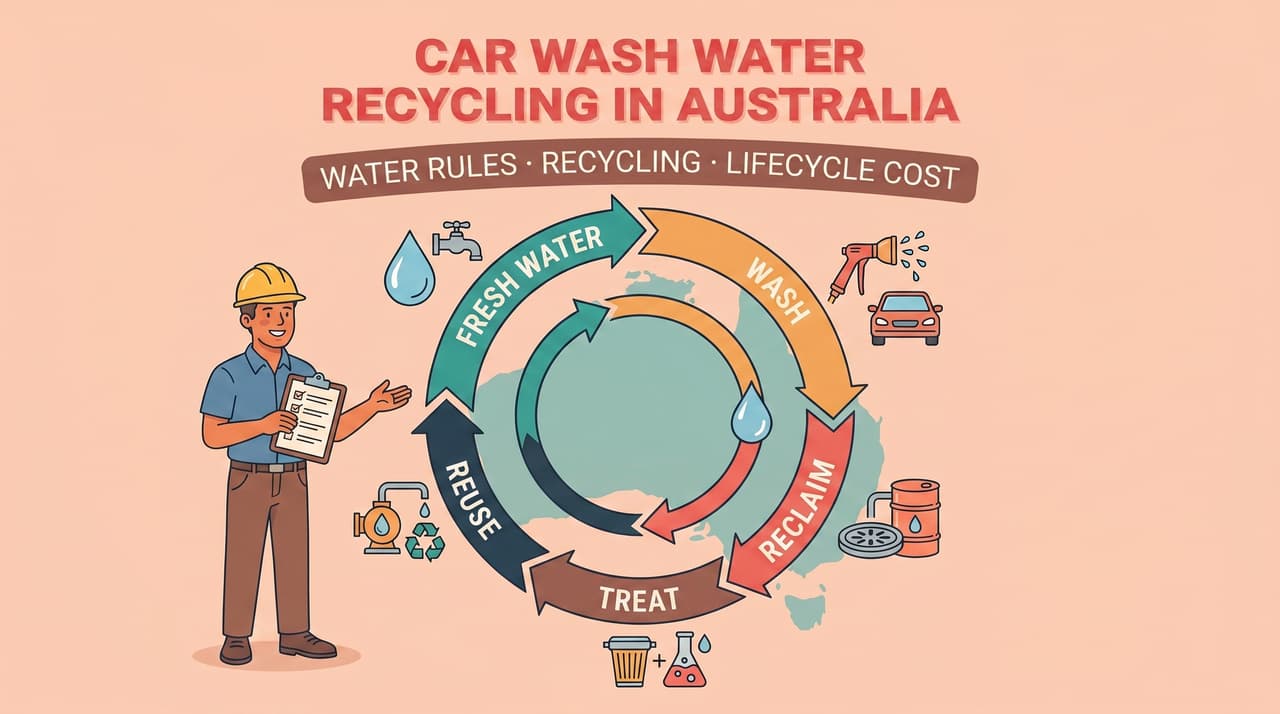
Car Wash Equipment in Australia: Water-Scarcity Compliance & Sustainable Systems
If you run or plan to build a car wash in Australia, water is the constraint that shapes every other decision. On the driest inhabited continent, the question is not only how well your equipment cleans a vehicle — it is whether you can keep washing when the next drought tightens the rules, and what your water and trade-waste bills do to your margin in the meantime. That is why australia car wash water recycling has moved from a sustainability talking point to a core equipment decision.
The pattern is consistent across water-constrained markets: the recycling system is what protects the business. This guide maps what Australia's water rules actually require of a wash, how recycling-ready systems turn those rules into an operating advantage, and whether it makes more sense to build recycling in from day one or retrofit it later. Every rule and figure below is attributed to its source — because on this topic, a vague claim is worse than no claim.
Why Water Defines the Australian Car Wash Market
Australia's car wash sector is not small. The Australian car wash services market was worth roughly US$985 million in 2025 and is projected to reach about US$1.24 billion by 2034, with rising environmental awareness and eco-friendly, tech-enabled offerings named among the growth drivers, according to IMARC Group. Demand is healthy — but it sits inside a water story that no operator can design around.
Water reaches your operation two ways. The first is compliance: whether your site can legally run, and keep running, when supply tightens. The second is cost: water and trade-waste charges are recurring operating expenses that compound over the life of the wash. A system chosen without either in mind can pass a demo and still fail the site. So before you compare wash quality or throughput, it is worth understanding the rules the equipment has to live inside.
What Australia's Water Rules Actually Require
Australia has no single national mandate that forces car washes to recycle water. Instead, state water authorities set permanent water-saving rules and escalate to drought restrictions, while local authorities govern what a commercial wash may discharge. The common thread across all of them is decisive for equipment selection: recycled water sits outside the rules that constrain drinking-water use.
That exemption is explicit. Victoria's Permanent Water Saving Rules "apply only to drinking water — not recycled water, greywater, rainwater or bore water," and they are permanent, with no end date. In New South Wales, Sydney Water's Water Wise Rules likewise do not apply to recycled or tank water, and they expressly permit washing a vehicle "at a commercial washing facility." When drought pushes a city into deeper restrictions — as it did in Sydney during the 2019–20 drought, when home car washing was cut back to a bucket or a commercial facility — the sites that keep running are the commercial washes, and the ones running most freely are those drawing on recycled water rather than town supply.
Then there is discharge. A commercial car wash cannot simply send its run-off down any drain. The Australian Car Wash Association is clear that "commercial car washes must have a valid Trade Waste Agreement before they can begin operations," and that in a regulated wash, all contaminated run-off passes through settlement pits to the sewer — never to the stormwater system. Capturing, separating, and treating wash water is not optional; it is the price of a discharge licence.
Rule type | Who sets it | What it means for your wash | How recycled water is treated |
|---|---|---|---|
Permanent water-saving rules | State water authorities (e.g. Victoria, via retailers like South East Water) | Always in force; govern drinking-water use every day of the year | Exempt — rules apply to drinking water only |
Drought restrictions (levels) | State water utilities (e.g. Sydney Water) | Escalate in dry periods; can cut home washing to a bucket or commercial site | Recycled and tank water generally exempt |
Trade-waste / discharge | Local water authority | Commercial washes need a Trade Waste Agreement; run-off must be treated before it reaches the sewer | Recycling reduces both discharge volume and load |
Rules vary by state and local authority; confirm the specifics with your water authority before you commit to a site or a system.
The practical reading is simple. A wash that depends entirely on drinking water is exposed every time the weather turns; a wash that recycles is insulated. Regulation in this space is regional — the way it works here is different from how Europe writes its car wash water rules — but the direction of travel is the same everywhere: toward reuse.
How Recycling-Ready Systems Turn Compliance Into an Advantage
Once you see that recycled water is exempt from the rules that constrain everyone else, the strategic value of a recycling-ready system becomes obvious. It is not only a compliance box; it is what keeps your bays open through a drought that idles your drinking-water competitors, and what trims your water and trade-waste costs in every ordinary month.
The savings are real because the baseline waste is real. The Australian Car Wash Association notes that a single home wash sends over 100 litres of wastewater — dirt, oils, and detergents — toward the stormwater system, whereas a regulated commercial wash captures and treats its run-off. Internationally, the benchmark is that reclaim systems reuse roughly 75 to 88% of wash water, per the International Carwash Association's water-use study. A wash reclaiming most of its water draws a fraction of the fresh supply per vehicle — the difference between a bill that scales painfully with volume and one that does not.
There is a marketing dividend, too. The Australian Car Wash Association runs a Water Rating Scheme, endorsed by Smart Approved WaterMark, that awards star recognition to the most water-efficient washes. In a market where drivers increasingly notice environmental credentials, a certified water-efficient wash is a signal you can put on your signage. The mechanics of the equipment behind that rating are covered in our guide to how a car wash water recycling system works, and the broader operating picture in sustainable car wash operations.
Recycling-Ready From Day One vs. the Mid-Life Retrofit
Here is the decision most Australian operators actually face: specify a recycling-ready system now, or run on fresh water and bolt reclamation on later when rising bills or tightening rules force the issue.
The retrofit is the expensive path, and the reason is engineering, not opinion. Adding reclamation to a running wash means installing below-grade treatment tanks and settlement pits, re-plumbing the wash bay back to the treatment loop, and taking the site — or at least a bay — offline while the civil work happens. Every day of that downtime is lost revenue, on top of construction cost that a greenfield build would have absorbed once. Designing the treatment loop in from the start avoids the teardown entirely: the pit, the tanks, and the plumbing go in while the slab is still open and the site is not yet earning.
Recycling-ready from day one | Mid-life retrofit | |
|---|---|---|
Compliance readiness | Built in; ready for drought restrictions and trade-waste rules | Exposed until the retrofit is complete |
Site disruption | None — installed during construction | Bay or site offline during civil works |
Lifecycle cost | Lower — one integrated build | Higher — construction plus lost revenue |
Water & trade-waste savings | Captured from opening day | Deferred until the system is running |
Spread across the ten-to-fifteen-year life of a wash, a recycling-ready system captures its savings from opening day and never forces a mid-life shutdown — which is the heart of its lifecycle-cost advantage. If you are pricing the decision, weigh it inside the full picture in our breakdown of the ROI math rather than against sticker price alone.
A Manufacturer's View: Building Water Recycling In
We build reclaim-capable systems for operators across 40+ countries, and our regional presence includes a subsidiary in Australia — so this is the lens we bring to a water-constrained site.
Water treatment is not an add-on we tack on at the end; it is designed into the platform. Our tunnel, bus, and custom systems support water recycling, and we build integrated water-treatment modules directly into the machine package. Where a site needs true closed-loop reuse, we engineer it: for a transit operator in Bolivia, we built a custom wash with closed-loop reclamation into a transit deployment that treats and reuses wastewater for the pre-rinse and brush stages, cutting the fresh-water draw on every cycle. The same principle scales down to a single-site express wash: match the reclaim capacity to your throughput and your state's rules, and the water problem stops being a liability.
That engineering sits on the credentials the compliance conversation actually cares about — ISO 14001 environmental management and CE conformity — backed by over three decades of manufacturing since 1992 and 20,000+ systems installed across 40+ countries. For operators who want reuse engineered in rather than retrofitted, our systems with multi-stage water reclamation built in are designed for exactly the water-constrained conditions Australian sites face.
Key Takeaways
Recycled water is your license to operate. Australia's permanent water-saving rules and drought restrictions apply to drinking water, not recycled water — so a recycling wash keeps running when competitors are restricted.
Discharge is regulated, not optional. A commercial wash needs a Trade Waste Agreement and must treat its run-off before it reaches the sewer.
Recycling pays twice. It cuts water and trade-waste costs and earns a water-efficiency rating you can market to drivers.
Build it in, don't bolt it on. Designing reclamation in from day one avoids the downtime and civil-works cost of a mid-life retrofit.
Size it to your site. Match reclaim capacity to your throughput target and your state's specific rules — the requirements vary by authority.
Frequently Asked Questions
Do car washes have to recycle water in Australia? There is no single national rule forcing recycling, but the practical answer is close to yes. State water authorities exempt recycled water from restrictions, and commercial washes must hold a Trade Waste Agreement and treat run-off before discharge to the sewer. Recycling is the reliable way to stay open through drought and meet discharge rules.
What are the water restrictions for car washes in Australia? Restrictions are set by state water authorities and escalate in dry periods. Permanent water-saving rules govern drinking-water use year-round, and drought levels can limit home washing to a bucket or a commercial facility. Both Victoria's and Sydney's rules exempt recycled and tank water, so recycling washes are largely insulated.
Do commercial car washes need a trade waste agreement in Australia? Yes. The Australian Car Wash Association states that commercial car washes must have a valid Trade Waste Agreement before they can begin operations, and contaminated run-off must pass through settlement and separation to the sanitary sewer — never the stormwater system.
Is it more cost-effective to build in water recycling or retrofit it later? Building it in is almost always more cost-effective over the asset life. A retrofit means below-grade tanks, re-plumbing, and site downtime on a wash that is already earning, whereas a recycling-ready build installs the treatment loop during construction and captures its savings from opening day.
Every site has its own water rules, throughput target, and constraints. Tell us your site, your state, and the volume you are building toward, and our engineering team will help you size a recycling-ready system that meets your local rules — before you build or retrofit. Tell us about your site and we will help you design the wash around it.