
How Much Does It Cost to Build a Car Wash? Build vs. Buy Economics
How Much Does It Cost to Build a Car Wash? Build vs. Buy Economics
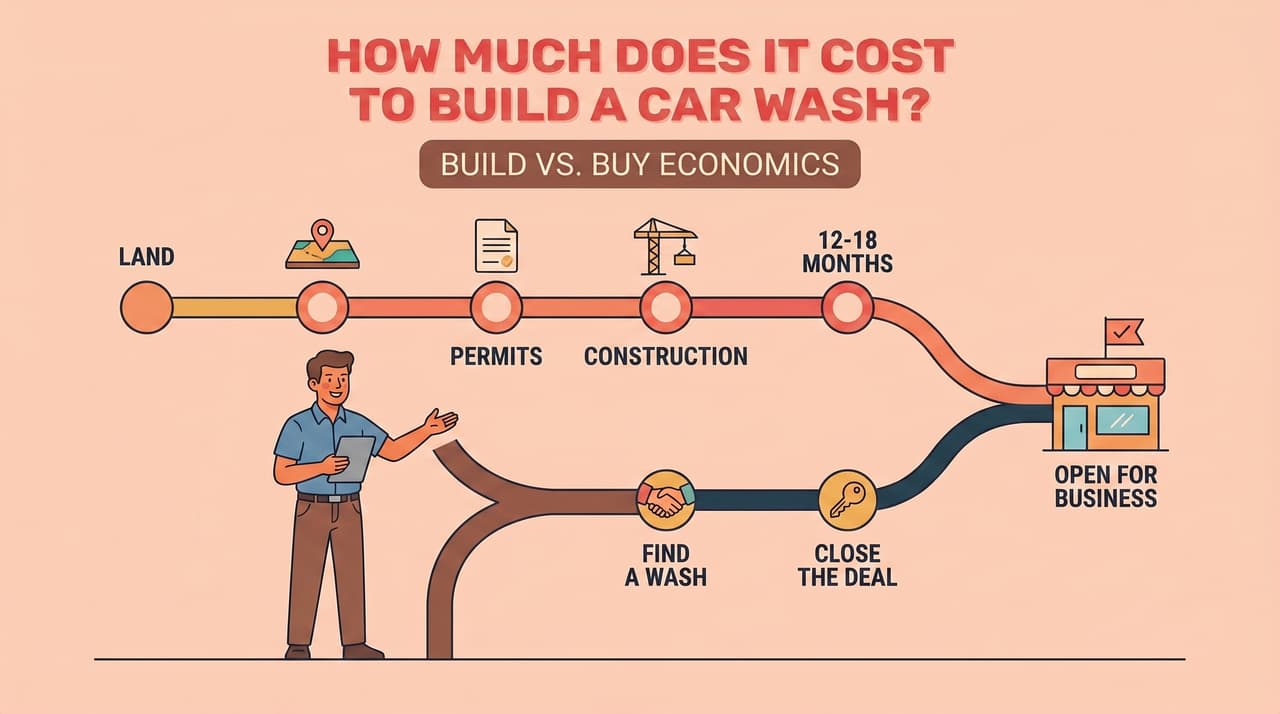
"How much does it cost to build a car wash" almost always hides a decision you haven't made yet. Before land, permits, or equipment specs matter, there's a fork: build a site from raw land, or acquire a wash that's already washing cars. Those are two different financial bets with different capital profiles, different timelines, and different risks — and most cost-to-build content answers only the first half of the question.
This guide covers the ground-up construction economics in detail — what land, site work, and equipment actually run when you're starting from an empty lot. Then it puts building side by side with buying, so you can make the call with real numbers instead of a gut feeling.
If you already know you want the full equipment-and-format cost table, our equipment and total-investment guide has it. If you haven't settled on the car wash business itself yet, our step-by-step startup guide covers that broader ground. This piece goes one layer deeper than either: what it costs to develop a site from nothing, and when that's the right call versus buying one that already exists.
What It Actually Costs to Build a Car Wash From the Ground Up
Ground-up construction has four layers, and equipment is usually the smallest and most predictable one. Land, site work, and the building itself typically dwarf the wash system sitting inside it.
Two independent car wash development consultancies have published detailed line-item models for a ground-up express tunnel build, and they land in a similar range once you account for how each firm scopes the project. Car Wash Advisory, a car wash M&A and valuation firm, breaks a full project down into real estate ($500,000–$2,000,000+), tunnel and support equipment ($500,000–$800,000), a water treatment system ($50,000–$250,000), site work and landscaping ($100,000–$300,000), and permitting ($75,000–$275,000). That adds up to a full-project total of roughly $2.6 million to $6.9 million.
PetroCal Associates, a car wash and fuel-retail real estate consulting firm, models it slightly differently: site acquisition ($0–$4,000,000 depending on whether you lease or buy the land), facility construction ($2,500,000–$6,000,000), and equipment ($1,000,000–$2,000,000). That arrives at a comparable $3.75 million to well over $10 million for a full-scope site.
Those numbers might look larger than what you've seen elsewhere on our site, and that's worth addressing directly rather than leaving you to wonder which figure to trust. Our own system cost guide prices a tunnel build at $560,000–$2,000,000, with land called out as a separate add-on of $200,000–$2,000,000. That's not a conflicting number — it's the same cost layers, presented pre-land instead of land-inclusive.
Add the two together and you land in the same territory the independent consultancies describe. The lesson either way you slice it: equipment is a comparatively narrow, quotable line item, and land is what turns a $600,000 project into a multi-million-dollar one.
Why the Range Is $600,000 in One Market and $10 Million in Another
Three variables explain nearly all of that spread.
Land is the dominant one. A leased site or a parcel in a lower-cost market can keep total land cost near the bottom of the range. Prime real estate on a high-traffic corridor can push land alone past $2 million — before a shovel touches the ground.
Format is second. A tunnel system needs a conveyor pit, a longer building footprint, and a larger-capacity water treatment setup than an in-bay automatic bay does. More format, more site work.
Regulatory environment is third. Water-recycling mandates and stormwater or environmental review add real cost and real time in stricter jurisdictions. Water recycling systems alone run $50,000 to $300,000, and many jurisdictions now require systems that recover 70–85% of wash water — a requirement your site plan needs to account for from day one, not retrofit in later. Our guide to water recycling system cost and compliance covers what that system needs to do.
Build vs. Buy: The Decision, Side by Side
Once you know roughly what a ground-up build costs, the real question most readers are actually asking is whether to build at all. Here's the honest version of that comparison — not a pitch for either path.
Building gives you full control. You choose the site, the layout, the brand presentation, and the exact equipment configuration for your throughput target. What it costs you is time and up-front capital concentrated in a single, large outlay before you've washed a single car.
Buying an existing wash gets you to cash flow faster. There's already a client base, a revenue history, and a functioning operation the day you close. What it costs you is inheriting whatever equipment condition, deferred maintenance, and site quirks came with the deal — which is exactly why we built a separate equipment due-diligence checklist for evaluating what you're actually acquiring before you sign.
Timeline is the piece of this decision that most cost-focused content skips entirely, and it's often the more binding constraint than capital. Per Wash Guru, a car wash development consulting firm, opening a car wash is a 12- to 18-month process from site selection through grand opening. That's the clock a ground-up build starts on day one; an acquisition can compress most of it away.
Path | Capital profile | Typical timeline | Control | Primary risk |
|---|---|---|---|---|
Build from the ground up | Large, front-loaded (land + construction + equipment) | 12–18 months, site selection to opening | Full — site, brand, equipment spec | Entitlement/permitting delays; land cost overruns |
Buy an existing wash | Smaller up-front outlay, priced off the business | Weeks to a few months to close | Limited — inherit site and equipment as-is | Deferred maintenance, orphaned equipment, hidden retrofit spend |
Retrofit an existing building or site | Mid-range — building shell already exists | Faster than ground-up; slower than a straight acquisition | High on equipment, limited on site | Building condition unknowns |
A simple way to decide: if capital is available and site control or brand presentation matters more to you than speed, build. If getting to revenue quickly matters more, or a specific well-located site is already for sale, buying — and then retrofitting selectively — is usually the faster path to the same end state. If you're leaning toward buying, read the due-diligence checklist before you make an offer; it's built specifically to help you price what you'd actually be inheriting. You can model payback either way with our car wash ROI calculator.
Every figure in this piece reflects sourced data on developed markets — mainly North America, where the independent consultancies above concentrate their coverage. Land cost, labor rates, and permitting complexity vary just as widely across other regions HyTian's systems operate in, from Southeast Asia to Latin America to the Middle East, and none of the ranges above should be treated as a global constant. The land and site-work variables move with local market conditions everywhere; the equipment line is the more portable number across markets, which is one more reason to nail it down early rather than let it drift with everything else.
The Middle Path: Retrofitting Instead of Building or Buying Whole
There's a third option worth naming explicitly: converting an existing building — a former retail pad, a vacant gas station, another commercial shell — into a car wash, or acquiring a site specifically to retrofit its equipment rather than replace the whole operation.
This is meaningfully faster and more cost-effective than ground-up construction, because the building shell and utility connections already exist. Reusing an existing structure can cut costs 20–40% versus new construction, with a typical conversion running $100,000 to $400,000 depending on the building's starting condition. It's the same math we cover from an acquirer's perspective in the equipment due-diligence checklist — here, it applies just as well to a developer scouting sites rather than evaluating a specific acquisition target.
How to Model Your Own Build Budget
No published range substitutes for a site-specific estimate. Here's how to build one that a lender or investor will actually trust.
Land. Don't anchor on any published range. Get a real quote for the specific parcel you're considering — local commercial real estate comparables are the only reliable input, and land is precisely where the wide industry ranges above come from.
Site work and permitting. Request a preliminary grading and utility estimate, and a jurisdiction-specific permitting timeline, from a local civil engineer or a general contractor with car wash experience. Permitting requirements and timelines vary enormously by municipality — generalizing them here would do you a disservice.
Equipment. This is the one line item with a genuinely comparable published range. Request quotes across two or three manufacturers for the throughput and format you're targeting, and evaluate them on total cost of ownership, not just the number on the quote — our guide on how to evaluate a car wash equipment manufacturer walks through what to compare beyond price. If you're weighing refurbished or previous-generation equipment to trim this line further, see our used vs. new equipment framework for the total-cost-of-ownership trade-offs.
Water treatment and recycling. Confirm your jurisdiction's discharge and recycling requirements before you budget this line. A system sized correctly for your throughput and your local compliance standard — not a generic figure — is what belongs in a real pro forma.
Frequently Asked Questions
How much does it cost to build a car wash?
There's no single honest number — the real range runs from roughly $135,000 for a modest in-bay automatic bay up to $10 million or more for a premium ground-up express tunnel with prime real estate. Land and format drive nearly all of that spread; equipment is comparatively narrow and quotable. See the full breakdown above for the underlying line items.
Is It More Cost-Effective to Build or Buy a Car Wash?
Buying an existing wash is typically the faster and less capital-intensive path to cash flow, since you're paying for a business with a revenue history rather than funding land and construction up front. Building wins when site control, brand presentation, and a from-scratch equipment configuration matter more to you than speed — see the build vs. buy comparison above for the full trade-off.
How long does it take to build a car wash?
Roughly 12 to 18 months from site selection through grand opening for a ground-up build, according to car wash development consultancy Wash Guru. Acquiring an existing wash compresses most of that timeline into the weeks or months it takes to close a deal.
What does an in-bay automatic car wash cost to build?
Our own equipment and total-investment guide puts a full in-bay automatic project — building, equipment, and site work — at roughly $135,000 to $495,000, with land as a separate variable on top. One clarification worth being upfront about: the International Carwash Association publishes quarterly primary research on the industry, but its detailed cost benchmarks sit behind a paid subscription we don't have access to. We're citing our own independently sourced figures here rather than an unverifiable ICA number.
A Manufacturer's View: The One Line Item That Doesn't Have to Be a Guess
Land, permitting, and construction will always be site-specific — no manufacturer can price those for you, and anyone who tells you otherwise is guessing. But the equipment line is different. Specified correctly against your site's footprint and your target throughput, it's the one part of the budget you can pin down precisely before you break ground.
That's the part of this decision HyTian can speak to directly. Over three decades of continuous manufacturing since 1992 has gone into building tunnel systems on a modular platform — configurable conveyor, brush, and dryer packages — so the equipment spec matches your actual site and throughput target instead of forcing you into a fixed configuration. Water recycling is integrated from the start, too, rather than bolted on later to meet a compliance deadline.
Modeling a build-vs-buy decision and want the equipment line locked down early? Talk to our engineering team about specifying a system to your site's footprint and throughput target before you finalize your budget.