
Car Wash Labor Cost: How Equipment Choice Cuts Staffing by 60%
Car Wash Labor Cost: How Equipment Choice Cuts Staffing by 60%
Hiring is harder. Wages are higher. And the wash still has to run — every Saturday, in every weather, with whatever team you can keep on the schedule. If that sounds familiar, you have already discovered the central problem of modern operations: car wash labor cost is no longer a hiring problem. It is an equipment problem.
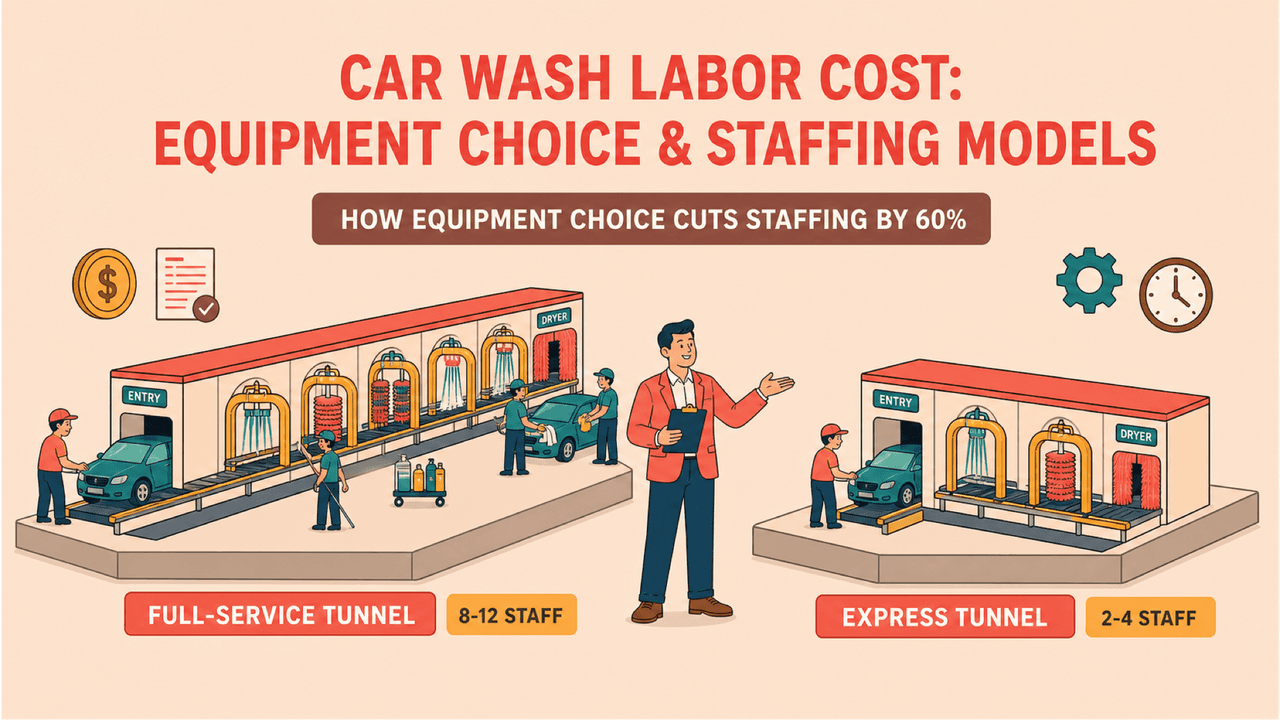
A site staffed for full-service hand-detail carries 8-12 people per shift. An express tunnel runs on 2-4. The difference is roughly 60% of payroll, locked in the day you choose your equipment — long before you post a single job ad. This guide walks through the staff-per-throughput math by business model, the equipment features that genuinely reduce headcount, and an honest framework for when automation actually pays back.
What Car Wash Labor Cost Actually Looks Like by Model
Industry sources consistently name labor as the single biggest operational challenge facing car wash operators in 2026. Wage inflation, hiring difficulty, and turnover are structural — widening as the U.S. Bureau of Labor Statistics tracks rising wages in the personal services category faster than most operators can pass through to ticket prices.
But "labor is hard" is the surface diagnosis. The deeper one: labor as a percentage of operating cost varies by 4x across business models, and the variation is structural.
Business model | Labor as % of operating cost |
|---|---|
Full-service tunnel (towel-dry, interior detail) | 35-50% |
Express exterior tunnel | 25-30% |
In-bay automatic (IBA) at fuel station | 15-25% |
Self-service rollover (cashless / unmanned) | 10-15% |
A full-service wash is a labor business that happens to use machines. An unmanned self-service rollover is an equipment business that happens to need a maintenance technician once a week. Two operators can run washes a block apart at the same ticket price and volume — and one will spend three times as much on payroll. The difference is configuration, not management.
Equipment choice is a labor-cost lever long before staffing tactics are. You cannot optimize a full-service business model down to express staffing without changing the equipment behind it.
Staff-per-Throughput by Business Model: The Numbers That Actually Matter
Here is the planning grid most "labor cost" articles never put in writing — staff per shift by system type, paired with the throughput each model is engineered to deliver.
Business model | Throughput (cars/hr) | Staff per shift | HyTian product reference |
|---|---|---|---|
Full-service tunnel (with hand-detail) | 30-60 | 8-12 | Tunnel + adjacent detail bay |
Express exterior tunnel | 50-100 | 2-4 | TX-380 tunnel system |
In-bay automatic (IBA) | 8-20 | 0-1 | XL-200 rollover |
Self-service rollover (cashless) | 5-20 | 0 | XL-200NET unmanned rollover |
Touchless premium / unmanned | 8-15 | 0-1 | MY-385 touchless |
Drive-through fleet (bus/truck) | 40-80 | 1-2 | TH-350 drive-through bus wash |
Let's walk row by row, because each one represents a structurally different labor model.
Full-Service Tunnels: The Labor-Heavy Baseline
Full-service is the original car wash business model — towel-dry, interior vacuum, sometimes hand-detail. It produces the highest ticket average, and in dense urban markets with the right local labor pool it remains profitable. But it carries 8-12 staff per shift across loader, prep crew, finish crew, and floor supervisor. At $20/hour fully loaded, that is $480-720 per 8-hour shift in payroll alone, before benefits or turnover cost.
If your market cannot reliably staff 10 people on a Saturday morning, this model is structurally wrong regardless of demand.
Express Exterior Tunnels: The 60% Staffing Reduction
Express exterior is the model that built the modern multi-site chains. It abandons towel-dry and interior detail in favor of high-throughput, exterior-only washing — and the staffing model collapses to 2-4 people per shift: a loader, an attendant managing lobby and pay station, and a floor supervisor splitting time across both. At equivalent volume, that is roughly a 60% headcount reduction versus full-service.
The TX-380 tunnel system is engineered for this model: 50-60 vehicles per hour with a full-plate entry guide that removes loader misalignment delays, VFD conveyor speed control that adapts to each vehicle without operator override, and CNC chemical metering pumps with 0.28 mL precision that extend a 20 kg drum to roughly 3,000 washes — meaning your staff are not swapping drums during peak hours.
For the cars-per-hour mechanics behind these numbers, see our breakdown of throughput optimization tactics.
In-Bay Automatic at Fuel Stations: The Attendant-Only Model
An IBA at a gas station is the simplest labor model in the industry. The site already has a cashier for fuel sales. The bay runs on its own — vehicle drives in, sensor triggers the cycle, rollover does its work, vehicle drives out. Effective wash-specific staffing: 0 to 1 per shift depending on how you allocate the cashier's time.
Throughput is lower (8-20 vehicles per hour) because you are running serial cycles in one bay, but labor as a share of revenue often beats high-volume tunnels because there is no incremental labor cost.
Self-Service Rollover: The Genuinely Unmanned Model
Self-service is where the labor model collapses to zero on-site staff for most operating hours. The XL-200NET rollover was designed for exactly this configuration — cashless scan-to-start payment that removes the cashier, cloud management with remote diagnostics that lets a maintenance technician troubleshoot from a laptop, auto-drain for cold-weather sites, and a 5-brush plus 4×5.5 kW dryer config running on 380V/17 kW. Throughput is 15-20 vehicles per hour, but the operating model assumes a single technician visiting once or twice per week — not a person on-site daily.
This is the model that makes sense in low-density rural markets, cold-weather states with seasonal demand, and any site where the local labor pool is too thin to staff a full-time attendant.
Touchless Premium: Brush-Free, Often Unmanned
The MY-385 touchless system delivers premium positioning without paint contact — 120 L/min at 1000 psi, brush-free wash with high-pressure water and staged detergents on a 380V/35 kW pump array (2×15 kW). Paint-safe positioning appeals to operators serving luxury and EV segments. Operationally, it staffs like a self-service rollover: 0-1 attendant, with the higher ticket price absorbing the higher capex.
Drive-Through Fleet Wash: 80 Buses, 1-2 Operators
The drive-through bus wash carries the highest staff-to-vehicle leverage in the equipment category. The TH-350 processes 40-80 buses per hour on 12 kW with Mitsubishi PLC control, staffed by 1-2 operators directing traffic. At Zhuhai Public Transport Group's bus depot, the TH-Series scales to 80 buses per hour at peak — converting what used to be a 6-person hand-wash crew into a 2-person flow operation.
The Equipment Features That Actually Reduce Headcount
The staffing differential between models is structural, but inside each model the equipment specification still moves the needle. Here is what we look for when an operator asks how to reduce car wash labor without changing the underlying business model.
Loading-zone automation. A full-plate entry guide (standard on the TX-380) removes loader misalignment delays — the most common reason an express tunnel "stops the line" mid-shift. Treadle triggers and license-plate-recognition entry let one loader handle higher cadence than two loaders did a decade ago.
Cashless / scan-to-start payment. This single feature eliminates the cashier role. The XL-200NET is built around it — the driver pays at the bay panel with no human transaction. For self-service and IBA models, this is what makes the unmanned configuration possible.
VFD conveyor and automatic vehicle profiling. A variable frequency drive lets the conveyor adapt speed to each vehicle without operator override. Combined with vehicle profiling sensors, it is the difference between a tunnel that runs cleanly with a single floor supervisor and one that needs a second body managing exceptions.
CNC chemical metering pumps. The TX-380's CNC pumps dose at 0.28 mL precision — a 20 kg drum lasts roughly 3,000 washes. Your staff are not changing drums during peak hours, and chemical cost stays predictable instead of bleeding through over-dosed cycles.
Cloud management and remote diagnostics. Self-service rollover with cloud management lets a maintenance technician respond to faults from a laptop instead of driving to the site. For a multi-site chain, this is where maintenance-headcount savings live — three sites covered by one tech instead of three.
Auto-drain and freeze protection. Cold-weather sites no longer need an operator to winterize the bay at end of shift. The system runs the drain cycle on its own.
The caveat competitor content rarely puts in writing: each feature reduces a specific labor task. A site running full-service hand-detail will not collapse to a 2-person staffing model just because the tunnel auto-doses chemicals — the labor savings is bounded by the business model the equipment is wired into.
The proof point is BYD's standardized factory PDI wash: TX-380 systems handle 60 cars per hour through the production line, replacing a variable manual process with a consistent equipment-driven workflow. The labor cost did not just go down — it became predictable, which is what BYD needed for production planning.
When Car Wash Labor Cost Savings Pay Back the Capex
Automation features carry capex. The honest framing — the one operators trust — is that below a throughput threshold the math does not pay back in a reasonable timeline.
A rough breakeven: a feature that saves 0.5 staff-shifts per day at $20/hour × 8 hours × 360 operating days equals roughly $28,800 per year in payroll savings. That pays back an equipment delta of $80-100K within 3-4 years on a high-volume site. On a low-volume site running 30 vehicles per day, the same feature might take 8-10 years — at which point most operators would rather absorb the manual labor.
The math flips for genuinely unmanned models. A self-service rollover carries higher capex per bay than a basic IBA, but $0 in front-of-house staff cost over a 5-year hold can flip the lifetime ROI for low-volume sites where the labor pool is too thin to support an attendant. In those markets, the question is not "can I afford the equipment?" — it is "can I find the staff at any wage?"
Multi-site operators see automation savings at a different layer. The XL-200NET's cloud diagnostics and remote management deliver savings at the maintenance-headcount layer rather than the front-of-house layer. One technician covering five unmanned sites is a different operating model than five attendants covering five manned sites — and the equipment is what makes it viable.
For the math behind these scenarios, see the full payback framework. For the broader operating-cost context, see our operating cost breakdown by business model.
We have deployed 20,000+ systems across 40+ countries, covering every model above. The pattern is consistent: operators who treat equipment selection as a labor-model decision keep their payroll math working five years in. Operators who treat equipment and staffing as separate decisions end up understaffed every Saturday.
How to Plan the Labor Model From Day One
Most labor problems start as equipment problems. Here is the decision sequence that prevents that.
Step 1 — Define your menu and target ticket. Express exterior at $9-15. Full-service at $25-40. Premium touchless at $20-30. Self-service at $5-12. Your menu sets revenue per car, which sets throughput target, which sets equipment options.
Step 2 — Site footprint and throughput target. A 30-meter lot supports an express tunnel. A 6-meter bay supports an IBA or self-service rollover. The footprint constrains the equipment, the equipment constrains the throughput.
Step 3 — Choose the system type, knowing it sets the staff load. This is the step most first-time operators skip. They pick equipment on cost or aesthetics, then discover at commissioning that it requires a staffing model their local labor market cannot sustain. Use the staff-per-shift table above as your check. If you cannot reliably staff that headcount on a Saturday, the equipment is wrong — not the team.
Step 4 — Design the staffing model. Roles, shifts, training, retention. This belongs at the end because it is downstream of everything else.
A pattern that works well: an express tunnel running 2-4 staff for high-volume exterior throughput, paired with a separate detail bay that scales independently. Express line carries the volume. Detail bay carries the higher-margin upsell. Each runs its own staffing model.
Splash N Go exported the express tunnel concept into the Japanese market — a market dominated by compact gantry systems — and proved that 500+ daily washes are achievable on the lean staffing model the TX-380 was built for. The staffing model that works in your market is the one your equipment is engineered to support.
Key Takeaways
- Labor cost is structural. It is set by the business model the equipment supports, not by the wages you negotiate. Express tunnels run 60% leaner than full-service tunnels at equivalent volume.
- The equipment specification matters within each model. Full-plate entry guides, VFD conveyors, CNC metering pumps, cashless payment, and cloud diagnostics each remove a specific labor task. Stack them and the model gets leaner. Skip them and you carry redundant headcount.
- Self-service and unmanned models flip the math for low-volume markets. When the local labor pool cannot sustain an attendant at any wage, $0 front-of-house staff cost becomes the only viable model — and the XL-200NET-class rollover is what enables it.
- Decide equipment before staffing. Menu → footprint → equipment → staffing. Skip steps and the labor model becomes a constraint you cannot back out of without a capital event.
Talk to Us About Your Specific Configuration
Trying to figure out which staffing model your next site can actually sustain — and which equipment configuration gets you there? Our engineering team can walk through your site footprint, target throughput, and local labor reality, then map that to the right system type. Talk to our engineering team about the configuration that fits the staffing model you can actually staff.
Related articles
Explore more insights from the HyTian team.
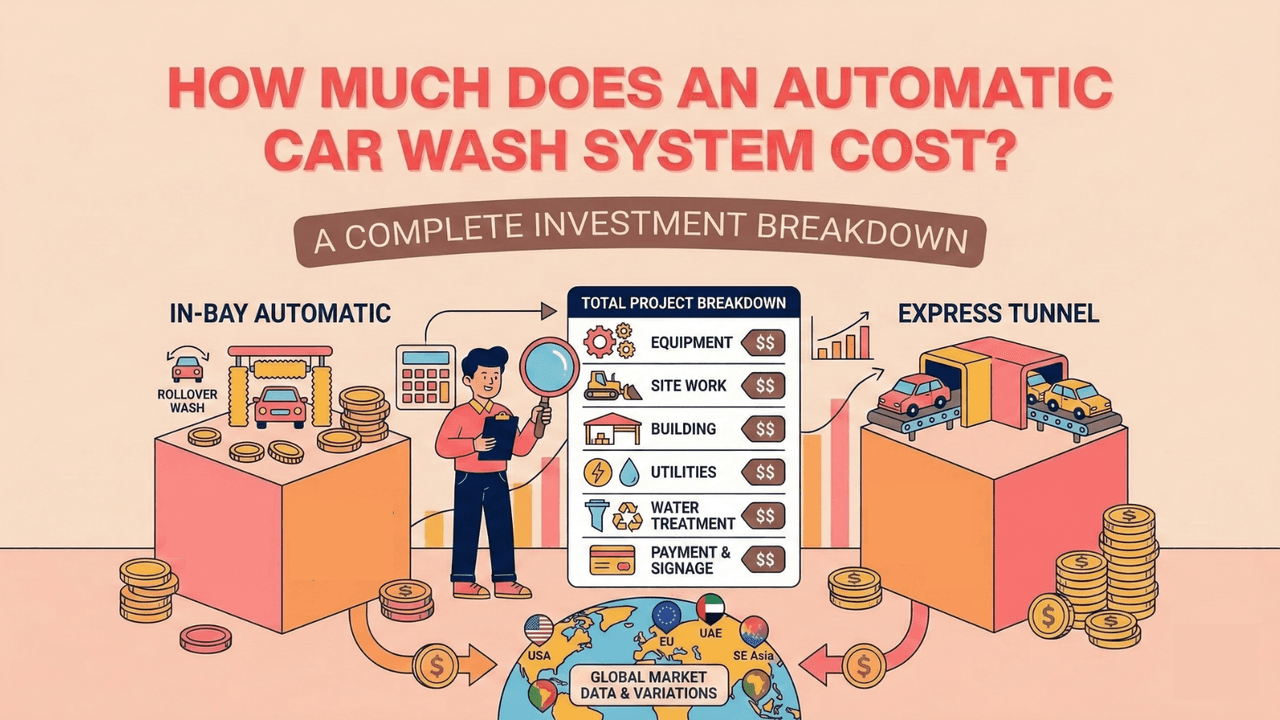
How Much Does an Automatic Car Wash System Cost? A Complete Investment Breakdown
Automatic car wash system costs range from $15,000 to $350,000+ for equipment alone. Here's what drives the price, what the total investment looks like, and how to compare quotes.
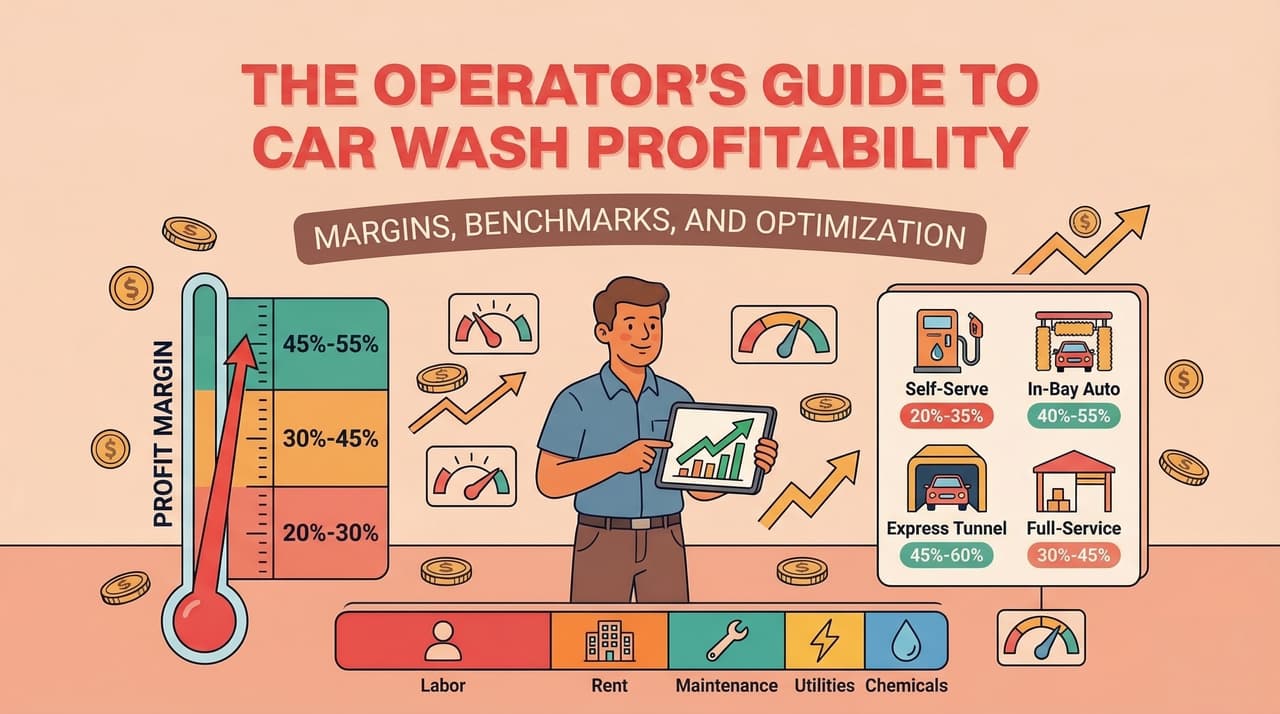
The Operator's Guide to Car Wash Profitability: Margins, Benchmarks, and Optimization
Car wash profit margins range 20–55% by business model. See realistic benchmarks, operating cost breakdowns, and five optimization levers operators control.
Car Wash Membership for Auto Service Shops: How Wash Packages Increase Retention and CSI
Learn how service shops use wash packages and memberships to boost repeat visits, improve delivery experience, and build predictable revenue—with the right equipment setup.