
Car Wash Water Recycling in South Africa: Regulation, System Cost & Equipment Fit
Car Wash Water Recycling in South Africa: Regulation, System Cost & Equipment Fit
If you're pricing out a water-recycling system for a South African car wash, you're probably asking two questions at once: what's actually required, and what does it cost. Neither has a single clean answer. South Africa doesn't regulate car wash water through one national rule. It regulates through a stack — national licensing, municipal by-laws, and drought-tier restrictions that can tighten fast.
The market behind that question is real. South Africa counted 3,765 car washes as of April 2026, a 4.48% increase over 2023, with Gauteng alone holding 54.32% of that total. The sector is projected to keep growing at more than 5.5% annually through 2029.
This article works through the regulatory structure that actually binds a site, what genuinely drives water-recycling system cost, and how to size equipment to your local water risk. For the mechanics of how a recycling system actually filters and reclaims water — the treatment stages, the payback math — start with our guide to car wash water recycling system cost and compliance. This piece picks up where that one leaves off, on the ground in South Africa.
How South Africa's Water Rules Actually Reach a Car Wash
Two layers apply before drought restrictions ever enter the picture. At the national level, the National Water Act 36 of 1998 requires a water use to be licensed, unless it falls under a General Authorisation, an existing lawful use, or a narrow Schedule 1 exemption. Discharging wastewater or effluent into a water resource is one of the uses this framework governs. That puts a wash's discharge line, not just its intake, inside the regulatory picture.
Municipal by-laws sit on top of that national layer, and they vary by council. The common pattern requires an operator to prevent contamination of the water supply. It also gives the municipality authority to restrict a business by public notice if its water use is judged wasteful during a shortage — a structure illustrated in Mangaung Municipality's car wash guidance. Some councils go further and publish dedicated car-wash by-laws; Limpopo's Collins Chabane Local Municipality adopted one in 2019, evidence that stand-alone local rules exist and that checking your own council is worth the effort.
Then there's the layer that makes South Africa's situation genuinely distinct: drought-emergency restriction levels, with a real precedent for how far they can go. During Cape Town's 2018 "Day Zero" crisis, the city's Level 3 restrictions let commercial car washes keep using municipal drinking water only if they met industry best-practice conservation norms and recycled at least 50% of the water used. Two months earlier, Level 6B restrictions had gone further still: no washing of vehicles with municipal drinking water at all, formal or informal — non-potable water, waterless products, or dry-steam cleaning only. Enforcement wasn't theoretical: in March 2018, city law enforcement ran blitz inspections across informal washes in Belhar, Delft, and Khayelitsha, confiscating hose pipes and drums from operators who couldn't show an approved alternative water source.
The takeaway isn't a fixed rule you can memorize. It's that the rules move, and they've moved fast before. Verify your municipality's current by-law and restriction level directly rather than relying on a generic checklist.
Gauteng's Pipes vs. the Western Cape's Dams
The two provinces that matter most here face genuinely different water risks, which is part of why South Africa has no single answer to "is recycling required." Gauteng holds the majority of the country's car washes, and its exposure is supply-infrastructure, not drought policy. Rand Water's bulk allocation to Johannesburg Water was cut in phases from an average 1,801 megalitres a day down to 1,600 in December 2024, 1,500 in February 2025, and 1,356 megalitres a day by September 2025, after a licence application to increase Vaal River extraction wasn't approved — a shortfall compounded by drought and unpredictable rainfall.
The Western Cape carries the restriction-tier history described above. Different mechanisms, same conclusion for an operator: treat municipal water as a variable you plan around, not a constant you can assume. It's the same conclusion we reached covering Australia's state-by-state water-scarcity rules and Germany, the Netherlands, and the EU's water-recycling regulations — the mechanism differs by region, but the operating advice doesn't.
What Actually Drives the Cost of a Water-Recycling System in South Africa
There's no single honest number for what a system costs. Cost is a function of treatment depth matched to your wash volume and your site's restriction-level exposure — a compact rollover recovering a modest share of its wash water is a different project than a high-throughput site running near-closed-loop recovery. A few variables specific to South Africa deserve more weight than a generic global cost guide gives them.
Imported equipment carries freight, import duty, and rand exchange-rate exposure on top of the base system price. Designing recycling in at commissioning, rather than adding it later, avoids a second disruptive project — a bigger factor where import and commissioning lead times run longer than a domestic supplier's. And where restriction levels push a site toward borehole or greywater sourcing, that source is its own capital line item, separate from the treatment system itself.
None of that is theoretical for South Africa specifically. eWasha, a South African wash-bay water-recycling installer running more than 150 plants across South Africa, Botswana, and Mozambique, reports cutting municipal water use by up to 90% at its King Shaka International Airport installations — a site washing 1,250 vehicles a day for Europcar, Budget, First Car, and Hertz. It runs similar systems at Cape Town International Airport (750 vehicles daily) and a Jet Park, Johannesburg site (1,000 vehicles daily). Recycling at commercial scale is already proven and financeable in this market.
Given that range, the more useful question for a supplier isn't "what does a system cost." It's three narrower ones: what treatment depth does your restriction-level exposure actually require, is the system sized for build-in or for a later retrofit, and what does after-sales and parts support look like for equipment you're importing. Our broader system cost breakdown and guide to evaluating an equipment manufacturer cover the surrounding decision if you're pricing a full site, not just the recycling loop. Our piece on sustainability as a procurement lever covers water reclamation alongside energy and chemical dosing as verifiable specification points.
Matching Recycling Depth to Your Site
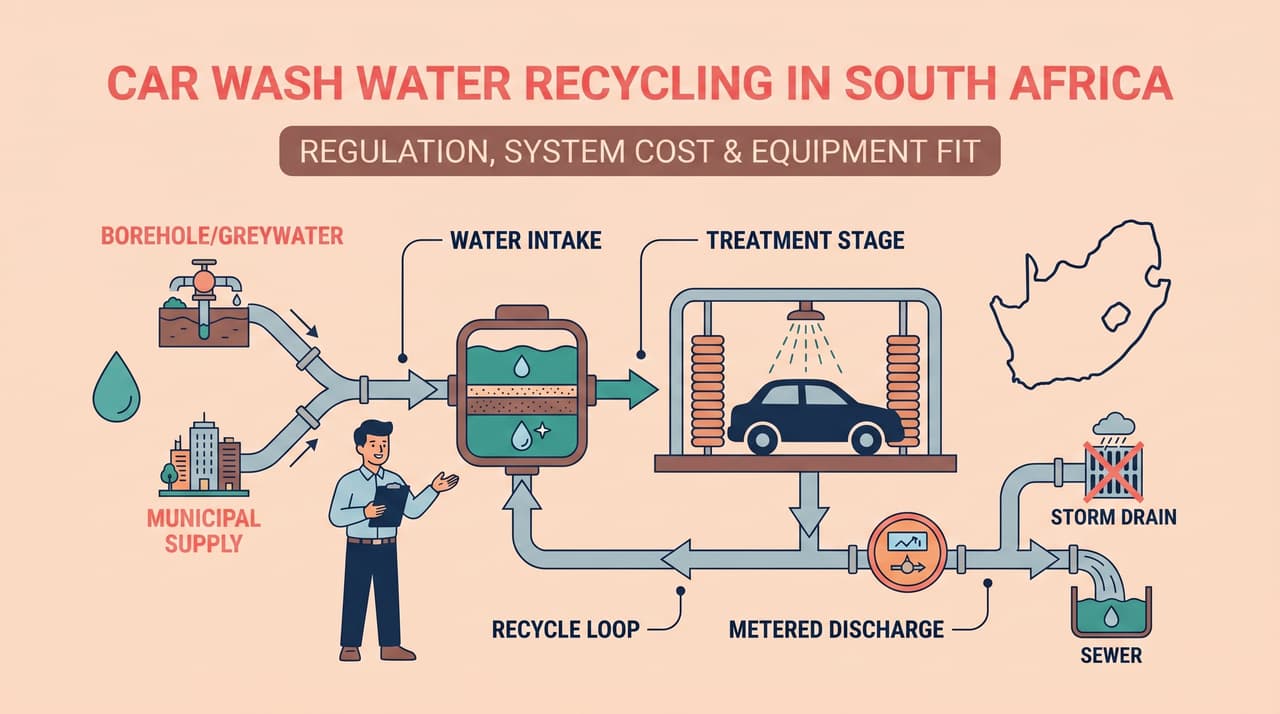
Strip away the branding, and a compliant recycling setup shares the same basic anatomy everywhere. An intake — municipal supply, or a blended borehole/greywater source where your restriction level requires one — feeds a treatment stage sized to your wash's throughput. A recycle loop returns treated water to the wash bay. A discharge line, separately metered, routes to the sewer rather than stormwater, matching the by-law pattern described earlier.
The same build-versus-retrofit logic from the cost section applies here in physical form. A system designed into the site plan at commissioning gets sized to actual throughput and plumbed correctly the first time. One retrofitted onto pipework that was never designed for it typically runs less efficiently, and costs more to install, than the same capability specified up front.
A Manufacturer's View: Water Recycling Built Into the Platform
Water recycling isn't a feature we bolt onto a system after the fact — it's a configuration decision made at the design stage. The TX-380 tunnel platform supports recycling as a standard configuration option, and the TH-Series drive-through bus washer ships with an integrated recycling system as standard, not an add-on. Across our rollover, tunnel, and bus/truck lines, the same class of sewage-purification treatment module scales from 4 to 10 tonnes of treatment capacity an hour, matched to site throughput.
We'll be direct about where we stand geographically: HyTian doesn't have a South African entity, distributor, or installed base today. What we do have is a genuine Zambia subsidiary, giving us real African operating and service experience rather than a cold start. That experience sits alongside ISO 14001 environmental management certification, CE conformity, and over three decades of continuous manufacturing since 1992.
Sizing a water-recycling system for a South African site? Our engineering team can walk through treatment depth, import and commissioning logistics, and how our African deployment experience informs what actually works on the ground — talk to us about your configuration.
Key Takeaways
South Africa regulates car wash water through three stacked layers: national licensing under the National Water Act, municipal by-laws that vary by council, and drought-emergency restriction levels that can tighten within weeks.
Cape Town's 2018 Day Zero crisis set a real precedent: a 50% recycling threshold at Level 3, a full municipal-water ban on vehicle washing at Level 6B, with active enforcement.
Gauteng and the Western Cape face different water risks — supply-infrastructure cuts in one, drought-tier history in the other — so there's no single national answer to "do I need this."
System cost is driven by treatment depth, import and currency exposure, and build-versus-retrofit timing, not a single published number; real South African installations already prove recycling works at scale.
Designing recycling in at commissioning beats retrofitting it later. Every compliant setup shares the same anatomy: alternative or blended intake, sized treatment stage, recycle loop, and separately metered sewer discharge.
Frequently Asked Questions
Is water recycling required for car washes in South Africa?
There's no single national mandate. Requirements depend on your municipality's by-law and the current drought-restriction level in your area. During Cape Town's Day Zero crisis, Level 3 restrictions required commercial car washes to recycle at least 50% of water used to keep municipal water access, while Level 6B removed municipal water access for vehicle washing entirely. Check your local municipality directly, since levels and thresholds change.
How much does a car wash water recycling system cost in South Africa?
Cost depends on treatment depth matched to your wash volume and restriction-level exposure, plus South Africa-specific variables like import duty, rand exchange-rate exposure, and whether a borehole or greywater source needs developing alongside the treatment system. Real installations already operate at scale in South Africa — eWasha reports up to 90% municipal water reduction across more than 150 plants — so ask a supplier for a site-specific quote rather than a single generic figure.
What happened to car washes during Cape Town's Day Zero water crisis?
Restrictions tightened in stages as dam levels fell. At Level 6B, from February 2018, no vehicle washing with municipal drinking water was allowed at all, and enforcement included blitz inspections that confiscated equipment from informal washes without an approved alternative water source. Commercial washes that met conservation norms and recycled at least half their water were later permitted to keep using municipal supply under Level 3.
Can a car wash use borehole or greywater instead of municipal water in South Africa?
Yes, and it's often the practical compliance path once restriction levels tighten — Cape Town's Level 6B specifically allowed non-drinking water sources for vehicle washing when municipal water was off the table. A borehole or greywater intake still needs to feed a properly metered system with discharge routed to the sewer rather than stormwater, matching the same by-law structure that governs municipal-water setups.