
Inside Car Wash Control Systems: How PLCs Sequence a Reliable Wash
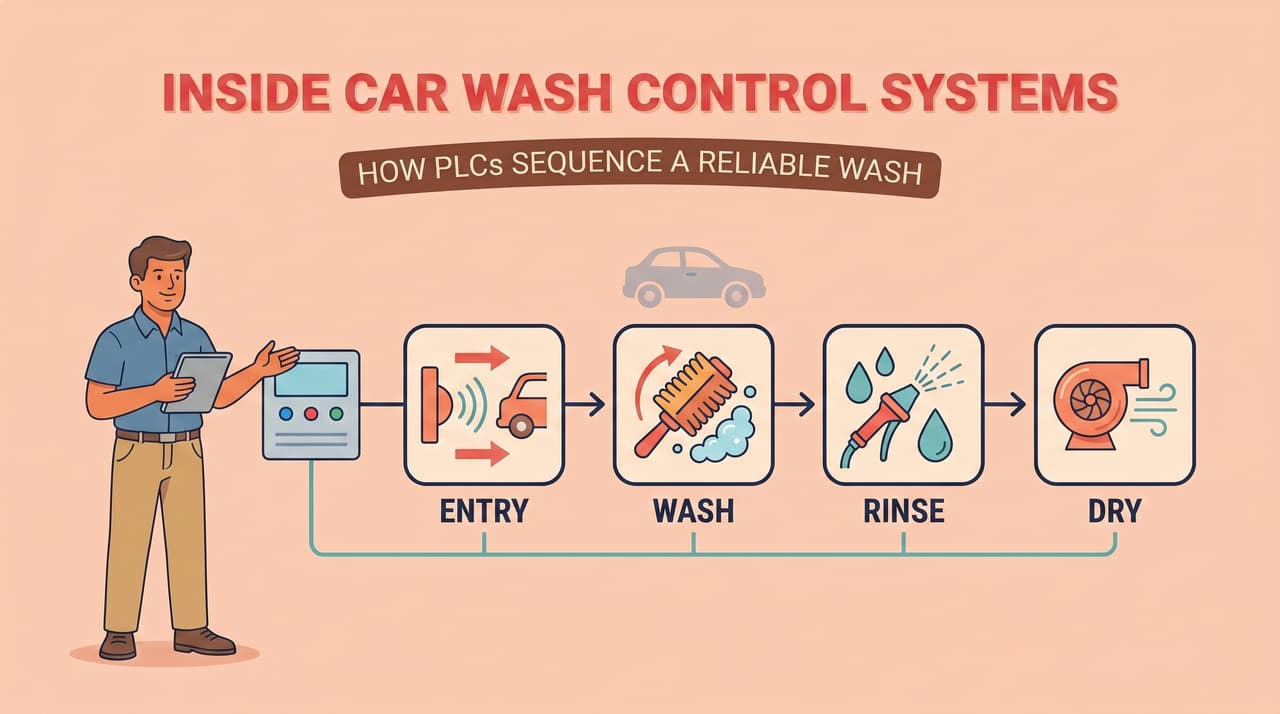
Inside Car Wash Control Systems: How PLCs Sequence a Reliable Wash
Every equipment spec sheet you read this year will mention a "PLC-controlled" or "fully automated" wash system. Almost none of them explain what that claim actually means. It gets listed the same way as stainless steel or high-pressure pumps — a checkbox, not an argument. That's a gap, because the control system often decides whether a wash runs reliably at volume or strands a vehicle mid-cycle.
This article is the plain-engineering explanation behind that checkbox: what a car wash PLC control system does, how it sequences a wash, and what a safety interlock protects against. It also covers what sensors feed the controller. The engineering applies to any manufacturer's PLC-controlled equipment. Where useful, we've grounded it in real HyTian products that document this control layer — evidence the explanation isn't hypothetical, not a sales pitch.
What a Car Wash PLC Control System Actually Does
A programmable logic controller is an industrial computer built to run one job continuously. It reads a set of inputs, evaluates a program against them, and sets a set of outputs, then repeats at high speed. Wikipedia's overview of the technology describes the basic loop in three steps: read inputs, execute the program, write outputs. A full cycle typically takes tens of milliseconds, which is what lets the controller react to what's actually happening in the bay, scan after scan.
Compare that to a simple timer-based controller, still found on older or simpler equipment. A timer runs a prewash for a set number of seconds, then a brush cycle, then a rinse. It does this regardless of whether the vehicle is actually positioned correctly, or whether anything went wrong upstream. A PLC's logic checks real conditions before it advances: has the vehicle reached the sensor marking this stage's start?
If a confirmation signal hasn't come back, the program can hold, retry, or fault out instead of pressing forward blind. The program itself is usually written and displayed as ladder logic. That layout deliberately resembles old relay-wiring diagrams, with horizontal "rungs" representing conditions that must be true before an output turns on. Ladder logic has stayed dominant for decades because it runs the same predictable sequence every scan.
For you as an operator, that predictability matters practically. A competent technician can read the sequence, find the exact rung holding a stage, and diagnose a fault without guesswork — something a black-box timer relay can't offer.
What does "PLC-controlled" mean for a car wash? It means the wash cycle is governed by a programmable controller that reads sensor inputs — vehicle position, water pressure, motor status. The controller only advances to the next stage once the condition it's waiting for is confirmed true, not after a fixed amount of time has simply elapsed.
How a PLC Sequences a Wash Cycle
The general pattern holds across PLC-controlled wash systems, regardless of manufacturer. An entry sensor detects the vehicle and starts the program. Each subsequent stage — prewash, brush or soft-contact wash, rinse, dry — is gated by its own sensor confirmation rather than a blind timer. The controller only moves the vehicle, or moves equipment around the vehicle, when the position it expects is the position it actually has.
HyTian's own product line documents this control layer on specific, shipped equipment rather than as a generic claim. The Drive-Through Bus Wash TH-350 and the Roller Wheel Wash DCX-100G both name Mitsubishi PLC control among their differentiators. That's not a small claim for the TH-350: the system runs at Zhuhai Public Transport's transit depots, handling up to 80 buses per hour at peak.
A throughput figure like that only holds up if sequencing between vehicles is sensor-confirmed rather than timer-guessed. Push a fixed-timer system to that pace and it will eventually stage a vehicle that isn't ready and jam the line.
Not every HyTian system shares the same named control architecture, and it's worth saying so plainly. The flagship TX-380 tunnel line lists variable-frequency-drive (VFD) speed control for its conveyor, not PLC, as its named control technology. It's a different tool solving a different problem — modulating conveyor speed rather than gating discrete stages. Manufacturers mix control technologies across a product line for good engineering reasons, and a spec sheet implying uniform architecture across an entire catalog is usually oversimplifying.
HyTian's engineered-to-order Custom-Made systems go a step further, pairing PLC control with license-plate recognition so a wash program can target a specific vehicle instead of running generically. That same custom-engineering category produced a wash-and-dry system built for a Bolivia light-rail operator — trams with identical, streamlined front and rear ends that standard equipment couldn't accommodate.
The system runs two distinct control modes. For the complex nose sections, the vehicle stays stationary while the machine moves around it. For the regular body section, the tram instead moves through at low speed while the machine stays fixed. Choosing between those two modes mid-cycle is exactly the kind of decision that separates a real control system from a fixed script.
The PLC's Eyes: Sensors That Drive the Sequence
None of this works without sensors — a PLC's logic is only as good as the inputs feeding it. Strip away the sensors and you're left with a controller that has nothing to sequence against but a clock, the fixed-timer problem all over again. Banner Engineering's overview of car wash vehicle-detection technology frames the job simply: verify the vehicle is correctly positioned, monitor traffic flow through the wash, and trigger the next step. That next step might be opening a door or releasing the next vehicle into the bay.
Two sensor technologies dominate this application. Photoelectric sensors use a light beam to detect presence or position, and are common at entry points and stage boundaries. Magnetometer or inductive-loop sensors instead detect a vehicle's mass and ferrous content, useful for in-ground positioning where a light beam isn't practical. Either way, the sensor's job is the same: hand the PLC a true-or-false condition it can act on.
A wash bay is a genuinely hostile environment for electronics — mist, spray, temperature swings, and constant motion. That's why sensors built for this application carry high ingress-protection ratings. Photoelectric models often use infrared wavelengths specifically chosen to read through mist and steam rather than lose the signal in it. It's a small detail that matters: a sensor that drops out under spray doesn't just miss one reading, it stalls the whole sequence behind it.
How does a car wash system know a vehicle is in position? Vehicle-detection sensors — typically photoelectric or magnetometer-based — confirm presence and position at each stage boundary and feed that confirmation to the PLC. The controller only advances the sequence once the expected position is verified.
Safety Interlocks: What Stops the Sequence When Something's Wrong
A safety interlock is logic, or a physical device, that blocks a hazardous machine function from running until a specific safe condition is confirmed. In a wash bay, a common example is a bay-door sensor. If the door is open, the interlock holds the program at its current stage, or blocks the next stage from starting, until the sensor confirms the door is closed. The interlock doesn't just warn you; it physically prevents the next action.
The engineering discipline behind this is well established. ISO 13849-1 is the international standard governing safety-related parts of machine control systems. It defines a graduated set of safety categories based on how much fault tolerance a given interlock design provides, and it's the benchmark manufacturers design against industry-wide.
Worth noting plainly: HyTian's certifications on record are ISO 9001, ISO 14001, and CE. We're citing the ISO standard here as context for how the industry approaches interlock design, not as a specific certification claim for any one HyTian product.
At the PLC level, failsafe behavior follows the same read-decide-act loop described earlier. On a sensor fault, an out-of-sequence signal, or an emergency-stop input, the program can halt the sequence at its current stage rather than continue forward on a guess. That's what actually sits behind a claim like "automated safety interlocks" on a spec sheet — a specific, testable behavior, not a vague promise.
Dedicated safety PLCs handle exactly this kind of function, managing responses like the shutdown triggered by an emergency-stop button on a production line. That safety logic stays logically separate from the process logic running the rest of the sequence.
What happens if a sensor fails mid-cycle? In a properly interlocked system, a sensor fault or an out-of-sequence signal halts the program at its current stage rather than letting it advance blind. The wash stops in a safe state instead of continuing on an assumption.
Where PLC Control Fits Next to AI and IoT
It's worth placing PLC control against the other technology conversation happening in this industry right now: AI-powered features, IoT and remote monitoring, and robotic and touchless systems. A PLC executes fixed, predictable logic — the same rung, the same order, every scan. AI and IoT features generally sit on top of that foundation. They read the PLC's data for predictive maintenance, extend its logic with vehicle-profile recognition, or expose its status to a remote dashboard.
That distinction is useful when evaluating a vendor's technology claims. Advanced or "smart" marketing language usually describes what's layered on top of a PLC's sequencing, not a replacement for it. The deterministic control layer still does the actual work of running the wash safely and predictably. Understanding that layering makes it easier to ask a sharper question than "is it smart" — namely, what governs the sequence itself, and what sits above it.
Key Takeaways
"PLC-controlled" is a specific engineering claim, not a marketing word — a wash governed by a programmable controller that reads sensor inputs and advances stages only when confirmed, not on a fixed timer.
Sensor-gated sequencing scales better than timers — throughput claims, like 80 buses per hour, only hold up when the controller confirms position instead of guessing.
An interlock is a physical or logical block, not just a warning — it prevents the next stage from starting until a safe condition is confirmed true.
Ask manufacturers what specifically governs sequencing and safety on the equipment you're evaluating — not whether it's "automated," but what the control architecture actually does and where it applies.
A Manufacturer's View: Control Architecture Is Worth Asking About
HyTian has documented this control layer on real, shipped equipment: Mitsubishi PLC control on the TH-350 and DCX-100G, PLC paired with license-plate recognition on the Custom-Made line. That's not a universal claim across the catalog, and we've said so above where it doesn't apply. That candor is itself part of the answer to the question this piece opened with. A spec sheet that names its control architecture, and is specific about where it applies, tells you more than one that just says "automated."
HyTian brings 30+ years of manufacturing experience to that candor, since 1992, building and supporting wash systems across a range of control architectures in the field. Curious what's actually running the sequence on the equipment you're evaluating, HyTian's or anyone else's? Talk with our engineering team about what governs sequencing and safety on the systems you're comparing.