
Robotic Car Wash Systems in 2026: What the Term Actually Means — and Where It Fits
Robotic Car Wash Systems in 2026: What the Term Actually Means — and Where It Fits
"Robotic" has become the loudest word in car wash equipment marketing this year. It's the framing on launch press releases, trade-press features, and equipment-show panels — and it's being used loosely enough that operators reading the coverage end up with three different mental models depending on which article they read last.
This is a manufacturer's honest read on what robotic car wash systems are in 2026 industry vocabulary, where they're working today, what the operator-economics math looks like, and how the trend fits the broader automated wash category that still does most of the cleaning. Not a product pitch. An analyst's view from a team that engineers automated wash systems and watches the robotic conversation closely.
Why "robotic car wash" became the loudest word in 2026
The signal is real. PREEN Technologies has commissioned six-axis robotic-arm wash bays in Germany, Dubai, and the UK, and openly markets 3-6 minute cycles, 10-20 vehicles per hour, and up to 50% less energy and water than traditional systems. Sonny's Enterprises launched its Quivio integrated software-and-hardware platform on November 3, 2025, framing the next phase of the category around AI-led automation. Auto Laundry News and CarwashPro have been running "Car Wash Robotics" features almost monthly. Carwash Magazine recently positioned next-gen robotic systems primarily as labor-cost reduction levers in the operator P&L.
The market context matters too. Global car wash services moved through $36.29 billion in 2025 and are projected to reach $54.48 billion by 2033 at a 5.1% CAGR — and "robotics" is the framing that dominates equipment-side coverage of that growth.
The trouble is that the term has been stretched. Six-axis industrial-arm wash bays, AI-overlay software on conveyor tunnels, rollovers with smart controls — all of it gets folded under "robotic" in the same paragraphs. Operators reading those paragraphs end up with the wrong mental model for capex planning. So the first useful thing is to be precise about what robotic means right now.
What "robotic" actually means right now
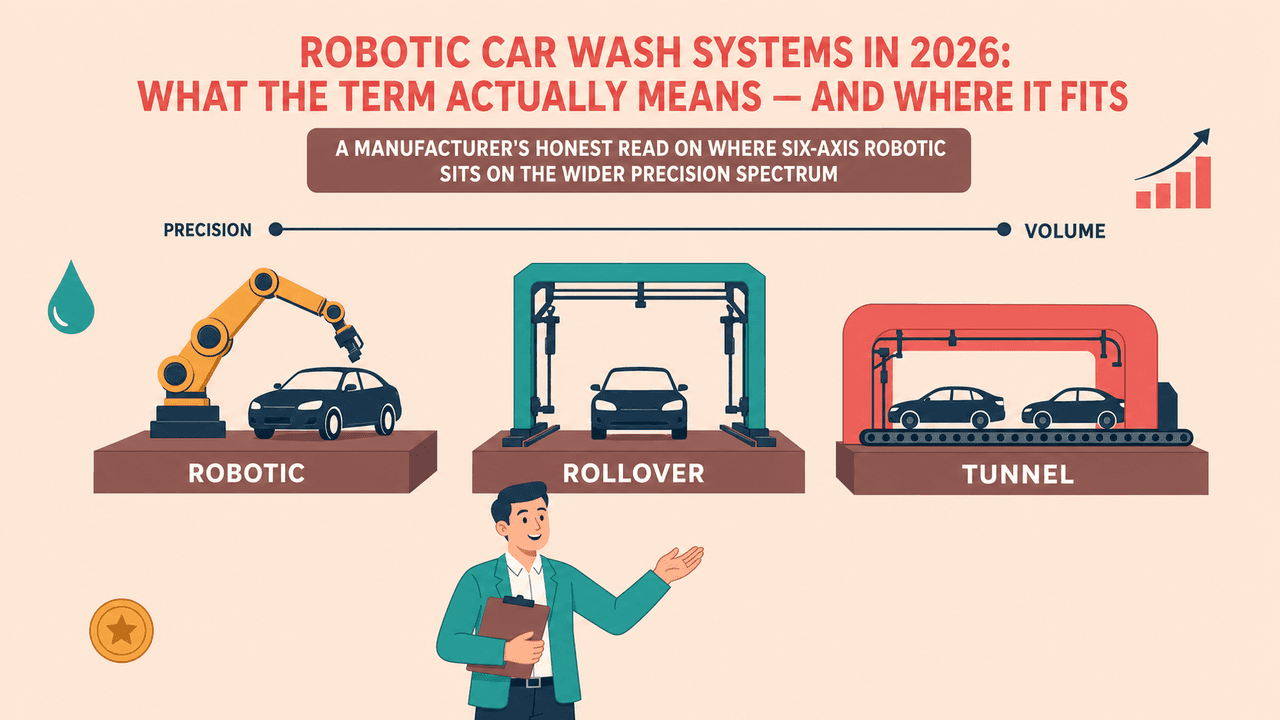
A robotic car wash system, in 2026 industry vocabulary, is a wash bay built around a six-axis industrial manipulator or an articulated robotic platform that orchestrates the wash sequence around a stationary vehicle. The arm moves; the car is parked; the toolhead delivers pressure, foam, rinse, and air on a planned path. PREEN Technologies defines the category commercially today, and Sonny's Quivio is extending the term into software-hardware framing. Both share one thing: no brush contact, by design.
That's the narrow definition. It's worth being equally precise about what robotic is not, because the term gets attached to four adjacent concepts that mean different things to operators.
Not "automated." Automated wash systems are programmable wash equipment orchestrated by PLC or master controller — rollovers, touchless gantries, conveyor tunnels. The category has shipped at scale for decades. In current industry usage, an automated rollover is not a robotic car wash unless it carries six-axis kinematics.
Not "touchless" or "no-touch." That's a contact type, not an automation type. Robotic-arm systems are touchless by design. Plenty of touchless systems are rail-mounted automated gantries that have nothing to do with six-axis robotics. Conflating the two is the most common error in trade-press coverage. See touchless car wash systems for the consumer-format frame.
Not "AI-powered." AI is a software layer — damage detection from a license-plate image, dynamic pricing, predictive maintenance algorithms. It runs on top of any architecture. The marketing word "robotic" sometimes describes the AI layer rather than the mechanical bay. We covered that distinction in AI car wash equipment.
Not "IoT" or "smart." That's a connectivity layer — remote dashboards, alert routing, fleet visibility across multiple sites. It also runs on top of any architecture. We covered that in smart car wash system IoT and remote monitoring.
When we say robotic in this article, we mean six-axis arm and articulated robotic systems — the PREEN-class architecture. The word gets used for any automated wash; we'll use it narrowly because the operator-fit math is different between a robotic-arm system and an automated tunnel.
Where robotic systems are working today (and where they aren't yet)
Adoption is real but narrow. PREEN has shipped commercial deployments in Germany, Dubai, and the United Kingdom. The early-adopter operators tend to share a profile: premium positioning, paint-safety as a brand-defining feature, low-volume sites, and capex headroom to be early on an emerging architecture.
The published specs anchor what the category does. PREEN's robotic-arm bay runs a 3-6 minute cycle with 10-20 vehicles per hour at the upper end. The Mini Tunnel technical specification published by PREEN puts total energy consumption under 1.5 kWh for a 2-minute wash at its Ruemlang test bay. Up to 50% less energy and water versus traditional touchless systems is the vendor utility claim. Treat those as upper bounds — they describe well-tuned operation, not the bottom of the operator-experience distribution.
What robotic does well today is straightforward. Paint safety is absolute — no contact at all, which is the strongest paint-safety profile available in automated wash. Water and energy efficiency is genuinely better than older-generation touchless. The bay reads as visually distinctive to the driver. The architecture fits a premium boutique site cleanly.
What it doesn't do well today is volume. The 10-20 vehicles-per-hour ceiling is the low end of in-bay throughput. A robotic-arm bay at peak doesn't approach the throughput of a 50-60 vehicles-per-hour automated conveyor tunnel, and it doesn't pretend to. The category competes on premium ticket and paint safety, not on volume.
Capex sits at the top of the in-bay band. Six-axis industrial manipulators remain a higher-cost piece of equipment than rail-mounted automated gantries, reflecting lower production volumes and the per-unit cost of an articulated platform. PREEN doesn't publish pricing, but industry coverage places it at the upper end of the touchless-bay capex band.
The operator profile fit today is narrow but clear: premium positioning, high average ticket, brand built on paint safety, low-to-mid volume, capex headroom, and willingness to be early on a category that's still finding its operator math. The profile that doesn't fit yet is also clear: high-volume operators running 300+ vehicles a day, subscription-membership P&L models, and capex-sensitive multi-site operators who need proven payback economics.
The capex and payback math for true robotic
The most-searched question on this category deserves a straight answer.
Robotic car wash cost: 2026 capex band
For in-bay touchless and robotic systems in 2026, the drivegadgethub USA Investment Breakdown puts equipment alone at $15K-$70K, installation at $25K-$90K, and total project at $75K-$300K. Commercial-standard configurations land at $85K-$110K; high-performance smart-system builds run $120K and up. Industrial-arm robotic systems — PREEN-class — sit at the upper end of that band, reflecting lower production volumes and the higher per-unit cost of a six-axis manipulator versus a rail-mounted gantry. For the deeper line-item walk-through that breaks down where each dollar goes, see our automatic car wash system cost breakdown.
The 2-3 year payback claim and what's behind it
The industry-benchmark payback for well-located in-bay touchless and robotic sites is 2-3 years. That number assumes three things: steady daily traffic, a healthy average ticket, and effective peak-hour utilization. Compress any of those inputs and the payback stretches.
Our published ROI methodology puts 20-35% annual ROI and 2-5 year payback for well-run automatic car wash operations. The 2-3 year robotic payback sits inside that range — at the optimistic end, conditional on a site that supports premium ticket and steady utilization. The PREEN 50% utility-savings claim is real but worth sizing in P&L terms. Utility line items — water, sewer, electric — typically run 8-15% of operating cost for in-bay sites. A 50% reduction on a 12% line item is about 6 percentage points of margin. That's meaningful. It's not transformative.
The bigger lever, in operator terms, is throughput times ticket times utilization. A robotic-arm bay clearing a premium ticket at 75% peak-hour utilization can pay back faster than a generic touchless rollover running at low utilization on a value-tier ticket — even with the higher capex. Architecture choice is a strategic decision tied to brand and site selection. Payback is an operations decision tied to traffic and pricing discipline.
What this trend means for the broader automated wash category
The operator's real question is whether the existence of true robotic should change anything in a current automated wash program. For most operators today, the answer is no — and the reasoning is in the numbers. For the wider set of shifts shaping equipment decisions this year, see our 2026 car wash industry trends and automation benefits.
Robotic doesn't displace high-throughput conveyor tunnels for volume operators. The structural gap is 10-20 vehicles per hour versus 50-60 vehicles per hour. The two architectures don't compete on the same axis; they compete on premium ticket versus volume ticket. An operator running a 300-vehicle-per-day site on subscription economics isn't shopping a robotic-arm bay.
Automated rollovers continue to dominate the in-bay segment globally. Roll-over and in-bay automatic formats held 55.2% of the global car wash services market in 2025 and 43.10% of the US market — the kind of share that doesn't get displaced by an emerging architecture in a 24-month window. The reason is simple: the category ships at proven capex, proven payback, and an installation base that operators trust.
Where automated conveyor tunnels continue to win is the high-volume operator-economics envelope. 50-60+ vehicle-per-hour throughput, multi-bay site economics, subscription-membership models tied to express-exterior formats. Express exterior tunnel and conveyor formats hold 48.12% of the US car wash services market and are projected to grow at 8.27% CAGR through 2031 (FMI). That's a category accelerating, not waiting to be replaced. For the operator playbook on volume, see how to increase car wash throughput.
The robotic car wash vs. automated tunnel framing isn't binary. As component costs fall and operator familiarity rises, robotic-arm in-bay could expand from premium-only into the broader paint-safe touchless segment. That's a multi-year transition, not a 2026-2027 event.
The honest summary: robotic is real, robotic is interesting, robotic is not a replacement for the broader automated wash category in the 2026-2028 horizon. Operators evaluating capex today should weigh robotic where the brand and ticket support premium pricing — and stay with proven automated rollover or conveyor tunnel architectures where volume is the business model.
How we read this trend from where we sit
For over three decades since 1992, HyTian has engineered automated wash systems — rollovers, touchless gantries, conveyor tunnels, and fleet wash — for operators worldwide. 20,000-plus systems across 40-plus countries, with ISO 9001, ISO 14001, and CE conformity across the program.
Robotic-arm systems are an exciting addition to the equipment landscape. PREEN and Sonny's Quivio are pushing the operator-experience envelope on premium positioning — and the design ideas they're proving (sensor-guided motion, programmable wash sequences, contactless throughput) are ideas the broader automated category has been advancing for decades. The two architectures aren't competing; they're points on the same precision spectrum, and that spectrum keeps widening.
What we see clearly from where we sit: most operators evaluating wash equipment in 2026 already have the right answers available — automated rollover, touchless, and conveyor tunnel systems that deliver predictable throughput, paint protection, and payback. As the robotic category matures into mid-volume and multi-site economics, we're tracking what works and where the next engineering envelope opens up.
Our position: build for the operator economics that work today, while staying ready for the architectures earning their place in the wash program tomorrow.
Key takeaways
In 2026 industry vocabulary, "robotic car wash" means six-axis arm and articulated robotic systems — the PREEN-class architecture, with Sonny's Quivio extending the term into software-hardware framing. It does not mean every automated wash.
True robotic works well today for premium, paint-safety-first, low-volume sites with capex headroom. It does not replace high-throughput automated conveyor tunnels for volume operators.
Capex for in-bay touchless and robotic sits at $75K-$300K total project with a 2-3 year payback for well-located sites — but payback math is more sensitive to throughput × ticket × utilization than to architecture choice.
The broader automated wash category — rollovers and conveyor tunnels — continues to dominate global and US market share and will for the 2026-2028 horizon.
Mechanical architecture is independent of the software layer and the IoT layer. Evaluate each separately.
Talk to our engineering team about how this trend fits your wash program
Watching the robotic wash trend and weighing where it fits your current automated wash program? We engineer automated rollover, touchless, and conveyor tunnel systems — and we have a manufacturer-engineer view on where six-axis robotic fits the operator-economics picture in 2026. Our team can walk you through capex bands, throughput targets, and architecture fit for your volume.
Related articles
Explore more insights from the HyTian team.
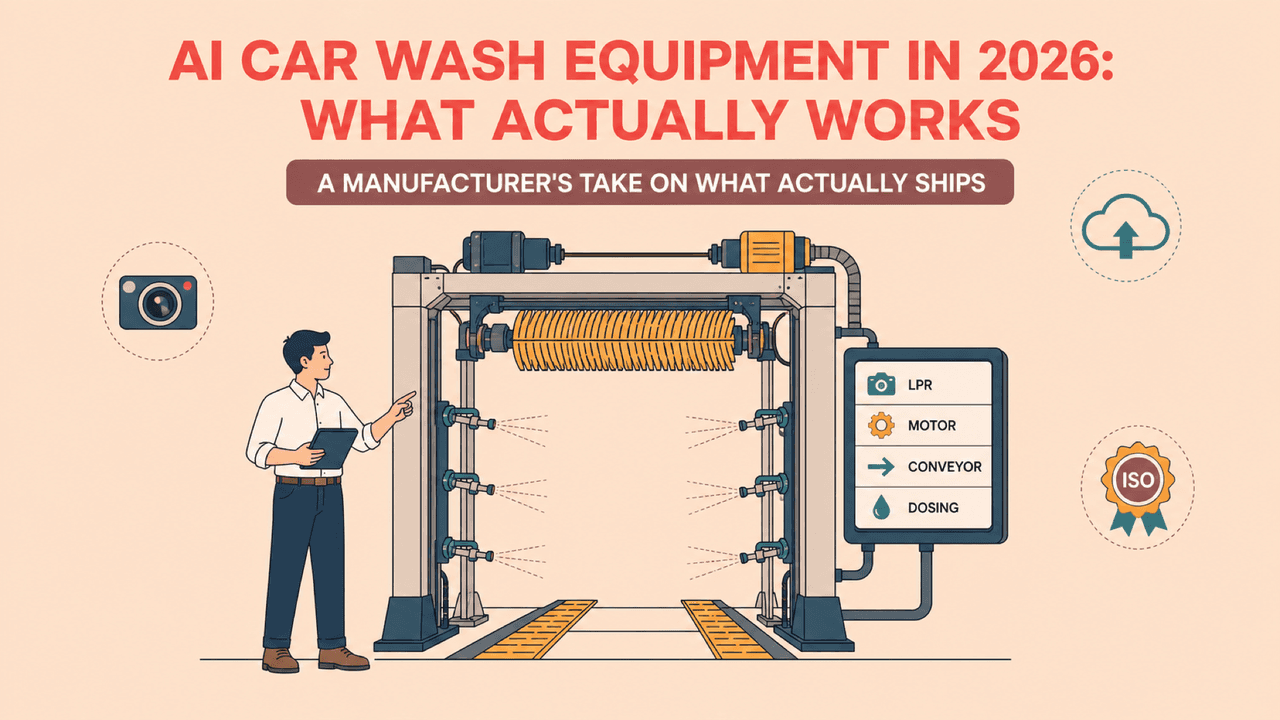
AI in Car Wash Equipment: What Actually Works in 2026 (A Manufacturer's Take)
A manufacturer's breakdown of AI car wash equipment in 2026 — what actually ships, what is still demo-stage, and how to evaluate vendor claims.
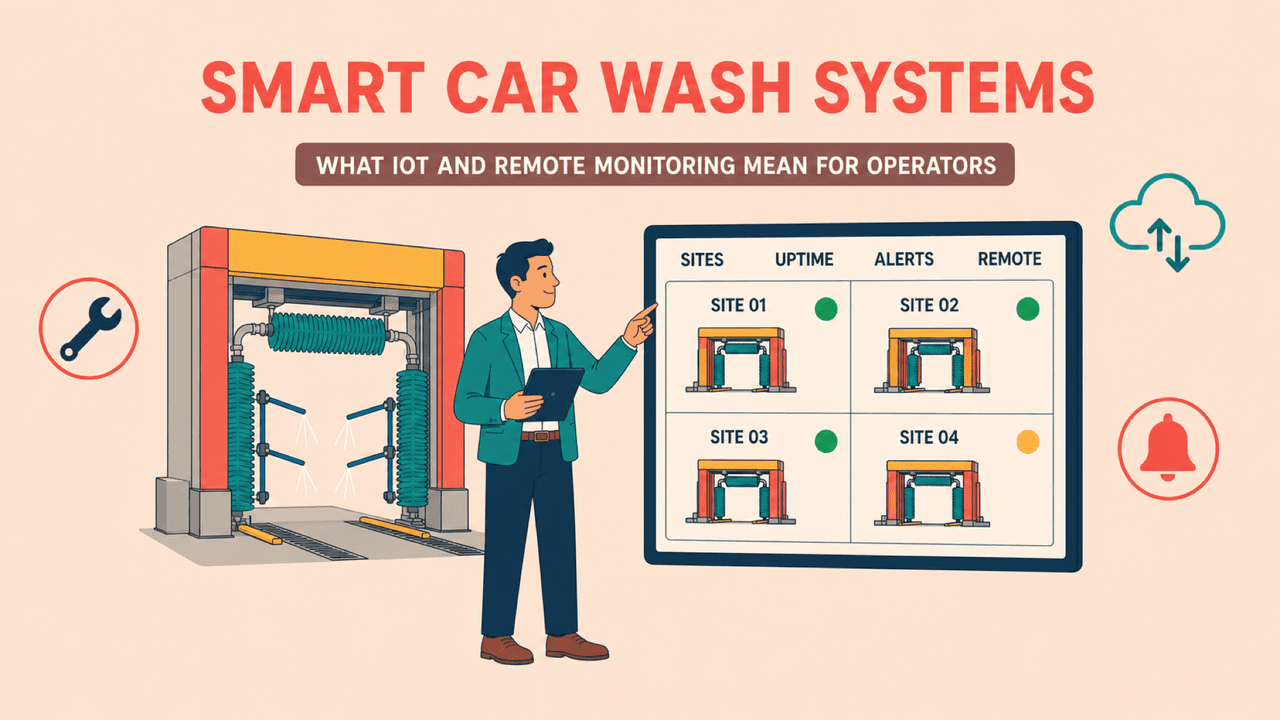
Smart Car Wash Systems: What IoT and Remote Monitoring Mean for Operators
A smart car wash system IoT layer turns sensor data into fewer breakdowns, faster fault response, and viable after-hours operation. Here's how it works.
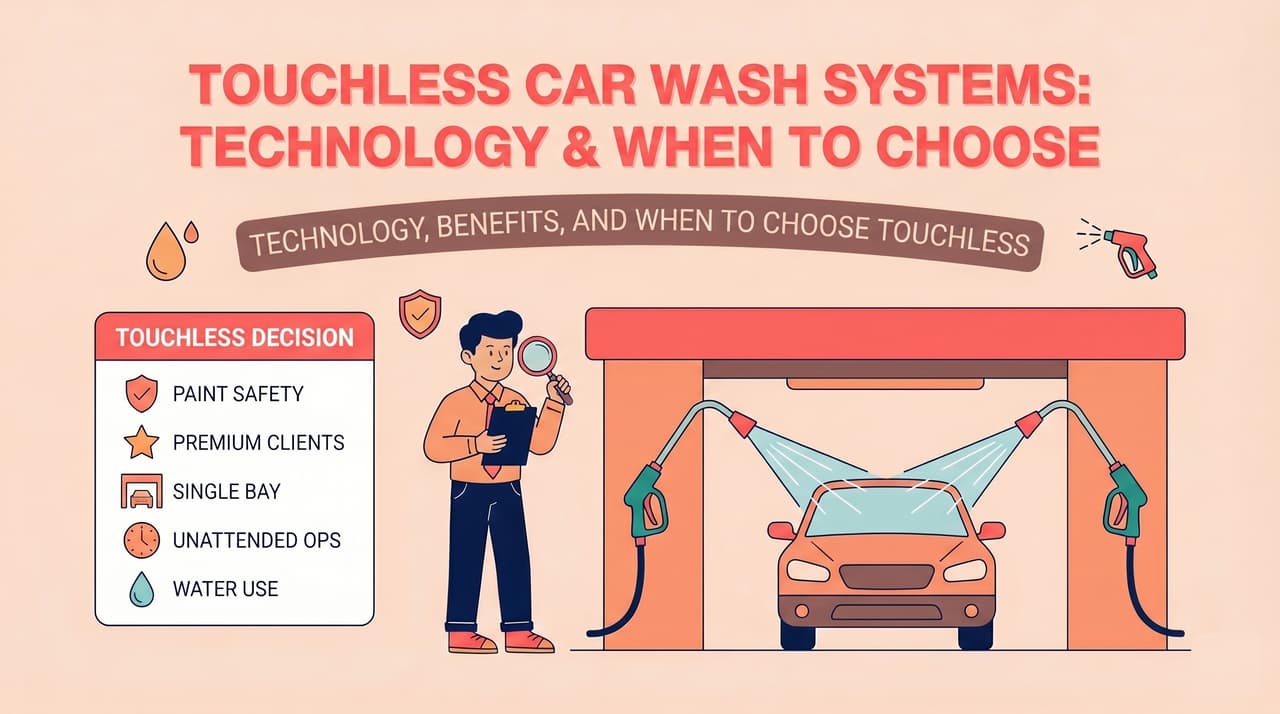
Touchless Car Wash Systems: Technology, Benefits, and When to Choose Touchless
Touchless car wash systems explained: how the technology works, honest tradeoffs vs soft touch, and when touchless is right for your site.