
AI in Car Wash Equipment: What Actually Works in 2026 (A Manufacturer's Take)
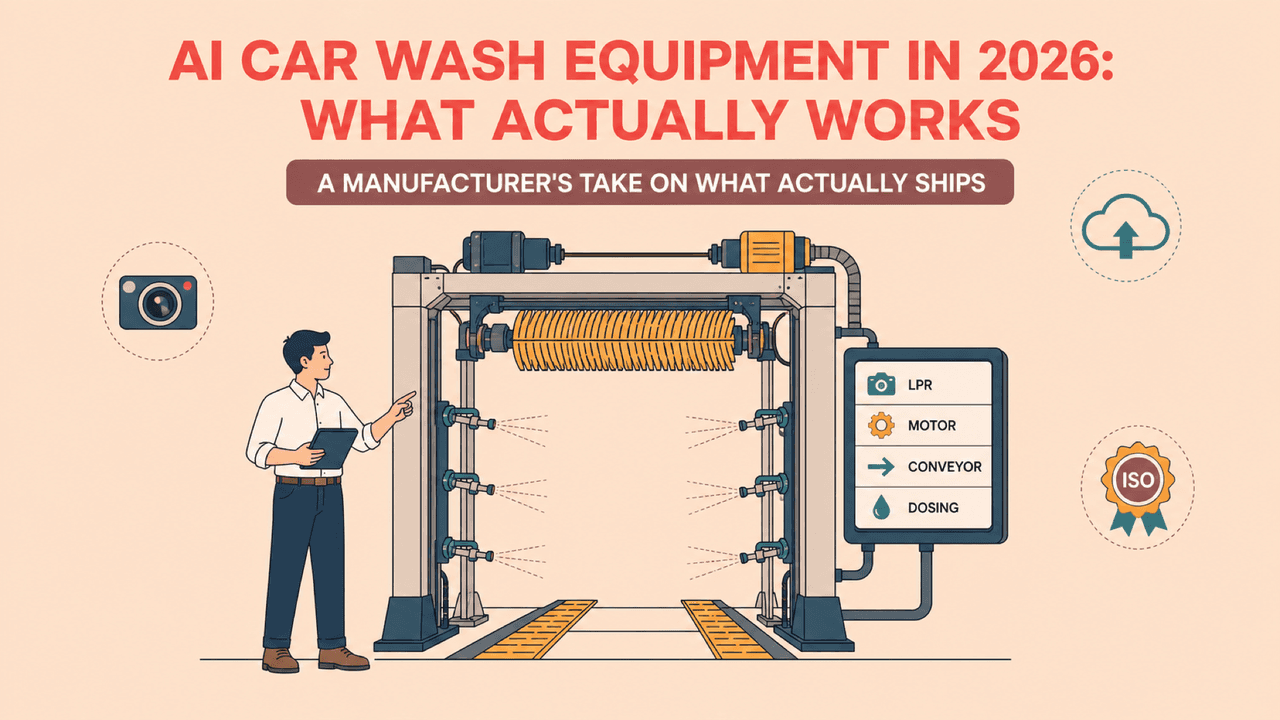
AI in Car Wash Equipment: What Actually Works in 2026 (A Manufacturer's Take)
Every trade-show booth, vendor email, and trade-press headline in 2026 is selling AI car wash equipment. The pitches arrive faster than the products do. Sonny's Quivio launched in November 2025 with an AI sales-coaching module slated for 2026. PREEN is scaling robotic wash bays into Germany, Dubai, and the UK. ICS is shipping AI-powered license-plate recognition with 99.9% accuracy claims. The global car wash market itself is projected to grow from $35.19 billion in 2025 to $37.09 billion in 2026 — a 5.4% CAGR with IoT-enabled equipment cited as a primary driver.
If you are an operator specifying your next system, the real question is which features ship today, which are demo-stage, and which will cost you measurable uptime, water, energy, or membership revenue if you skip them. This article is a manufacturer's calibrated breakdown — written from the perspective of an engineering team that has shipped automated controls, sensor-driven dosing, cloud-connected diagnostics, and license-plate recognition in production systems across more than 40 countries.
What AI Car Wash Equipment Actually Means in 2026
Car wash equipment has had PLC-driven automation for decades. Mitsubishi PLCs run brush cycles, conveyor speed, dosing schedules, and safety interlocks across virtually every modern bay. That is not AI. AI in 2026 specifically refers to machine-learning models running on either edge hardware (cameras, controllers) or in the cloud, plus computer-vision and sensor-feedback systems that adapt behavior based on what they detect.
Four categories are genuinely productized in 2026 equipment:
Computer vision — license-plate recognition, vehicle-attribute detection, damage-prevention pre-scans
Predictive maintenance — sensor data plus ML models that flag component drift before failure
Adaptive wash cycles — wash-program selection driven by detected vehicle profile
IoT and remote diagnostics — cloud-managed control with multi-site visibility
Several other capabilities are still demo-stage or vendor-only-in-press-release. PREEN's Neural Radiance Field robotic articulation is real engineering, but at 3-6 minute cycle times and 10-20 vehicles per hour, it is not yet a tunnel-replacement at scale. Fully unmanned wash operation is technically possible but rarely deployed without operator backup. And true AI sales coaching — announced by multiple vendors at late-2025 trade shows for 2026 release — is not yet broadly shipping. Specifying around announced features rather than shipping ones is the most common way an operator overpays for AI.
AI Capability | Status in 2026 | Sensor or Data Input | Measurable Outcome |
|---|---|---|---|
License Plate Recognition | Shipping | Wash-bay camera + edge ML | Membership ID, prepaid validation, throughput |
Vehicle-Attribute Scanning | Shipping | Wash-bay camera + ML model | Adaptive cycle selection, damage-prevention flags |
Predictive Maintenance | Shipping (selective) | Motor current, vibration, pump pressure, brush torque | Reduced unplanned downtime, fewer service-truck rolls |
IoT Remote Monitoring | Shipping | Cloud-connected PLC + sensor telemetry | Multi-site visibility, remote diagnostics, faster fault response |
Adaptive Wash Cycles | Shipping (early) | Vehicle-attribute output | Better wash-result consistency, water/chemical efficiency |
Full Robotic Articulation | Emerging | NeRF 3D vehicle modeling | 3-6 min cycle, 10-20 vehicles/hour (PREEN scope) |
AI Sales Coaching | Demo / Announced | Wash menu + transaction analytics | Multiple 2025 announcements; verify general-availability shipping with each vendor |
When a vendor demos a feature, ask which row it occupies. The line between shipping and emerging is where cost-versus-outcome gets honest.
Computer Vision: What License-Plate Recognition and Vehicle-Attribute Scanning Actually Deliver
Computer vision is the most mature AI category in car wash, and license-plate recognition is its anchor capability. LPR drives membership identification, prepaid-package validation, damage-prevention pre-scans, and the entire revenue-recognition workflow on tunnel and express sites. ICS launched its AI-LPR solution claiming 99.9% accuracy at speed, in dirt, and under wash-bay lighting and water spray — without added camera hardware or a system upgrade. That specificity is the right shape for a vendor claim. A number, a defined operating envelope, and the integration cost.
Vehicle-attribute scanning is the newer second wave. Engines like Plate Recognizer's vehicle-attribute API analyze geometry in the same frame as the plate read and output a JSON payload describing height, body type, accessories, and visible damage. That payload feeds two downstream uses: flagging risk vehicles before conveyor entry (damage prevention) and adapting the wash cycle to match the detected profile (adaptive cycle selection). Both features pay for themselves in claims avoided and consistent wash quality.
How This Connects to HyTian's Catalog
HyTian's Custom-Made (engineered-to-order) line ships license-plate recognition plus PLC integration and multi-stage water reclamation as standard modular components. That configuration is already deployed in waste-management depots, power plants, steel facilities, rail depots, vehicle manufacturing plants, and transit systems where vehicle-identification is a compliance requirement, not a marketing layer. The point worth making to an operator: when a vendor describes LPR as an "AI-powered" upgrade, the underlying capability has been shipping in industrial-vehicle wash systems for years. What is new is the model accuracy and the integration with consumer-tunnel POS workflows.
For consumer-facing operations, the XL-200NET rollover supports cashless scan-to-start with cloud management — the same identification flow LPR enables on tunnel sites, sized for self-service and small-chain sites running 15-20 vehicles per hour. Either path gets you a verifiable identification layer. The vendor question is whether the AI features layer onto your existing identification flow or require a rip-and-replace.
Predictive Maintenance Car Wash Systems: From Sensor Data to Fewer Breakdowns
Predictive maintenance is the AI category most likely to repay its own cost. Continuous sensor data — motor current, vibration patterns, pump pressure, chemical-flow rates, brush-rotation torque — feeds machine-learning models that flag drift before component failure. Industry analyses note AI-driven systems monitoring motor vibrations, chemical pump efficiency, and conveyor belt wear patterns to forecast servicing windows. The shipping-today portion of that capability is the monitoring and alerting layer. The still-emerging portion is fully autonomous parts-ordering and dispatch — useful, but not yet ubiquitous.
The contrast worth understanding is between calendar-based and sensor-driven maintenance. Most operators run on calendar-based preventive maintenance schedules — replace the brush bearings every 12 months, refresh the dosing pumps every 18 months, swap the dryer filters every quarter. Predictive maintenance does not replace that schedule. It tells you when a specific component is drifting outside its expected operating envelope before the calendar interval, so you replace it on a planned visit instead of an emergency one. That difference is where the unplanned-downtime savings actually come from.
Predictive models depend entirely on the precision of the sensor data feeding them. The HyTian TX-380 tunnel uses CNC metering pumps with 0.28 mL dosing precision, extending a 20 kg chemical drum to approximately 3,000 washes. That precision is the data backbone — a chemical flow rate that drifts by 5% on a precision dosing system is a meaningful signal; the same drift on a coarse dosing system disappears into the noise. VFD-controlled conveyor speed and EVA closed-cell foam brushes with linear pressure curves provide the upstream telemetry. Without that sensor density, predictive maintenance becomes a marketing label on a calendar reminder.
When a vendor pitches predictive maintenance, ask which sensors feed the model and what their resolution is. If the answer is vague, the model will be too.
Car Wash IoT Remote Monitoring: What Cloud Management Actually Delivers
IoT remote monitoring covers three operator-facing capabilities: real-time equipment status across sites, remote diagnostics (changing parameters or restarting a system without a service visit), and aggregated multi-site analytics. The growing IoT-enabled equipment adoption cited in industry market research is, in practice, this category becoming a default expectation rather than an upgrade.
The operator-side benefit is concrete. Reduced unplanned-downtime cost. Fewer service-truck rolls. Faster fault response when an alert surfaces — typically minutes from sensor event to operator notification. For multi-site operators, the aggregated analytics let you compare throughput, water consumption, and chemical use across locations and find the underperforming bay before the monthly P&L does. None of that requires AI in the strict sense. It requires cloud-connected PLC architecture, reliable telemetry, and an operator dashboard. The AI layer adds anomaly detection on top of that data, but the underlying value is the visibility itself.
HyTian's XL-200NET cloud management and remote diagnostics is designed exactly for this profile. The system ships cloud management, remote diagnostics, cashless scan-to-start, and auto-drain for cold-weather sites — engineered for self-service and multi-site networks rather than single-bay express sites. The proof-of-concept moment was 2020: HyTian commissioned a TX-380 tunnel for Splash N Go in Japan entirely via remote commissioning during pandemic travel restrictions, and the site has since grown to 500-plus washes per day at peak through a multi-site Japanese franchise network. Remote operability was a pandemic-era necessity then. It is a baseline specification now.
Remote monitoring connects directly to throughput levers like remote monitoring and faster fault response — every minute saved between fault and resolution is a wash that does not get refunded. That is the economic argument for IoT before any AI layer is added on top.
How to Evaluate AI Car Wash Equipment Claims When a Vendor Pitches You
The practical question is how to evaluate any AI feature in equipment without becoming an ML researcher. A four-question framework covers most cases, and it is the same evaluation discipline you would apply to any manufacturer claim:
Is this shipping in production today, or announced for a future release? ICS AI-LPR is shipping. Several AI modules announced at late-2025 trade shows are still working through general-availability rollout. The price you pay for an announced feature should reflect that gap.
What sensor or data input does the model rely on, and is that input native to your equipment? A predictive-maintenance model that needs sensor inputs your current equipment does not produce is not a software upgrade. It is a hardware program. Ask for the sensor list.
What measurable outcome does the vendor commit to, and where can you see it deployed? "Up to 99.9% LPR accuracy at speed" is verifiable. "AI-powered smarter wash experience" is not. Ask for a reference site running the feature, not a demo bay.
How does this integrate with the equipment you already operate — native, retrofit, or rip-and-replace? A feature that requires proprietary cloud lock-in or a complete control-system swap is rarely cost-effective for an operator already running on serviceable equipment. Configuration-level AI features beat capital-replacement ones.
Two red flags worth naming. Claims using only superlative language without numbers are the first. AI features that demand a proprietary cloud platform with no exit path are the second. The right shape of vendor commitment is specific, bounded, and verifiable — the same standard you would hold any other equipment claim to.
Where HyTian Sees AI Heading: Precision, Not Replacement
The next 24 months in AI car wash equipment will concentrate around precision and visibility, not full operator replacement. Better identification at entry. Better diagnostics across the wash cycle. Better sensor fidelity on the consumables and motors that drive operating cost. Better cycle adaptation to vehicle profile. Each lever is incremental — and each is verifiable in a way "AI-powered" is not.
The operator who wins is the one who specifies AI features that pay for themselves in measurable uptime, energy, water, or membership-revenue terms — and structures the next equipment specification so AI-feature additions are a configuration choice, not a capital re-investment. HyTian's engineering posture reflects that: sensor-rich PLC controls, cloud-connected diagnostics on rollover variants, customizable LPR and control logic on engineered-to-order systems. ISO 9001, ISO 14001, and CE conformity across the manufacturing program. A globally proven installed base of 20,000-plus systems across 40-plus countries — the population where sensor data is most useful and where operator feedback shapes the next iteration of the platform.
That posture is evolutionary by design. AI in car wash equipment is not a wholesale category reset. It is a precision upgrade on top of automation that has been quietly maturing for thirty years.
Key Takeaways
AI car wash equipment in 2026 is best understood as four shipping categories: computer vision (LPR plus vehicle attributes), predictive maintenance, adaptive wash cycles, and IoT remote monitoring. Everything else is demo-stage or product marketing.
The operator who benefits most is the one who specifies AI features by sensor input and measurable outcome — not by buzzword. A 4-question vendor evaluation framework (shipping vs announced, sensor inputs, measurable outcome, integration path) covers most pitches.
HyTian already ships the underlying capability across its catalog: LPR plus PLC in Custom-Made systems, cloud management plus remote diagnostics in the XL-200NET, sensor-precision metering and VFD speed control in the TX-380. The next equipment specification is where those features get configured in, not bolted on later.
Talk to the Engineering Team About Your AI-Feature Priorities
Want to talk through which AI features actually move the numbers at your site? Our engineering team can walk you through the configuration that fits your throughput, your existing equipment, and your AI-feature priorities — without selling you a roadmap of features that have not shipped yet. Tell us about your wash menu and site footprint, and we will scope what is real versus what is years away.
Related articles
Explore more insights from the HyTian team.
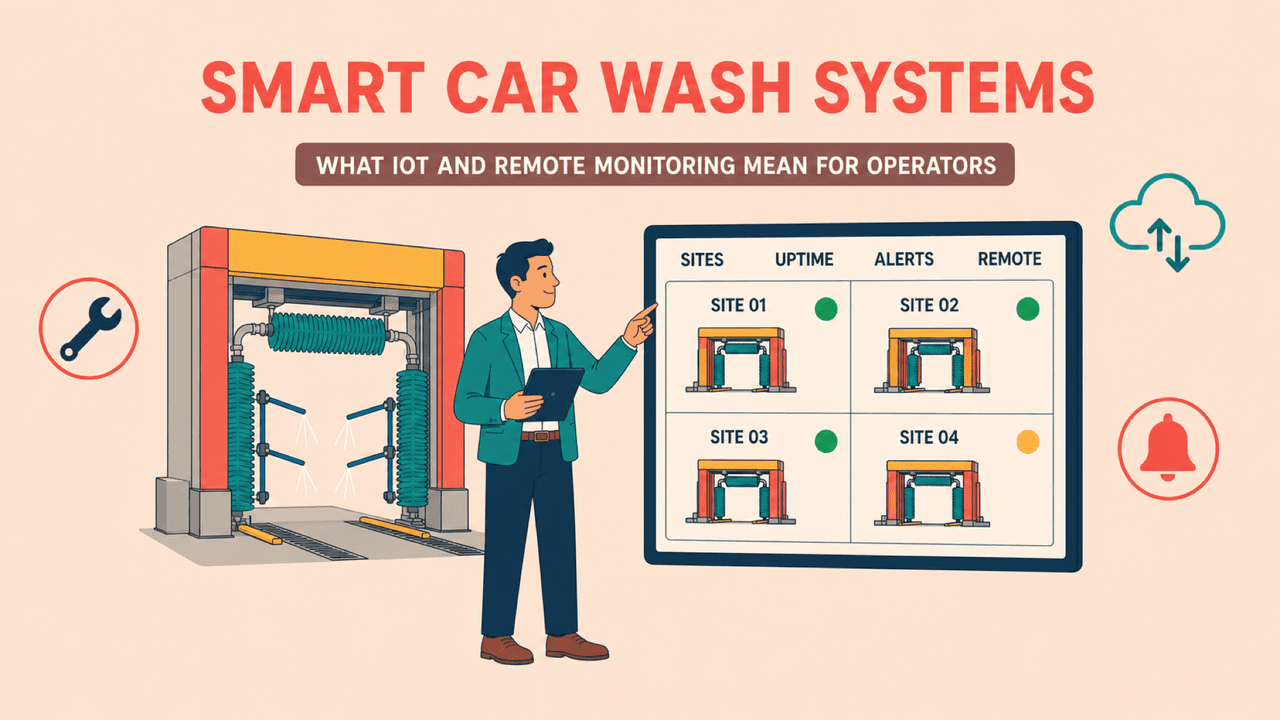
Smart Car Wash Systems: What IoT and Remote Monitoring Mean for Operators
A smart car wash system IoT layer turns sensor data into fewer breakdowns, faster fault response, and viable after-hours operation. Here's how it works.
2026 Car Wash Industry Trends: What Equipment Buyers Need to Know
Discover the top 2026 car wash industry trends shaping equipment decisions. Learn about automation, sustainability, EV compatibility, and smart technology.
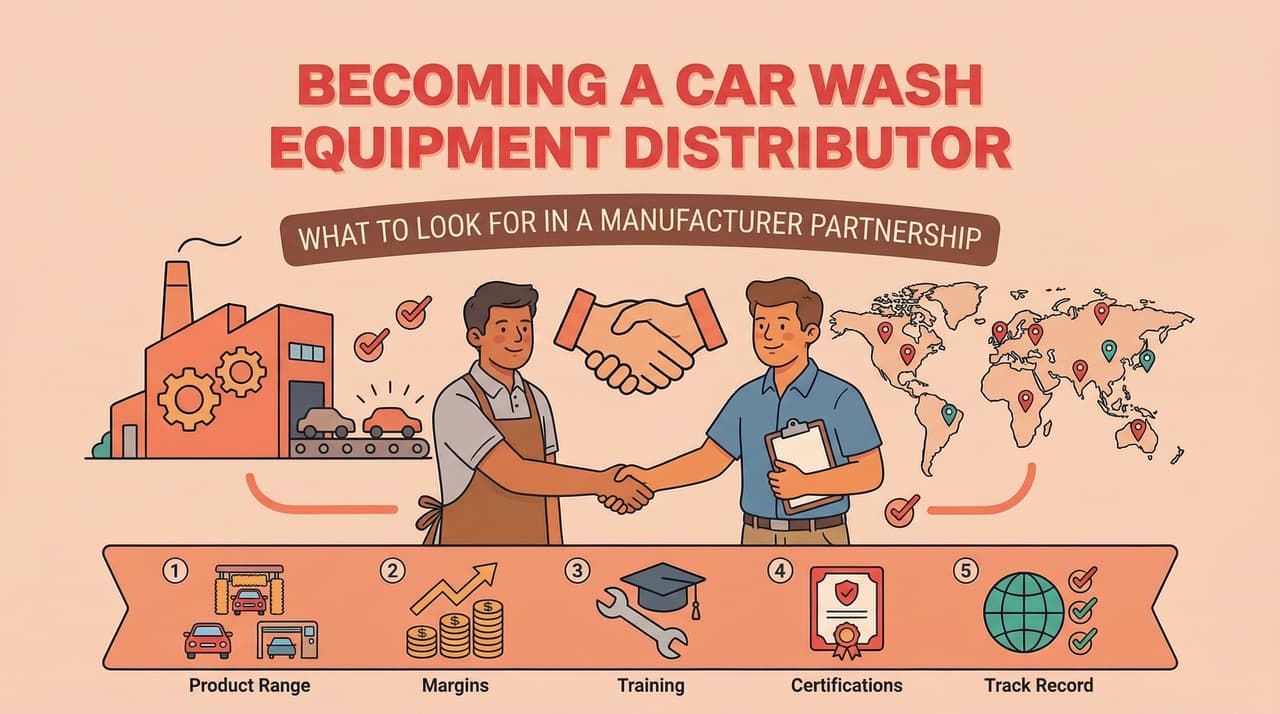
Becoming a Car Wash Equipment Distributor: What to Look for in a Manufacturer Partnership
Evaluating car wash equipment distributor partnerships? Five factors — from product range to global track record — that separate strong manufacturer relationships from risky ones.