
The Middle East Car Wash Market in 2026: GCC Growth, Water-Scarce Regulation, and the Distributor Opportunity
The Middle East Car Wash Market in 2026: GCC Growth, Water-Scarce Regulation, and the Distributor Opportunity
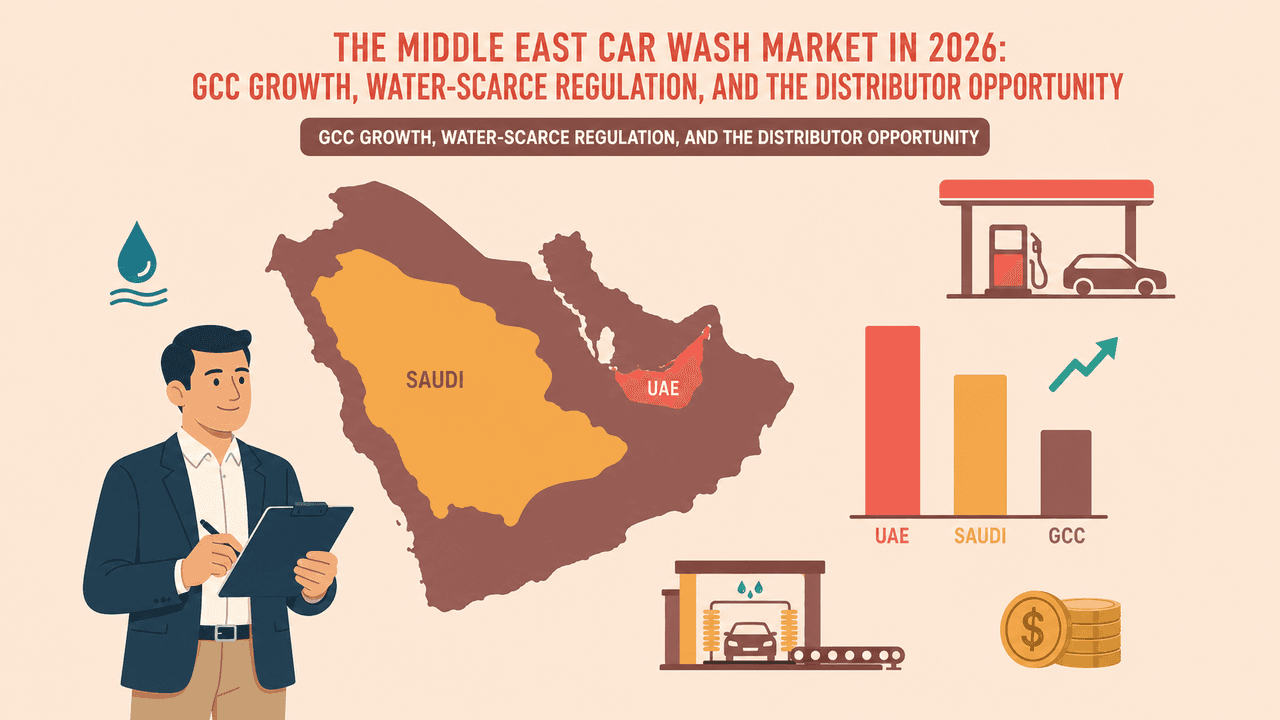
If you are evaluating the car wash market Middle East opportunity from outside the region, the first thing worth understanding is the shape, not the size: the GCC is the fastest-growing major car wash region by CAGR, yet small in absolute terms, structurally shaped by water scarcity, and dominated by fuel-retail-integrated formats rather than standalone sites. Those four facts determine which equipment categories operators actually buy and how distributors win accounts.
This article is a manufacturer's distributor-perspective primer on the GCC market in 2026: size and growth, by-nation concentration, regulatory environment, format share, fuel-retail integration, and equipment-demand implications. It is the second in a three-part regional series. The first piece, the US car wash market in 2026, covered a roughly $18.7 billion mature market shaped by chain consolidation and subscription economics; a Southeast Asia primer follows. For broader context, the global car wash equipment market context anchors the GCC share within a roughly $37 billion global category.
How Big Is the Middle East Car Wash Market? Reconciling the Numbers
The GCC car wash services market is approximately USD 315 million in 2025 and projected to reach USD 389 million by 2030 at a 4.30% CAGR, according to Mordor Intelligence. That is the headline figure for the regional services scope. By-nation outlooks paint a larger picture: Grand View Research sizes the Saudi Arabia car wash service market at USD 417 million in 2024, projected to reach USD 628 million in 2030 at a 7.1% CAGR, and the UAE service market at USD 348 million in 2024 rising to USD 545 million in 2030 at a 7.8% CAGR — together about USD 766 million in combined 2024 services revenue.
The spread is not a contradiction; it reflects scope. Mordor's GCC services number is the retail wash slice; the Grand View national outlooks are broader because they include detailing and ancillary services. Ken Research's UAE car wash and detailing automation aggregate is reported at roughly USD 1.2 billion when equipment and service revenue are combined. Grand View's longer UAE outlook runs services from USD 374 million in 2025 to USD 632 million by 2033 at a 6.7% CAGR; Ken Research's Saudi services thesis runs at 8.2% CAGR through 2027.
Anchored against the US figure ($18.7 billion IBISWorld 2026), the GCC is materially smaller in absolute terms — vehicle parc and population are smaller. What the GCC trades in size, it makes up for in growth rate: Saudi and UAE service CAGRs are running 1.5 to 2 times the US trajectory. The takeaway for a distributor is straightforward — this is a growth market, not a scale market, and equipment-demand inference comes from services-market growth, automation-share growth, and format-mix shifts rather than a single published equipment figure.
Saudi Arabia and the UAE: Where the GCC Growth Is Concentrated
Saudi Arabia is the largest absolute car wash services market in the GCC; the UAE is the fastest-growing on a per-capita basis. Together the two nations account for the overwhelming majority of GCC car wash services revenue and the great majority of GCC equipment demand. Qatar, Kuwait, Bahrain, and Oman are real but smaller markets with high vehicle-ownership-per-capita and material fleet-wash adjacencies.
Saudi Arabia Car Wash Market Size and Runway
Saudi Arabia operates approximately 8 million passenger cars and adds roughly 650,000 new vehicles each year, with a 90%-plus private vehicle ownership ratio concentrated in Riyadh, Jeddah, and Dammam. Ken Research estimates that only 15 to 20% of the total addressable Saudi car wash market is currently captured — by far the longest runway of any major GCC market. Grand View projects Saudi services revenue rising from USD 417 million in 2024 to USD 628 million in 2030 at a 7.1% CAGR; Ken Research's alternate scope runs at 8.2% CAGR through 2027.
Adjacent fleet demand layers onto the retail story. The King Abdulaziz Project for Riyadh Public Transport operates an 842-bus Mercedes and MAN fleet across two maintenance centers, with similar fleet-wash demand profiles emerging in Doha and at oil-services convoy operations across the Eastern Province. For a distributor whose portfolio includes bus wash systems for fleet operators, the Saudi transit and oil-services adjacency is a parallel demand stream with its own procurement cycle.
UAE Car Wash Market Growth and Premium Density
The UAE operates more than 3 million registered vehicles with annual growth around 5%, concentrated in Dubai and Abu Dhabi, with high luxury-vehicle density supporting premium wash demand and a tourism layer that lifts peak utilization. Grand View projects UAE services from USD 348 million in 2024 to USD 545 million in 2030 at a 7.8% CAGR — the highest national CAGR in the GCC. The longer outlook to 2033 runs at 6.7%, and Ken Research's UAE detailing-automation aggregate sits near USD 1.2 billion when equipment and service revenue are combined.
The Doha public-transport program — 4 bus depots and 650-plus electric-bus charging stations across 8 bus stations — illustrates the fleet-wash adjacency pattern in the smaller GCC markets. Qatar, Kuwait, Bahrain, and Oman together contribute a meaningful tail of GCC equipment demand once transit, oil-services, and government-fleet wash bays are aggregated alongside the standalone retail signal.
Water Scarcity and the Regulatory Environment Shaping Equipment Selection
The most important structural difference between the GCC car wash market and the US market is regulatory: water scarcity is not a sustainability talking point in the Gulf — it is the design constraint that determines which equipment categories operators are allowed to install and operate. Equipment selection follows from the regulation.
In Saudi Arabia, the National Water Strategy under Vision 2030 frames sustainable water management as a long-horizon priority for the Ministry of Environment, Water and Agriculture (MEWA). Royal Decree M/6 (1421H, 2000) establishes the wastewater treatment and reuse framework that car wash plants operate under: facilities are required to provide oil-water separation traps before public sewage discharge, and public reuse of treated wastewater is policy direction rather than aspiration. MEWA licensing oversight applies to commercial operations.
In the UAE, the Federal Recycled Water and Biosolids Regulations took effect in January 2018, superseding the 2010 framework and establishing a national recycled-water reuse and management regime (Stantec policy reference). At the municipal level, Dubai and Abu Dhabi enforce water-use permits and discourage open-water washing of vehicles on public roads — published guidance cites fines of up to Dh3,000 for unauthorized open-water washing on public property. Closed-loop water management is the de facto baseline for commercial operations across both emirates.
Regulatory Comparison | Saudi Arabia | UAE |
|---|---|---|
Primary framework | Vision 2030 National Water Strategy + Royal Decree M/6 (1421H) | Federal Recycled Water and Biosolids Regulations (effective Jan 2018) |
Regulating authority | Ministry of Environment, Water and Agriculture (MEWA) | UAE federal framework + Dubai and Abu Dhabi municipalities |
Operator obligation | Oil-water separation traps before sewage discharge; MEWA licensing; reuse of treated wastewater is policy direction | Municipal water-use permits; commercial operations expected to run closed-loop; fines up to Dh3,000 for unauthorized open-water washing |
Equipment implication | Reclamation-equipped tunnel and rollover formats; touchless systems for water-permit-pressured sites | Closed-loop filtration as baseline; touchless and reclamation-equipped tunnel structurally favored |
The equipment-demand implication is direct: GCC operators favor low-water-consumption formats. Reported industry figures put water consumption with advanced reclamation at 80 to 150 liters per vehicle, against roughly 150 to 250 liters per vehicle for conventional setups — approximately a 70% reduction. Closed-loop filtration is increasingly a baseline expectation rather than a premium upgrade, and Saudi and UAE operators standardly require recycling capability in their tender specifications. For more on the water, energy, and ISO 14001 dimensions, see sustainable car wash operations — water, energy, and ISO 14001; for the technology-level discussion of why brush-free systems matter when water permits are tight, see touchless car wash systems — technology and when to choose.
Format Share: Rollover Dominance Today, Tunnel and Touchless Gaining Ground
Rollover and in-bay automatic formats led 2024 car wash services revenue across both Saudi Arabia and the UAE, with tunnel projected as the fastest-growing format from 2025 to 2030 (Grand View Research via CarwashPro). The format mix matters because it determines which equipment categories carry the most current demand and which categories carry the most growth.
Rollover leads in the GCC for structural reasons. The installed footprint is small enough to fit a fuel-station forecourt, water consumption is manageable when paired with reclamation, and capital cost is lower than tunnel — all three matter in a market where retail car wash is overwhelmingly co-located with a fuel-retail operator. The format also matches the forecourt throughput profile: dozens to low hundreds of vehicles per day per bay, not thousands.
Tunnel is gaining because demand is shifting. As chain-style operators enter the GCC and flagship sites scale beyond what a forecourt rollover can serve, tunnel throughput becomes the rational choice. Grand View projects tunnel as the fastest-growing segment over the next five years in both Saudi and UAE — the same pattern the US lived through earlier, arriving in the GCC later but real.
Touchless adoption is the format with the most regulatory tailwind. Globally, rollover and in-bay automatic systems hold roughly 55.2% of 2025 revenue share, with touchless installations splitting roughly 60% in-bay touchless / 35% conveyor-tunnel touchless / 5% other. The GCC is over-indexed on touchless because water-scarce regulation plus premium-vehicle density in the UAE produce demand for paint-safe, low-water wash methods. The practical implication for a distributor's portfolio is that any product line entering the GCC needs to cover three formats, not one: rollover or in-bay automatic for the dominant forecourt category, touchless for the regulatory-and-premium slice, and reclamation-equipped tunnel for the growth segment chain operators will demand.
Fuel-Retail Integration: Why the GCC Car Wash Is Built into the Forecourt
The single largest structural difference between the GCC and US retail car wash markets is channel: GCC retail car washes are predominantly co-located with fuel-station forecourts, not operated as standalone destination sites. The major fuel-station car wash operators in the Gulf include ADNOC Distribution (Abu Dhabi), Emarat and EGPC (UAE), ENOC and EPPCO (Dubai), Saudi Aramco retail forecourts, and Bapco (Bahrain) — all of which offer co-located automatic and manual car wash services at the forecourt level. ADNOC Distribution, founded in 1973, runs forecourt car wash across its network; Emarat operates 139-plus stations across Dubai and the Northern Emirates with car wash, tyre, and vehicle testing services bundled at the forecourt; ENOC and EPPCO follow the same model across Dubai.
The structural consequence for equipment demand is twofold. First, rollover and in-bay automatic systems with small footprint and reclamation are the dominant retail SKU because they fit the forecourt envelope — tunnel does not, except at flagship sites. Second, touchless rollover layouts gain disproportionate traction at forecourts where water-permit pressures are highest, combining small footprint with paint-safe low-water operation.
For a distributor, the channel reality reshapes the account-acquisition motion. Serving the GCC requires accounts at the fuel-retail chain procurement level, not just at standalone-operator level. That means manufacturer support for fleet and chain standardization across dozens or hundreds of stations, guaranteed parts availability across geographically dispersed forecourts, and engineering support for forecourt-integration retrofits where the existing fuel-station envelope dictates equipment dimensions. The distributor-relationship sales motion is the dominant pattern, not the direct-to-operator motion of much of the US market.
What the Middle East Car Wash Market Means for International Equipment Manufacturers and Their Distributor Partners
Pulling the threads together: the GCC car wash equipment market is smaller than the US in absolute terms but faster-growing, structurally shaped by water-scarce regulation, format-mixed between rollover and in-bay automatic dominance today and tunnel and touchless growth ahead, integrated into fuel-retail forecourts rather than standalone-site economics, and approached through distributor relationships rather than direct-to-operator motion.
Incumbent positions are held by European manufacturers — WashTec (Germany), Otto Christ AG (Germany, founded 1879), and Istobal (Spain, founded 1950) — alongside regional distribution houses such as Cleantech Gulf, supplying car-washing-machine equipment in the UAE for more than 25 years. The structural openings for international manufacturers entering the GCC sit in four areas: CE and ISO certifications as a tender baseline (GCC tenders typically require both), full product range covering touchless and reclamation-equipped tunnel as well as rollover, fleet and bus and truck range to serve the transit and oil-services adjacency, and partnership terms that match the distributor-relationship sales motion the market actually runs on.
HyTian's view on this market is anchored in measurable credentials rather than positioning claims. Parent company Nanjing Haiying Machinery has manufactured car wash equipment since 1992. The combined HyTian product platform has placed more than 20,000 systems across 40+ countries, with annual production capacity of 3,000 units from the Nanjing Binjiang facility. Certifications cover ISO 9001, ISO 14001, and CE — the baseline set GCC tenders typically expect. Documented regional subsidiaries today sit in the United States, Australia, and Zambia; the GCC sits in the broader 40+ countries footprint rather than as a named subsidiary, and partnership conversations with prospective GCC distributors are how that footprint extends. This is the market view, not a partner-recruitment pitch — the distributor partnership conversation has its own dedicated read in what to look for in a manufacturer partnership.
Key Takeaways
The GCC car wash services market is approximately USD 315 million in 2025 (Mordor) — much smaller than the US ($18.7 billion) but growing at 1.5 to 2 times the rate.
Saudi Arabia is the largest absolute market (8M vehicle parc, 7.1-8.2% CAGR, only 15-20% of addressable market currently captured); the UAE is the fastest-growing per-capita market (6.7-7.8% CAGR, 3M+ vehicles, premium-vehicle dense).
Water-scarce regulation (Saudi Vision 2030, UAE Federal Recycled Water and Biosolids Regulations 2018, municipal Dh3,000 fines for unauthorized washing) makes touchless and reclamation-equipped tunnel the structurally-favored growth formats over open-water rollover.
Retail car wash in the GCC is fuel-retail-integrated — ADNOC, Emarat, ENOC, Aramco, and Bapco forecourts are the dominant retail channel, not standalone sites.
The distributor opportunity is real but mediated. Entry requires CE and ISO certification, full-range product portfolio coverage, and partnership terms that match a distributor-relationship sales motion rather than direct-to-operator.
Talk to Our Partner-Development Team
Evaluating the GCC car wash equipment market as a distributor or trading partner? Our team can walk you through the regional opportunity, certification-and-product fit for GCC tenders, and what a HyTian partnership looks like in practice. Start with the manufacturer partnership guide linked above, then talk to our partner-development team about your territory and product focus.
Related articles
Explore more insights from the HyTian team.
The US Car Wash Market in 2026: Size, Format Share, and the Distributor Opportunity
The US car wash market size reached $18.7B in 2026 — here's the format share, regional concentration, and equipment-demand picture a manufacturer sees.
The Global Car Wash Equipment Market: Size, Growth, and Opportunity by Region
Car wash equipment market size and regional growth through 2031 — a distributor's view from a manufacturer with 20,000+ systems in 40+ countries.
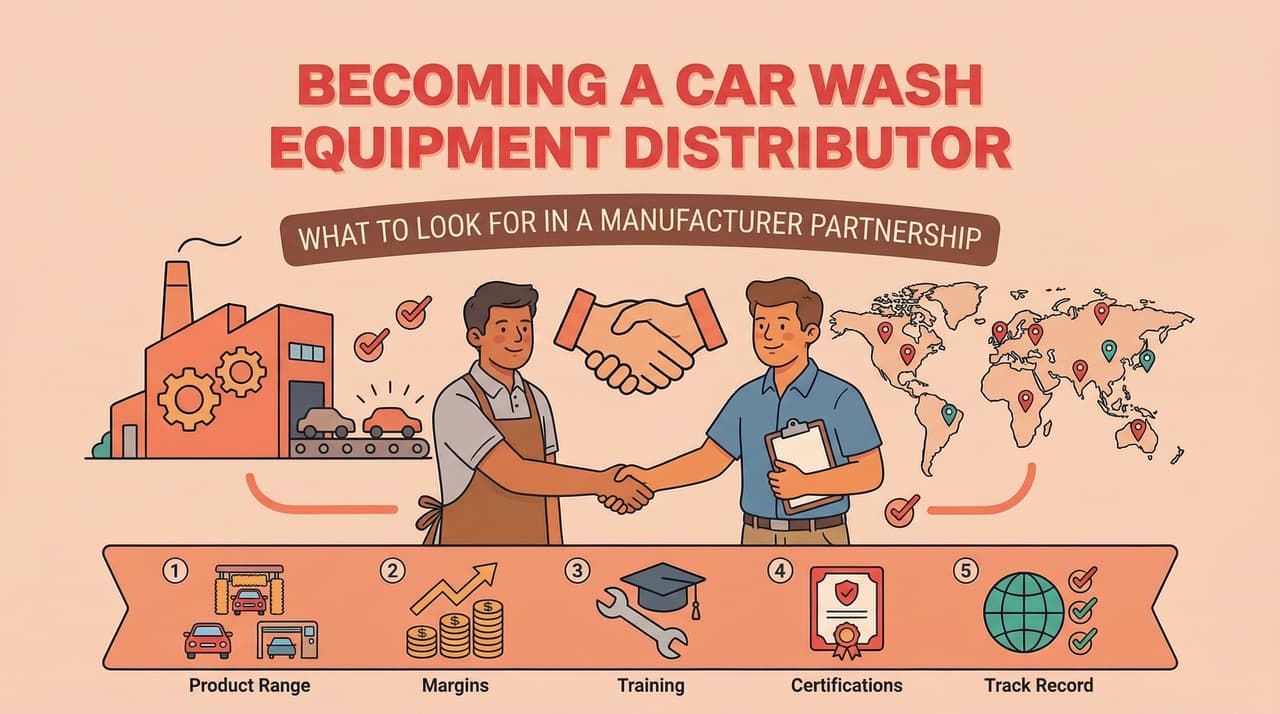
Becoming a Car Wash Equipment Distributor: What to Look for in a Manufacturer Partnership
Evaluating car wash equipment distributor partnerships? Five factors — from product range to global track record — that separate strong manufacturer relationships from risky ones.