
The US Car Wash Market in 2026: Size, Format Share, and the Distributor Opportunity
The US Car Wash Market in 2026: Size, Format Share, and the Distributor Opportunity
If you are evaluating the US car wash equipment opportunity from outside North America, the first number that matters is also the most useful: the US car wash market size sits at roughly $18.7 billion in 2026, making it the single largest national market in the global car wash equipment economy. It is also dense, capital-backed, and consolidating at a pace most regional markets have not seen.
This article is a manufacturer's distributor-perspective primer on that market — what it is worth, how it splits by wash format, where demand is concentrated, what consolidation means for equipment-purchase decisions, and how subscription economics are rewriting the operator's buying criteria. It is the first in a three-part regional series; companion primers covering the Middle East and Southeast Asia follow. For broader context, the global car wash equipment market context anchors the US share within a roughly $37 billion global category.
How big is the US car wash market? Reconciling the numbers
The US car wash market size is approximately $18.7 billion in 2026 according to IBISWorld — a figure that reflects car wash and auto detailing services revenue across an estimated 55,000-plus operating sites. That number frames the prize. But credible research firms publish a wider spread, and a distributor needs to understand why.
Pure-play wash services scopes from Future Market Insights estimate the market at $15.28 billion in 2025, rising to $15.75 billion in 2026. Innowave Studio and Persistence Market Research, which include ancillary wash revenue captured at fuel and dealer sites, report a 2025 figure closer to $20.7 billion. Precedence Research projects the global car wash services market reaching $48.25 billion by 2035. The spread is not a contradiction — it reflects scope. Pure-play establishments produce one number; pure-play plus ancillary wash bays attached to gas stations, dealers, and fleet sites produce another.
IBISWorld registered a 0.1% revenue contraction in 2025, then a return to growth in 2026. Reading the trajectory: a flat year on the back of consumer-discretionary softness, not a stalled category. Membership-driven revenue continued to grow even as transactional wash counts dipped, which is itself a structural signal worth holding onto for the subscription section.
Anchored against the global figure, the US represents roughly half of the global car wash market by most credible scopes. No other national market comes close. For a manufacturer evaluating where international distributor expansion produces the most leverage, the math starts here.
Format share: tunnels, in-bay automatics, and the express exterior wave
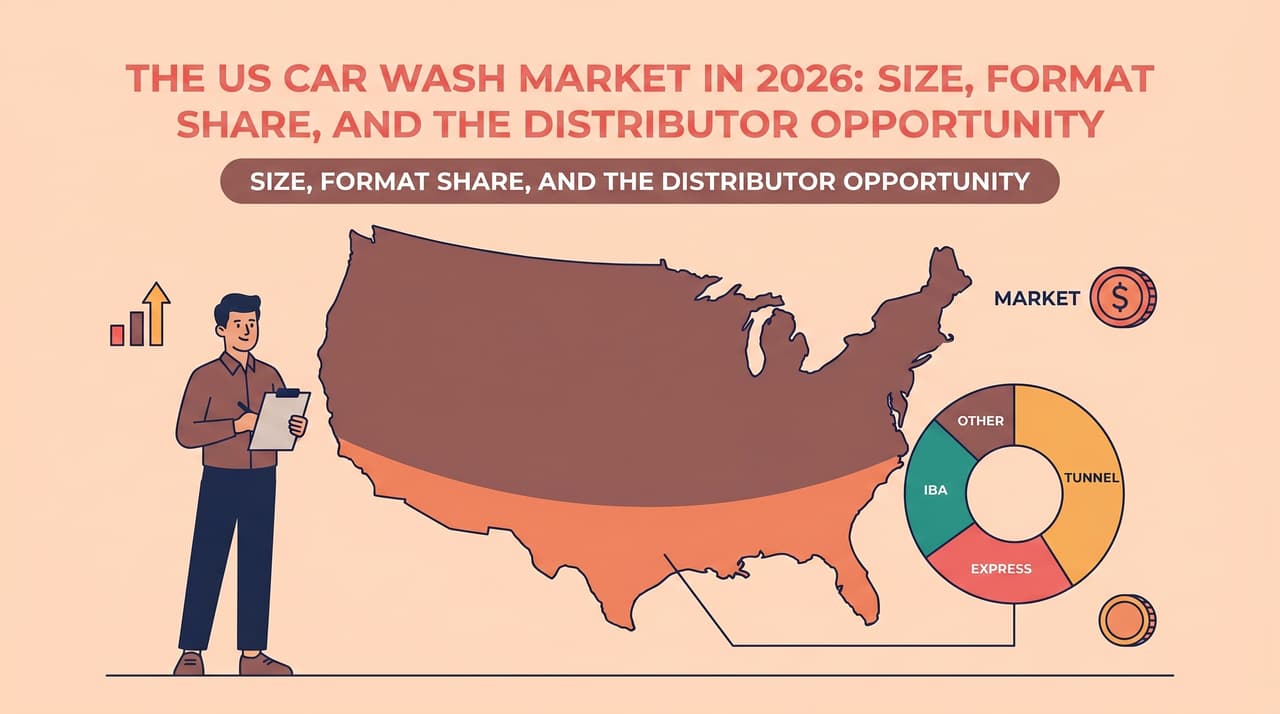
Format share is where market sizing translates into actual equipment categories a distributor would carry. The US revenue mix breaks down roughly as follows: full-service conveyor tunnels account for about 32% of revenue, express exterior conveyor sites another 20%, in-bay automatics roughly 16%, with self-serve, hand-wash, and ancillary formats making up the remainder. Tunnel and conveyor formats together hold 48.12% of market share in 2025 per Future Market Insights. Automated drive-through formats — tunnel, express exterior, and in-bay automatic — together drive roughly 70% of category revenue.
Express exterior car wash growth in the US
Express exterior is the fastest-growing format. Future Market Insights projects the segment at an 8.27% CAGR through 2031 — well above the category average. The operating logic is straightforward: throughput of 100-plus vehicles per hour, minimal labor (often one or two attendants for entire lane operations), and a model that pairs naturally with monthly subscription pricing. Express exterior is the format US capital flows have been backing aggressively for the last five years, and it is the format most directly responsible for the consolidation activity covered later in this piece.
For a distributor, that growth rate has direct equipment-mix implications. An express-exterior tunnel typically needs a high-throughput conveyor with variable-speed control, a redundant brush and high-pressure array engineered for sustained run hours, and integration with point-of-sale and RFID gate systems for member recognition. The format also reshapes the staffing math — see the staffing model implications of express exterior format for the operator-side P&L view.
In-bay automatic market share has held steady at roughly 16% of revenue and remains the default format for gas-station ancillary sites and convenience-retail wash programs. It is a slower-throughput, lower-capital-intensity format than tunnel, but the installed base is enormous and the replacement cycle is real. Touchless systems hold a smaller revenue share but command premium pricing in dealer, fleet, and premium-retail contexts — see touchless format positioning for premium and dealer markets for the equipment specifics.
A manufacturer with full-format coverage maps cleanly to this distribution. HyTian's TX-380 conveyor tunnel runs at 50-60 vehicles per hour and serves the full-service and express demand; the XL-200 and XL-200NET rollovers cover the in-bay automatic category; the MY-385 touchless system addresses the premium and dealer slice. Distributors who carry only one wash type can only chase part of the buying activity.
Where the US market is concentrated: the Sun Belt advantage
US car wash growth is concentrated in the Sun Belt, with the Southwest region holding approximately 45% of national market share by Future Market Insights' regional breakdown. The Southwest carries the highest site densities and the highest revenue per wash in the country. For a distributor planning territory analysis, the first map is not the contiguous United States — it is Texas, Florida, California, Arizona, and the secondary Sun Belt states.
Site-count data backs the regional concentration. Texas operates approximately 1,679 car washes and Florida approximately 1,608, placing them second and third behind California by absolute site count. The metropolitan corridors of Dallas, Phoenix, Houston, Tampa, and Orlando concentrate a disproportionate share of tunnel and express-exterior new builds — many of them now operating RFID-gated subscription programs. Cleanfreak operates roughly 85% of its locations in Arizona, a chain-density pattern that signals institutional confidence in the regional operating economics.
The Sun Belt advantage is structural. Year-round operating weather eliminates the seasonal idle periods that depress northern site economics. High car ownership and drive-through commuter patterns produce predictable peak demand. Tourism layers additional wash volume on top of the resident base. These factors shape equipment specifications operators in those regions prioritize: sustained high-throughput runtime, heat-resistant components, and water-recycling capacity all matter more in a Phoenix or Houston deployment than in a Buffalo one.
Consolidation, capital, and what it means for equipment demand
The US car wash industry remains highly fragmented at the site level — roughly 55,000-60,000 operating wash sites, with about 80% operated by chains running fewer than five units. Even Mister Car Wash, the largest publicly traded operator, holds only 3-4% of market share. The runway for consolidation is long, which is why capital has been flowing into the category for the better part of a decade.
The headline 2025 transaction reset the operator landscape: Whistle Express acquired 380 Driven Brands sites for $385 million — a deal structured as $255 million cash plus a $130 million seller note — creating a roughly 530-location operator across 23 states. That single transaction made Whistle Express one of the four largest US car wash operator platforms overnight.
Operator platform | Locations (approx.) | States | Business model | Ownership |
|---|---|---|---|---|
Mister Car Wash | 500+ | 21 | Express exterior, subscription-led | NYSE:MCW (public) |
Whistle Express | 530+ (post-Driven Brands) | 23 | Express exterior, subscription-led | Private equity-backed |
Mammoth Holdings | 200+ | 17 | Multi-brand platform (Ultra, Pals, Swifty, Quick) | Private equity-backed |
Driven Brands Carwash (residual) | Reduced post-divestiture | Multi-state | Mixed-format | NASDAQ:DRVN (public) |
Quick Quack Car Wash | 250+ | 12+ | Express exterior, subscription-led | Private (PE-backed) |
Mammoth Holdings has publicly stated a target of 500-plus locations achieved through a combination of acquisition and greenfield development across more than 20 brands. Quick Quack, Splash Car Wash, and Tidal Wave continue active acquisition programs. Independents still control approximately 67.14% of US car wash market share in 2025, but chain platforms are advancing at a 9.42% CAGR through 2031 per Future Market Insights.
The implication for an equipment distributor is direct: consolidation concentrates purchasing decisions. A regional operator with five sites makes equipment decisions site by site; a 200-site platform standardizes specifications across the portfolio and runs procurement through a central engineering or operations function. Multi-site standardization is now the dominant operator buying pattern — see the equipment standardization playbook chain operators use for the operator-side mechanics. For a manufacturer's distributor, chain accounts reward portfolio breadth, parts-availability commitments, engineering support for site-specific configuration, and the ability to support multi-state rollouts on a coordinated schedule.
Subscription economics: why operators are buying differently in 2026
Subscription is the structural force changing US operator buying behavior — and it is the single most important data point for a distributor reading this market.
Car wash subscription penetration in the US
Mister Car Wash reports 2.1 million-plus active Unlimited Wash Club members and approximately 75% of wash sales coming from subscribers in its most recent disclosed quarter. Quick Quack reports more than 1 million active members. The Rinsed Q4 2025 quarterly report — drawing on aggregated chain-operator data — shows same-store sales growing 4.8% year-over-year while membership revenue grew 11.3% year-over-year. Membership revenue is now the primary driver of total revenue growth at chain operators. The average Unlimited Wash Club member visits roughly 3.2 times per month, compared with single-digit annual visits for the average non-member.
Future Market Insights projects the US Subscription Carwash Services segment growing at a 7.9% CAGR from 2025-2035, with unlimited plans specifically growing at 10.42% through 2031. The structural shift is real, durable, and accelerating. For revenue benchmarks by business model, the subscription-led operator P&L looks fundamentally different from the transactional one.
Why does subscription matter for equipment? Because it changes which engineering attributes determine an operator's buying decision. A transactional operator buys for throughput at peak and acceptable maintenance cost. A subscription operator buys for three things the transactional operator did not have to weigh as heavily: throughput at sustained run hours (because members concentrate visits in narrow peak windows), uptime (because every minute of downtime degrades a paying member's retention curve), and wash-quality consistency (because membership churn is driven primarily by perceived wash-quality variance, not by pricing).
Those criteria translate to specific equipment characteristics. Variable-frequency-drive conveyor systems that hold speed and torque under sustained load. Redundant control architecture so that a single component failure does not stop the line. Brush and chemistry systems engineered for paint safety across thousands of monthly washes. CNC-precision chemical metering — HyTian's TX-380 platform meters at 0.28 mL precision — so that consistency is maintained across vehicle volumes that would expose loose tolerances on lower-engineered systems. Distributors who can speak the subscription operator's language on these attributes are positioned for the dominant 2026 buying pattern.
What the US car wash market size means for equipment manufacturers and distributors
Pull the threads together. The US car wash equipment market is large (roughly $18.7 billion in services revenue, supported by tens of thousands of operating sites). It is growing — modestly at the headline level, materially in the express-exterior and subscription-driven segments. It is geographically concentrated in the Sun Belt. It is dominated by tunnel and express-exterior formats, with in-bay automatic and touchless rounding out the equipment mix. It is structurally consolidating, with the largest operator at only 3-4% share and capital actively backing platform plays. And it is being reshaped by subscription economics that reward equipment with the engineering attributes that protect member retention.
The competitive set for incumbent manufacturers covering this market includes WashTec, Coleman Hanna, PECO Car Wash Systems, Belanger, Tommy Car Wash Systems, and MacNeil. These manufacturers have deep operator relationships, established service infrastructure, and the parts-availability footprint that chain operators expect. They also have publicly visible production constraints, pricing structures shaped by domestic cost bases, and product portfolios that in some cases cover only a subset of the four dominant US formats. The consolidation wave and the membership-driven retrofit cycle both create entry windows for manufacturers offering credible product range, international certifications, and partnership terms that allow regional distributors to compete on responsiveness without giving up engineering depth.
HyTian's position in that conversation is anchored in measurable credentials, not positioning claims. Parent company Nanjing Haiying Machinery has manufactured car wash equipment since 1992. The combined HyTian product platform has placed more than 20,000 systems across 40+ countries, with annual production capacity of 3,000 units from the Nanjing Binjiang facility. The product portfolio covers all four dominant US formats — TX-380 conveyor tunnel, XL-200 and XL-200NET rollovers, MY-385 touchless, and the TH-series for bus and commercial-vehicle wash, plus engineered-to-order systems for custom site requirements. Certifications cover ISO 9001 (quality management), ISO 14001 (environmental management), and CE (European compliance), with UL/CSA pathway available on an engineered-to-order basis for US-deployed systems requiring those marks. HyTian already operates a US-region distributor and agent footprint that supports the existing installed base.
This is the market view, not a partner-recruitment pitch — the distributor partnership conversation has its own dedicated read in what to look for in a manufacturer partnership.
Key takeaways
The US car wash market is approximately $18.7 billion in 2026 (IBISWorld) and represents roughly half of the global car wash market — the single largest national opportunity for any equipment manufacturer.
Tunnel and express exterior together drive about 52% of US revenue; in-bay automatic adds another 16%. Equipment portfolios that cover only one format leave material revenue on the table.
Sun Belt concentration (~45% of market) means a distributor's territory analysis starts with Texas, Florida, California, and Arizona — not a uniform national rollout.
Consolidation is real but the runway is long. Mister Car Wash still holds only 3-4% market share. Multi-site chain operators are the high-priority equipment-purchase decision-makers.
Subscription-driven operator economics (Mister Car Wash at 75% sales from subscribers, +11.3% YoY membership revenue growth across the industry per Rinsed) reward throughput, uptime, and wash consistency — the engineering attributes a credible international manufacturer can speak to specifically.
Talk to our team
Evaluating the US car wash equipment opportunity as a distributor or international manufacturer partner? Our team can walk you through the regional opportunity, product fit by format, and what a HyTian partnership looks like in practice. Start with the manufacturer partnership guide linked above, then talk to our partner-development team about your territory and product focus.
Related articles
Explore more insights from the HyTian team.
The Global Car Wash Equipment Market: Size, Growth, and Opportunity by Region
Car wash equipment market size and regional growth through 2031 — a distributor's view from a manufacturer with 20,000+ systems in 40+ countries.

How Much Does a Car Wash Make? Revenue Benchmarks by Business Model
How much does a car wash make? Revenue ranges from $41K to $2M+ depending on business model. See benchmarks for self-serve, IBA, tunnel, and express operations.
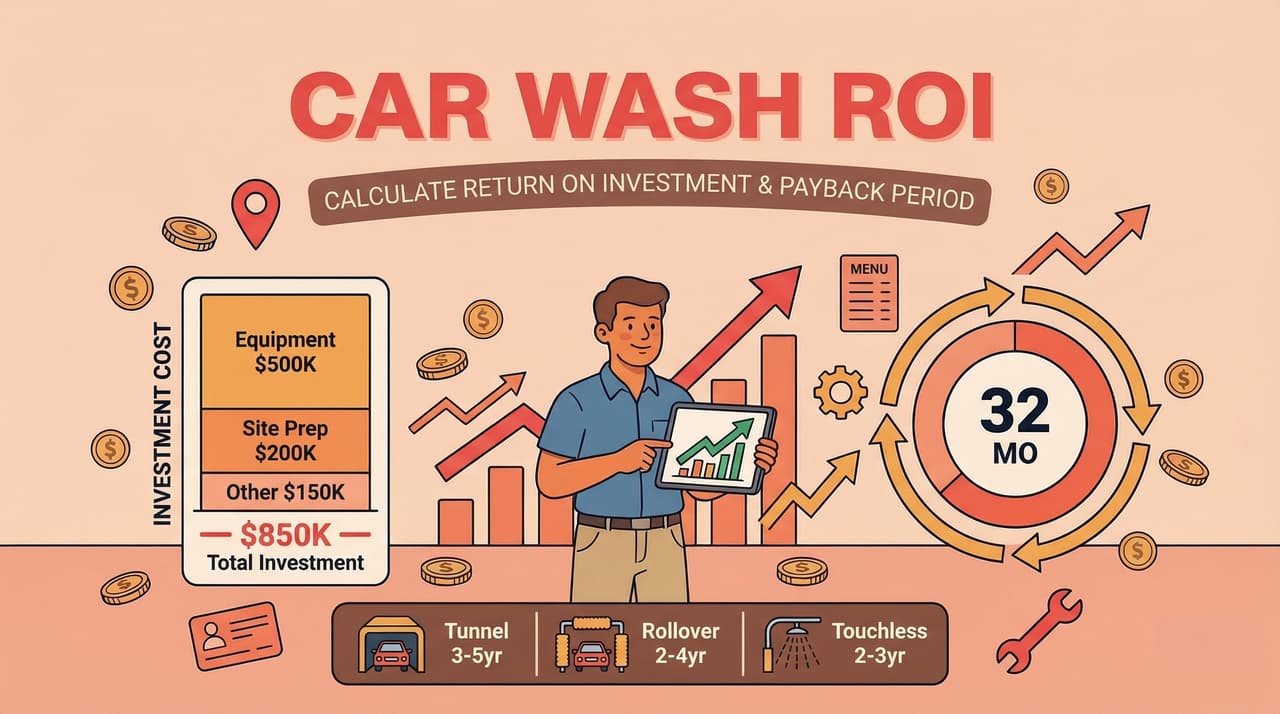
Car Wash ROI: How to Calculate Your Return on Investment and Payback Period
Car wash ROI typically ranges 20–35% annually with 2–5 year payback. Learn how to calculate your return, compare system types, and accelerate break-even.