
Are Automatic Car Washes Safe for EVs? A Manufacturer's Perspective
Are Automatic Car Washes Safe for EVs? A Manufacturer's Perspective
EV drivers are walking up to your bay and asking the same question: are car washes safe for EVs, especially mine? They have read forum threads about charging-port damage, sensor mis-alignment, and paint warnings buried in their owner's manuals — and they want a straight answer before they hand over their card. As a manufacturer that engineers both touchless and brush wash systems for sites in 40+ countries, including the factory PDI line at BYD, the equipment-side answer is yes: modern automatic car washes are safe for EVs when the equipment matches the vehicle. This article is written for operators who need to reassure EV clients, train staff, and decide what configuration positions their site for the segment — and so you can hand the link to a driver and have them walk away with the answer.
Direct Answer: Are Car Washes Safe for EVs?
Yes. Modern automatic car washes are safe for electric vehicles, with two qualifications. First, drivers should follow their EV manufacturer's wash-mode procedure — every major OEM publishes one. Second, the wash equipment should be either touchless or paint-safe brush technology operating within the water-pressure and chemistry envelopes EV makers specify. High-abrasion bristled brushes designed for older paint codes are the exception, not the rule, and the wash industry has largely engineered past them.
The rest of this article walks through what is actually at risk on an EV (and what is not), what each EV manufacturer tells drivers to do, the honest tradeoffs between touchless and paint-safe brush wash, the engineering choices wash manufacturers like HyTian make to support modern vehicles, and how operators should position their wash for a growing EV segment.
What Is Actually at Risk During an EV Car Wash
Let's get one thing out of the way: high-voltage battery damage and "electrocution" from a car wash are not real engineering risks. EV battery packs and motor electronics are sealed to IPX-rated standards that exceed any pressure or volume a commercial car wash produces. The high-voltage system is the most over-engineered, water-tight component in the vehicle. It is not what you need to worry about.
What is actually at risk falls into four categories — and they are mostly mechanical and surface-level, not electrical:
Paint and clearcoat. The risk here is not that EVs are uniquely fragile, but that EV paint codes are often newer and use thinner clearcoats. A bristled brush from an older industrial design can carry grit and apply uneven pressure across a modern finish. Match the brush technology to the paint code, and the risk goes to zero.
ADAS sensors and cameras. Forward-radar housings, mirror-mounted side radar, 360-degree cameras, and LIDAR units on premium EVs are precision-aligned at the factory. High-pressure water aimed directly at them, or repeated brush impact, can lift their alignment. The wash-equipment design point that matters is staying below pressure thresholds that disturb factory calibration.
Charging-port flap. The flap itself is mechanical, with a seal designed for road exposure. The vulnerability is not water ingress — it is the flap being mechanically actuated mid-wash. This is exactly why every EV car wash mode locks the port closed.
Antenna fins and bonded composite trim. Many EV-platform vehicles use lighter-weight composite trim and adhesive bonding to optimize for range. Forced contact from older drying technology can fatigue these bonds; forced-air drying does not.
Notice the pattern: every real risk is something equipment-side engineering already addresses. The engineering question is not "can EVs handle water." It is whether the wash equipment in front of the EV matches the paint code, sensor layout, and charge-port design of modern vehicles. That is a question operators can answer — and it is the question this article is built around.
For a deeper look at how high-pressure water systems are engineered to clean without exceeding modern-vehicle thresholds, our Touchless Car Wash Systems: Technology & When to Choose guide covers the touchless side of that equation.
What EV Manufacturers Tell Drivers to Do
Every major EV maker now publishes wash-mode guidance. The pattern is so consistent that operators can train staff on a single template — "use your manufacturer's wash mode" — rather than a per-brand script. Here is what the canonical sources actually say.
Tesla Car Wash Mode
Tesla's Model Y owner's manual (and the equivalent pages for Model 3, Model S, Model X, and Cybertruck) document Car Wash Mode. The driver activates it from Controls -> Service -> Car Wash Mode. The vehicle then:
Closes all windows and locks them against wash-bay water pressure
Locks the charge port closed so a high-pressure wand cannot blast the charging pins
Disables the windshield wipers
Disables Sentry Mode and walk-away door locking
Silences parking sensor chimes
Offers Free Roll Mode, which keeps the vehicle in Neutral and prevents the parking brake from engaging if the driver gets out — required for conveyor washes
Tesla prohibits hot water and pH >13 caustics or hydroxide-based detergents, and notes that car-wash damage may not be covered under warranty if Car Wash Mode was not used. That last line is why Tesla drivers ask about your wash chemistry — the operator who can answer "yes, our chemistry runs inside the OEM-acceptable pH band" wins the visit regardless of architecture.
Ford, Hyundai, GM, and Other OEMs
Ford publishes equivalent Car Wash Mode guidance for the Mustang Mach-E and F-150 Lightning in their respective 2026 owner's manual packages. Hyundai does the same for the Ioniq 5 and Ioniq 6 in vehicle-settings menus. GM publishes parallel guidance on the Bolt and Hummer EV. The mechanical pattern is identical: close windows, lock the charge port, isolate the wipers, and disable touch-based driver-attention features that the wash will trigger.
BYD: A Different Kind of Endorsement
BYD's relevant signal to wash operators isn't a driver-side mode — it is a factory-side equipment decision. BYD selected the HyTian TX-380 tunnel system for standardized PDI (Pre-Delivery Inspection) wash on their factory-new EVs. The line runs at 60 cars per hour, and the brush specification — EVA closed-cell foam — is the engineering reason it can run on factory-new paint where any blemish is unacceptable. When a globally recognized EV manufacturer chooses brush wash for their own factory-fresh vehicles, the question of whether brush systems can be safe for EVs is settled at the highest possible bar. See how BYD standardized their PDI wash for the full deployment.
This section is the one to lift into a site FAQ or staff training script. When a driver asks "is your wash Tesla Car Wash Mode compatible?" the right answer references their manual, your equipment, and — if relevant — the same brush technology used on the factory line that built their car.
Touchless vs Brush Car Wash for EVs: An Honest Comparison
Drivers ask this question most and operator-marketing pages oversimplify it most. Here is the straight comparison — including where each option falls short.
Touchless: The Safe Default
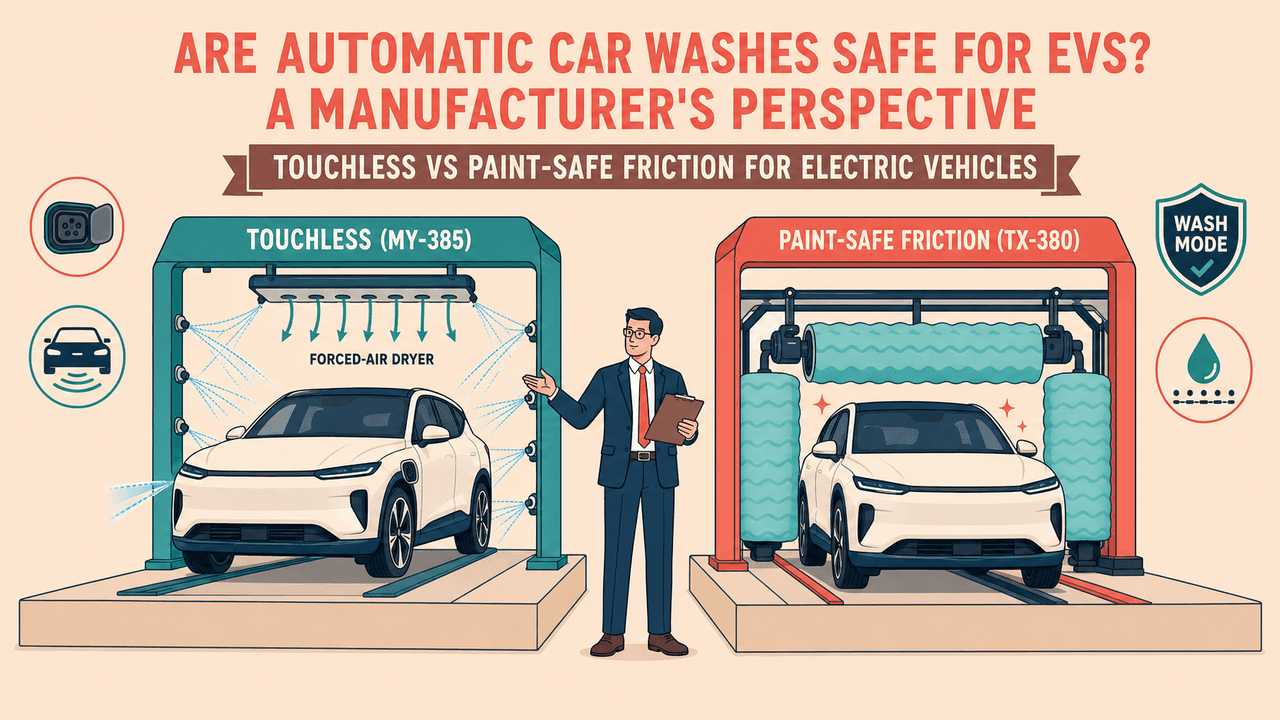
Touchless removes the contact variable entirely. HyTian's MY-385 touchless system operates at 120 L/min and 1000 psi, driven by two 15 kW high-pressure pumps, with no brush contact at any point in the cycle. Cleaning happens through high-pressure water, staged detergents, and forced-air drying. For EVs that means no paint contact and no mechanical proximity to the charging-port flap. Pressure stays below the design limits of mirror-mounted sensors and antenna assemblies. Contactless drying avoids fatiguing bonded trim.
The honest tradeoff is cleaning effectiveness. On heavy soil (winter road grime, ground-on bug residue, brake dust on lower rockers) touchless needs more chemistry and pre-soak time to match a brush system. Acceptable for EV-segment positioning; a constraint for high-throughput sites. Browse the broader touchless wash systems lineup if you are evaluating where touchless fits your bay layout.
Paint-Safe Brush: When the Brush Specification Is the Variable
Brush wash is not the villain operator marketing sometimes makes it out to be — it is only as safe as the brush technology in it. HyTian's TX-380 uses EVA closed-cell foam brushes: a wide-profile, linear-pressure design that resists grit carryover and protects modern clearcoats, wipers, mirrors, and accessories. Throughput runs 50-60 vehicles per hour. The pressure curve is gentle enough to be the brush specification BYD uses on factory-new EV paint. Cleaning effectiveness is significantly higher than touchless on lower-body soil and wheel wells. CNC metering pumps hold detergent dosing to 0.28 mL precision — keeping pH inside the envelope EV makers specify.
The tradeoff: brush wash is only as safe as the brush specification you bought. An older industrial brush at the same RPM is not the same product. A site running the same program for ten years without re-evaluating its supplier may not be EV-ready. Brush specification is the engineering variable — not wash type.
Side-by-Side: Touchless vs Paint-Safe Brush for EVs
Dimension | Touchless (MY-385) | Paint-Safe Brush (TX-380 with EVA brushes) |
|---|---|---|
Paint contact | None | EVA closed-cell foam — paint-safe to BYD factory-PDI standard |
Sensor exposure | Controlled water pressure (1000 psi @ 120 L/min) | Brush proximity managed by EVA pressure curve |
Charge-port handling | Direction-controlled nozzles; wash mode locks port | Mechanical clearance maintained; wash mode locks port |
Cleaning effectiveness | Moderate — longer pre-soak on heavy soil | High — including lower body, wheels, bug residue |
Throughput | Lower (single-bay) | 50-60 vehicles/hour |
Best fit | Explicit EV positioning, paint-conscious clientele | High-throughput sites wanting one EV-capable lane |
Most modern sites do not pick one. Hybrid layouts — a touchless bay alongside a paint-safe brush tunnel — give the driver the choice and the operator both economics and EV credibility.
Engineering Inside the Equipment: How Wash Systems Are Designed for EV-Era Vehicles
This is the section the title promises — the manufacturer's perspective. Four design points matter more than the marketing label on the front of the bay.
Water-pressure thresholds matter more than wash type. High-pressure systems are tuned to clean effectively without exceeding pressures that disturb mirror-mounted sensor alignment or stress charge-port seals. The MY-385's 1000 psi at 120 L/min is the deliberate design point — high enough to remove road grime, low enough to leave sealed components untouched. High-pressure water above the design threshold can lift mirror-mounted sensors out of factory alignment; reputable equipment operates well below it, regardless of whether the cleaning method is touchless or brush.
Brush specification is the under-discussed variable. Bristled brush technology from earlier generations applied uneven pressure, carried grit between cycles, and predated the paint codes used on EVs and many newer ICE vehicles. EVA closed-cell foam brushes replaced bristled designs because their linear pressure curve protects clearcoats. The reason BYD selected TX-380 brushes for factory PDI wash is exactly this: they trust the brush to run on the paint they just sprayed.
Drying without contact damage. Forced-air drying on the MY-385 and configurable dryer arrays on the TX-380 (profiling, fixed, or silenced) avoid the trim-fatigue issues older mechanical drying produced. For EVs with antenna fins, blade fenders, and bonded composite trim, this is non-trivial.
Chemistry stays inside the OEM envelope. Tesla's manual prohibits hot water and pH >13 caustics; other EV makers publish similar restrictions. The TX-380's CNC metering pumps hold dosing to 0.28 mL precision — consistent detergent strength across roughly 3,000 washes per 20 kg drum. Precise dosing keeps wash chemistry inside the OEM envelope batch after batch — part of the broader operational picture covered in Sustainable Car Wash Operations.
Pressure thresholds, brush technology, drying method, and chemistry precision are what determine whether your wash is EV-ready. The wash-type label on the marquee is not.
What This Means for Operators: Positioning Your Wash for the EV Segment
The EV segment of your wash volume is growing. According to 2026 industry trends coverage, EV compatibility is now a top client question across the segment. Silence is a position — usually the wrong one. Here is the operator playbook.
Step 1: Audit Your Equipment
If you run a brush system, confirm the brush specification. EVA closed-cell foam (or a comparable paint-safe specification) is the line between an EV-ready brush wash and one with an outdated brush specification. If your equipment predates modern brush technology, plan an upgrade before marketing to the EV segment. Touchless sites are EV-ready by default — but the chemistry program still needs to stay inside OEM-acceptable pH ranges.
Step 2: Publish a One-Page EV Wash FAQ
Five questions cover 90% of what your EV clients ask:
Is your wash safe for my Tesla / Ford EV / Hyundai Ioniq?
Should I use my car's Car Wash Mode?
Is touchless or brush better for my EV?
Will the wash damage my charging port or sensors?
What chemistry and equipment do you use?
The answers come from the sections above. Link to OEM owner's manuals where appropriate — drivers trust answers their manufacturer also confirms.
Step 3: Train Staff on the Same Script
EV drivers ask at the entry point, not in the lobby. Whoever takes the order needs the same five answers in the same direct, calm language. A hesitant "I think it's fine" loses repeat visits faster than a confident "yes, with Car Wash Mode engaged, your Tesla is safe on our wash — here is the brush specification and chemistry envelope we run."
Step 4: Signal It Visibly
Site signage referencing "EV-ready" or "Car Wash Mode compatible" puts you on the right side of the conversation. Operators with touchless lanes — or paint-safe brush lanes — should advertise it. The EV segment is a marketing opportunity, not a defensive question.
Step 5: Plan the Equipment Direction
For operators evaluating a new bay or an upgrade:
Touchless lane (MY-385) — explicit EV positioning, premium service framing, simplest answer to "is it safe?"
Paint-safe brush tunnel (TX-380 with EVA brushes) — throughput sites wanting one EV-capable lane without segregating EVs
Hybrid layout — where most modern high-volume sites land. Both wash types, driver picks the lane
Key Takeaways
Modern automatic car washes are safe for EVs. Match the equipment to the vehicle.
Tesla Car Wash Mode and equivalents from Ford, Hyundai, and GM cover the driver side. Equipment-side responsibility is touchless or paint-safe brush, controlled pressure, OEM-compatible chemistry, and contactless drying.
Touchless is the safe default. Paint-safe brush wash with EVA closed-cell foam brushes — the specification BYD uses for factory PDI wash — is also engineered for modern paint codes. The brush specification is the variable.
Equipment direction: MY-385 touchless for explicit EV positioning, TX-380 with EVA brushes for high-throughput, hybrid layouts for both.
Positioning your wash for the EV segment? Whether you're evaluating a touchless lane like the MY-385 or upgrading brush technology to the EVA closed-cell foam specification used at BYD's factory PDI line, our team can walk through your site footprint and EV-segment positioning. Talk to our engineering team about your configuration.
Related articles
Explore more insights from the HyTian team.
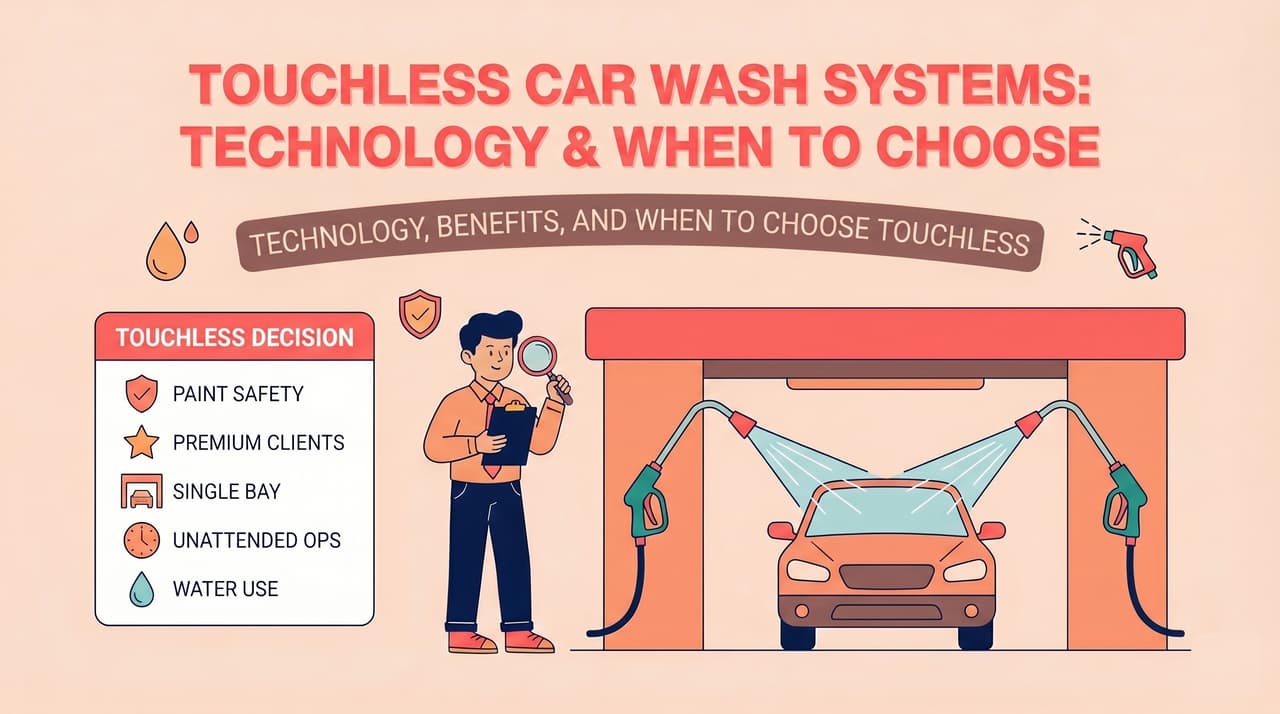
Touchless Car Wash Systems: Technology, Benefits, and When to Choose Touchless
Touchless car wash systems explained: how the technology works, honest tradeoffs vs soft touch, and when touchless is right for your site.
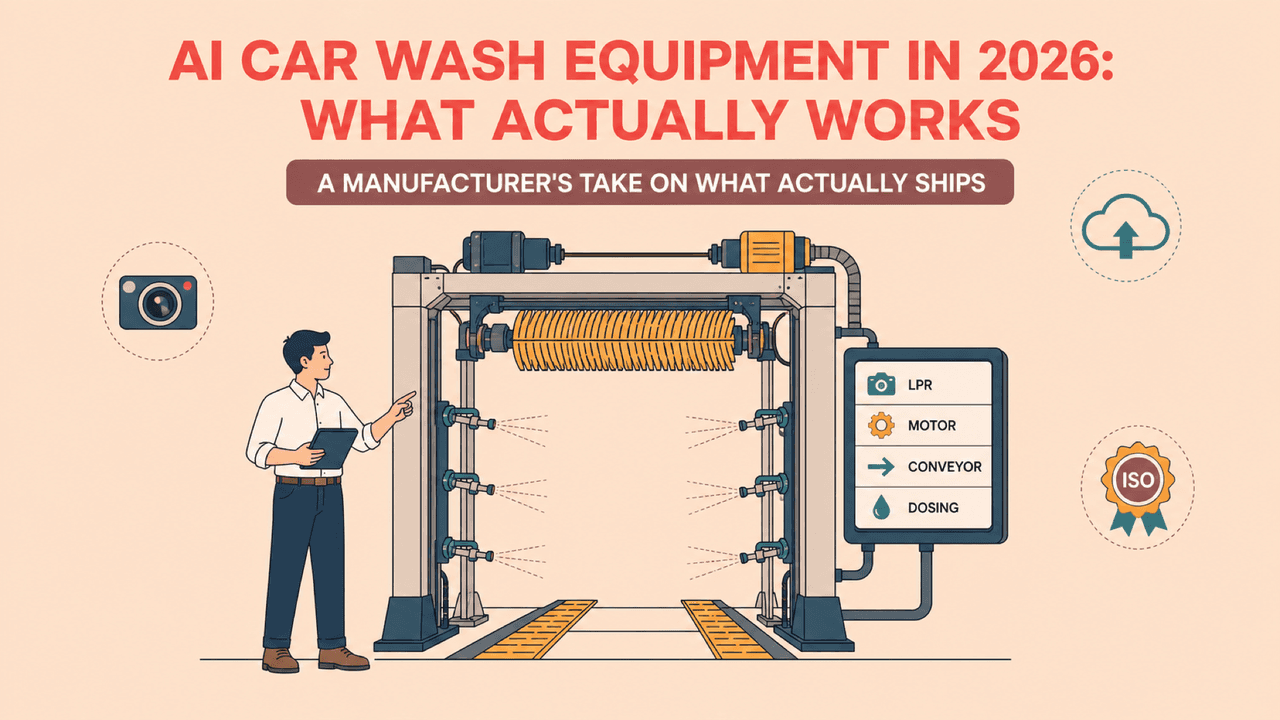
AI in Car Wash Equipment: What Actually Works in 2026 (A Manufacturer's Take)
A manufacturer's breakdown of AI car wash equipment in 2026 — what actually ships, what is still demo-stage, and how to evaluate vendor claims.
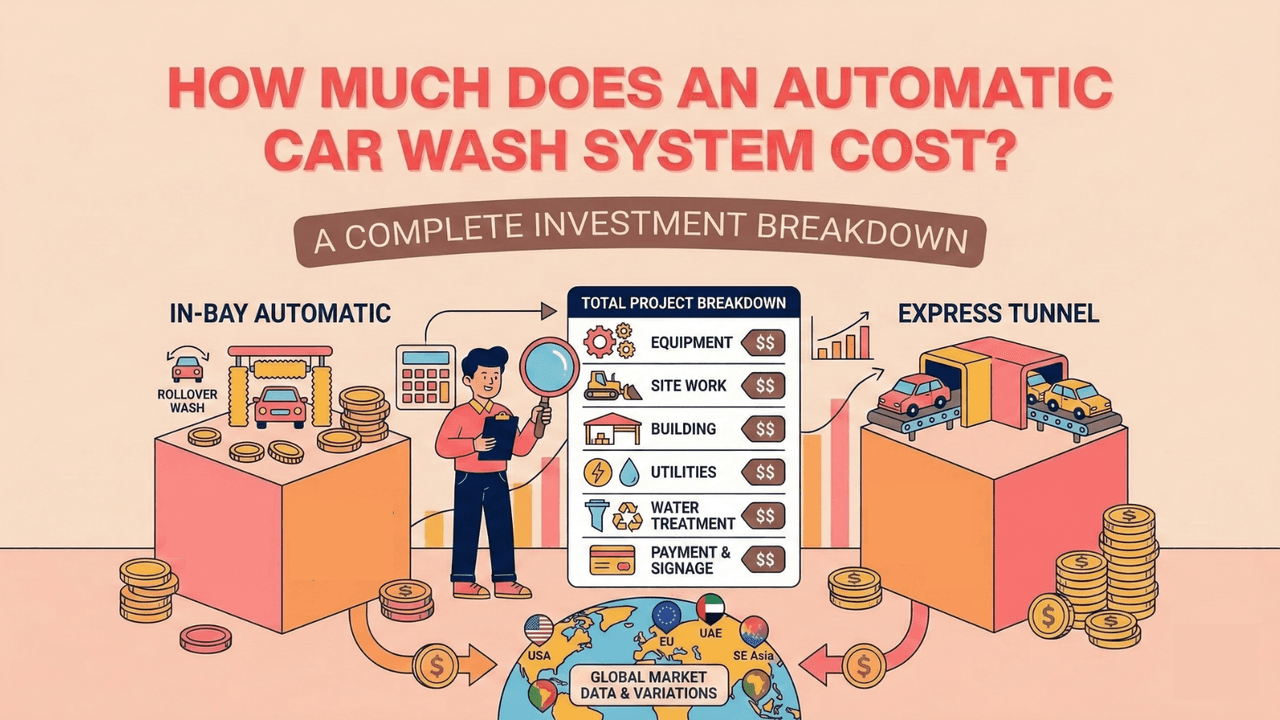
How Much Does an Automatic Car Wash System Cost? A Complete Investment Breakdown
Automatic car wash system costs range from $15,000 to $350,000+ for equipment alone. Here's what drives the price, what the total investment looks like, and how to compare quotes.