
Specifying Car Wash Equipment for an EV-Heavy Region: Beyond the Safety Question
Specifying Car Wash Equipment for an EV-Heavy Region: Beyond the Safety Question
You have already settled the safety question. Modern automatic washes are safe for electric vehicles when the equipment matches the vehicle — and your EV clients have stopped asking whether it is safe to drive their car through your bay. The decision in front of you now is different and harder: what do you actually spec when electric vehicles are a large and growing share of your traffic? For an operator building or retrofitting in an EV-dense market, the search for the best car wash for electric vehicles is not a safety question at all. It is an equipment-specification question, and the variables that decide it are brush specification, water pressure, sensor and charging-port clearance, and chemistry precision.
If you are still working through whether automatic washes are safe for EVs at all, start there first. Our manufacturer's-perspective guide — Are Automatic Car Washes Safe for EVs? — covers the battery sealing, the ADAS-sensor mechanics, the charging-port flap, and the driver-side wash modes in depth. This article picks up where that one leaves off. It assumes the safety answer is yes and asks the operator's real question: in an EV-heavy region, what configuration do you buy?
The thesis is simple. An EV-heavy region is not just a region with more electric cars. It is a region where three things shift at once: vehicles are newer, with thinner clearcoats and current paint codes; they are more sensor-laden, because advanced driver-assistance hardware rides alongside electrification; and they are washed more often by owners who care about the finish. Your equipment spec has to answer all three — not just "is it safe."
What "EV-Heavy Region" Actually Means for Your Equipment
Start by making "EV-heavy" concrete. In 2025, roughly a quarter of new cars sold worldwide were electric, with global sales crossing more than 20 million units. But the global average hides how lopsided the map is. In Norway, around 96% of new-car sales are now electric. In China, the figure is over half, on more than 13 million electric cars sold in a single year. Across Europe it is more than a quarter and climbing, and in markets like the Netherlands it has passed 50%. In the United States the share sits just below 10%, with California well ahead of the national figure.
An operator in Oslo, Shenzhen, Amsterdam, or coastal California is therefore specifying for a fundamentally different fleet than one in a low-EV market. That difference has three equipment-relevant consequences.
Newer paint codes are over-represented. A high EV share means a high proportion of recent-model vehicles with current clearcoat chemistry. These finishes are not uniquely fragile, but they are less forgiving of a legacy brush program designed for the paint codes of fifteen years ago.
ADAS density rides alongside EV density. The same markets buying electric cars are buying cars dense with sensors. By model year 2023, five advanced driver-assistance features — forward collision warning, automatic emergency braking, pedestrian detection, pedestrian AEB, and lane departure warning — had each surpassed 90% penetration on new vehicles, reaching 91% to 94%. Many of those sensors sit on mirrors and windshields, directly in a wash's line of action. Specifying for an EV-heavy region means specifying for a sensor-heavy region.
EV owners tend to wash more often, and watch the finish. This is an operator-observable pattern rather than a precise published figure, so treat it as a planning assumption, not a statistic: a paint-conscious, frequent-wash clientele raises both your repeat volume and the finish expectations you are held to.
The takeaway is that EV density is a useful proxy for "newer paint, more sensors, more frequent washing." That is your real spec brief. It is not "avoid water."
The Four Spec Variables That Decide EV-Readiness
Reframe the engineering points from the safety conversation as purchase criteria. These are the four variables to evaluate before you sign for any system — and the four questions to put to any supplier.
1. Contact method and brush specification. Touchless equipment removes the contact variable entirely: no brush, no paint contact, no mechanical proximity to trim or charging-port flap. A brush system can be equally EV-ready, but only if the brush is a modern, low-grit-carryover specification rather than a legacy bristled design. The material matters. Closed-cell foam brushes — EVA foam, for example — present a wide profile and a linear pressure curve that resists carrying grit between cycles and protects clearcoats, wipers, and mirrors. The lesson for procurement: spec the brush, not just the wash type. "We run a brush tunnel" tells you nothing about EV-readiness; "we run a closed-cell foam brush specification" does.
2. A sensor-aware water-pressure threshold. Water pressure has to do two jobs at once: clean effectively, and stay below the level that disturbs the alignment of mirror- and windshield-mounted sensors. ADAS calibration is precision-sensitive — alignment tolerances are measured in fractions of a millimeter, which is why direct high-pressure water at the wrong threshold is a real concern for sensor housings (the full mechanics are in the safety guide). At the spec level, this becomes a number you ask for. HyTian's Touchless Car Wash MY-385, for instance, is built around a deliberate operating point of 120 litres per minute at 1000 psi, driven by two 15 kW pumps — high enough to strip road grime, controlled enough to leave sealed components and sensor alignment untouched. Whatever system you evaluate, ask for the operating pressure and confirm it is a designed threshold, not an afterthought.
3. Charging-port and antenna clearance, plus contactless drying. The driver-side wash mode locks the charging-port flap closed; that part is handled by the vehicle, and it is covered in detail in the safety guide. The equipment-side question is mechanical: does the system maintain clearance around the port, antenna fins, and bonded composite trim, and does it dry without contact? Many EV-platform vehicles use lightweight bonded trim to save weight, and older contact-based drying can fatigue those bonds over thousands of cycles. Spec forced-air or otherwise configurable drying so the finish is dried, not dragged.
4. Chemistry precision and pH control. EV makers cap wash chemistry. Tesla, for example, prohibits hot water and pH greater than 13 caustics and notes that wash damage may not be covered under warranty if the vehicle's Car Wash Mode was not used. Meeting that ceiling once is easy; meeting it on every cycle is an equipment question. Precise dosing keeps detergent strength inside the OEM envelope batch after batch. HyTian's TX-380 tunnel system uses CNC metering pumps that hold dosing to 0.28 mL of precision — consistent chemistry across roughly 3,000 washes per 20 kg drum. Spec the dosing precision, not just the chemical.
These four variables are also your supplier-evaluation script. If a manufacturer cannot answer all four with specifics, the EV-readiness claim is marketing, not engineering. For the full vendor-vetting framework, see our guide on how to evaluate a car wash equipment manufacturer.
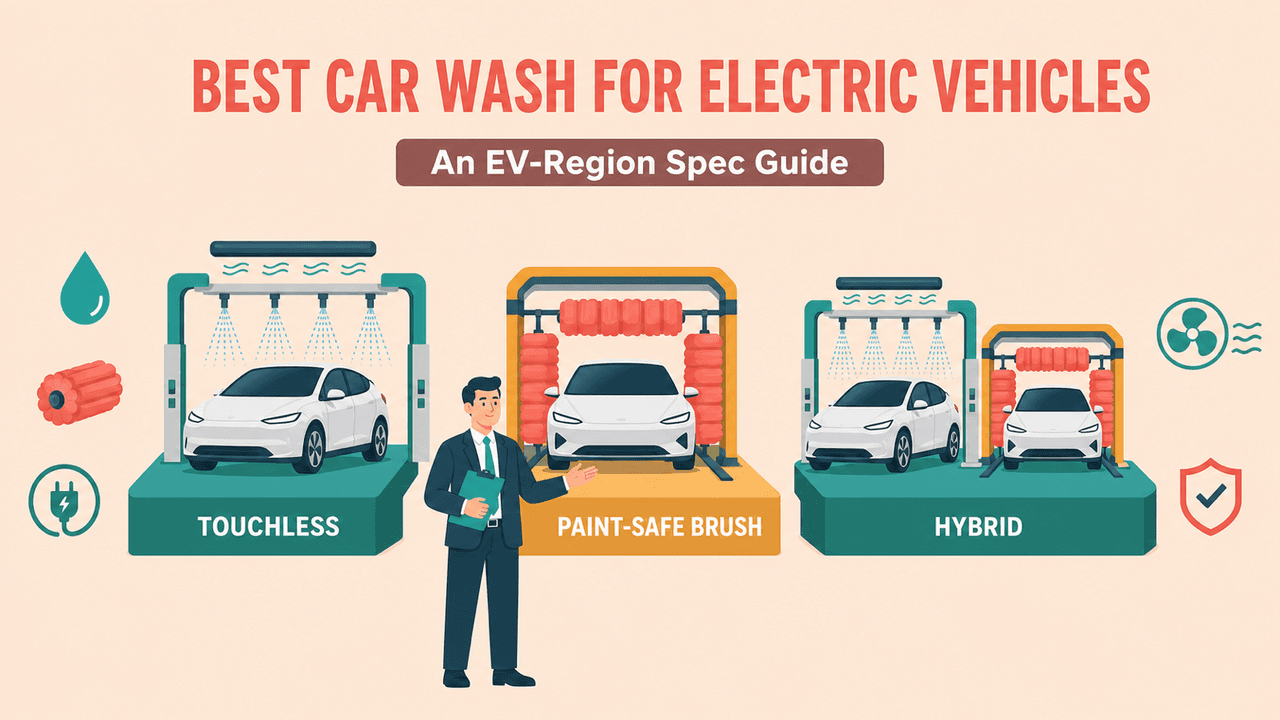
Touchless, Paint-Safe Brush, or Hybrid: Specifying the Best Car Wash for Electric Vehicles
With the four variables in hand, the architecture decision becomes a procurement comparison rather than a safety debate. Three configurations are on the table for an EV-heavy region.
Touchless. A brush-free system is the simplest answer to a paint-and-sensor-conscious EV clientele, and it carries the cleanest marketing story: EV-ready, no contact. The MY-385 is the worked example — high-pressure water, staged detergents, forced-air drying, no brush in the cycle. The honest tradeoff is cleaning aggression. On heavy lower-body soil, brake dust, and ground-in bug residue, touchless needs more chemistry and pre-soak time to match a brush, and single-bay throughput is lower. For a site positioning explicitly around the EV segment, that tradeoff is acceptable. For a high-volume site, it is a constraint to plan around. If you are weighing this option, our touchless car wash systems guide covers the technology in depth.
Paint-safe brush tunnel. A brush tunnel with a modern closed-cell foam specification delivers superior cleaning and the volume an EV-dense market still expects. The TX-380 runs at 50 to 60 vehicles per hour, and its EVA closed-cell foam brushes are the same specification BYD — a globally recognized EV manufacturer — selected for standardized factory new-vehicle wash, running at 60 cars per hour on factory-fresh paint where any blemish is unacceptable. When a manufacturer trusts a brush specification on the paint it just sprayed, the paint-safety question is answered at the highest possible bar. The honest tradeoff: a brush tunnel is only as EV-ready as its brush specification. A legacy bristled program disqualifies the lane until it is upgraded. You can see the deployment detail in the case study on how BYD standardized their factory-new vehicle wash.
Hybrid layout. This is where most high-volume EV-region sites land: a touchless bay for the explicitly paint-conscious EV owner, plus a paint-safe brush tunnel for throughput. It lets you serve the segment without segregating EVs or capping volume — the driver picks the lane, and you carry both the economics and the EV credibility.
Specification | Touchless (MY-385) | Paint-Safe Brush (TX-380, EVA brushes) | Hybrid Layout |
|---|---|---|---|
Contact method | Brush-free, water + detergent only | Closed-cell foam brush, low grit carryover | Both lanes available |
Sensor exposure | Controlled 1000 psi @ 120 L/min | Brush proximity managed by EVA pressure curve | Driver selects by vehicle |
Charging-port handling | No mechanical contact; mode locks port | Clearance maintained; mode locks port | Either path |
Cleaning effectiveness | Moderate — more pre-soak on heavy soil | High — including lower body and wheels | Full range |
Throughput | Lower (single bay) | 50–60 vehicles/hour | Highest combined |
Best-fit EV-region scenario | Premium, explicit EV positioning | High-volume market that still wants paint safety | High-volume site serving a mixed, EV-dense clientele |
One more variable belongs in this decision: throughput economics. Frequent-wash EV owners raise your repeat volume, so under-speccing throughput in an EV-heavy region is as costly a mistake as under-speccing paint protection. Equipment cost varies widely — sourcing model, project scope, and whether you are quoting equipment-only or fully-installed turnkey all drive significant variance — so build the cost case against your own volume forecast rather than a generic figure. Our guide to automatic car wash system cost walks through the framework.
Your Spec Checklist for the Best Car Wash for Electric Vehicles
Turn the analysis into something you can carry into a supplier conversation. Six checks decide whether a configuration is genuinely ready for an EV-dense market.
Confirm the brush specification — or spec touchless. Require a closed-cell foam or comparable paint-safe brush specification, and reject legacy bristled brushes for an EV-dense market. If in doubt, touchless removes the question.
Ask for the operating water-pressure spec, and confirm it is sensor-aware. The MY-385's 1000 psi at 120 L/min is a useful reference point for what a designed threshold looks like.
Spec contactless or forced-air drying. Protect antenna fins and bonded composite trim from contact fatigue over thousands of cycles.
Spec dosing precision for pH control. Confirm the system holds chemistry inside the OEM envelope on every cycle, not just on paper.
Size throughput for repeat EV volume. Specify for the frequent-wash traffic an EV-heavy region generates, not just today's count.
Test the manufacturer's EV claims against proof. Look for deployment references and OEM relationships, not marketing language.
The same six criteria scale up. Dealership service drives and fleet depots in EV-heavy regions apply them at multi-site scale, and the BYD factory deployment is the OEM-grade reference point — the same EVA brush specification trusted on factory-new EV paint at production cadence. HyTian's broader track record sits behind that: more than 20,000 systems deployed across 40-plus countries, manufactured by parent company Nanjing Haiying Machinery over three decades since 1992, under ISO 9001, ISO 14001, and CE certification.
Above all, hold onto the principle that carries over from the safety conversation: EV-readiness is a specification, not a wash-type label on the marquee. The label tells your clients what you want them to think. The specification tells you what the equipment will actually do to the newest, most sensor-laden, most frequently washed vehicles in your market.
Key Takeaways
The safety question is settled — see the manufacturer's safety guide. In an EV-heavy region, the real decision is what to spec.
EV density is a proxy for newer paint, higher ADAS sensor density, and more frequent washing. Your equipment spec must answer all three.
Four variables decide EV-readiness: brush specification (or touchless), a sensor-aware water-pressure threshold, charging-port and trim clearance with contactless drying, and chemistry pH precision.
Touchless (MY-385) is the simplest EV-region answer; a paint-safe brush tunnel (TX-380 with EVA brushes, the BYD factory specification) adds throughput; hybrid layouts serve both. EV-readiness is a specification, not a wash-type label.
Specifying a wash for an EV-heavy market? Whether you are leaning toward a touchless lane like the MY-385, a paint-safe brush tunnel like the TX-380 with the EVA closed-cell foam specification BYD runs on factory-new EV paint, or a hybrid layout, our engineering team can walk through your site footprint, throughput target, and EV-segment positioning. Talk to our engineering team about your configuration.
Related articles
Explore more insights from the HyTian team.
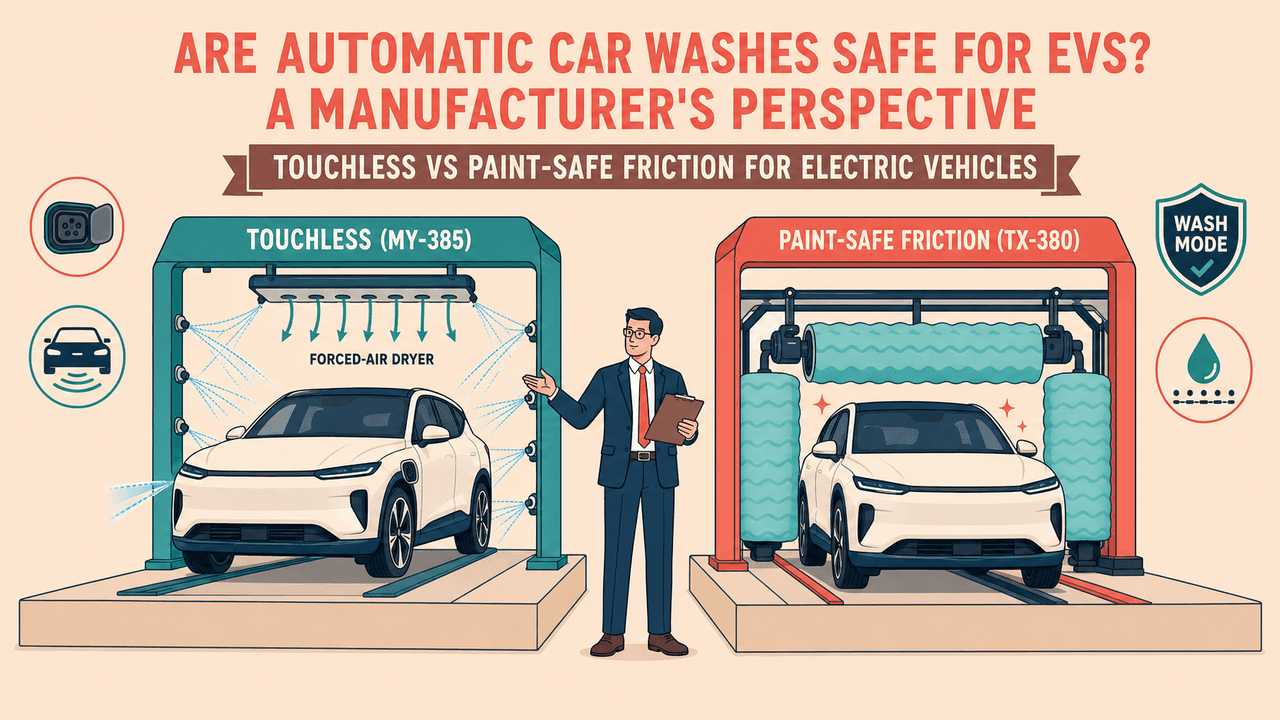
Are Automatic Car Washes Safe for EVs? A Manufacturer's Perspective
Are automatic car washes safe for EVs? A manufacturer's straight answer on touchless vs brush systems, charge-port protection, and EV-OEM wash modes.
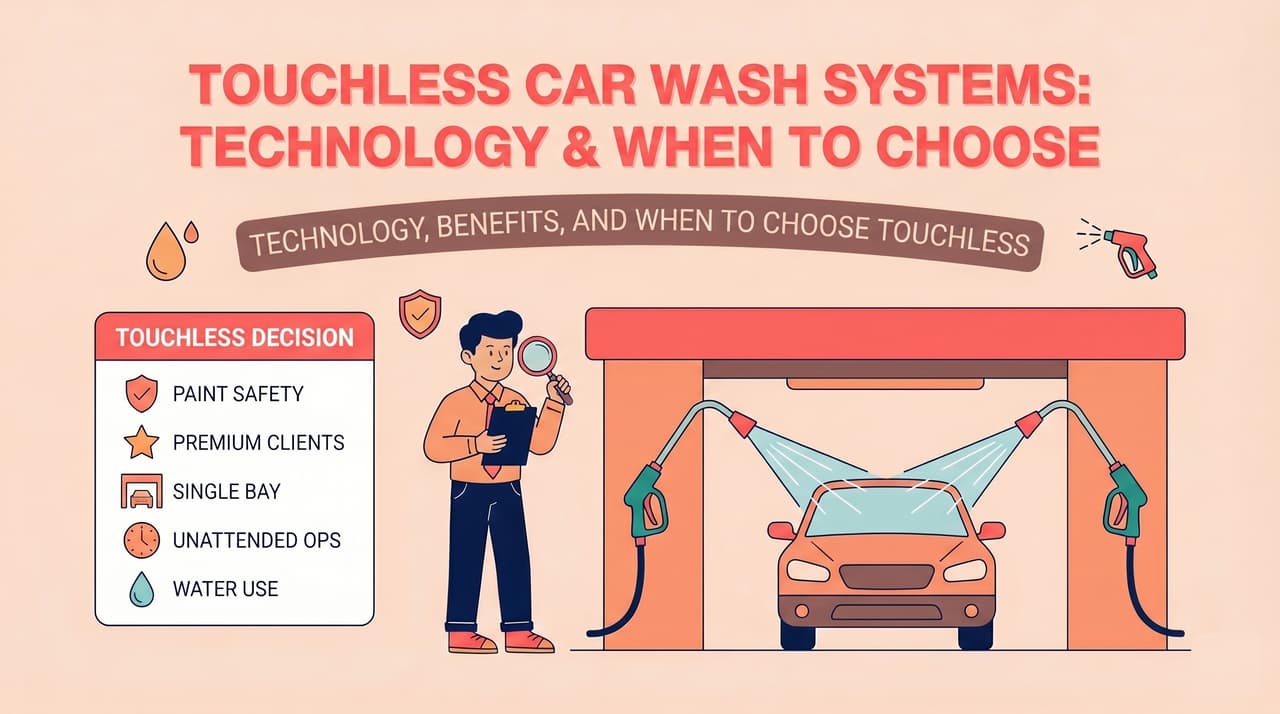
Touchless Car Wash Systems: Technology, Benefits, and When to Choose Touchless
Touchless car wash systems explained: how the technology works, honest tradeoffs vs soft touch, and when touchless is right for your site.
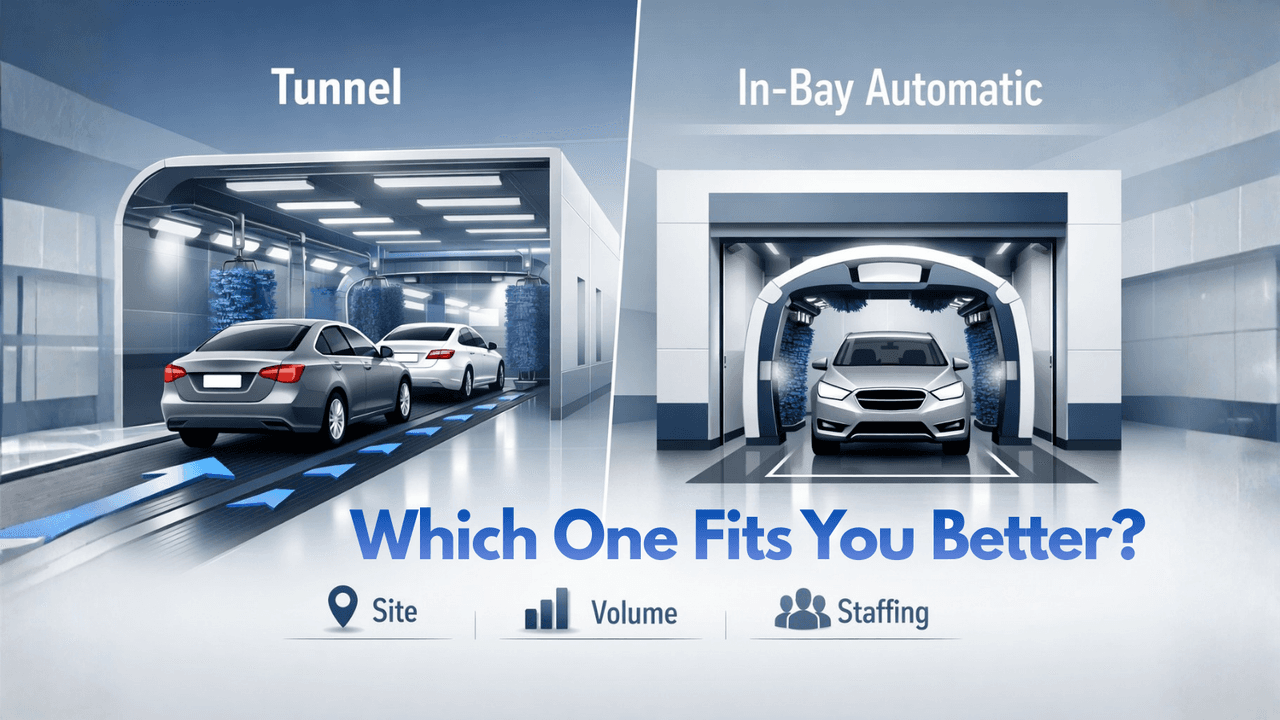
Tunnel vs In-Bay Automatic: Which One Fits Your Site, Volume, and Staffing?
Compare tunnel vs in-bay automatic car washes by footprint, peak-hour volume, staffing, and customer flow. Use this checklist to choose the right format and plan your site.