
Car Wash Franchise vs. Independent: Fees, Startup Costs and the Unit Economics That Decide It
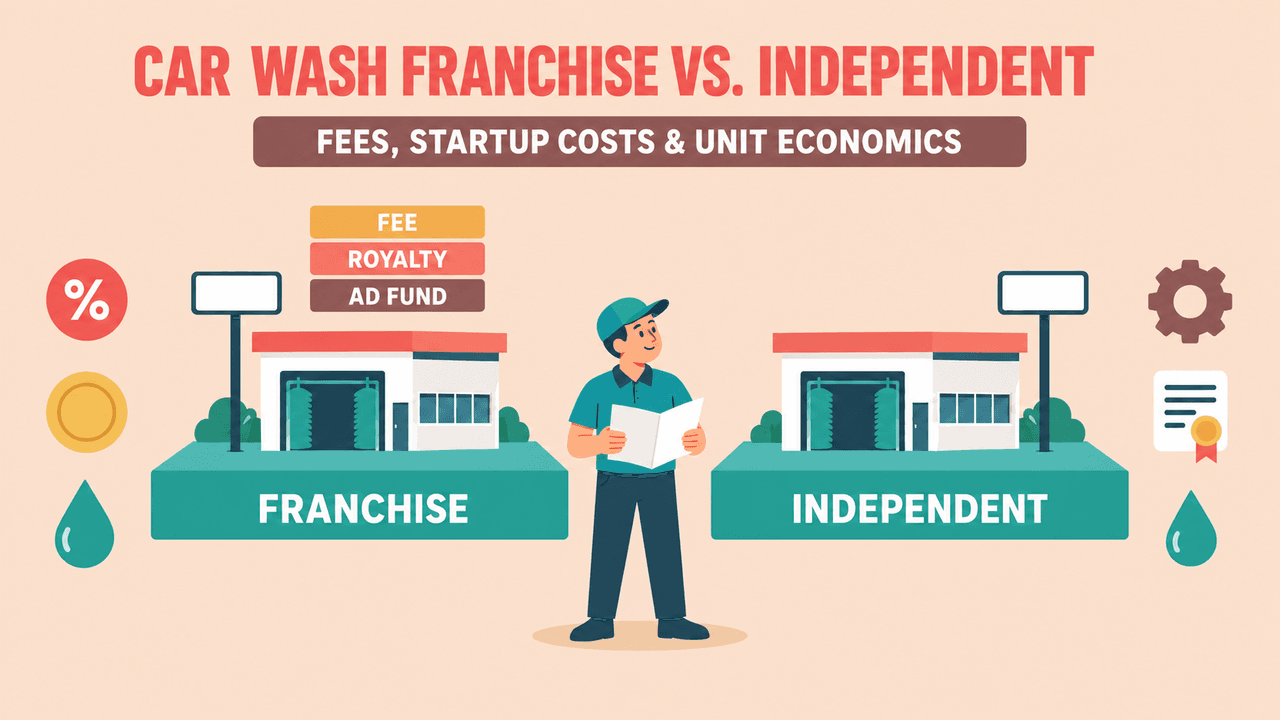
Car Wash Franchise vs. Independent: Fees, Startup Costs and the Unit Economics That Decide It
You have a franchisor's investment figure in front of you — six or seven digits — and no real way to tell what it buys. That is the trouble with most car wash franchise cost research: the headline number is the thing every source agrees on, and the thing that tells you least. The real fork isn't what a car wash costs to open. It's who sets the rules, and who takes a cut of every wash you sell.
If you're still deciding whether to open one at all, our step-by-step startup guide covers that ground. This piece is about the ownership structure you sign up for.
Where a Franchise's Numbers Actually Come From
Every US franchisor has to hand you a Franchise Disclosure Document with 23 required items, and you must receive it at least 14 days before you're asked to sign any contract or pay any money. That document — not the brochure, not a broker's summary page — is where the numbers live.
Four items carry the money. Item 5 is what you pay to get in. Item 6 is what you keep paying once you're open. Item 7 estimates your total initial investment. Item 19 is where any claim about what a location earns has to appear.
Item 19 is worth understanding before you read anything else, because it is optional. The FTC's own guidance is blunt about it: the Franchise Rule "doesn't require a franchisor to provide that information, but most do." What follows matters more than any figure inside it — if a claim isn't in Item 19, "the franchisor – as well as brokers, dealers, or other sellers – can't make any spoken or written financial performance claims." A revenue number someone quotes you on a call and can't point to in Item 19 is not a number you can act on.
Where an Item 19 does exist, read its shape before its totals. Prime Car Wash Franchising's 2025 FDD bases its Item 19 on six affiliate-owned washes and three franchised ones open for the whole of 2024, and says plainly: "We have not audited this information, nor independently verified this information." Nine sites, mostly the franchisor's own, unaudited — context you need in order to weigh it. For what car wash revenue actually looks like across formats, our revenue benchmarks by business model is the better place to start.
One caveat before any figure below: FDDs are re-filed annually and the numbers move. Read the current one.
Car Wash Franchise Cost, Line by Line: What You Actually Pay
A franchise cost isn't one number. It's a stack of them, and they arrive at different times. Prime Car Wash Franchising's 2025 Franchise Disclosure Document — issued 25 April 2025 — is worth walking through, because it's a filed document rather than a summary of one.
Getting in. Item 5 sets an initial franchise fee of $50,000, payable in a lump sum when you sign, and "not refundable under any circumstances." Sign a development agreement for several sites and the fee tiers down: $50,000 for the first, $30,000 for the second, $20,000 for the third and each after.
Staying in. Item 6 runs for the life of the agreement:
A royalty of 4% of gross sales, collected weekly.
A brand development fund contribution of up to 2% of gross sales, once the franchisor establishes that fund.
A local advertising requirement of 2% of gross sales, which the franchisor may raise to 3%.
Point-of-sale software at roughly $437.50 a month, via an approved third-party supplier.
Optional, but priced. The same document offers project management for $100,000, marketing services at $2,000–$3,500 a month, and equipment maintenance at $2,000–$3,500 a month. Optional today — worth pricing before you assume you'll absorb them.
The architecture repeats across the category. Tommy's Express publishes its own structure on its franchise page: a $50,000 initial franchise fee, a 4% royalty, and 1% toward a national brand fund. Different brand, same three layers: a fee to enter, a percentage of the top line to stay, a marketing contribution on top.
What a Royalty on Gross Sales Really Costs You
Here's the mechanic most first-time operators miss. A royalty is levied on gross sales, not on profit. It comes out ahead of labour, chemicals, utilities and your loan payment.
Add up Prime's own Item 6 lines and the arithmetic on that one document reaches as much as 8% of gross sales: 4% royalty, up to 2% brand development fund, 2% local advertising. Six of those points are certain; the brand fund is the contingent two. That is not an industry average and shouldn't be read as one — other franchisors file different numbers. But under this agreement, eight cents of every dollar the site takes leaves before it has paid for a single gallon of water.
Whether that's a fair trade depends on what the brand puts back onto the top line. Our car wash profit margin benchmarks cover what margins look like once operating costs are in the picture — which is the number that royalty is really competing with.
How Much Does It Cost to Open a Car Wash Franchise?
It depends on the format and the franchisor, and the figure to ask for is Item 7 of that brand's current FDD. Prime's 2025 filing estimates a single-unit initial investment of $1,944,500 to $3,671,000 if you lease the land, or $1,994,500 to $3,681,000 if you buy it.
Then read the footnotes, because that total is smaller than the project.
Item 7 generally excludes the two largest costs in a ground-up car wash — the land and the building — because they're financed rather than paid. Prime's own explanatory notes estimate the building at $3,500,000 to $5,000,000 and, under the purchase option, the land at $900,000 to $1,700,000. What appears inside the Item 7 total is the down payment plus five to seven months of mortgage payments: $200,000 to $280,000. The site itself needs at least an acre and a half.
Read the headline as the project cost and you'll be short by millions. That isn't evasion — it's how the disclosure format works, for every brand. Item 7 answers "what cash do I need to bring," not "what does this site cost."
Nor will Item 7 give you a single number. Franchisors file a separate range for each format — Tommy's Express files one per tunnel length — and re-file them every year. Published summaries of its 2025 and 2026 filings report materially different figures for the same models, both accurate for their year. If you're quoting an Item 7 range to a lender, quote the filing year with it.
The Independent Path: Same Capital Layers, No Fee Layer
An independent build has exactly the same capital layers underneath: land, site work, the building, the equipment. What it doesn't have is the layer on top — no initial fee, no royalty, no brand fund, no advertising requirement.
We've costed those layers in detail elsewhere. Our guide to what it costs to build a car wash from the ground up works through land, site work, construction and timeline with sourced consultancy figures, and sets building beside buying. The car wash system cost breakdown handles equipment and total investment by format. And if you're looking at a wash that already exists — including a car wash franchise for sale, a legitimate route into either structure — our equipment due-diligence checklist covers what to inspect before you make an offer.
What the independent path costs you is everything that fee layer was buying. No brand recognition on opening day, in a category where drivers often choose by the sign they know. No membership program to copy — you design the tiers, the pricing and the retention model yourself. No site-selection support, no operating playbook, no pre-negotiated supplier pricing. Financing is frequently harder, too: a lender reviewing a franchise application can underwrite against a system with a track record, where an independent application is underwritten on you.
Those are real advantages. The question was never whether a franchise gives you something — it's whether that's worth a percentage of every wash for the length of the agreement.
The Clause Most Operators Miss: Who Chooses Your Equipment
Item 8 covers restrictions on sources of products and services. First-time readers routinely skip from Item 7 straight to the financial statements; on a car wash, Item 8 deserves more attention than either.
Prime's 2025 Item 8 states that its affiliate, Axia, "is an Approved Supplier for certain tunnel and vacuum equipment and supplies that you are required to purchase in connection with the opening and operation of your Franchised Business." The franchisor also reserves the right to designate itself or an affiliate as approved supplier for any item you must purchase in future. An alternative supplier is possible, but only with written approval and a non-disclosure agreement.
In the same document's Item 7, tunnel equipment, vacuum equipment and supplies run $1,000,000 to $1,500,000 — a substantial share of the leasing-option total. Item 7 records the payee as the franchisor's affiliate and/or other third-party suppliers: part of that line is mandated, part isn't, and Item 8 is where you find out which.
The consequence isn't only price. Competitive quoting is off the table on your largest equipment line — the usual test of whether a number is fair. And the system you're assigned sets your throughput ceiling, your chemical consumption per wash and how serviceable the site is on a busy Saturday — for the length of the agreement, not just the build.
Four questions worth asking before you sign, in this order:
Read Item 8 before Item 7. It tells you which of Item 7's line items you actually control.
Is alternative-supplier approval genuinely available, and against what written criteria?
Who supplies spare parts, and what are the real lead times when a component fails?
What happens at renewal if the approved supplier changes — are you expected to re-equip?
Which Structure Fits Which Operator
Franchise | Independent | |
|---|---|---|
Fee layer | Initial fee, royalty, brand fund and ad requirement on gross sales | None |
Equipment choice | May be fixed by an Item 8 Approved Supplier | Yours to specify |
Day-one recognition | Established brand and signage | Built from zero |
Operating playbook | Provided — pricing, memberships, procedures | You design it |
Financing | Lenders can underwrite against a system with a record | Underwritten on you |
Reversibility | Bound for the term and its renewal conditions (Item 17) | Can convert to a franchise later |
The franchise case is strongest for a first-time operator with capital but no operating history, in a market where the brand already means something to drivers, who would rather execute a proven playbook than write one. That's a real profile, and a lot of successful sites fit it.
The independent case is strongest when you already know how to run a wash, when you want to specify equipment to your own traffic pattern and site constraints rather than to a national standard, when no franchise brand carries recognition in your market, or when your margin model cannot absorb a percentage of the top line.
Note the asymmetry in that last row — it's the one that's hard to undo. An independent can franchise later, or sell to a group that will. A franchisee is committed for the term and to whatever the renewal conditions say. Model the payback either way before you decide — our car wash ROI guide walks through the calculation.
Questions Operators Ask Before Signing
What fees do car wash franchisees pay? Under Prime Car Wash Franchising's 2025 FDD, five line items: an initial franchise fee (Item 5, $50,000), a royalty on gross sales (Item 6, 4%), a brand development fund contribution (Item 6, up to 2%), a local advertising requirement (Item 6, 2%, rising to 3% at the franchisor's option), and point-of-sale software (Item 6, about $437.50 a month). Other franchisors file different figures in the same items.
Is a car wash franchise more profitable than an independent wash? Not inherently — the structures move different levers. The fee layer is subtracted from gross sales, so it reduces margin before any operating cost is counted. A franchise has to make that back on the top line — through recognition, a ready-made membership program and pricing discipline the independent builds alone. Which one wins is a site-by-site question, not a category-wide one.
A Manufacturer's View
Whichever structure you land on, the equipment is the line item that quietly sets your economics: throughput at peak, chemical cost per wash, and how many hours a year the site isn't washing cars. Under a franchise agreement, that choice may already have been made for you. Independently, it's the place your site-specific decisions compound.
Metering precision is a concrete example: CNC metering pumps dosing to 0.28 mL accuracy extend a 20 kg chemical drum to roughly 3,000 washes — an operating-cost difference that lands in the same margin line a royalty comes out of. That's the layer we've spent over three decades since 1992 engineering, and the layer we'd tell any operator to specify carefully, regardless of whose sign ends up on the building.
Key Takeaways
Read Item 6 before the headline investment number. Ongoing fees on gross sales shape your economics far longer than the entry fee does.
Assume Item 7 excludes the land and the building until you've checked the footnotes.
Read Item 8 to find out whether you choose your own equipment. On a car wash it can be the largest single line in the build.
Item 19 is optional — and any financial claim that isn't in it can't legally be made to you at all.
The royalty is levied on gross sales, so model it against revenue, not against profit.
The equipment spec sets your throughput and your cost per wash for the next decade. If you want to price that line against your own site and volume — franchise agreement permitting — talk to our engineering team about the configuration your site actually needs.