
In-Bay Automatic Car Wash Systems: A Practical Guide to Rollover Equipment
In-Bay Automatic Car Wash Systems: A Practical Guide to Rollover Equipment
If you've already ruled out a full tunnel — the site's too small, the volume doesn't justify it, or the budget points somewhere else — you're probably comparing in bay automatic car wash systems now. That's the right instinct. But "rollover" isn't one thing. It's a category that spans brush and touchless wash media, attended and self-service configurations, and a real range of throughput and footprint depending on the unit.
This guide picks up where the format decision leaves off. It covers how an in-bay automatic system actually works, where it fits on a site, the brush-versus-touchless choice inside the category, standard versus self-service configuration, and what to check before you commit to a specific system. If you're still weighing tunnel against rollover in the first place, our tunnel vs. in-bay automatic comparison covers that decision — this piece assumes you've already leaned rollover.
Every rollover system on the market shares the same basic mechanism, but the specifics — throughput, footprint, wash media, whether it runs attended or unattended — vary enough between units that "rollover" alone doesn't tell you what you're buying. Treat the sections below as the questions to bring to any manufacturer you're evaluating, HyTian included.
What an In-Bay Automatic Car Wash System Actually Does
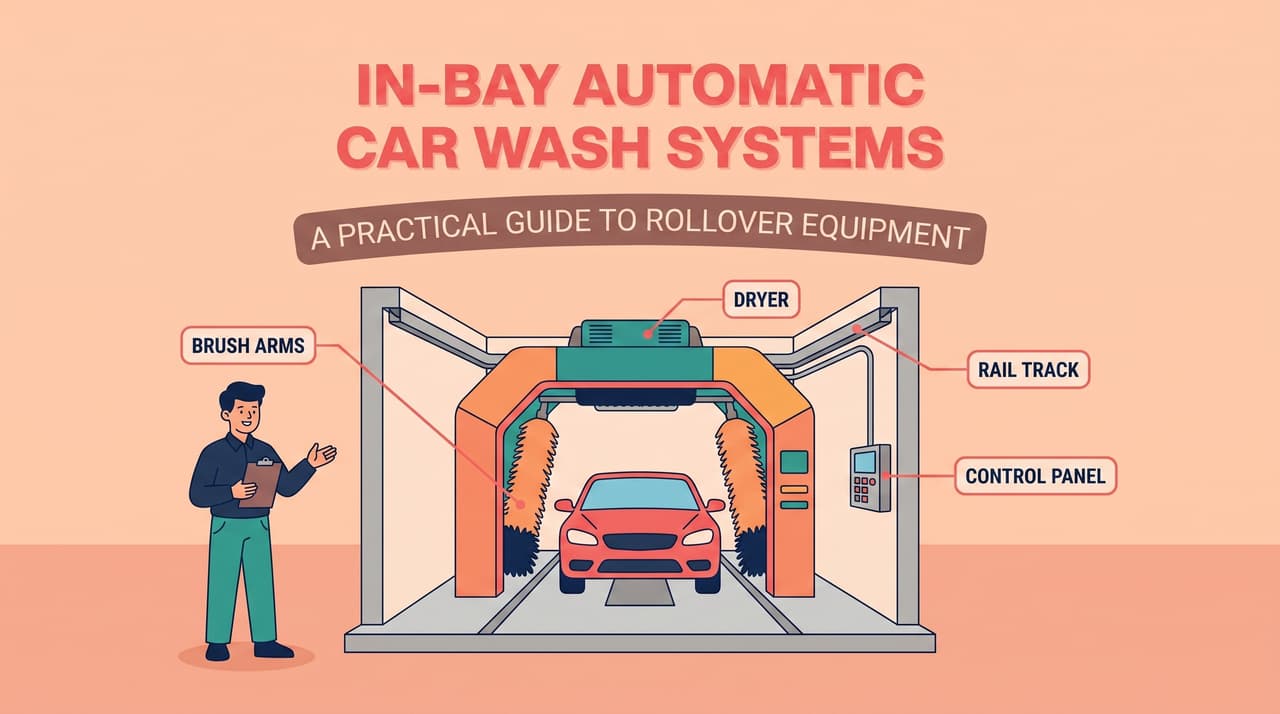
A tunnel moves the car through a line of stationary equipment on a conveyor. An in-bay automatic does the opposite: the vehicle stays parked in a single bay, and a gantry — the "rollover" arch — travels along a rail over and around it, applying wash media, rinse, and drying in sequence. One car, one bay, one pass.
That's the entire mechanical premise, and it's why "in-bay automatic" and "rollover car wash" describe the same equipment category. You'll see both terms used interchangeably, including on this site.
Inside a single pass, the gantry cycles through the same broad stages a tunnel does — pre-soak, wash media application, high-pressure rinse, and drying — just compressed into one machine moving over a stationary car instead of stations spread along a conveyor line. That compression is the format's whole value proposition: less equipment, less building, and a much smaller footprint than a tunnel needs to deliver the same basic wash quality.
A real unit makes the format concrete. HyTian's XL-200 rollover measures 220cm long, 385cm wide, and 300cm tall, and travels along a 9-meter rail. It processes 15–20 vehicles per hour and runs on a 380V, 17kW power supply. That throughput sits at the upper end of what the category typically delivers — in-bay automatic systems generally run 10–15 vehicles per hour industry-wide, well below tunnel throughput, because a rollover system is fundamentally a one-car-at-a-time machine.
The same gantry architecture scales up, too — HyTian's rail-mounted GH-500 rollover bus wash applies the identical rollover mechanism to fleet depots washing full-size buses and trucks, which is a reasonable proxy for how mature the underlying engineering is, even though this guide's focus stays on car wash sites.
Where In-Bay Automatic Car Wash Systems Fit: Site, Throughput, and Business Model
The trade-off against a tunnel is straightforward and we won't re-litigate it here — our full tunnel vs. rollover vs. touchless breakdown covers that ground. What matters for this guide is where rollover specifically earns its footprint: gas station add-on bays, space-constrained urban lots, and small-to-medium single-site operations where a full conveyor line isn't practical or justified.
The footprint math is the reason. A 9-meter rail fits inside a bay where a tunnel line simply can't go. If you're adding wash capacity to an existing gas station site, our guide to adding a rollover system to a gas station walks through the layout and ROI specifics for that exact scenario.
The business-model implication follows from the footprint: a rollover system is usually a lower-capital entry point into automatic wash operations than a tunnel line, since you're sizing one bay and one machine rather than a full building around a conveyor. That makes it a common first automatic system for an operator adding wash revenue to an existing site, not just a "smaller tunnel" for space-constrained operators who'd otherwise prefer one.
Brush vs. Touchless Inside the Bay
Here's a point of confusion worth clearing up directly: "touchless" isn't exclusive to tunnels. In-bay automatic systems come in both brush and touchless configurations, and the two use genuinely different cleaning approaches — this is a separate decision from the tunnel-vs-rollover format choice, and conflating them leads to the wrong comparison.
Brush-based rollover systems, like the XL-200, use EVA closed-cell foam brushes engineered with a linear pressure curve — media designed to flex evenly across a vehicle's contours rather than concentrate pressure on any one panel, which is the mechanism that keeps a brush wash paint-safe. Brush contact also does more mechanical work per pass, which generally means lower chemical cost per wash on typical soil loads.
Touchless in-bay systems clean with high-pressure water and chemistry alone — no brush ever contacts the vehicle. HyTian's MY-385 touchless system is the in-bay touchless equivalent, and it's worth exploring in more depth in our dedicated guide to touchless car wash technology. Touchless earns its place where zero-contact is a hard requirement — fleet accounts with paint-liability concerns, sites serving a lot of high-clearance or oddly shaped vehicles, or operators who've had brush-related damage claims before. For most single-site owner-operators washing a typical mixed fleet, brush delivers the stronger clean per cycle; touchless trades some of that cleaning power for zero mechanical contact.
Standard vs. Self-Service Configuration
Rollover platforms aren't only attended-site equipment. The same core mechanism ships in a self-service, cashless configuration built for unattended operation — and this is a real, separate decision from brush-versus-touchless.
HyTian's XL-200NET is the self-service variant of the XL-200 platform: same core throughput and footprint, but built around cashless scan-to-start entry, cloud management with remote diagnostics, an auto-drain feature for cold-weather sites, and a 5-brush plus 4×5.5kW dryer configuration. It's aimed squarely at self-service sites, cold-climate operators who need freeze protection, and multi-site networks that want centralized cloud visibility across locations rather than a standalone unit at each stop.
This isn't a niche configuration choice. The global self-service car wash market was valued at $36.29 billion in 2025 and is projected to reach $54.48 billion by 2033, a 5.1% compound annual growth rate — self-service demand is a growing segment of the category, not an afterthought.
XL-200 (Standard) | XL-200NET (Self-Service) | |
|---|---|---|
Throughput | 15–20 vehicles/hour | 15–20 vehicles/hour |
Footprint | 220cm L × 385cm W × 300cm H, 9m rail | 220cm L × 385cm W × 300cm H, 9m rail |
Power | 380V, 17kW total | 380V, 17kW total |
Entry / payment | Attended | Cashless scan-to-start |
Management | On-site | Cloud management + remote diagnostics |
Cold-weather protection | — | Auto-drain |
Wash / dry config | EVA brush media | 5-brush + 4×5.5kW dryer configuration |
What to Evaluate Before You Choose a Rollover System
Once you've settled on rollover, brush or touchless, and attended or self-service, the remaining decision is unit-level. Walk any specific system against these six items.
Throughput vs. Site Volume
Match the unit's rated vehicles-per-hour to your realistic peak-hour demand, not your average. A system rated for 15–20/hr comfortably handles a steady single-bay operation, but if your peak hour regularly pushes past that, you're building a line regardless of how good the equipment is. A single rollover bay has a hard ceiling — unlike a tunnel, there's no second lane to add — so this is the one spec where "close enough" isn't good enough.
Footprint and Rail Length
Confirm your bay's actual dimensions against the unit's housing size and rail length before you order anything. A 9-meter rail needs 9 meters of clear travel — measure the bay, not just the parking space, and account for clearance at both ends of the rail plus any structural columns or drainage that might sit inside that path.
Power Supply
A 380V, 17kW total draw is standard for this class of rollover system. Confirm your site's electrical service can support that load before you commit; if it can't, a panel or transformer upgrade becomes part of the project cost, not a surprise after installation. This is worth confirming with a licensed electrician early, since it can affect your installation timeline as much as the equipment lead time does.
Brush Technology and Water Handling
Ask any manufacturer specifically about brush media design, not just brush count — the pressure curve and material determine paint safety, not the number of brush arms. HyTian's full rollover systems lineup uses the same brush approach across every SKU, which is worth asking any manufacturer whether their range is that consistent. On the water side, if your jurisdiction requires on-site discharge treatment or reclaim, ask what's available: HyTian offers an optional sewage purification system in the JX-4B class, rated for 4 T/h treatment capacity, for sites that need it.
Attended vs. Self-Service
Revisit the standard-versus-self-service decision here against your actual staffing model. If you're not staffing the bay, cashless entry and cloud diagnostics aren't optional extras — they're the difference between a system that runs itself and one that can't take a payment when no one's on site.
Manufacturer and Parts Support
Equipment outlives its warranty. A manufacturer's track record is a reasonable proxy for how well-supported you'll be five years in. HyTian has been manufacturing continuously for over three decades since 1992 through parent company Nanjing Haiying Machinery, with 20,000-plus systems deployed across 40-plus countries, and holds CE, ISO 9001, and ISO 14001 certification. Ask any manufacturer you're evaluating for the equivalent — track record, certifications, and a real parts-support channel.
Cost Considerations
Rollover system pricing depends on configuration, options, water handling, and installation scope — enough variance that a single number would mislead more than it helps, so we won't quote one here. Standard versus self-service configuration moves the number on its own, and add-ons like extended drying, coating systems, or an on-site water treatment package each shift it further. As a market scale reference, in-bay automatic equipment generally runs $80,000 to $250,000 per bay across the industry, before installation. For the full financial picture — investment ranges across all system types and how to model payback — see our complete cost breakdown and ROI calculator.
Key Takeaways
In-bay automatic and rollover name the same category — a single bay, one car at a time, with a gantry moving over the vehicle instead of a conveyor moving the vehicle.
Brush and touchless are a separate decision from format. Both exist inside the in-bay automatic category; choose based on cleaning power versus zero-contact requirements, not tunnel-vs-rollover logic.
Standard and self-service are a third, independent decision. Cashless entry, cloud management, and cold-weather auto-drain matter only if you're running unattended.
Match throughput, footprint, and power to your actual site before comparing any two units on price — a 15–20/hr, 9-meter-rail, 380V system isn't a fair comparison against a smaller unit on spec alone.
Frequently Asked Questions
What is an in-bay automatic car wash?
An in-bay automatic is a car wash format where the vehicle stays parked in one bay while a gantry — a "rollover" — travels along a rail over and around it, applying wash media and drying in a single pass. It's the same equipment category as a rollover car wash; the two terms are used interchangeably.
How many cars can an in-bay automatic wash per hour?
Industry-typical in-bay automatic throughput runs 10–15 vehicles per hour. Higher-rated systems, like HyTian's XL-200 and XL-200NET, process 15–20 vehicles per hour, sitting at the upper end of the category. Because a rollover bay washes one vehicle at a time with no second lane available, this rated figure is a hard ceiling on your site's automatic-wash capacity, not just a nameplate number.
Is a rollover car wash the same as an in-bay automatic?
Yes. "Rollover" describes how the gantry moves over the vehicle; "in-bay automatic" describes the format — a single bay, one car at a time. They name the same equipment category and are used interchangeably in the industry.
Is brush or touchless better for an in-bay automatic system?
It depends on the site. Brush-based systems generally clean more effectively per pass and cost less per wash in chemical use, thanks to the mechanical contact from paint-safe media like EVA closed-cell foam. Touchless systems trade some of that cleaning power for zero brush contact — the better choice where liability concerns or vehicle mix make contact-free washing a requirement.
Sizing a rollover system for your site? Our engineering team can help you match throughput, footprint, and attended-vs-self-service configuration to your specific bay.